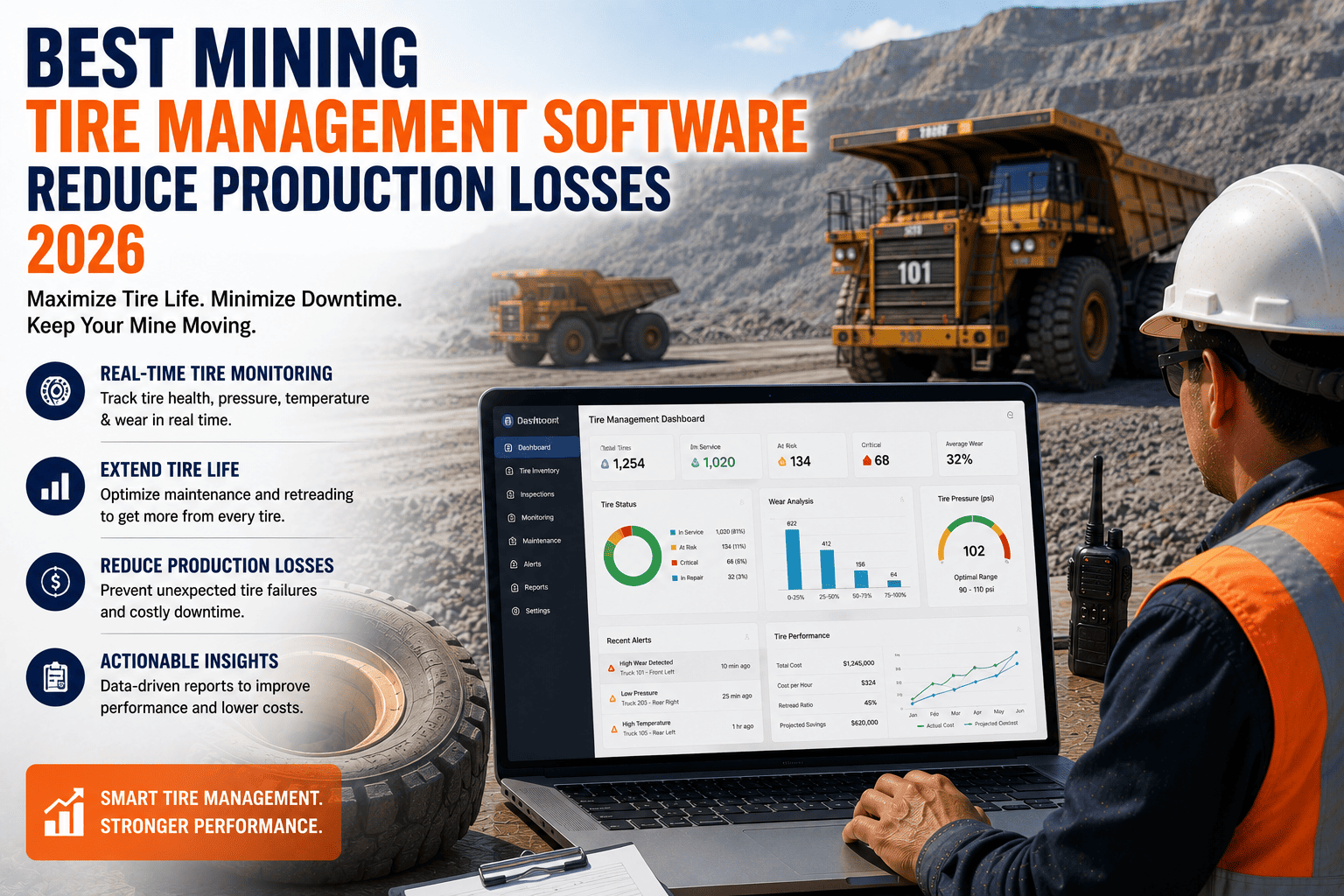
A single haul truck tire in an open-pit mine can cost as much as a small house, and it can be destroyed in a single shift by a slow leak nobody caught in time. Tires are one of the largest controllable costs in mining operations, yet most sites still manage them the same way they did twenty years ago: a walk-around inspection, a gut feeling, and a hope that the tire lasts until the next scheduled check. Mining tire management software changes that equation entirely. By combining real-time pressure and temperature sensors, wear analytics, and centralized fleet dashboards, it gives mining operations the visibility they need to catch problems before they become five-figure failures and multi-hour production stoppages.
Mining tire management software monitors pressure, temperature, tread wear, and load data across an entire fleet in real time, alerting teams before a tire fails. Sites using structured tire monitoring programs typically see tire-related downtime drop by 20 to 35 percent and extend average tire life by several hundred operating hours, while cutting the risk of catastrophic blowouts that can halt production for a full shift or more.
Why Tire Management Deserves Its Own Software Layer
Tires are unlike almost any other component on a mining fleet. They are consumable, they are enormous in cost, and they fail in ways that are genuinely dangerous when a haul truck weighs several hundred tons fully loaded. On many surface mining operations, tires represent one of the largest line items in the maintenance budget, right alongside fuel and major component rebuilds. A single failure on a large rigid-frame haul truck does not just mean a repair bill. It means a truck parked on a haul road, a production line waiting, and a maintenance crew scrambling to source a replacement that may need to be trucked in from another site.
What makes tire management especially difficult is that failure often builds quietly. A slow air leak, a small cut picked up on a haul road, or a slightly overloaded bucket load can raise internal tire temperature for days before anyone notices a problem. By the time a visual inspection catches something wrong, the tire may already be beyond saving. Purpose-built mining tire management software closes that gap by watching every tire, on every truck, continuously, and turning raw sensor data into a ranked list of what needs attention today versus what can wait until the next scheduled stop.
The Real Cost of Reactive Tire Management
Reactive tire management, waiting for a tire to visibly fail before acting, carries costs that go far beyond the price of the tire itself. A blown or badly damaged tire on a haul truck typically takes that vehicle out of production for several hours while a replacement is sourced, mounted, and balanced. On sites with limited spare tire inventory, that downtime can stretch into a full shift or longer. Add in the risk of rim damage, the labor cost of an emergency tire change crew working outside a planned maintenance window, and the ripple effect on haul road congestion, and a single incident can easily cost far more than the tire replacement invoice suggests.
Where the Hidden Costs Accumulate
Beyond the immediate repair, reactive tire failures accelerate wear on the tires around them. When one truck goes down, the remaining fleet often has to compensate with faster cycle times or altered routing, which increases stress on tires that were otherwise performing well. Safety incidents involving tire failure also tend to trigger site-wide reviews and temporary slowdowns while the cause is investigated, adding an operational cost that rarely appears on a maintenance spreadsheet but is felt across the entire shift.
FleetRabbit brings pressure, temperature, and wear data from your entire fleet into a single dashboard, so your team can act on the tires that need it most before a failure ever reaches the haul road. You can start a free trial today and see your fleet's tire health in real time.
What the Best Mining Tire Management Software Actually Does
Not every tire monitoring tool is built for the scale and harshness of a mining environment. The best platforms are engineered specifically around the realities of open-pit and underground operations: extreme heat, constant vibration, dust, and equipment that runs around the clock. Below is a breakdown of the core capabilities that separate a genuinely useful mining tire management system from a basic pressure gauge with an app attached.
| Capability | What It Monitors | Why It Matters On Site |
|---|---|---|
| Real-Time Pressure Sensing | Continuous internal tire pressure across every wheel position | Under and over-inflation are the leading causes of premature wear and catastrophic failure on haul trucks |
| Temperature Tracking | Internal tire heat build-up during load and haul cycles | Rising temperature is often the earliest signal of an overload, underinflation, or developing structural issue |
| Wear and Tread Analytics | Tread depth trends and wear patterns over time | Uneven wear points to alignment, load distribution, or haul road issues that can be corrected before more tires are affected |
| Load and TKPH Monitoring | Ton-kilometer-per-hour ratings against manufacturer limits | Operating within rated limits lets trucks run at safer speeds and payloads without shortening tire life |
| Fleet-Wide Dashboards | Every tire, on every vehicle, ranked by urgency | Maintenance teams can prioritize the two or three tires that need attention today instead of inspecting the whole fleet blind |
| Historical Tire Records | Full lifecycle history per tire, including rotations and repairs | Reveals which tire brands, positions, or maintenance habits are delivering the best cost per operating hour |
Sensor-Based Monitoring vs. Manual Inspection Programs
Manual inspection programs still have a place on many sites, particularly for visual damage that sensors cannot detect, like sidewall cuts or embedded debris. But manual checks are only ever a snapshot, taken once or twice a shift, of a condition that changes continuously while a truck is working. Sensor-based tire management software fills the gaps between those checks, watching pressure and temperature every few seconds rather than every few hours. The strongest tire management programs combine both: automated sensors for continuous coverage, and trained personnel for the physical inspections that data alone cannot replace.
Integration With Your Existing Fleet Systems
Tire data is most valuable when it is not sitting in its own isolated app. The best mining tire management platforms connect tire health data with telematics, maintenance scheduling, and fuel systems already in use on site. That means a technician looking at a work order can see tire status alongside engine hours and brake condition, and a maintenance planner can schedule a tire swap during a truck's next planned downtime window instead of pulling it off the haul road unexpectedly.
How to Evaluate Mining Tire Management Software for Your Site
Choosing the right platform depends heavily on fleet size, site conditions, and how tire data needs to connect with the rest of your maintenance operation. A few questions consistently separate the systems worth investing in from the ones that add complexity without adding value.
Questions Worth Asking Before You Choose a Platform
Does the sensor hardware hold up in extreme heat, dust, and constant vibration without frequent recalibration or battery replacement. Can the platform scale from a handful of vehicles to a full autonomous haul fleet without a system redesign. Does it integrate with the telematics and maintenance software you already run, or will it create a second data silo your team has to check separately. Can alerts reach the right person, whether that is a control room operator or a maintenance planner, within seconds rather than minutes. And finally, does the vendor provide the historical reporting needed to track tire cost per operating hour over time, not just a live pressure reading.
Sites that answer these questions honestly tend to land on platforms built specifically for heavy mining equipment rather than adapted from on-highway trucking tools. The difference shows up quickly in sensor durability and in how well the system handles the scale of a large open-pit fleet.
FleetRabbit connects tire sensors, telematics, and maintenance scheduling into one system, so your team spends less time guessing and more time keeping trucks on the haul road. Book a demo and walk through your fleet's tire data with our team.
The ROI Case for Mining Tire Management Software
The return on investment for tire management software tends to show up faster than most other fleet technology purchases, largely because a single prevented blowout can offset an entire year of platform cost. Consider a mid-size open-pit operation running a fleet of large haul trucks, where each major tire represents a significant capital cost and every hour of downtime translates directly into lost tonnage moved. Preventing even a small number of catastrophic failures per year, while also extending average tire life through better pressure and load management, typically pays back the software investment well within the first year of use.
Beyond direct savings, better tire data supports safer working conditions by reducing the odds of a rollover or blowout incident on a haul road, which in turn supports stronger safety metrics and can influence insurance costs over time. Extended tire life also reduces the frequency of tire changeouts, which lowers the labor burden on maintenance crews and reduces how often trucks need to be pulled from production for scheduled tire work.
Getting Started With Tire Monitoring on Your Site
Most mining operations start small, equipping one section of the fleet or a single pit with sensors before expanding site-wide. This lets maintenance teams get comfortable reading the dashboards, tuning alert thresholds to their specific trucks and haul roads, and building confidence in the data before it becomes the primary decision-making tool for tire replacement timing. A phased rollout also gives your team the chance to see real before-and-after numbers on downtime and tire life, which makes the case for full-fleet expansion straightforward.
Once the system is running across the fleet, the biggest shift is cultural as much as technical. Maintenance planning moves from reacting to failures toward scheduling tire work during planned downtime windows, based on what the data says a tire actually needs rather than a fixed calendar interval. That shift alone is often where sites see the largest gains in both cost and uptime.
Frequently Asked Questions
Every unmonitored tire on your fleet is a risk you cannot see coming. FleetRabbit gives your maintenance team a live view of tire health across every truck on site, so problems get caught during planned downtime instead of in the middle of a haul cycle.