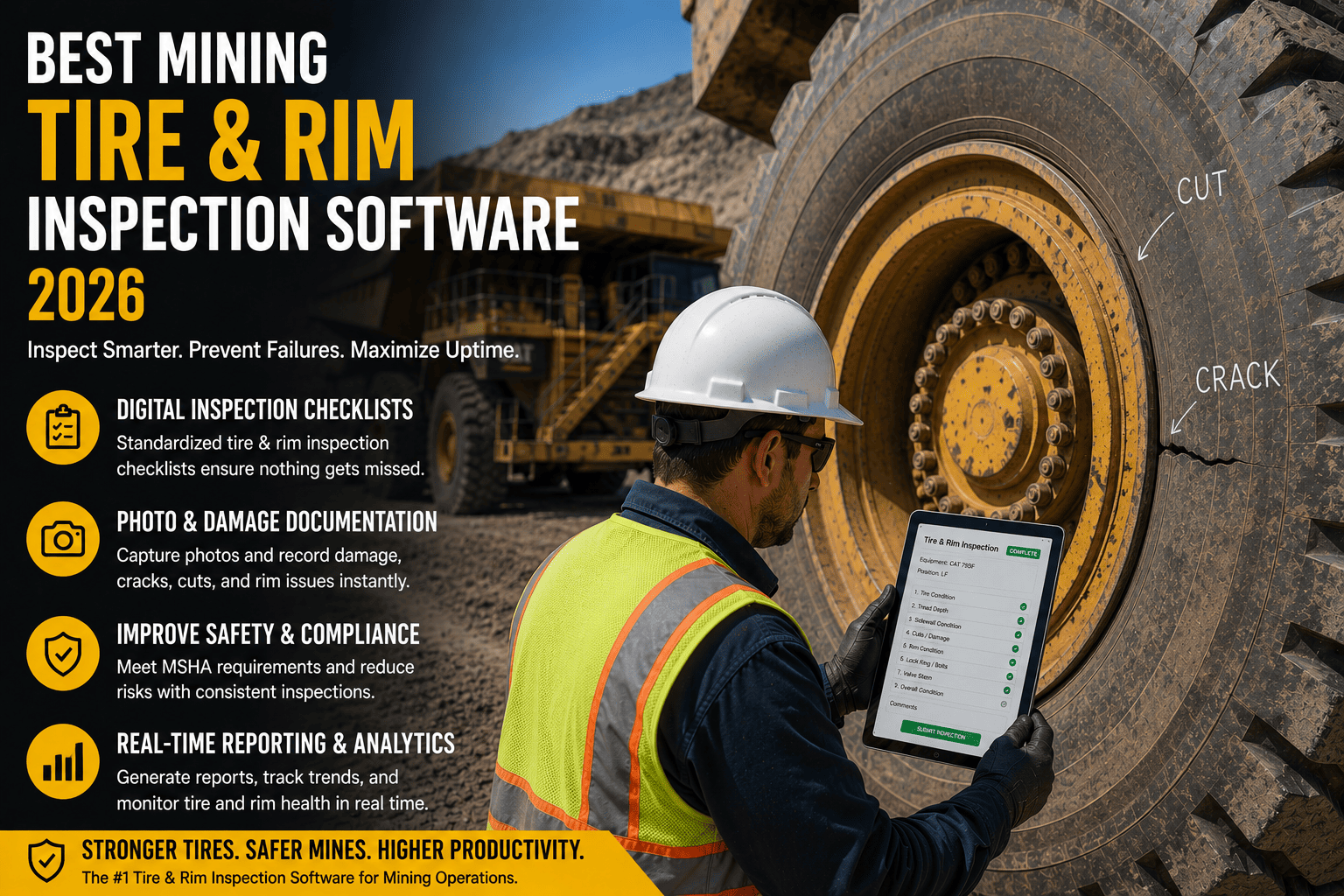
A single ultra-class haul truck tire costs somewhere between 40,000 and 70,000 dollars, and it's expected to last 4,000 to 6,000 hours if it's cared for properly. Run it underinflated, overloaded, or past a hairline rim crack, and that lifespan gets cut in half, or the tire fails catastrophically before anyone even notices a problem. OTR tire and rim work sits among the most dangerous tasks on a mine site, and the inspection that happens before a technician ever touches a wheel is what keeps a routine pressure check from turning into an explosion.
The best mining tire and rim inspection software gives operators and technicians a digital checklist covering tread depth, sidewall condition, inflation pressure, rim cracks, and multi-piece wheel component integrity, flags any tire running below 80 percent of recommended pressure for mandatory demounting, and keeps every inspection tied to a specific tire and rim serial number. It should work offline, require photo evidence on flagged defects, and track tire life against hours in service.
Why Tire and Rim Inspection Is Treated Differently From Other Mining Checks
Most equipment defects create a maintenance problem. A missed tire or rim defect can create an explosion. A multi-piece rim under 80 to 100 psi of contained air is storing enough energy to throw wheel components thirty feet, and MSHA's own incident records include mechanics killed or seriously injured servicing wheels that looked routine right up until the moment they weren't. That's why tire and rim inspection carries its own procedures, separate from a general equipment walkaround.
FleetRabbit gives operators and technicians a tire-specific inspection checklist tied to each wheel's serial number, flags underinflated tires automatically, and keeps a full defect and service history. Sign up to load your fleet and start tracking tire condition today.
What a Pre-Shift Tire and Rim Check Should Cover
Under 30 CFR §56/57.14100, self-propelled mobile equipment has to be inspected by the operator before each shift, and tires are one of the fastest-changing safety items on that list. A proper pre-shift tire check is quick, but it can't skip the basics.
Tread and Sidewall Condition
Tread depth checked against the minimum for the application, sidewalls examined for cuts, bulges, or embedded material, and any dark lines or broken cords in the sidewall flex area treated as a sign the tire may have been run flat.
Inflation Pressure
Pressure checked against the manufacturer's specification for the load and application. Anything at or below 80 percent of that number gets flagged immediately for demounting, not just a quick top-off and a note to check again next shift.
Why a quick top-off isn't enough
A severely underinflated tire may have already suffered internal damage from flexing. Re-inflating it without demounting and inspecting the casing risks a zipper rupture, one of the most violent tire failure modes in mining.
Wheel and Rim Visual Check
Lock rings, bead seat bands, and O-ring grooves checked for cracks, corrosion, or improper seating, with any mismatched rim components, wrong make, size, or type paired together, flagged before the wheel goes back into service.
Pre-Shift Visual Checks vs. Full Tire and Rim Service Inspection
Not every tire check is the same depth. A quick pre-shift look is meant to catch obvious problems before dispatch. A full tire and rim service inspection, done when a tire comes off for rotation, repair, or replacement, goes far deeper into the rim assembly itself.
| Check Type | When Performed | What's Verified | Software Requirement |
|---|---|---|---|
| Pre-Shift Visual | Before every shift, by the operator | Tread, sidewall, visible damage, obvious underinflation | Fast mobile checklist, tag-out on defect |
| Pressure Verification | Pre-shift and after any reported soft tire | PSI against manufacturer spec, 80 percent threshold | Logged reading tied to tire ID, auto-flag on low pressure |
| Full Rim Inspection | During tire changes, rotations, or repairs | Rim cracks, O-ring grooves, lock ring condition, component match | Photo-mandatory checklist, cleaned-surface confirmation |
| Restraining Device Check | Before use and after any air release | Cracks at welds, bent components, corrosion pitting | Separate equipment record, independent inspection log |
Tracking Tire Life, Not Just Tire Condition
A tire that passes today's visual check can still be closer to end of life than anyone realizes if no one is tracking hours in service against expected lifespan. Heat, overload, and pressure abuse can cut a 6,000-hour tire down to 3,000 hours without a single obvious defect showing up on a walkaround.
How FleetRabbit Handles Mining Tire and Rim Inspections
FleetRabbit's tire and rim module treats every wheel as an individually tracked asset, not a generic line item on a broader pre-shift form. That distinction matters when a single tire failure can cost tens of thousands of dollars and put a technician in the trajectory zone of a multi-piece rim.
Serial-Number-Level Tire Tracking
Every tire gets logged by position, serial number, install date, and running hours, so pressure readings, tread measurements, and defect reports all build a complete history for that specific tire rather than a vague note about "the left rear."
Automatic flagging at the 80 percent threshold
When a logged pressure reading falls at or below 80 percent of the specified value, the app flags the tire for mandatory demounting and inspection, removing the judgment call about whether a "little soft" tire needs full attention.
Photo-Mandatory Rim Inspections
Full rim checks during tire changes require photo evidence of the cleaned rim base, lock rings, and O-ring grooves before the inspection can be closed out, creating a visual record that a crack wasn't simply missed under grease or rust.
Offline Capture in Tire Shops and Remote Pits
Tire bays and remote loading areas don't always have reliable signal. Inspections are completed fully offline and sync automatically once a connection is available, so no tire record gets lost to a dead zone.
Load your equipment and tire inventory and see how serial-level tracking, pressure alerts, and photo-verified rim inspections work together to extend tire life and prevent failures. Book a demo to walk through it with your team.
Frequently Asked Questions
Protect Your Tires, Your Rims, and the People Servicing Them
Tire and rim work will always carry real risk, but most of that risk is manageable with the right visibility. Knowing exactly which tire is underinflated, which rim has an unresolved crack, and which unit is approaching the end of its service life turns a dangerous guessing game into a tracked, provable process.
FleetRabbit tracks tire pressure, tread condition, rim integrity, and hours in service across your entire mining fleet, flagging defects before they become failures. Start free or talk to our team about your equipment.