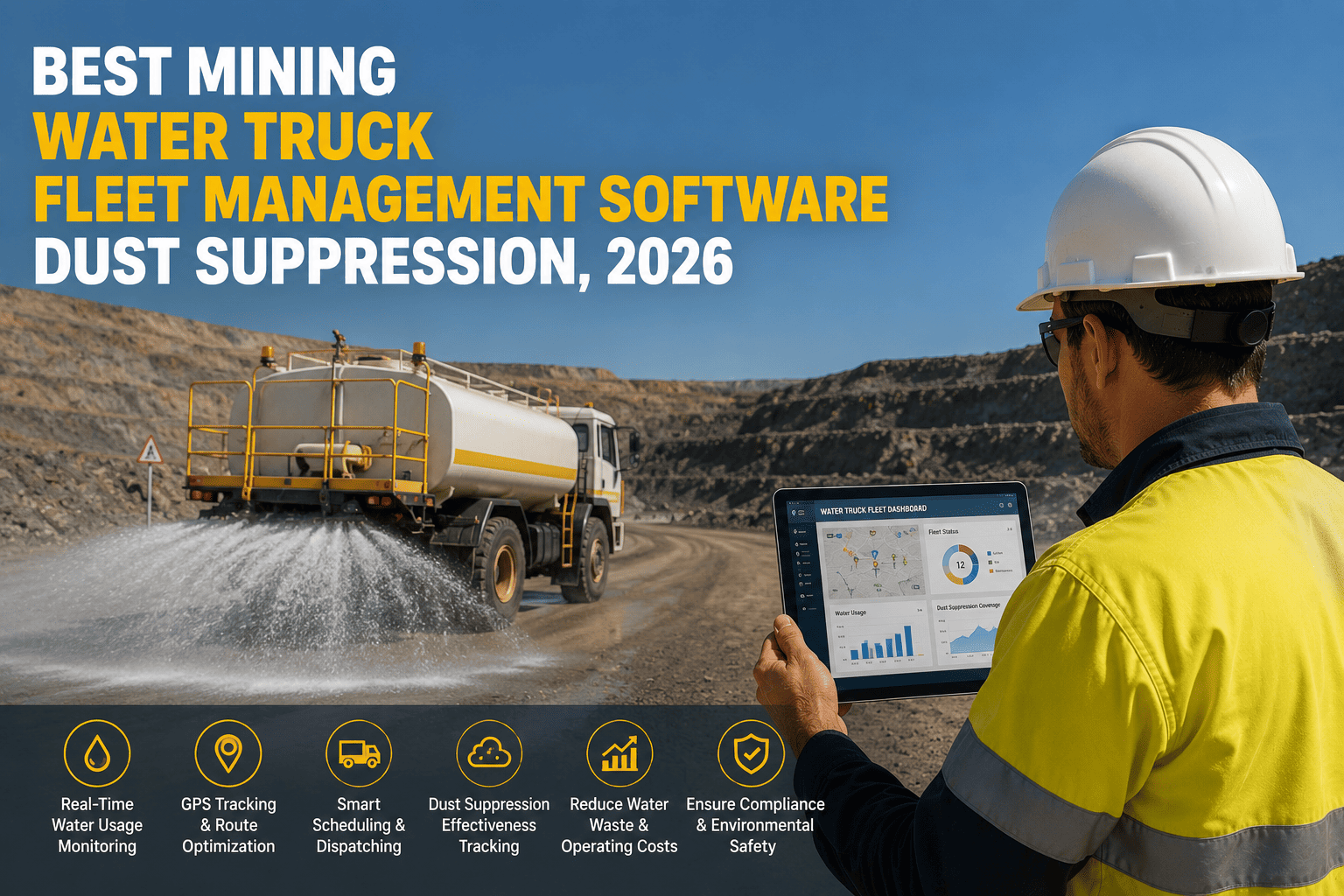
A water truck rarely gets discussed in the same breath as a haul truck or excavator, yet it is often one of the largest single consumers of diesel on an entire mine site. Most operations run their water cart fleet on instinct: send another truck out, water the road again, repeat every shift regardless of what the dust conditions actually call for. That instinct-driven approach is quietly one of the most expensive habits in mining, and it is also one of the easiest to fix once a mine can actually see the data behind it.
Mining water truck fleet management software tracks watering routes, frequency, water usage, and engine hours in real time, replacing fixed watering schedules with data-driven dust suppression. Operations that move from instinct-based watering to data-confirmed schedules have documented reducing their water cart fleet size by 50 to 80 percent, generating millions of dollars in annual fuel and operating cost savings while maintaining the same or better dust control.
Why Water Trucks Are a Bigger Cost Problem Than Most Mines Realize
Dust suppression looks like a simple operational task on paper: keep the haul roads wet enough that visibility stays good and air quality stays compliant. In practice, most water cart fleets are sized and scheduled around a worst-case assumption rather than actual conditions, which means trucks keep running full routes on cool, humid shifts when far less water would do the job just as well. That gap between scheduled watering and actually necessary watering is where an enormous amount of avoidable diesel cost hides.
The scale of that hidden cost is larger than most site managers expect. Documented case studies show one mining operation reducing its water cart fleet by 80 percent through engineered, data-confirmed dust suppression, saving close to 9.4 million dollars annually before even counting the freed-up production capacity of those trucks or the improved haul road condition that follows. Another operation off-hired 57 percent of its water cart fleet within twelve months and generated more than 6 million dollars in direct savings. Mining water truck fleet management software is what makes that kind of reduction possible, because it replaces guesswork with a real record of where, when, and how much watering actually moved the needle.
Instinct-Based Watering vs. Data-Driven Watering
The difference between how most water cart fleets run today and how the best-managed fleets run comes down to one thing: whether decisions are based on a fixed schedule or on real route and condition data.
FleetRabbit tracks engine hours, route coverage, and watering frequency for every truck on site, so dust suppression decisions are based on data instead of habit. Sign up free and see your fleet's status within a day.
What Water Truck Fleet Management Software Should Track
Dust suppression software needs to cover ground that general fleet tracking tools usually miss entirely. Four areas matter most for a water cart fleet specifically.
Route Coverage and Watering Frequency
Logging which haul road sections have been watered, and how recently, exposes exactly where the fleet is over-servicing low-traffic areas while potentially under-servicing high-dust zones. Without this record, watering decisions default to the same fixed loop every shift regardless of actual need.
Water Usage and Diesel Consumption Per Truck
Water trucks consume significant volumes of both diesel and water on a continuous basis. Tracking both per individual truck, rather than as a fleet average, is what reveals which units are running inefficient routes or burning more fuel than the dust conditions actually justify.
Engine-Hour Based Preventive Maintenance
Water trucks running multiple shifts accumulate hours quickly, and a broken water truck means dusty roads that damage haul truck air filters and reduce visibility across the entire site. Maintenance scheduling pulled from real engine hours through OEM telematics keeps the dust suppression fleet itself from becoming the next breakdown.
Compliance and Environmental Reporting
Dust suppression activity increasingly needs to be documented for environmental permits and regulatory audits. Automated logs of route coverage, frequency, and water volume used create the audit trail regulators ask for, without someone manually compiling spreadsheets after the fact.
| Fleet Approach | How It Works | Common Result | What Software Changes |
|---|---|---|---|
| Fixed Schedule Watering | Same route and frequency every shift regardless of conditions | Over-watering on low-dust days, wasted diesel and water | Route data confirms when reduced watering still meets standard |
| Oversized Fleet | Trucks added to cover worst-case dust scenarios | Surplus trucks sit underutilized, draining the budget | Utilization tracking identifies trucks to redeploy or off-hire |
| Reactive Maintenance | Water trucks serviced only after a breakdown | Broken truck means dusty roads and damaged haul truck filters | Engine-hour PM scheduling prevents the cascading failure |
| Manual Compliance Logs | Spreadsheets compiled after the fact for audits | Inconsistent records and gaps during regulatory review | Automated route and usage logs build the audit trail live |
What an Unmanaged Water Truck Fleet Is Actually Costing You
The financial case for managing a water cart fleet with real data rather than instinct is one of the clearest in mining operations, simply because the fleet is one of the largest discretionary diesel consumers on most sites. Reducing water truck diesel consumption by 50 to 80 percent through better scheduling has been documented to cut water truck operating costs by well over 1 million dollars per truck annually in some cases, while still maintaining or improving dust control.
That math compounds further once redeployment is factored in. A water truck taken off an inefficient fixed route and either off-hired or shifted to productive work is not just a cost saved, it is capacity recovered. Book a demo to see what that math looks like applied to your specific water cart fleet and route network.
What To Look For When Comparing Water Truck Fleet Software in 2026
Not every fleet platform is built to handle the specific data a dust suppression program needs. A few capabilities separate genuinely useful water truck software from a generic vehicle tracker.
OEM Telematics Compatibility
Look for direct integration with existing telematics hardware so engine hours, fuel burn, and location data sync automatically rather than requiring manual logging that falls behind on a busy shift.
Route-Level Watering History
A platform should show exactly which haul road sections were watered, how recently, and how often, not just where a truck currently sits on a map. This route-level history is what turns dust suppression from a fixed habit into a data-confirmed, adjustable schedule.
Offline-Capable Tracking For Remote Routes
Water trucks often cover the furthest, least-connected sections of a mine site. Tracking and inspection tools should capture data offline and sync once connectivity returns, rather than losing the record entirely in low-signal areas.
Fast Setup Without A Long Rollout
A water cart fleet, even a small one, should not need months of configuration to start generating useful utilization data. Sign up for a platform that connects to what is already on your trucks and surfaces a first utilization report within a day.
FleetRabbit connects to your existing telematics, tracks route coverage and engine hours automatically, and gives your team the data to confirm exactly how much watering your site actually needs. No new hardware. No long rollout.
Frequently Asked Questions
The Bottom Line on Water Truck Fleet Management
Dust suppression is non-negotiable on a mine site, but how much fleet, fuel, and labor it takes to achieve does not have to stay fixed at a worst-case assumption forever. The operations that have actually measured their watering data have found enormous room to reduce fleet size, redeploy trucks, and cut diesel cost without sacrificing dust control or compliance. The opportunity is sitting in data most sites already have access to. It just needs the right platform to make it visible.
FleetRabbit turns route coverage, engine hours, and water usage into a live dashboard, so your dust suppression program runs on real data instead of a fixed habit. No new hardware. No long rollout. No credit card required to start.