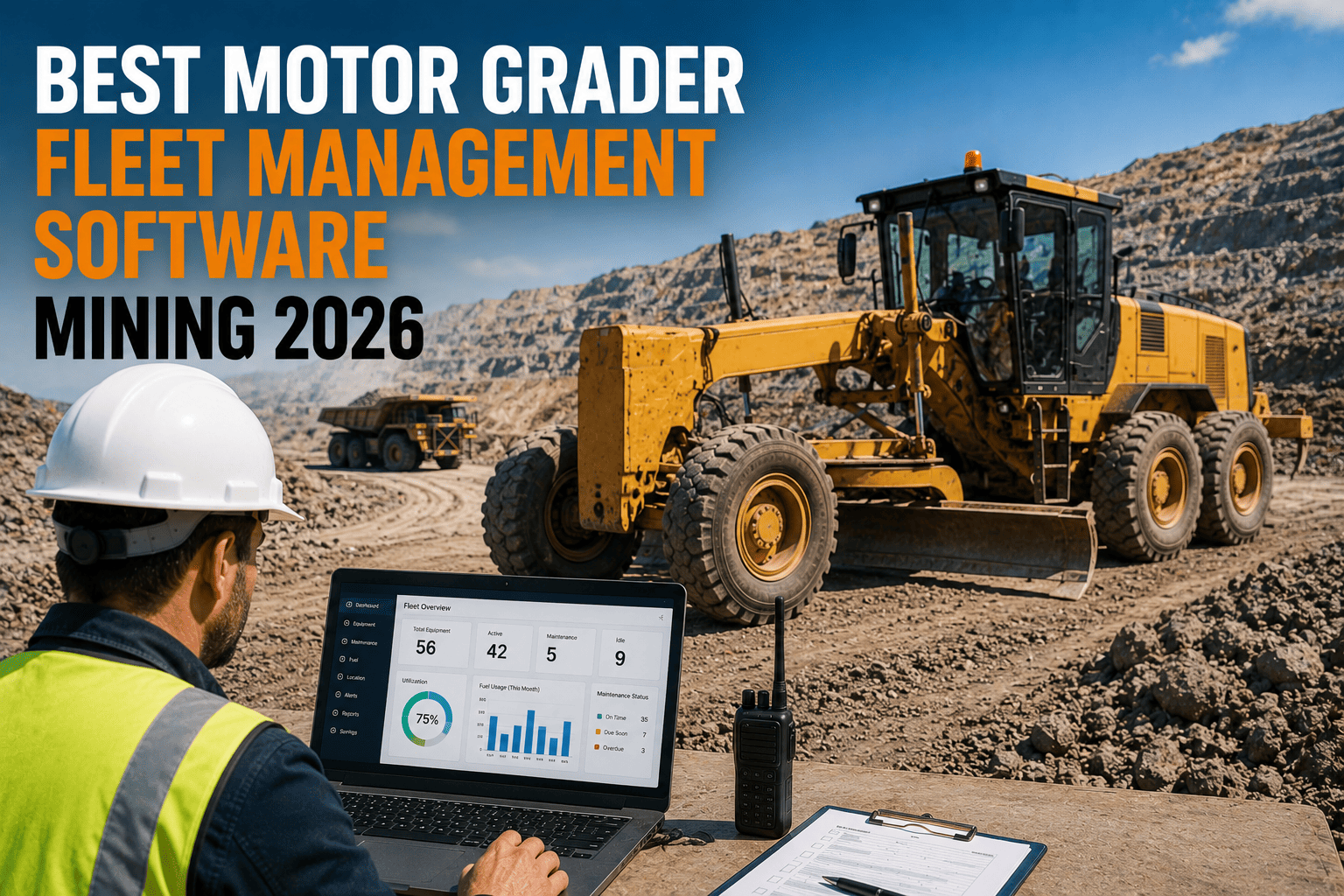
A motor grader rarely gets the attention a haul truck or excavator does on a mine site, yet it has more influence over fleet-wide fuel and tire cost than almost any other single machine. The reason is simple: every truck on the property drives over the roads that grader maintains, and the condition of those roads determines how much fuel each truck burns and how long each set of tires lasts. A grader sitting idle when it should be working is not a small problem confined to one machine. It is a cost that multiplies across the entire haul fleet, every single trip.
Motor grader fleet management software tracks grading frequency, engine hours, and haul road condition trends, then ties that data to preventive maintenance scheduling. Since haulage already accounts for up to half of total mining operating costs, and a one percent rise in rolling resistance can raise truck fuel consumption by 2 to 3 percent while cutting tire life by up to 30 percent, even modest improvements in grader deployment and uptime translate into fleet-wide savings far larger than the grader's own operating cost.
Why One Grader's Uptime Affects Your Whole Haul Fleet
Rolling resistance is the hidden number that connects haul road condition to everything a mine spends on fuel and tires. A well-maintained haul road typically holds rolling resistance around 2 to 3 percent. Let that road go even a few days without grading, and resistance can climb past 5 to 8 percent as ruts, washboarding, and loose material build up. Research modeling this exact relationship found that for every hour a grader does not maintain a haul road, production loss reaches roughly 600 tons and fuel consumption rises by close to 1,800 liters across the affected haul fleet in a single day.
That is the core reason grader fleet management deserves its own dedicated software rather than being an afterthought bolted onto truck tracking. A grader that goes unscheduled for maintenance, or simply is not deployed often enough, is not failing in isolation. It is quietly inflating fuel bills and shortening tire life across every truck running that road. Motor grader fleet management software exists to make sure that ripple effect runs in the mine's favor instead of against it.
How One Grading Gap Ripples Across The Fleet
The chain reaction from a single under-maintained haul road section shows exactly why grader uptime is a fleet-wide cost lever, not just a single-machine concern.
FleetRabbit tracks engine hours, grading frequency, and maintenance status for every grader on site, so haul road upkeep never quietly slips through the cracks. Sign up free and see your fleet's status within a day.
What Motor Grader Fleet Management Software Should Track
A platform built specifically for graders needs to connect two things that are usually managed separately: the machine's own operating condition, and the condition of the roads it is responsible for maintaining. Four capabilities matter most.
Grading Frequency and Route Coverage
Tracking which haul road sections have been graded, and how recently, exposes coverage gaps before they turn into a rolling resistance problem. High-tonnage routes, steep ramps, and known bottleneck sections deserve priority over lower-traffic roads, and software that logs grading history per route makes that prioritization possible instead of relying on a supervisor's memory of what was graded last week.
Engine-Hour Based Preventive Maintenance
Standard service intervals for blade wear, hydraulic systems, and the drivetrain should trigger automatically from real engine hours pulled through OEM telematics rather than a fixed calendar date. A grader running extended shifts during a wet season or after heavy truck traffic accumulates hours faster than usual, and calendar-based scheduling has no way to account for that.
Fuel Consumption and Idle Time Monitoring
A grader sitting idle instead of actively working a deteriorating road section is a double cost: it burns fuel doing nothing, and the road it should be maintaining keeps getting worse. Idle-time alerts let dispatch redeploy the grader to the route that needs it most before the gap widens.
Digital Inspections Built For Grading Equipment
Blade condition, articulation joints, circle drive components, and tire condition all need pre-shift attention specific to how a grader works, not a generic checklist borrowed from a truck or loader template. Mobile inspections with mandatory photo capture on flagged defects build a permanent record and catch developing issues before they take the grader out of service entirely.
| Road Condition | Typical Rolling Resistance | Fleet-Wide Impact | How Software Helps |
|---|---|---|---|
| Well-Maintained Road | 2 to 3 percent | Baseline fuel use, normal tire wear, on-plan cycle times | Grading history tracking confirms coverage is current |
| Lightly Deteriorated | 4 to 5 percent | Fuel use rising, early tire wear pattern changes | Idle-time alerts redeploy graders before it worsens |
| Heavily Deteriorated | 6 to 8 percent or higher | Significant fuel increase, up to 30 percent shorter tire life | Route priority data flags this section for immediate grading |
What Skipped Grading Is Actually Costing Your Fleet
The financial case for grader uptime is one of the clearest in mining operations, simply because haulage already represents up to half of total operating costs at most surface mines. Industry modeling on this exact relationship found that one South American gold mine traced a haul ramp bottleneck to roughly 6,000 tonnes per week in lost production, and after remediation, throughput increased by 38,000 tonnes weekly, generating an estimated 174,880 dollars in incremental revenue from that single fix.
The fuel side of the equation is just as direct. Research has shown that reducing rolling resistance from 8 percent down to 4 percent on a single haul route delivered a 29 percent decrease in equipment capital cost and a 25 percent decrease in operating cost on that route alone. None of that improvement requires a new fleet or a new mine plan. It requires keeping the grader fleet running, scheduled correctly, and deployed to the routes that need it most. Book a demo to see what that math looks like applied to your specific haul network.
What To Look For When Comparing Grader Fleet Software in 2026
Most fleet platforms treat a grader as just another asset on the map. The ones that actually move the needle on haul road cost track grader performance alongside road condition, not in isolation.
OEM Telematics Compatibility
Look for direct integration with Cat MineStar, Komatsu KOMTRAX, Volvo CareTrack, and similar OEM systems so engine hours and fault codes sync automatically rather than relying on manual logbook entries that fall behind.
Route-Level Grading History
A platform should let maintenance teams see when each haul road segment was last graded, not just where the grader currently sits. Route-level history is what turns grading from a reactive task into a planned, prioritized schedule.
Offline-Capable Inspections For Remote Routes
Graders often work the furthest, least-connected sections of a mine site. Inspection tools that require live connectivity get abandoned in favor of paper within weeks. The right software captures the check offline and syncs once the device reconnects.
Fast Setup Without A Long Rollout
A grader fleet, even a small one, should not need months of integration work to start generating useful data. Sign up for a platform that connects to what is already on your machines and surfaces a first utilization report within a day.
FleetRabbit connects to your existing OEM telematics, tracks engine hours and route coverage automatically, and gives dispatch the data to keep every grader working the routes that need it most. No new hardware. No long rollout.
Frequently Asked Questions
The Bottom Line on Motor Grader Fleet Management
A grader's value is measured in the cost it prevents across an entire haul fleet, not in what the machine itself produces. Treating grader uptime, route coverage, and preventive maintenance as a fleet-wide cost lever rather than a single-machine afterthought is one of the highest-leverage changes a mine site can make without buying a single additional truck. The math is already proven in the research. What most operations are missing is the visibility to act on it every single day.
FleetRabbit turns grader engine hours, route coverage, and maintenance status into a live dashboard, so haul road upkeep happens on schedule instead of by chance. No new hardware. No long rollout. No credit card required to start.