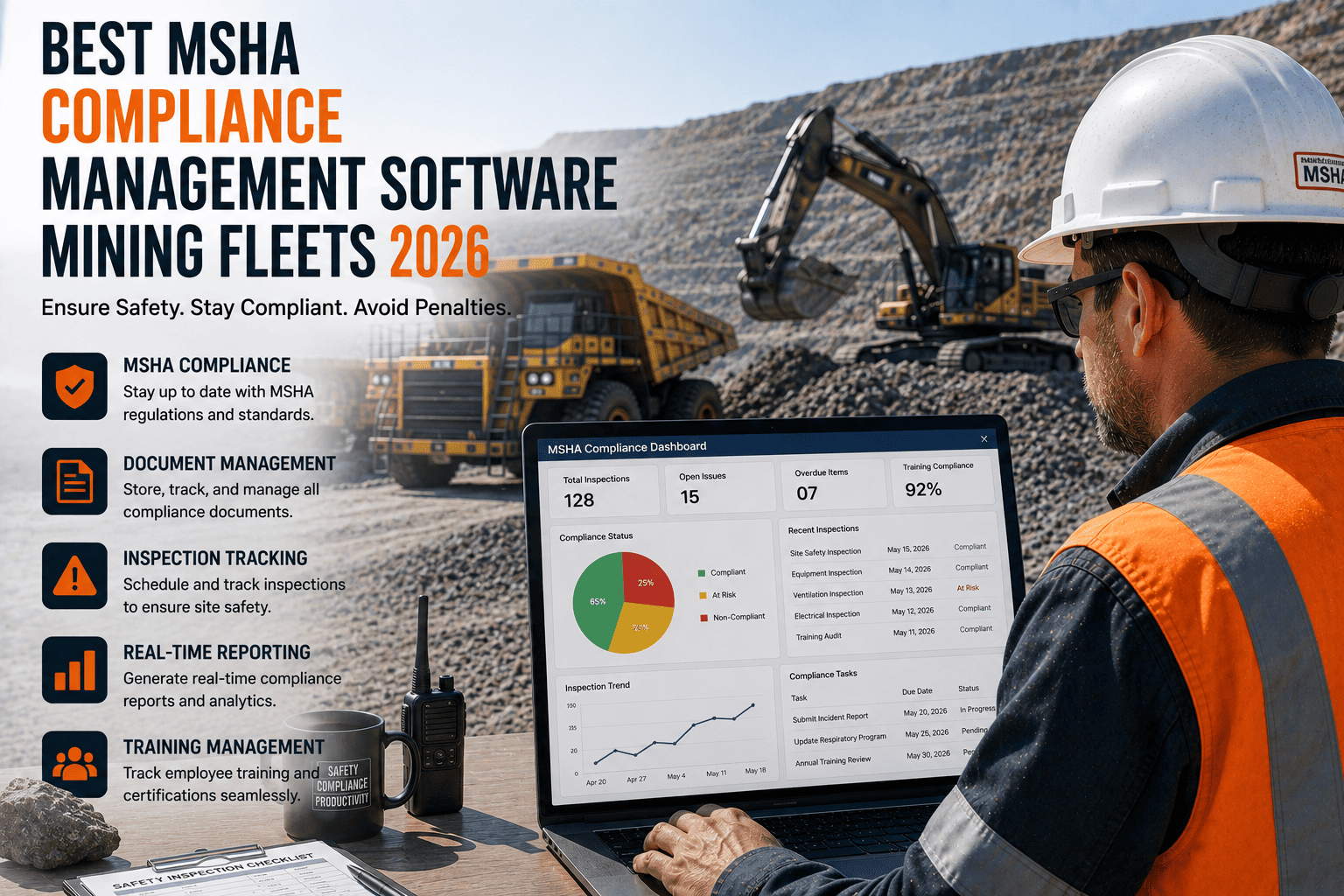
An MSHA inspector doesn't call ahead. One morning they are simply on site, asking for ninety days of pre-shift inspection records, current training certifications for every operator, and a corrective action log for every open hazard. If those records live in a filing cabinet, a shared spreadsheet, or a supervisor's memory, the next few hours get very uncomfortable. This is the exact moment that separates mines running on paper from mines running on MSHA compliance management software — and it is the moment this guide is built around.
The best MSHA compliance management software in 2026 digitizes pre-shift inspections, tracks Part 46 and Part 48 training certifications, automates corrective action follow-up, and exports audit-ready records in minutes instead of days. Purpose-built platforms like FleetRabbit start at roughly 5 dollars per asset per month, work fully offline underground, and typically move inspection completion rates from 60 to 75 percent on paper to 98 to 100 percent within the first month. A single serious MSHA citation can carry a penalty near 70000 dollars, which is why compliance software usually pays for itself the first time it prevents one.
Why Paper and Spreadsheets Keep Failing MSHA Audits
Most compliance gaps are not caused by careless workers. They are caused by systems that were never designed to hold up under audit pressure. A paper checklist can be filled out honestly and still disappear into a truck cab for weeks. A spreadsheet can track certifications perfectly until a contractor arrives whose training records live on a different site's laptop. MSHA compliance management software closes these gaps by making every inspection, certification, and corrective action a searchable, timestamped digital record the moment it happens.
Records Nobody Can Find Fast
Paper pre-shift checklists sit in glove boxes and file drawers. When MSHA asks for 90 days of records across a mixed fleet, someone spends a full day photocopying and sorting instead of running an operation.
Certifications Expire Silently
An operator's 8-hour annual refresher lapses three weeks before anyone notices. Spreadsheets don't send alerts. They only reveal the gap once an inspector or an incident exposes it.
Built for the Wrong Industry
Safety apps borrowed from trucking or warehousing miss mining-specific items like ROPS, FOPS, fire suppression, and MSHA-distance backup alarms — the exact items inspectors check first.
FleetRabbit replaces paper pre-shift checklists and scattered spreadsheets with one live compliance dashboard covering inspections, training, and corrective actions across surface and underground equipment. Sign up free and load your own equipment list in under an hour, or book a demo to see it running on a real mine site first.
Core Capabilities Every MSHA Compliance Platform Needs
Not every feature marketed as "compliance software" actually holds up on an active mine site. The table below breaks down the capabilities that matter and what they replace when done well.
| Capability | What It Replaces | Why It Matters for MSHA |
|---|---|---|
| Digital Pre-Shift Inspections | Paper checklists and glove-box logs | Timestamped, photo-verified records covering 30 CFR Part 56/57 items, exportable instantly by date range |
| Offline-First Mobile App | Apps that fail underground or in remote pits | Inspections and near-miss reports complete with zero signal, then sync automatically when connectivity returns |
| Part 46 / Part 48 Training Tracking | Spreadsheets and paper certificate files | Automated expiry alerts for annual refreshers and new-miner hour requirements, flagged by the correct standard |
| Corrective Action Routing | Verbal handoffs between operators and mechanics | Defects found in inspection route instantly to maintenance with a closed-loop resolution record |
| One-Click Audit Export | Manual record assembly during an active inspection | Produces 90 days of records for any equipment or worker in minutes, not hours |
Surface Mines and Underground Mines Are Not the Same Audit
MSHA treats surface and underground operations differently, and compliance software that ignores that distinction will always leave gaps somewhere in your records.
Surface Operations
Surface mines are inspected roughly twice a year, and the majority of citations trace back to haul truck and loader pre-shift items — backup alarms, lighting, mirrors, and seat belt condition. Equipment operates with reliable cellular signal most of the time, so real-time GPS tracking and cycle-time monitoring add operational value on top of compliance records.
What surface compliance software should prioritize
Fast inspection completion during shift change, automated PM scheduling tied to engine hours rather than calendar days, and a dashboard that flags any truck approaching an overdue service before it becomes a citation.
Underground Operations
Underground mines are inspected roughly four times a year, and connectivity is the defining constraint. Software that requires a live connection to complete an inspection or log a near-miss will be abandoned by operators within a week and replaced right back with paper — which defeats the entire point of going digital in the first place.
What underground compliance software should prioritize
True offline-first architecture, not a "poor connection" fallback mode. Data should capture locally on the device and sync the moment a worker returns to surface signal, with zero records lost in between.
What to Look For When Comparing Platforms
Three tiers of software typically show up in an evaluation: enterprise EHS platforms built for corporate-wide environmental and safety programs, generic safety apps adapted from other industries, and purpose-built mining compliance tools. Before committing to any of them, confirm the platform can genuinely do the following on your own equipment list.
Works With Zero Signal
Ask to see offline mode demonstrated live, underground or in an area with no coverage, before signing anything.
Mining-Specific Checklists
Confirm inspection templates cover ROPS, FOPS, fire suppression, and equipment-specific items rather than a generic vehicle form.
Same-Day Deployment
No IT team, no hardware install, no enterprise contract negotiation before your first digital inspection.
The Real Cost of Getting Compliance Wrong
A single serious MSHA citation carries an average penalty near 70000 dollars. Repeat or pattern-of-violation citations climb higher, and each one also invites closer scrutiny on every future inspection. Compare that to what compliance software actually costs, and the decision becomes straightforward math rather than a leap of faith.
| Scenario | Approximate Cost | Notes |
|---|---|---|
| Single Serious MSHA Citation | 70000 dollars or more | Average penalty, before legal and remediation costs |
| 20-Truck Fleet, FleetRabbit Annual Cost | Around 1200 dollars per year | At roughly 5 dollars per asset per month, no setup fees |
| Audit Prep Time, Paper Records | Hours to a full day | Manual sorting and photocopying under time pressure |
| Audit Prep Time, Digital Records | Minutes | One-click export by date range, equipment, or worker |
FleetRabbit AI covers pre-shift inspections, Part 46 and Part 48 training alerts, corrective action tracking, and instant audit exports for surface and underground fleets alike. Start your free trial today, or book a 30-minute demo to walk through your own equipment list with our team.
Getting Started Without Disrupting Active Operations
The most common reason mines delay adopting compliance software is the fear that setup will be slow and disruptive. In practice, purpose-built platforms are designed to go live during a single shift change.
Step One: Load Your Equipment
Add haul trucks, loaders, drills, and support equipment by CSV import or manually. Surface and underground assets sit in the same dashboard from day one.
Step Two: Configure Inspection Templates
Assign equipment-specific pre-shift checklists so operators see the right items for the machine they are actually running, not a generic form.
Step Three: Upload Training Records
Import existing Part 46 or Part 48 certificates so expiry alerts start running immediately, including for contractors who trained at a different site.
Step Four: Deploy to Operators
Send a mobile link to every operator's device. Most sites complete full rollout during one shift change window, with digital inspections replacing paper from the very next shift.
Frequently Asked Questions
Every shift without digital compliance records is a shift where a gap can go unnoticed until an inspector or an incident exposes it. FleetRabbit brings pre-shift inspections, Part 46 and Part 48 training tracking, and one-click audit exports into a single platform built specifically for mining.