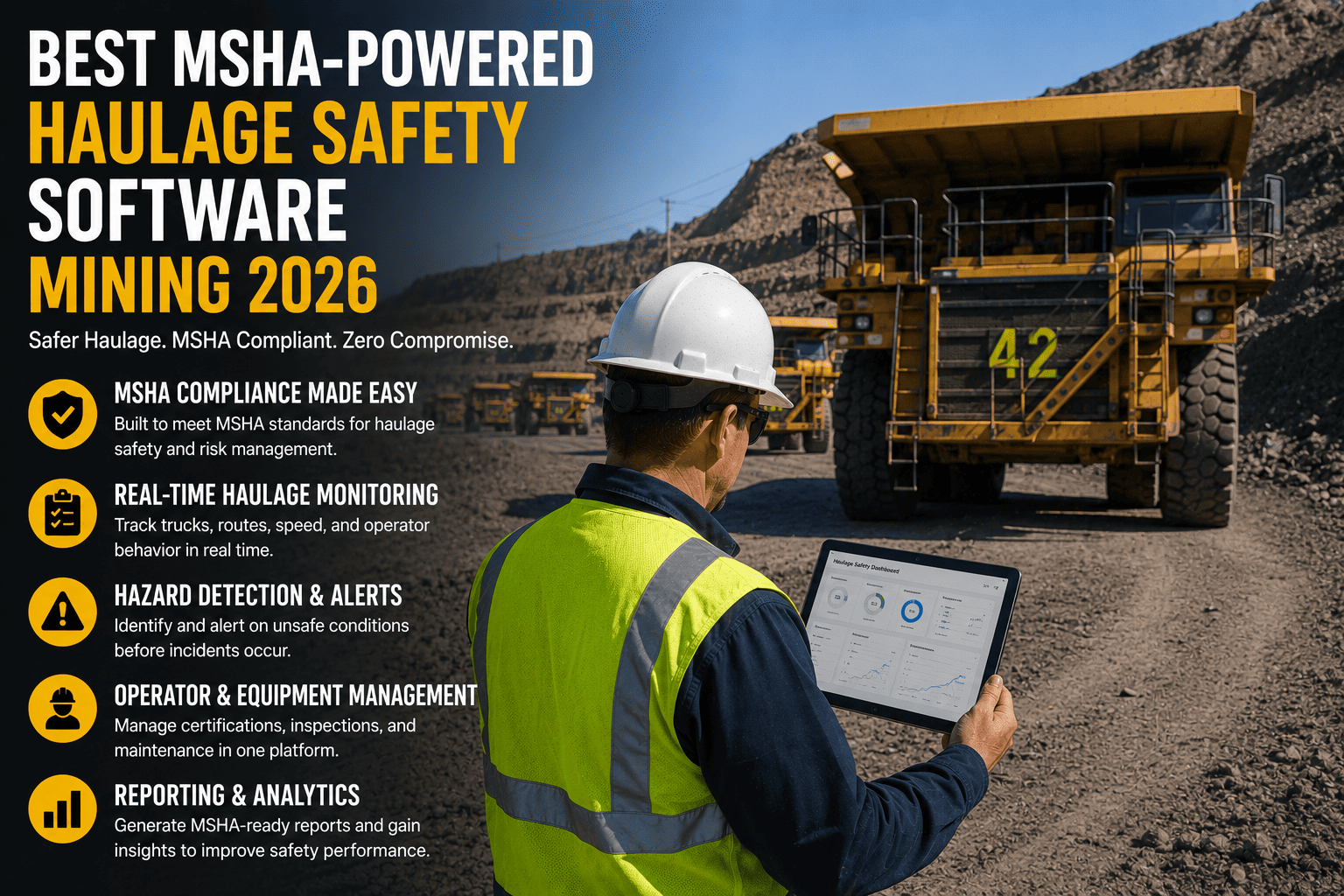
Powered haulage equipment — haul trucks, service vehicles, and other surface mobile machinery — has been one of the leading causes of serious and fatal accidents in mining for years. MSHA's Powered Haulage Rule, effective since January 2024, now requires mine operators running six or more miners to maintain a written safety program addressing these exact hazards. The question most safety directors are asking isn't whether they need a program — it's which software actually makes that program work in the field instead of sitting in a binder.
MSHA's Powered Haulage Rule requires a written, site-specific safety program covering hazard identification, traffic management, visibility, maintenance and inspection procedures, and worker input. Software built for this compliance need should combine proximity and collision alerts, speed monitoring, digital inspection records, and incident documentation in one system, since a written plan that isn't backed by real field data is difficult to defend during an MSHA inspection.
Why Powered Haulage Got Its Own Rule
Between 2011 and 2020, surface mobile equipment was involved in more than 13,000 non-fatal injuries, resulting in nearly half a million lost workdays. Machinery and powered haulage incidents have consistently ranked among the leading causes of mining fatalities, which is why MSHA moved away from general training requirements toward a rule demanding a formal, site-specific safety program with documented hazard controls, maintenance procedures, and worker participation.
The rule specifically calls out blind spots, poor communication, traffic hazards, and equipment malfunction as the recurring causes behind powered haulage accidents. That list matters because it's effectively a feature checklist for any software claiming to support compliance — a system needs to address visibility, communication, traffic management, and maintenance tracking, not just one of them.
What Your Written Safety Program Must Cover
Back Every Requirement With Real Field Records
FleetRabbit connects proximity alerts, speed data, digital inspections, and maintenance records into one system, so your written safety program is backed by evidence an MSHA inspector can actually verify. You can start a free trial to see how it maps to your current program, or book a demo for a compliance walkthrough with our team.
Core Capabilities to Look For in Powered Haulage Safety Software
Not every fleet or safety platform on the market was built with mining's specific hazard profile in mind. The strongest options share a handful of core capabilities that map directly to what the rule requires.
Why Integration Matters More Than Any Single Feature
A standalone proximity sensor or a standalone inspection app each solve one piece of the rule. The gap most operations fall into is running four or five disconnected tools that never talk to each other, which means nobody has a single view of whether the written program actually matches what's happening on the ground. Software that ties proximity data, speed exceptions, inspections, and incident history into one dashboard is what turns a compliance document into something you can actually manage day to day.
The Audit Trail Problem
MSHA inspections ask for records, not intentions. A safety program that says maintenance is tracked "regularly" is far weaker than one backed by timestamped digital inspection logs tied to specific equipment. This is usually the single biggest gap between mines that pass an inspection smoothly and those that scramble to reconstruct records after the fact.
How to Evaluate Software Against Your Program
A platform that checks every box on this list is doing the job a fragmented toolkit of separate apps struggles to do — giving you one place to prove the written program and the daily operation actually match. If you want to walk through this checklist against your own site's current tools, you can book a demo and bring your existing safety program documentation.
Getting Started Without Disrupting Operations
Mines that have successfully modernized their powered haulage safety program typically start with the equipment involved in the highest number of near misses or the most restricted visibility — haul trucks and service vehicles operating near active pits are usually first. Getting proximity and speed monitoring live on that subset within the first few weeks builds the data foundation the rest of the program can expand from, without requiring a full-site rollout on day one.
Frequently Asked Questions
Make Your Powered Haulage Program Inspection-Ready
A written safety program is only as strong as the field data behind it. FleetRabbit brings proximity alerts, speed monitoring, digital inspections, and incident records into one system, so your MSHA compliance is backed by evidence, not just intentions. Sign up to see how it fits your current safety program, or book a demo for a compliance walkthrough with our team.