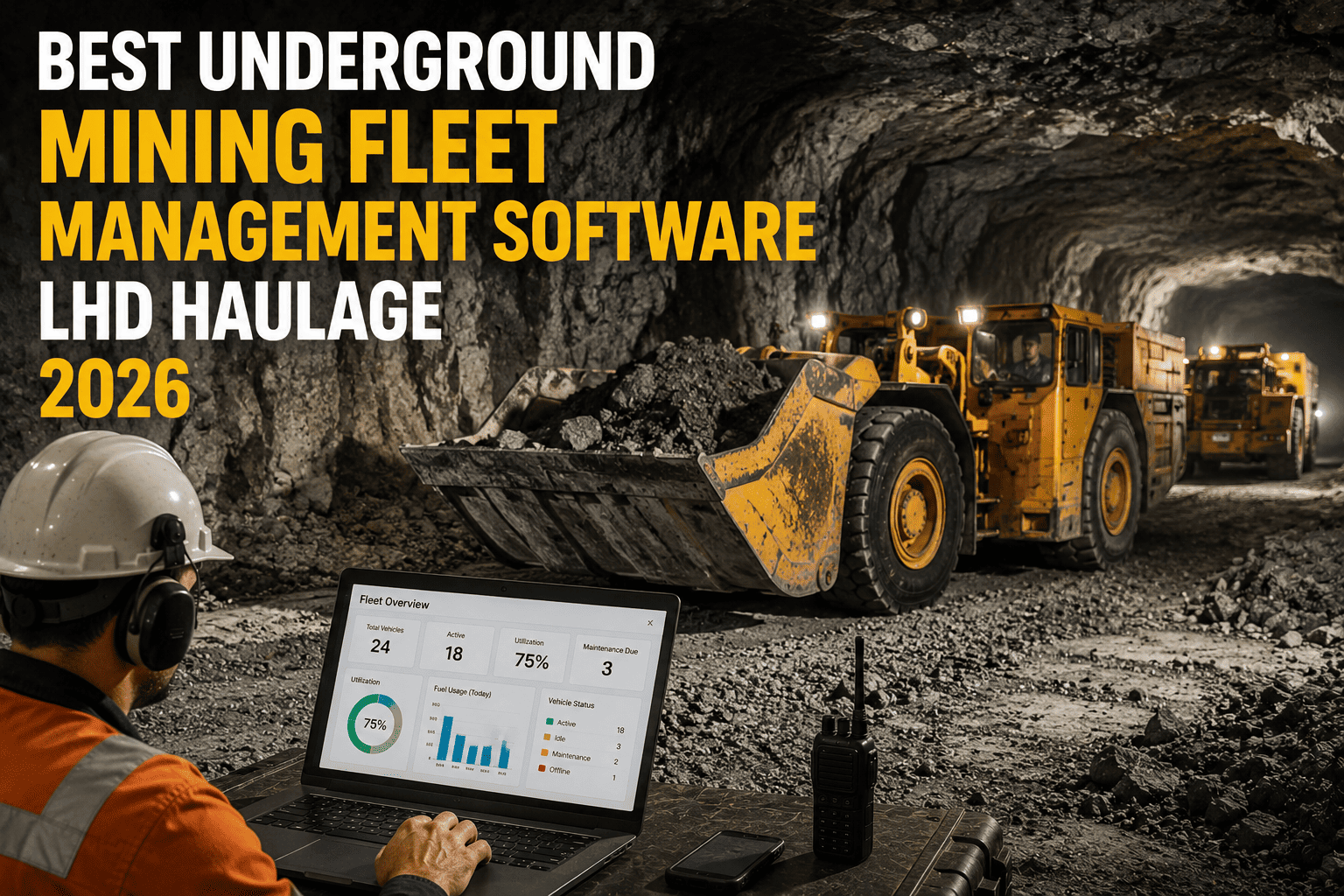
Underground mining is one of the most operationally demanding environments on Earth. Equipment operates in confined tunnels, far from signal coverage, under intense heat, dust, and vibration — and a single unplanned LHD or haul truck breakdown can halt an entire production face. Most fleet management platforms were built for surface trucking and adapted for mining as an afterthought. Underground mines need software that was built for their world: one that works offline, tracks equipment by the hour, handles MSHA compliance, and predicts failures before they shut down production. If you are evaluating the best underground mining fleet management software for LHDs and haulage in 2026, this guide covers what actually matters, what to look for, and how leading platforms compare.
Underground mining equipment operates at 5–7% lower availability than surface fleets due to access constraints and ventilation shutdowns. An unplanned LHD breakdown costs between $5,000 and $20,000 per hour in lost production. Implementing predictive, hours-based maintenance reduces unexpected breakdowns by up to 42% and delivers ROI exceeding 300% within the first year.
Why Underground Mining Fleets Need Specialized Software
A surface trucking fleet and an underground mining fleet share almost nothing beyond the word “fleet.” LHDs, underground haul trucks, jumbos, bolters, and shotcrete rigs operate in environments with no GPS signal, extreme duty cycles, mandatory pre-shift inspections under MSHA law, and ventilation constraints that dictate when and where diesel equipment can run. Using a standard fleet management tool in this environment is like using a weather app to navigate a submarine. You need purpose-built software designed for the realities of underground operations.
Underground equipment maintenance scheduling must trigger on engine hours, not calendar dates. PM intervals at 250, 500, 1,000, and 2,000 hours must account for severe-duty conditions that can reduce standard intervals by 20–40%. Diesel particulate matter is a primary health concern, meaning emission system maintenance is not optional — it is safety-critical. Battery-electric underground equipment is growing rapidly, introducing new maintenance profiles that legacy platforms struggle to support.
No GPS Underground
Standard GPS tracking fails inside tunnels and stopes. Underground systems require Wi-Fi mesh, RFID, or peer-to-peer relay networks to maintain equipment location visibility.
Hours-Based Maintenance
Underground equipment runs at extreme duty cycles. Calendar-based maintenance misses critical service windows. Hour-triggered PM scheduling is essential for equipment longevity.
MSHA Compliance
Underground mines face mandatory MSHA inspections at least four times per year. Pre-shift inspections are legally required before any equipment is operated, with penalties up to $90,649 per violation.
Offline Data Capture
Signal dropout is constant underground. Fleet software must capture inspection records, work orders, and equipment data offline and sync automatically when connectivity is restored.
Emission System Monitoring
Diesel particulate matter in confined tunnels is a regulated health hazard. Emission system maintenance tracking must be automated and auditable, not left to paper-based checklists.
LHD Cycle Tracking
Load-haul-dump cycle times directly drive ore production output. Software must track loading, tramming, dumping, and idle states automatically to give supervisors real production visibility.
Key Features to Demand From Underground Mining Fleet Software
Not every feature on a vendor checklist translates into real value underground. These are the capabilities that separate platforms that perform from platforms that get abandoned after six months. If you are evaluating software for your underground fleet, these are the non-negotiables. You can book a demo with FleetRabbit to see how each of these is handled in a purpose-built system.
Hours-Based Preventive Maintenance Scheduling
PM intervals in underground mining must trigger on engine hours, not calendar days. A jumbo drill running two shifts per day reaches its 500-hour service in a fraction of the time a calendar-based system would predict. Best-in-class platforms auto-sync hour counters from OEM telematics, apply site-specific severity adjustments, and generate work orders with parts lists before PM is due. FleetRabbit’s PM module is built around tiered hour-based intervals (250 / 500 / 1,000 / 2,000 hrs) and has delivered a 42% reduction in unexpected breakdowns at mining operations.
Offline-First Digital Inspections
MSHA pre-shift inspections must be completed before any underground equipment is operated. Paper checklists are the industry default, but they create audit gaps, get lost, and provide no real-time visibility into defects found. Digital inspection tools with mandatory photo capture, GPS timestamp (captured at sync), and machine-specific underground templates eliminate the paper trail and create an audit-ready compliance record automatically. The platform must function with zero connectivity and sync when the device surfaces or reconnects to a Wi-Fi mesh point.
Real-Time Equipment Location Tracking Underground
GPS does not penetrate rock. Underground location tracking uses Wi-Fi mesh networks, RFID tags, ultra-wideband beacons, or peer-to-peer telemetry relay between vehicles to maintain real-time asset positions. Supervisors need to know where each LHD, haul truck, and support vehicle is at all times, not because of surveillance, but because it is the only way to coordinate production safely and respond to incidents. Software that relies on GPS alone is useless below surface.
Downtime Tracking With Reason Codes
Every minute of equipment downtime underground should be captured with a reason code: mechanical failure, scheduled maintenance, ventilation shutdown, blast clearance, fuel and lube, operator unavailability, waiting for parts. Without reason codes, you know your equipment availability is 88% but you do not know why the other 12% is being lost or how to recover it. The best platforms surface these reasons in real-time dashboards and weekly reports, enabling managers to target the highest-impact losses first.
Haulage Productivity and LHD Cycle Monitoring
LHD cycles — load, tram to dump, dump, tram back to face — are the heartbeat of underground production. Each completed cycle represents a bucket of ore moved toward the mill. Software that automates cycle state detection (loading, hauling, dumping, idle, parked) using onboard sensors and context-aware algorithms removes operator data entry burden and gives production supervisors an accurate, real-time picture of tonnes moved per shift. Comparing actual cycle times to planned targets reveals productivitiy losses that are invisible without automated tracking.
FleetRabbit for Underground Mining Fleets
FleetRabbit delivers hours-based PM scheduling, offline-capable digital inspections, LHD cycle tracking, and downtime analytics built for the demands of underground mining. Reduce unplanned breakdowns by up to 42% and get complete visibility into every asset, every shift.
Underground Mining Fleet Software: Feature Comparison
The table below maps the critical capability areas for underground mining fleet management and how different platform approaches handle them. Use this to shortlist platforms that fit your operation’s actual requirements rather than vendor marketing claims.
| Capability | Why It Matters Underground | What to Look For | FleetRabbit Approach |
|---|---|---|---|
| PM Scheduling | Underground equipment degrades faster under severe duty cycles | Hour-triggered intervals, OEM telematics sync, severity adjustments | Tiered 250/500/1,000/2,000 hr scheduling with automated work order generation |
| Digital Inspections | MSHA pre-shift inspections legally required before each shift | Offline capability, photo capture, machine-specific templates, audit trail | Underground-specific checklists with mandatory defect photos, full offline sync |
| LHD Cycle Tracking | Cycle efficiency directly drives ore production output per shift | Automated state detection, cycle time analysis, shift-level reporting | AI-assisted cycle state identification with real-time dashboard visibility |
| Downtime Analytics | Without reason codes, 12% lost availability cannot be targeted for recovery | Real-time reason codes, MTTR/MTBF tracking, trend alerts | Configurable reason code library with daily and shift-level downtime reports |
| Emission Monitoring | Diesel particulate is a regulated safety hazard in confined tunnels | Service interval tracking for emission systems, compliance documentation | Emission system PM tasks with compliance record generation |
| Parts Management | Remote mine logistics mean longer lead times and higher safety stock needs | Min/max stock alerts, advance parts ordering from PM schedules, supplier links | Integrated parts inventory with automatic reorder triggers from upcoming PMs |
| Fuel Monitoring | Abnormal fuel consumption signals mechanical issues before failure occurs | Per-asset fuel tracking, idle time alerts, consumption anomaly detection | Real-time fuel consumption tracking with threshold alerts per equipment type |
The Real Cost of Underground Equipment Downtime
Numbers make the case better than any argument. An underground haul truck generating $8,000 per hour in ore throughput that sits idle for an unplanned 10-hour repair costs $80,000 in lost production, before the emergency repair bill is added. When a primary LHD at a production face goes down, every drill, bolt, and support vehicle behind it often stops too — cascading losses that dwarf the cost of the breakdown itself.
Planned vs. Unplanned: The Gap That Matters
A planned brake service on an underground haul truck costs approximately $800–$1,200 in parts and scheduled labor. The same repair performed as an emergency — with overtime technicians, parts flown in, and a production face waiting — runs $3,500–$6,000 for identical components. Multiply that difference across 15–20 unplanned incidents per year across a mid-size underground fleet, and the cost of reactive maintenance exceeds $70,000 annually before production losses are counted.
The solution is not a bigger maintenance budget. It is shifting from reactive to predictive. Sign up for FleetRabbit to see how automated PM scheduling eliminates the reactive cycle that most underground operations are still trapped in.
LHD Fleet Management: What Good Looks Like
Load-haul-dump machines are the backbone of underground ore extraction. LHDs work in narrow, winding drives where access constraints limit maintenance windows, and where breakdowns directly block ore flow from the production face to the ore pass. Managing an LHD fleet well requires visibility that paper-based systems and basic CMMS platforms cannot provide.
Pre-Shift Digital Inspection
Operators complete machine-specific digital checklists covering hydraulics, tires, lighting, braking, emission systems, and ROPS/FOPS integrity before each shift. Defects are photographed and instantly routed to maintenance. No paper, no gaps, full MSHA audit trail.
Automated Cycle State Detection
Onboard sensors and context-aware algorithms identify whether the LHD is loading, tramming loaded, dumping, tramming empty, or idle without operator input. Supervisors see live cycle status on a shift dashboard without radio calls.
Hour-Triggered PM Scheduling
When an LHD reaches its 500-hour interval, the system automatically generates a work order, checks parts availability, and alerts the maintenance planner to schedule the service during the next available planned shutdown window.
Downtime Reason Capture
Every minute the LHD is not in production is captured with a reason code. Operators or supervisors log the cause in real time. Maintenance planners see weekly summaries showing exactly where availability is being lost and which causes are trending upward.
Emission System Compliance
Diesel emission system service intervals are tracked separately from general PM, with compliance documentation generated automatically after each service. Operators cannot clear a machine for shift start if emission system overdue alerts are active.
Shift Performance Reporting
At shift end, supervisors receive an automated summary: cycles completed, tonnes moved, downtime minutes, defects found, PMs completed, and comparison against planned targets. Mine managers see rolling weekly trends without manual data compilation.
Haulage Fleet Management Underground: Unique Demands
Underground haul trucks — articulated dump trucks, low-profile trucks, battery-electric haulers — face maintenance profiles that surface haulage software does not account for. Confined ramp gradients put enormous stress on transmissions and braking systems. Ventilation shutdowns during blasting create unexpected idle periods that distort hour-based utilization metrics. Battery-electric haul trucks introduce charging cycle management as a maintenance discipline that diesel-centric platforms do not support.
Effective haulage fleet management underground requires software that can handle multi-fuel fleets simultaneously, model ramp-cycle-specific wear patterns, and distinguish between ventilation idle time (unavoidable) and mechanical downtime (recoverable). Book a demo to see how FleetRabbit handles mixed-fleet underground haulage operations.
How to Evaluate Underground Mining Fleet Software: A Practical Checklist
Before committing to any platform, run every vendor through this evaluation framework. The questions below are based on the real operational gaps that cause underground fleet software implementations to fail. Take this list into every demo and sign up to test FleetRabbit’s answers yourself.
Transform Your Underground Mining Fleet Operations
FleetRabbit gives underground mining operations the tools to manage LHDs, haul trucks, and support equipment the way they deserve: with hours-based PM, offline digital inspections, real-time downtime analytics, and production visibility from face to surface. Start your free trial today with no credit card required.
Implementation: Getting Underground Mining Fleet Software Running
The biggest reason fleet software implementations fail underground is not the software itself — it is the implementation approach. Mines that try to digitize everything at once, retrain everyone simultaneously, and go live across the full fleet in week one end up reverting to paper within six months. The operations that succeed start narrow and expand deliberately.
Phase 1: Baseline and Data Foundation (Weeks 1–4)
Audit the last 12 months of maintenance records. Document every unplanned breakdown: equipment, downtime hours, repair cost, cause category. Calculate your actual mechanical availability per equipment type. Most mines discover their real availability is 4–8 percentage points lower than their estimated figure once paper records are consolidated. This baseline is what you will measure improvement against.
Phase 2: Digital Inspections First (Weeks 4–8)
Start with pre-shift inspections before touching maintenance scheduling. This is the fastest win because it eliminates the paper inspection entirely, gives operators a familiar daily touchpoint with the system, and immediately generates the defect capture data that feeds maintenance planning. Target 100% inspection compliance within the first 30 days of deployment.
Phase 3: PM Scheduling Activation (Weeks 8–16)
Once hour data is flowing from equipment and inspection defects are being captured digitally, activate PM scheduling. Build out your tiered intervals starting with the highest-value equipment: primary production LHDs and haul trucks. Set up work order generation and parts pre-ordering. Measure planned versus unplanned ratio weekly — this is the leading indicator of improvement before downtime numbers change.
Phase 4: Production Analytics and Continuous Improvement (Ongoing)
After 90 days of active system use, downtime reason patterns become visible. Operations typically find that 3–4 reason codes account for 60–70% of lost availability hours. Target those first. Monthly trend reviews with maintenance planners and production supervisors using system data drive the continuous improvement loop that separates high-performing underground operations from the rest.
Frequently Asked Questions
Underground mining fleets operate at 5–7% lower availability than surface fleets; systematic PM programs close most of that gap
Unplanned underground equipment downtime costs $5,000–$20,000 per hour; preventive maintenance costs 4–5 times less than emergency repair of the same component
MSHA pre-shift inspections are legally required; digital inspection tools with offline capability and mandatory photo capture are now the audit standard
Hours-based PM scheduling, not calendar-based, is the foundational requirement for underground fleet maintenance management
LHD cycle tracking and downtime reason codes are the two highest-impact production analytics capabilities for underground operations
Phased implementation starting with digital inspections delivers the fastest initial ROI and highest adoption rates in underground environments
Every shift your LHDs and haul trucks run without predictive maintenance and digital inspections is a shift where preventable breakdowns and compliance gaps are accumulating. FleetRabbit gives underground mining operations the tools to close those gaps, recover lost availability, and run leaner, safer, more productive fleets. Start your free trial today — no credit card required.