Public transportation authorities, regional commuter systems, and municipal paratransit operators operate under strict reliability benchmarks: sustaining high on-time performance (OTP), protecting commuter connections, satisfying Federal Transit Administration (FTA) Triennial Review standards, and minimizing unbudgeted operational expenses. When a 40-foot transit coach or articulated bus suffers an unscheduled mechanical breakdown during morning or afternoon peak service—such as an air compressor governor failure, cooling system burst, electrical multiplexer blackout, or stuck wheelchair lift—the financial impact reaches far beyond a standard repair invoice. An in-service peak road call triggers commercial heavy-duty towing ($650 to $1,200), emergency road-service truck dispatches, secondary reserve coach rollouts, dual operator overtime payroll, and cascading route cancellations that erode rider trust and trigger National Transit Database (NTD) mechanical failure penalty reviews. When transit agencies manage bus roadworthiness using siloed garage clipboards, unlinked CAD/AVL fault logs, and manual driver defect slips, maintenance directors remain blind to chronic failure precursors. FleetRabbit delivers purpose-built road call reduction and fleet health software engineered specifically for public passenger transit fleets. By linking real-time J1939 CAN-bus telemetry, predictive thermal and air system degradation modeling, mobile driver eDVIR checklists, and automated shop work orders into a unified operations console, FleetRabbit cuts peak-service bus road calls by up to 52%. Stop roadside breakdowns before morning pull-out, protect commuter service intervals, and manage inspection checkouts completely offline inside concrete bus barns, subway concourses, and layover tunnels with zero cellular reception. Learn how our software stops mechanical breakdowns by scheduling a custom session when you book a demo or start immediate setup when you sign up for our platform.
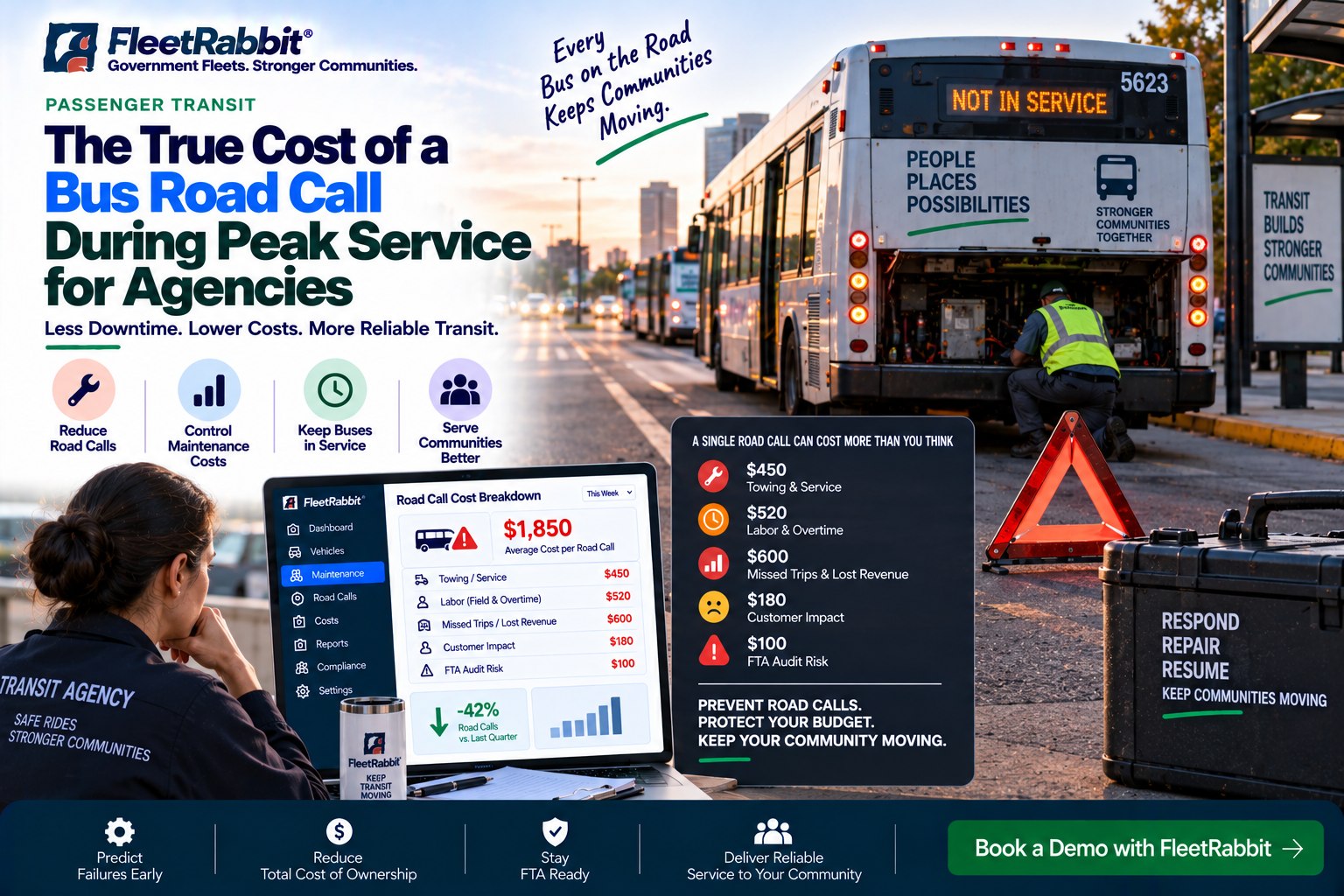
The True Cost of a Bus Road Call During Peak Service for Agencies
A single peak-hour mechanical failure costs between $1,850 and $4,200 across towing, dual operator wages, shop overtime, and passenger delay penalties. Intercept cooling, air brake, multiplexer, and ADA ramp failures before coaches leave the morning depot gate.
The Anatomy of an In-Service Road Call Cascade
A breakdown during rush hour triggers operational chaos that ripples across lines, transit centers, and maintenance shifts. See how you can prevent this sequence by choosing to sign up for our early warning engine.
The Mid-Route Stall (T+0m)
A high-stress subsystem fails under commuter load—such as an air compressor governor failure or coolant hose burst—leaving the bus stranded in an active urban lane with 40 passengers on board.
Passenger Evacuation & Relief (T+25m)
Dispatch scrambles a secondary reserve bus and standby operator to transfer riders. Delays cascade down the route schedule, causing missed transfers and frustrated commuter passengers.
Heavy Tow & Traffic Disruption (T+60m)
An authorized heavy-duty commercial wrecker arrives to rig the 32,000-pound transit bus. Towing through city traffic burns valuable shop hours and exposes the coach to bumper and body damage.
Emergency Shop Bottleneck (T+120m)
The towed coach arrives at the garage, displacing scheduled preventive maintenance (PM-A/B/C) work. Mechanics work overtime rates to diagnose and repair secondary component damage.
The Hidden Direct and Indirect Costs of Peak Transit Road Calls
Reactive repair programs disguise the true operational and financial drain of mid-route failures across municipal accounting ledgers. Learn how our software protects operating funds when you book a demo with our product specialists.
Cascading Labor Overtime and Relief Driver Inefficiencies
A stalled bus ties up the stranded operator who must remain with the asset until towed, while simultaneously requiring an overtime wage for a relief driver. Paying double wages to cover a single scheduled run inflates annual transit authority labor costs by hundreds of thousands of dollars.
Premature Fleet Depreciation and Secondary Asset Damage
Neglecting early diagnostic signals turns minor repairs into catastrophic failures. A $45 coolant level sensor defect escalates into blown head gaskets and cracked cylinder heads; a sticking air brake brake slack adjuster destroys drums and hubs, driving up long-term State of Good Repair (SGR) capital needs.
National Transit Database (NTD) Mechanical Failure Scrutiny
Transit authorities must report all major mechanical system failures and roadcalls on annual NTD filings. Elevated road call counts lower an agency's mean distance between failures (MDBF), triggering mandatory FTA oversight audits and jeopardizing federal capital grant allocations.
Bus Barn Basements and Subterranean Terminal Dead Zones
Morning pre-trip inspections and mechanic work order handoffs occur inside reinforced concrete maintenance pits, parking decks, or underground transit stations with zero cellular reception. Disconnected cloud-only apps drop critical defect logs, allowing compromised buses to roll into peak commuter traffic.
Built to Intercept Failures Before Morning Pull-Out
FleetRabbit connects engine telemetry, operator mobile eDVIRs, and shop inventory into a centralized failure interception radar. Discover how fast your team can deploy our system when you sign up today.
Real-Time CAN-Bus Degradation Tracking
Analyze high-frequency J1939 telemetry: monitor air compressor build-up pressure curves, coolant temperature slopes, and alternator ripple voltages to catch failing components before roadside stalls.
Automated Pull-Out Safety Lockout
When an operator or sensor flags a critical mechanical safety defect—such as an inoperable wheelchair boarding ramp or low brake line pressure—FleetRabbit blocks the coach from clearing morning dispatch.
Photo-Verified Mobile eDVIRs
Drivers complete mobile-guided pre-trip checkouts: cycling ADA ramps, verifying kneeling air suspension, inspecting air brake stroke adjusters, and capturing photo proof of fluid leaks before vehicle rollout.
Depot Pit Offline Mobile Syncing
Operators perform walkarounds and mechanics sign off repairs inside reinforced concrete maintenance bays with zero cellular connectivity; all timestamps and logs auto-sync securely once connectivity returns.
1-Click NTD S&S-40 Failure Dossiers
Export certified mechanical failure logs, roadcall histories, and mean-distance-between-failures (MDBF) performance records formatted for National Transit Database filings and FTA Triennial Reviews.
Real-Time Cost-Per-Roadcall Analytics
Track fully-burdened roadcall expense across towing, relief driver hours, mechanic shop time, and passenger delay metrics by bus model and powertrain to guide capital replacement investments.
Direct Mapping to Federal Transit and Safety Directives
FleetRabbit’s road call reduction architecture operates in strict alignment with federal transit directives, safety rules, and civil rights requirements.
Enforces statutory requirements for Safety Management Systems (SMS), safety risk mitigation, hazard identification, and verified maintenance inspection tracking across all rolling stock.
Maintains rolling asset condition scores, useful life benchmark (ULB) ratings, and objective TERM-scale ratings to ensure vehicles remain in a State of Good Repair before roadside failures occur.
Mandates continuous maintenance of accessibility features: daily functional cycling of wheelchair lifts, kneeling systems, public address systems, and passenger securement equipment.
Standardizes driver pre-trip/post-trip eDVIR walkarounds (§ 396.11), qualified mechanic repair signatures (§ 396.13), and 90-day minimum electronic maintenance record retention.
Transit Road Call Reduction Software Comparison
A feature-level comparison focused on failure interception, road call reduction, and FTA audit speed as of 2026. Review a custom cost evaluation when you book a demo with our team.
| Capability | FleetRabbit | Generic Transit CAD | Basic Telematics Portals | Paper Shop Whiteboards |
|---|---|---|---|---|
| Pricing (per asset/month) | $5/month | $30–$75/month | $15–$35/month | High emergency towing spend |
| Peak Road Call Reduction | Up to 52% verified | Marginal (cad only) | 0% (tracking only) | 0% (breakdown driven) |
| Predictive CAN-Bus Failure Interception | Native air, electrical & coolant solver | Post-breakdown alarm only | Basic low-battery ping | None (breakdown driven) |
| Automated Dispatch Safety Lockout | Instant pull-out block on defect | Manual supervisor check | Not supported | None (unverified dispatch) |
| Bus Barn Offline Mobile Syncing | Full store-and-forward | Network dependent | Data dropped | Paper only |
| Free Trial Access | 14 days, up to 3 assets | Sales demo only | Demo only | None |
| Contract Terms | Monthly or annual | 3 to 5-year lock-in | 3-year minimum | None |
5-Step Road Call Reduction Implementation Pathway
FleetRabbit embeds cleanly into your passenger transit operations, maintenance garages, and driver devices in under two weeks without route disruptions. Get started immediately when you sign up for a free pilot.
Fleet Roster & Historical Failure Audit
Import transit buses, articulated coaches, paratransit cutaways, lift serial numbers, and historical roadcall work orders via CSV or direct API integration.
Telemetry Stream & Failure Threshold Setup
Connect J1939 CAN-bus dongles to track early-warning thresholds for air compressor pressure recovery times, coolant temperature curves, and alternator voltages.
Pull-Out Lockout & ADA Checklist Configuration
Configure mobile eDVIR inspection templates and establish automated dispatch lockout rules that physically block coaches with safety defects from leaving the yard.
Operators & Shop Technicians Mobile Rollout
Equip transit operators and garage mechanics with the offline-first mobile app on standard smartphones or rugged tablets for rapid pre-trip walkarounds.
Reliability Command Go-Live
Activate live dispatch pull-out readiness scorecards, automated repair work order queues, and 1-click NTD State of Good Repair compliance reporting.
2-Week Deployment Plan & Milestones
Modernize your transit authority's fleet maintenance and eliminate costly peak-service breakdowns with zero disruption to daily service schedules. We can walk through this rollout when you book a demo today.
Week 1: Telematics Audit & System Integration
- Audit historical roadside breakdown logs, commercial towing invoices, and NTD failure forms
- Connect J1939 telematics dongles to verify real-time diagnostic trouble code (DTC) feeds
- Configure mobile pre-trip eDVIR walkaround checklists and photo-verified defect forms
- Assign user access permissions for Transit Supervisors, Shop Foremen, and Bus Operators
Week 2: Depot Rollout & Live Verification
- Distribute mobile app to operators and conduct 15-minute training on pre-trip walkarounds
- Validate store-and-forward offline syncing inside concrete maintenance pits and garages
- Simulate an air brake pressure defect to verify automated dispatch lockout gating and shop routing
- Launch live fleet reliability dashboard and automated NTD compliance reporting archives
Cut Your Agency's Bus Road Calls by Up to 52% in Less Than 30 Days
Intercept cooling, brake, and electrical failures before morning roll-out, protect passenger service schedules, and eliminate heavy-duty commercial towing fees at $5/asset/month with a 14-day free trial. Ready to evaluate your potential savings? You can book a demo with our transit consultants or sign up for immediate platform testing.
Real-World Public Transit Reliability Results
Operational improvements documented by regional public transportation authorities and municipal transit agencies. Review the full audit and performance report when you book a demo with our team.
52% Reduction in In-Service Road Calls Across 85 Buses
A regional public transportation authority operating 85 clean-diesel and hybrid transit coaches suffered from frequent peak-hour breakdowns caused by alternator ripple failures and cooling leaks. FleetRabbit deployed predictive telematics monitoring and mobile eDVIR walkarounds, slashing in-service road calls by 52% and saving $142,000 in towing and secondary overtime labor in year one.
$0.38 Operating Cost-Per-Mile Reduction
A city paratransit network managing 60 cutaways faced escalating maintenance invoices and rider missed-trip complaints due to unmonitored wheelchair lift and brake wear. FleetRabbit automated pre-trip ADA walkarounds and predictive brake wear tracking, extending component lifecycles by 28% and driving operating expenses down by $0.38 per vehicle revenue mile.
In passenger transit, having a forty-foot bus break down on an urban commuter corridor at 7:45 in the morning is an operational and financial disaster. You have forty passengers standing on a sidewalk missing their trains, your dispatcher is frantically routing a relief bus through rush-hour gridlock, you are paying eight hundred dollars for a heavy-duty wrecker, and both operators end up with three hours of overtime. Before FleetRabbit, our maintenance department was completely reactive. FleetRabbit transformed our posture. It flags dying batteries, air compressor recovery delays, and sticking wheelchair lifts days before they fail on the street. It locks out compromised buses before morning roll-out and schedules repairs for the evening shift. It cut our peak road calls by more than half in three months, protected our federal formula grants, and gave our transit board complete confidence in our operations.
Frequently Asked Questions
Cut Your Agency's Peak Bus Road Calls in Less Than 2 Weeks
Eliminate roadside towing invoices, prevent in-service route cancellations, and protect FTA grant compliance at $5/asset/month with a 14-day free trial.