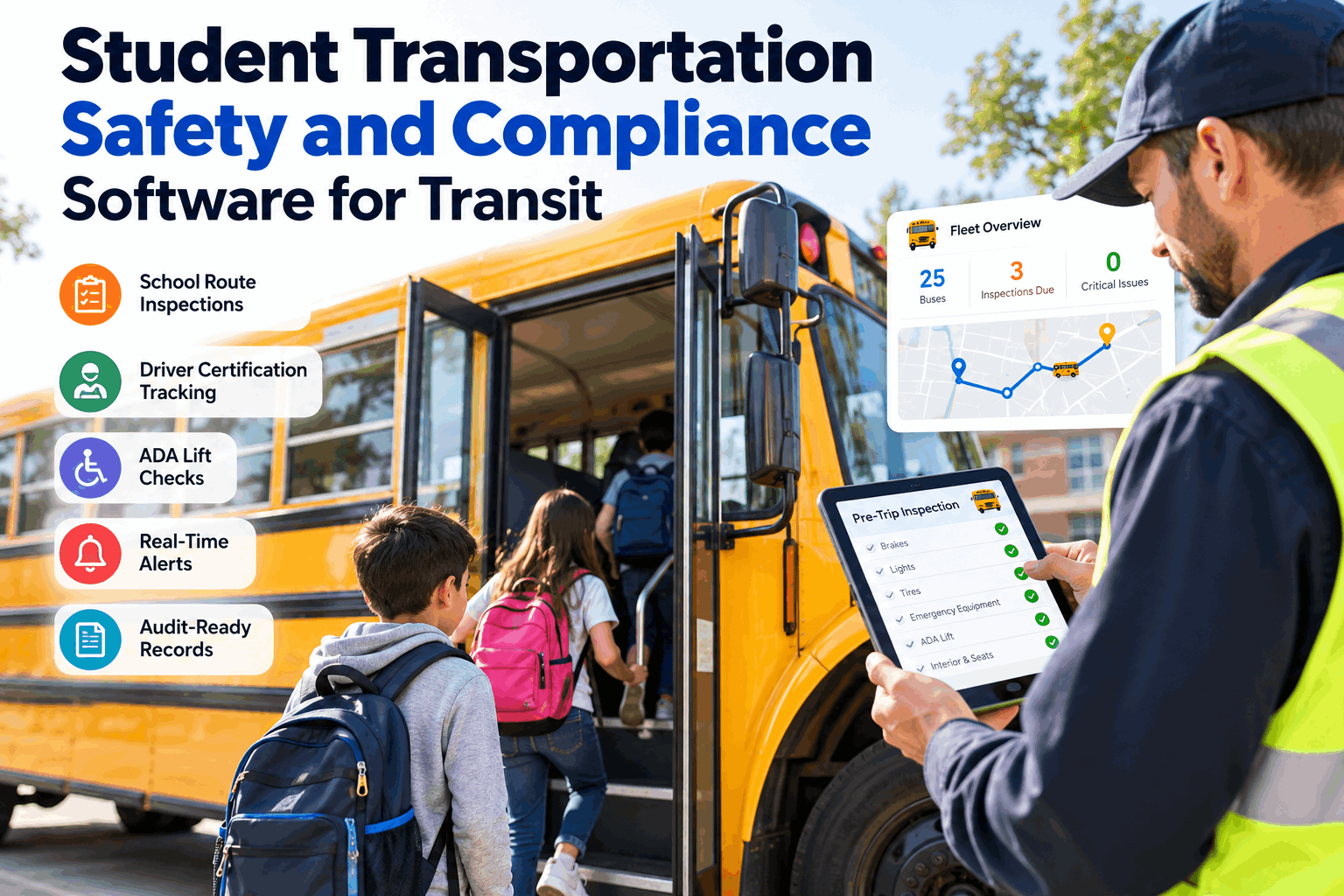
Student Transportation Safety and Compliance Software for Transit
Public school district transportation directors, regional student transit authorities, and contracted school bus fleet superintendents operate under the highest duty of care in commercial passenger transportation: safeguarding student passengers every morning and afternoon route. Operating yellow Type A, C, and D school buses or contracted municipal student-transit shuttles involves strict legal and mechanical compliance that standard city transit never encounters: mandatory electronic child-check sleeping student verification, alternating 8-way warning light and stop-arm actuation cycles, emergency roof hatch and rear door interlocks, driver qualification file (DQF) audits, and hydraulic or electric ADA wheelchair lifts for special-needs routes. When student transportation departments attempt to track pre-trip inspections, state DOT certifications, and preventive maintenance using paper clipboards, dry-erase route boards, or fragmented spreadsheets, life-critical safety vulnerabilities emerge: crossing control gates stick open, driver CDL medical cards expire unnoticed, and vehicles drift beyond the strict 10% preventive maintenance variance window mandated by state departments of education and the Federal Transit Administration (FTA). Missing a mechanical defect or suffering a roadside breakdown with children aboard sparks immense community outrage, immediate state safety oversight citations, and severe legal liability. Fleet Rabbit delivers specialized student transportation safety and compliance software engineered specifically for pupil transit fleets. Standardize mobile pre-trip walkarounds, automate sleeping child verification audits, monitor driver credential expirations, enforce tiered PM-A/B/C schedules, and generate audit-proof state inspection records in a single cloud platform. Book a Demo to see our student transit compliance platform live.
Pupil Transportation Safety MandateFMCSA & State DOT School Bus ComplianceChild Check & ADA Lift Verification
Student Transportation Safety and Compliance Software for Transit
An operational engineering, driver credentialing, and pupil safety blueprint: enforce digital pre-trip walkarounds, automate electronic sleeping child check verification, track driver DQF medical milestones, and maintain 100% state inspection pass rates.
Mandatory digital tail-to-front walkarounds ensure no student is left unattended after route completion.
0
Expired Driver Citations
Automated DQF tracking monitors CDL medical certifications, background checks, and state S-endorsements.
99.9%
Route Pull-Out On-Time
Streamlined mobile pre-trip workflows eliminate morning depot gate logjams and late school bell arrivals.
$5
Per Student Transit Asset / Mo
Transparent public sector software pricing with zero locked long-term enterprise RFP markups.
Safeguard Student Passengers and Ensure 100% State DOT Compliance
Eliminate paper inspection clipboards, automate sleeping child verification audits, track driver qualifications, and maintain audit-proof safety records for just $5/asset/month.
The Acute Operational Liabilities of Student Transportation Fleets
Student transportation carries unique regulatory and legal exposures that general public transit fleets never encounter. Transporting dozens of young passengers on tight school-bell schedules requires flawless execution across complex mechanical, electrical, and driver qualification systems. When student transit operations rely on paper pre-trip slips, loose driver files, or memory-based maintenance, critical safety gaps emerge. Sign up to automate student transportation safety across your district fleet.
Liability 01
Sleeping Student Left Behind & Child-Check Bypass
Leaving a sleeping child unattended on a parked school bus is a catastrophic safety failure that triggers instant media coverage, state license revocation, and severe civil lawsuits. Drivers under pressure sometimes bypass interior post-trip walkarounds or disable mechanical push-button child-reminder systems without checking beneath high-back passenger seats. Digital audit trails prove every seat row was physically inspected before yard shutdown. Book a demo to inspect our digital child-check verification workflows.
Liability 02
Driver Credential Expiration & DQF Audit Fines
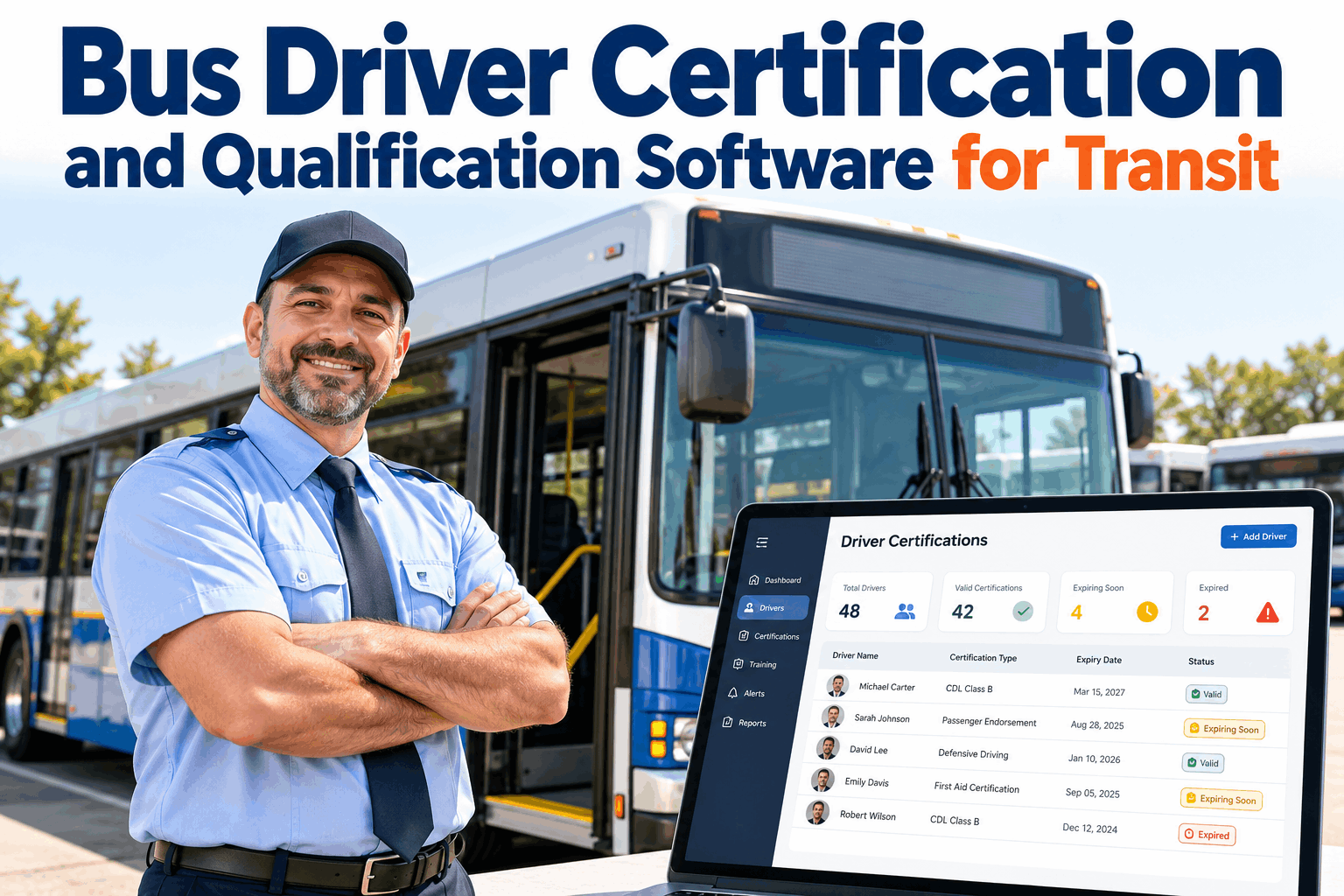
School bus drivers must maintain up-to-date Commercial Driver's Licenses (CDL) with Passenger (P) and School Bus (S) endorsements, DOT medical examiner certificates, state criminal clearances, and mandatory random drug-and-alcohol test logs. Lacking automated credential tracking allows drivers with expired medical cards to operate active student routes, leading to immediate state safety oversight fines. Sign up to automate driver qualification file tracking.
Liability 03
8-Way Warning Light & Stop-Arm Mechanical Failure
The alternating amber and red 8-way warning system and pneumatic or electric stop-arm paddles are the primary line of defense against oncoming motorists during roadside student loading. Burned-out strobe bulbs, vacuum line leaks, or broken crossing control gate hinges endanger children crossing traffic lanes. Drivers who pencil-whip paper forms fail to catch intermittent wiring faults before morning school runs.
Liability 04
The Strict 10% PM Variance Window & State DOT Audits
State departments of education and state police commercial vehicle divisions enforce strict preventive maintenance intervals, requiring inspections within a tight 10% mileage variance of manufacturer specifications (e.g., a 3,000-mile inspection must occur between 2,700 and 3,300 miles). Vehicles exceeding this window fail annual state safety certifications, stripping the district of bus operating permits. Book a demo to inspect our automated 10% PM compliance engine.
The Tiered School Bus PM Matrix: PM-A, PM-B, and PM-C Schedules
To comply with state school transportation standards and FTA Transit Asset Management (TAM) requirements under 49 CFR Part 625, student transit fleets schedule vehicle servicing around standardized preventative maintenance tiers rather than reactive breakdown repairs. Sign up to configure automated student transportation PM intervals.
Preventive Maintenance Tier
Mileage / Operating Benchmark
Inspection, Safety Device & Chassis Scope
Compliance & Pupil Safety Objective
PM-A: Safety & Lubrication
Every 3,000 Miles / 150 Hours
Full chassis grease lubrication; air brake pushrod stroke measurement; stop-arm and crossing gate extension test; 8-way flasher timing audit; emergency door buzzer check; ADA wheelchair lift cycle and interlock test; tire tread depth audit.
Ensure vehicle passes daily pre-trip standards, prevent brake drum heat glazing, maintain active student crossing defense, and guarantee ADA accessibility.
PM-B: Powertrain & Electrical
Every 6,000 Miles / 300 Hours
PM-A scope PLUS: synthetic engine oil and filter flush; primary and secondary fuel filter swap; high-output alternator charging output test; battery conductance and terminal cleaning; transmission fluid and retarder check; heater booster pump and defroster duct test.
Maintain heavy stop-and-go linehaul reliability, prevent electrical brownouts during severe winter heater operations, and protect engine warranties.
PM-C: Heavy Structural & Overhaul
Every 12,000 Miles / 12 Months
PM-A & PM-B scope PLUS: complete chassis suspension torque audit; steering drag link and kingpin wear check; transmission filter replacement; cooling system flush; body outrigger weld ultrasonic test; annual state police DOT certification audit.
Comprehensive structural integrity certification, roll-stability verification, State of Good Repair (SGR) compliance, and annual state operating permit renewal.
The 4 Core Pillars of Student Transit Safety Software
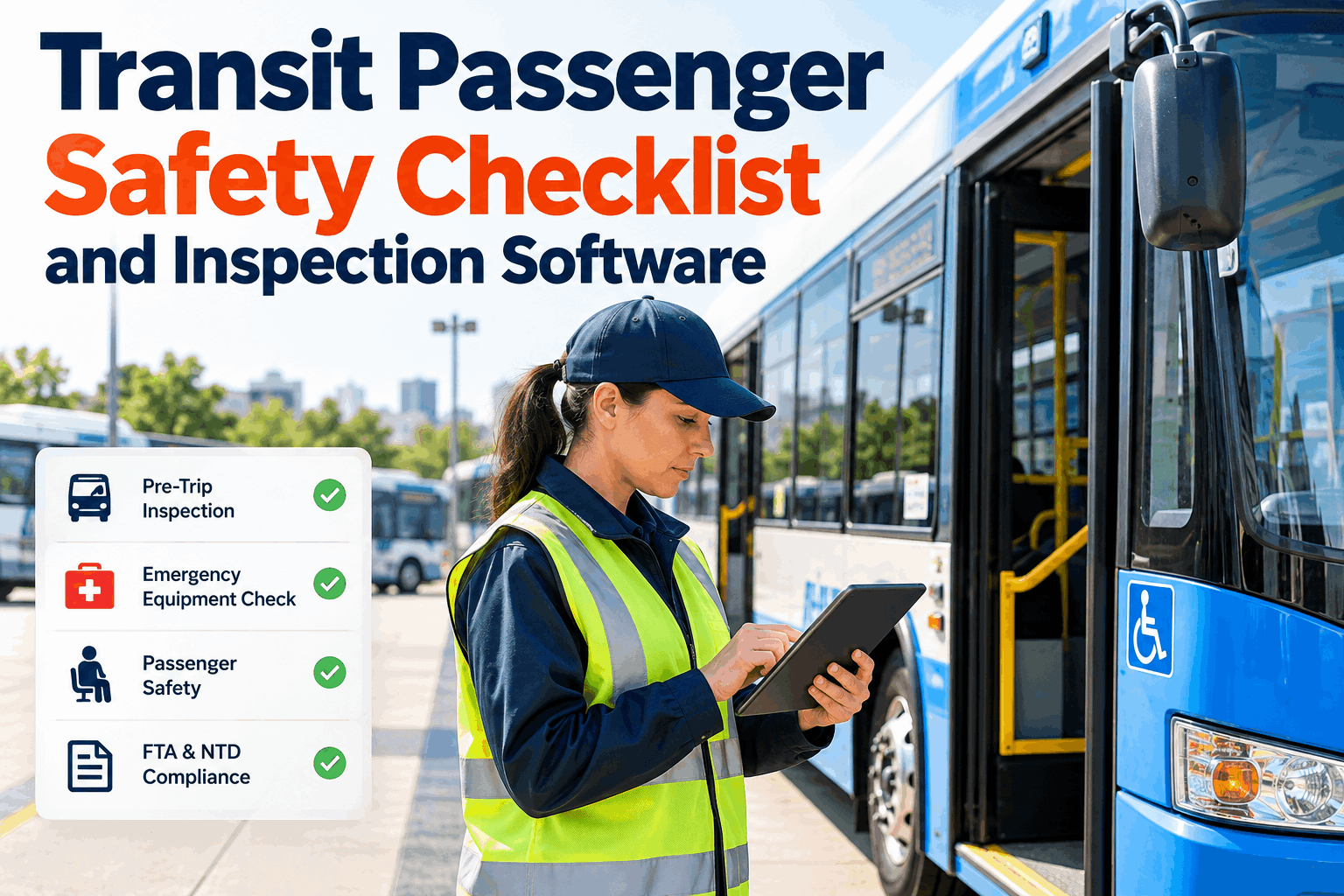
Equip bus drivers with a guided mobile DVIR application on agency smartphones or tablets. The workflow requires drivers to complete a front-to-back pre-trip walkaround, verifying emergency exits, 8-way warning lights, and wheelchair securements. At route conclusion, the app enforces a physical tail-to-front walkaround to confirm all seats are clear of sleeping children.
Pillar 02
Driver Qualification File (DQF) & Medical Alert Engine
Centralize all driver credentials in an automated compliance ledger. The system monitors CDL renewals, DOT physical expiration dates, CPR/First-Aid certifications, annual driving record reviews (MVR), and background clearance milestones, alerting safety directors 60, 30, and 15 days before any credential lapses. Sign up to automate driver credential tracking across your district.
Pillar 03
Automated J1939 CAN-Bus Odometer & 10% PM Sync
Capture verified odometer and engine runtime data directly through J1939 telematics links. The software automatically tracks approaching PM-A, PM-B, and PM-C service thresholds, alerting garage supervisors as vehicles enter the mandatory 10% window to ensure total compliance with state pupil transportation rules.
Pillar 04
Critical Defect Red-Tag Dispatch Lockout
When an operator reports a safety-critical defect during pre-trip inspection—such as an inoperable stop-arm, defective emergency door buzzer, or low air brake pressure—the system red-tags the vehicle instantly. The bus is locked from route assignment while an emergency work order routes to the garage with attached defect photos. Book a demo to see our digital lock-out controls in action.
The Step-by-Step Morning Pull-Out & Route Safety Pipeline
Driver scans their ID on the dispatch tablet; the system confirms valid CDL endorsements, active DOT medical clearance, and negative drug pool status before issuing keys.
Stage 02
Exterior & Signal Walkaround
Driver completes the guided digital walkaround, testing 8-way warning flashers, stop-arm paddles, crossing control gates, tires, and under-hood fluid levels.
After finishing the run, the driver walks from the rear of the bus forward, checking under every seat for sleeping students, and submits a digital child-clear audit.
Platform Comparison: Manual Clipboards vs. Fleet Rabbit Platform
School District Case Study: Metro Valley Regional School District
Learn how a regional public school district operating 62 yellow school buses and special-needs cutaways modernized their pupil safety compliance and passed annual state police inspections with zero defects. Book a demo to see how pupil transit fleets achieve 100% compliance.
School District Case Study
0
State Police Inspection Violations
100%
On-Time Child-Check Audits
$68,000
Annual Maintenance & Admin Savings
Regional School District Eliminates Safety Deficiencies Across 62 School Buses
Operating 62 Type C conventional and Type A special-education buses transporting over 4,800 students daily across twelve schools, Metro Valley Regional School District faced severe compliance challenges. Drivers completed pre-trip inspections inconsistently on paper clipboards, resulting in unrecorded air brake pushrod drift and defective emergency window latches. During an annual state police commercial vehicle safety audit, inspectors placed three buses immediately out of service due to inoperable stop-arm flashers and cited the district for two substitute drivers operating with expired DOT medical cards.
By deploying Fleet Rabbit at $5/asset/month, the district equipped drivers with mobile inspection tablets enforcing step-by-step walkarounds and tail-to-front post-route child-check verifications. Driver qualification profiles tracked CDL medical cards automatically, blocking drivers with pending expirations from receiving morning route keys. Connected J1939 telematics scheduled PM-A and PM-B services precisely within the state's mandatory 10% mileage window. Over 12 months, the district passed its subsequent state police fleet inspection with a perfect 100% first-time pass rate, achieved zero child-check violations, and saved $68,000 in prevented emergency repairs, eliminated fines, and reduced administrative labor.
Frequently Asked Questions
How does the software verify that drivers check for sleeping students?
Fleet Rabbit enforces a mandatory post-trip child-check workflow on the driver's mobile device at the conclusion of every route. The application guides the driver through a physical walkaround from the front of the bus to the extreme rear, requiring confirmation that every seat, floor row, and overhead rack has been inspected. The post-trip report captures a cryptographic timestamp and GPS coordinate at the back of the bus, proving the driver physically walked the aisle before the vehicle can be marked clear for the day.
What driver records are managed under the Driver Qualification File (DQF) module?
The DQF module maintains a complete digital record of commercial driver qualifications required under FMCSA and state pupil transportation regulations. This includes CDL license copies with Passenger (P) and School Bus (S) endorsements, DOT medical examiner certificates, annual Motor Vehicle Record (MVR) reviews, state background checks, drug and alcohol testing consortium records, and First Aid/CPR training certifications. Automated alerts notify administrators well in advance of upcoming expirations.
What specific checks does the software require for ADA wheelchair lifts?
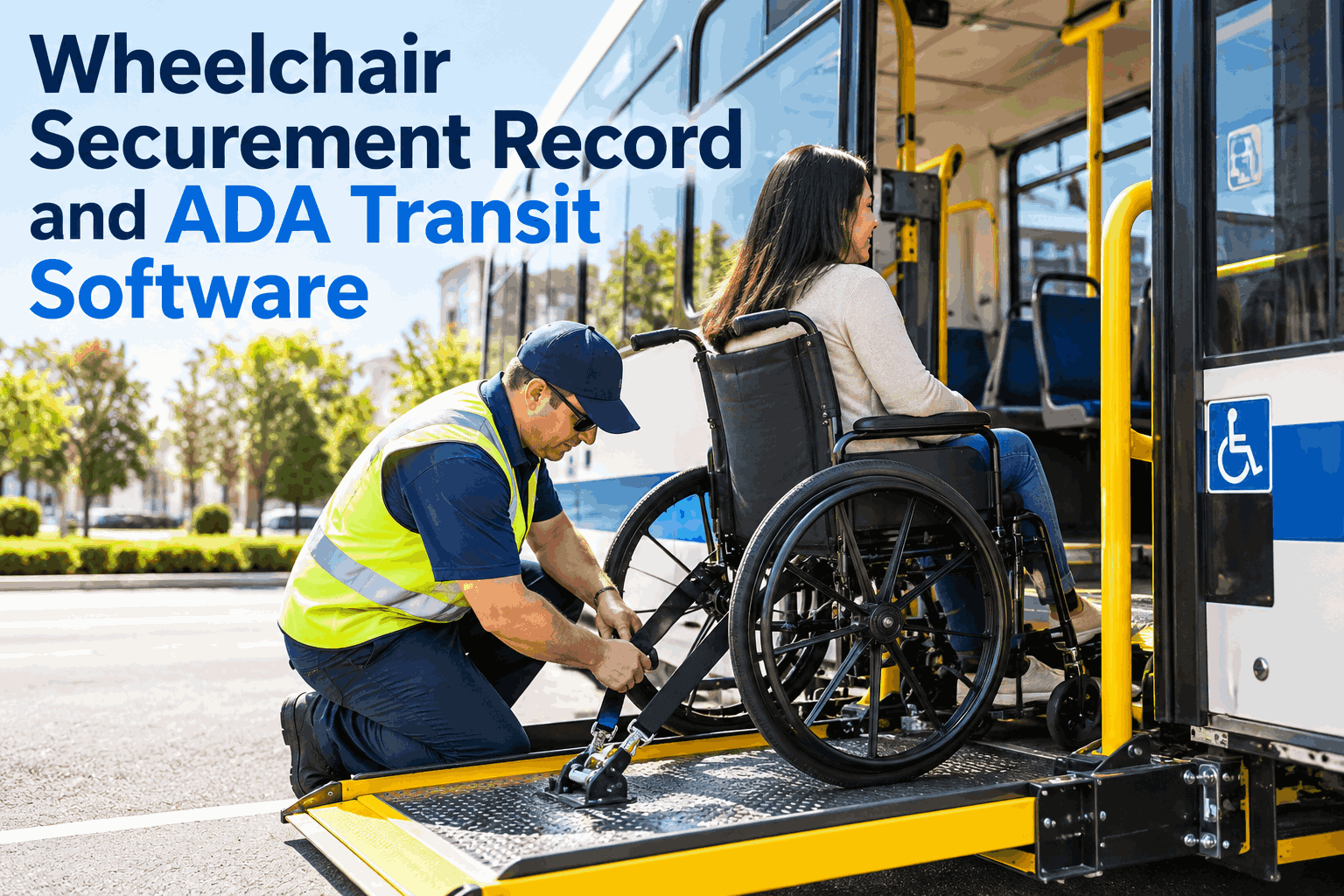
Fleet Rabbit requires operators of special-needs buses to execute a complete operational lift cycle during the pre-trip inspection: deploying the lift platform to ground level, verifying that outer roll-stop barriers lock securely, testing handrail and remote pendant controls, confirming that the vehicle transmission interlock prevents driving while the lift door is open, and checking that four-point wheelchair tie-down retractors and lap/shoulder belts are present and undamaged.
Can drivers complete pre-trip inspections in rural school bus parking depots without cellular service?
Yes. Fleet Rabbit features an offline-first mobile architecture. School bus drivers can perform complete pre-trip walkarounds, take defect photos, and complete post-trip child checks in remote rural parking lots, gravel yards, or metal-sided bus garages without cellular reception. All inspection data caches securely on the mobile device and automatically synchronizes to central transportation dispatch the moment cellular or depot Wi-Fi connectivity returns.
What are the pricing details and contract terms for Fleet Rabbit's software?
Fleet Rabbit is priced at a transparent flat rate of $5 per active student transit vehicle per month billed annually. This gives complete access to school bus pre-trip checklists, post-route child-check audits, driver DQF compliance tracking, J1939 telematics integration, 10% PM window monitoring, and audit-ready state inspection reporting. We provide a 14-day free live trial on up to 3 vehicles with zero setup fees or long-term locked enterprise contracts.
Ready to Automate Student Transportation Safety Across Your Fleet?
Enforce daily child-check walkarounds, automate driver DQF compliance, and ensure 100% state DOT inspection pass rates for just $5/asset/month.