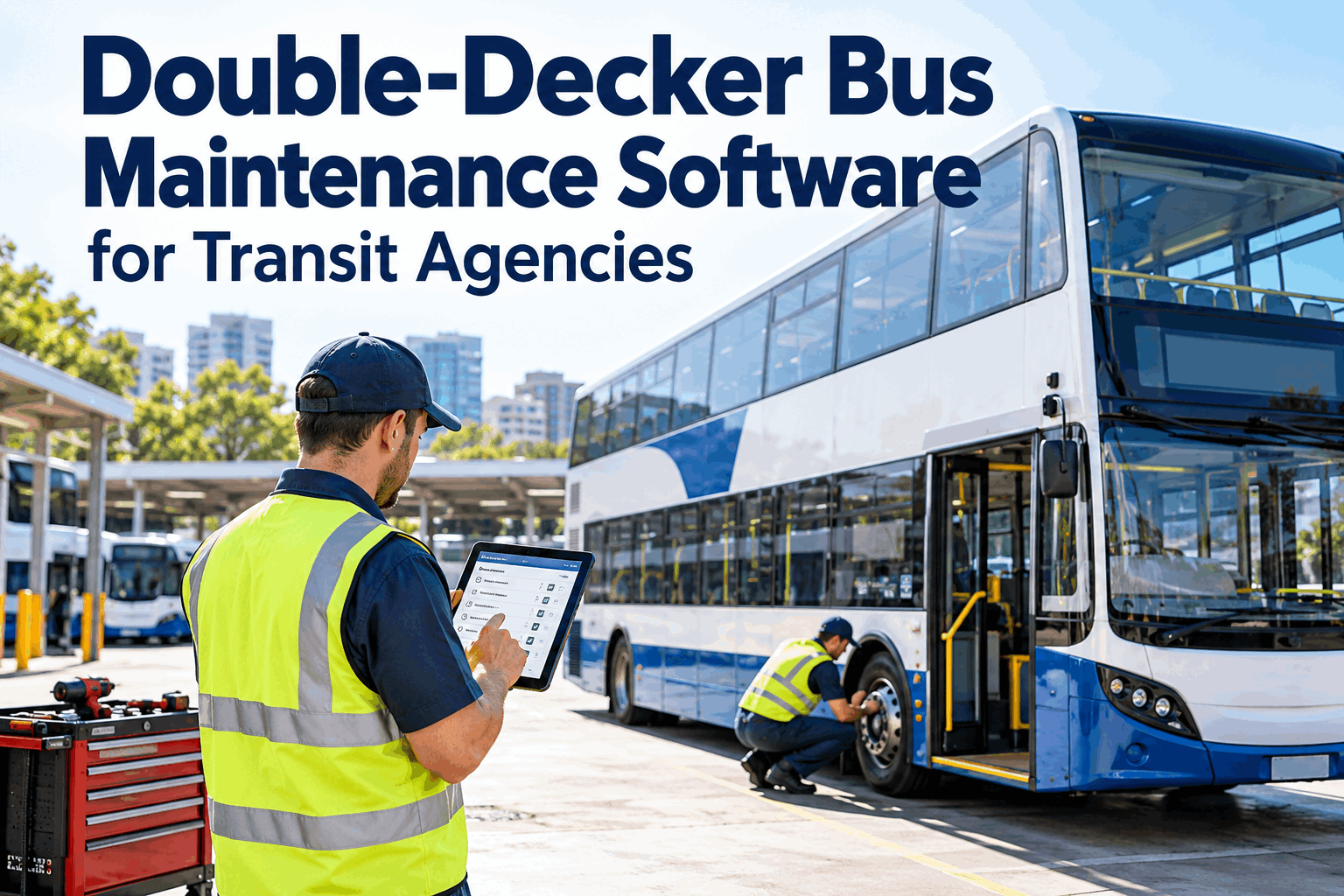
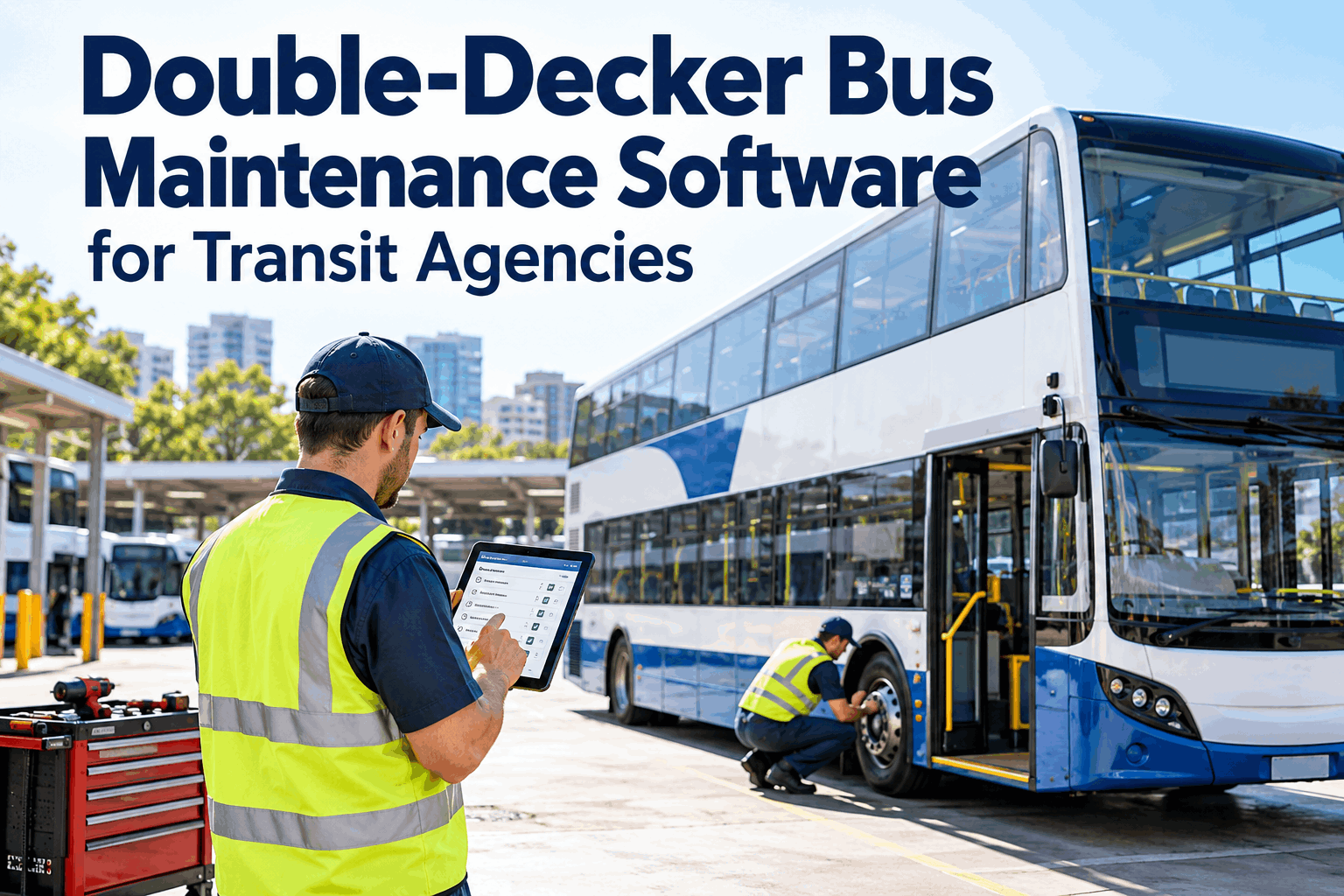
Double-Decker Bus Maintenance Software for Transit Agencies
Metropolitan transit authority directors, regional commuter rail connectors, and high-density urban transit superintendents face exceptional engineering scrutiny when managing double-decker passenger buses. Operating a dual-level passenger vehicle carrying up to 100 seated riders across express commuter corridors introduces mechanical physics and passenger safety liabilities that standard 40-foot low-floor transit buses never encounter: severe high-center-of-gravity lateral roll, multi-deck emergency egress management, upper-deck stairway safety compliance, dual independent HVAC environmental capacity, and high-load tri-axle air suspension calibration. When transit agencies attempt to manage double-decker morning pull-out clearances using paper clipboards or generic bus inspection sheets, critical safety items are overlooked: upper-level emergency roof escape hatches go unverified, electronic surveillance stair mirrors fail unnoticed, and vehicles drift beyond the strict 10% preventive maintenance variance window mandated by the Federal Transit Administration (FTA) under 49 CFR Part 625 Transit Asset Management (TAM). Missing a mechanical defect or suffering an in-service roadside suspension tilt strands dozens of commuters, invites severe tort liability, and jeopardizes federal formula funding reported through the National Transit Database (NTD). Fleet Rabbit delivers specialized double-decker bus maintenance and pull-out software engineered for complex multi-level passenger operations. Standardize multi-deck morning pull-out inspections, automate tiered PM-A/B/C schedules, verify ADA wheelchair lift cycles, and generate audit-defensible NTD records in one unified platform. Book a Demo to see our double-decker transit bus maintenance software in action.
High-Capacity Mass Transit GovernanceFTA 49 CFR Part 625 (TAM) & NTD ComplianceMulti-Deck Safety & Egress Verification
Double-Decker Bus Maintenance Software for Transit Agencies
An engineering, passenger safety, and federal compliance operational manual: enforce digital multi-deck morning yard pull-out inspections, monitor tri-axle electronic leveling systems, streamline PM-A/B/C cycles within strict FTA 10% windows, and safeguard urban commuter capacity.
The Unique Mechanical and Safety Liabilities of Double-Decker Transit
Double-decker buses maximize passenger throughput across crowded urban corridors without requiring the street real-estate of 60-foot articulated buses. However, their physical geometry creates distinct operational challenges. Managing multi-level coaches with generic single-deck checklists or paper logs exposes transit agencies to severe safety and financial hazards. Sign up to automate double-decker bus maintenance across your fleet.
Liability 01
High Center of Gravity & ECAS Air Suspension Imbalance
With sixty seated passengers on the upper deck, double-decker coaches have a high center of gravity. They rely on Electronically Controlled Air Suspension (ECAS) and tri-axle load distribution to prevent roll. Worn leveling valves or slow air line leaks cause body sway during highway cornering, triggering emergency roadside service calls. Book a demo to inspect our suspension and chassis diagnostic tracking.
Liability 02
Upper-Deck Passenger Egress and Blind Spot Neglect
Unlike standard buses where drivers have direct sightlines to every seat, double-decker operators depend on convex mirrors and staircase CCTV monitors. In an emergency, passengers rely on upper roof escape hatches and push-out windows. Drivers skipping upper-deck checks during rushed morning pull-outs leave transit agencies defenseless during passenger injury lawsuits.
Liability 03
The Strict FTA 10% PM-A/B/C Variance Window Trap
Federal Transit Administration oversight requires all preventative maintenance to occur within a strict 10% mileage variance of the manufacturer's benchmark (e.g., a 6,000-mile inspection must occur between 5,400 and 6,600 miles). On high-mileage commuter routes, double-deckers log thousands of miles weekly. Manual paper log entries often miss this window, resulting in immediate Triennial Review citations. Sign up to automate FTA 10% PM variance window tracking.
Liability 04
Dual-Circuit HVAC Thermal Inefficiency on Upper Decks
Upper passenger decks act as thermal greenhouses in summer heat. Double-decker buses utilize dual-compressor or auxiliary rear-mounted cooling systems. If the upper evaporator coil clogs or an auxiliary condenser fan fails, upper deck temperatures surge past 90°F, forcing drivers to take buses out of service mid-route.
The Tiered Transit Bus PM Matrix: PM-A, PM-B, and PM-C Schedules
Full chassis grease lube; air brake stroke measurement and slack adjuster travel check; ECAS suspension leveling valve verification; passenger door interlock test; ADA ramp deployment cycle; upper-deck CCTV check.
Ensure vehicle passes daily pre-trip standards, prevent uneven brake lining wear, and verify ADA accessibility.
PM-B: Powertrain & Electrical
Every 18,000 Miles / 900 Hours
PM-A scope PLUS: synthetic engine oil and filter flush; primary and secondary fuel filter replacement; dual-alternator output and battery conductance test; transmission fluid and retarder check; steering tag-axle alignment.
Maintain heavy commuter linehaul reliability, prevent electrical brownouts under full HVAC load, and protect engine warranties.
PM-C: Heavy Structural & Overhaul
Every 36,000 Miles / 1,800 Hours
PM-A & PM-B scope PLUS: transmission filter and fluid flush; differential gear lube replacement; cooling system flush; air dryer desiccant cartridge swap; upper-deck structural roof frame and staircase weld inspection.
Comprehensive structural integrity certification, roll-stability verification, and State of Good Repair (SGR) compliance.
The 4 Pillars of Double-Decker Transit Maintenance Software
Fleet Rabbit unites on-board vehicle diagnostic telemetry, multi-deck mobile inspection tools, and garage repair queues into an automated, paperless transit management platform. Sign up to connect your transit bus diagnostic telemetry.
Pillar 01
Multi-Deck Mobile Pull-Out & Egress Inspection App
Equip transit operators with an intuitive mobile DVIR application on agency tablets. The workflow requires drivers to physically walk both decks: verifying upper-deck escape hatches, testing staircase security mirrors, cycling ADA wheelchair ramps, and photographing interior clean status before morning departure.
Pillar 02
Automated FTA 10% PM-A/B/C Window Synchronization
Extract verified odometer and engine runtime data directly through J1939 CAN-bus telemetry. The software automatically tracks approaching PM-A, PM-B, and PM-C service thresholds, alerting garage supervisors as vehicles enter the mandatory 10% window to ensure complete federal compliance. Book a demo to inspect our automated 10% PM compliance engine.
Pillar 03
Tri-Axle ECAS Suspension & Air Brake Diagnostic Triage
Monitor real-time vehicle ECU data to detect pending brake stroke sensor faults, air pressure drop-offs, and tag-axle steering misalignments. The system isolates suspension drift and body tilt anomalies, auto-generating prioritized shop work orders before buses leave the garage.
Pillar 04
Automated NTD Revenue-Mile & TAM Asset State of Good Repair
Maintain digital maintenance records, actual vehicle revenue miles, deadhead miles, and asset condition scores under 49 CFR Part 625. Generate 1-click compliance dossiers formatted specifically for annual Federal Transit Administration National Transit Database (NTD) reporting audits. Sign up to automate NTD transit asset reporting.
The Closed-Loop Morning Pull-Out & Shop Triage Workflow
Driver executes the guided multi-level inspection on a ruggedized tablet, cycling the ADA ramp and verifying upper-deck escape hatches before yard departure.
Step 02
Gatekeeper Defect Interception
If an ADA ramp fails to stow or an ECAS suspension leveling valve faults, the system flags a safety-critical defect and locks the coach from dispatch clearance.
Maintenance technicians receive a priority work order on shop tablets with attached photos, ECU fault codes, and required replacement parts pre-staged in the service bay.
Platform Comparison: Manual Logs vs. Fleet Rabbit Platform
Transit Authority Case Study: Metro Commuter Transit District
Learn how a regional commuter transit authority operating 36 Alexander Dennis and MCI double-decker buses eliminated morning pull-out bottlenecks and passed federal safety reviews with zero deficiencies. Sign up to achieve similar transit operational reliability.
Transit Case Study
99.7%
On-Time Morning Pull-Out Rate
0
FTA Triennial Audit Findings
$86,000
Annual Maintenance & Tow Savings
Metropolitan Transit Authority Eliminates Highway Stalls Across 36 Double-Decker Coaches
Operating 36 high-capacity double-decker commuter buses carrying over 14,000 daily riders along express highway corridors into a major metropolitan downtown, Metro Commuter Transit District struggled with complex fleet maintenance. During a state Department of Transportation spot inspection, inspectors cited the agency for two coaches operating with inoperable upper-deck emergency roof escape latches. Furthermore, an FTA Triennial Review revealed five buses had exceeded their mandatory 10% PM-B service window due to manual paper log entry lag, putting federal formula grant funding at risk.
By implementing Fleet Rabbit at $5/asset/month, the transit authority equipped operators with mobile tablets running multi-deck pre-trip walkarounds that required photo-verified checks of upper-deck emergency exits, stairway mirrors, and ADA wheelchair ramps. Live J1939 telematics pulled true vehicle odometer readings directly from engine control units, automatically scheduling PM-A, PM-B, and PM-C services precisely within the 10% FTA window. Over 12 months, on-time morning gate pull-out compliance rose to 99.7%, in-service road failures dropped to zero, and the agency passed its subsequent FTA Triennial Review with a clean audit record, while saving $86,000 in eliminated emergency towing, reduced technician overtime, and streamlined NTD reporting.
Frequently Asked Questions
What is the "10% rule" enforced during FTA Triennial Reviews?
Under Federal Transit Administration (FTA) oversight, transit agencies receiving federal grant funds must perform scheduled preventive maintenance inspections within a strict 10% variance window of the manufacturer's established benchmark. For example, if a double-decker bus requires PM-A servicing every 6,000 miles, the inspection must occur between 5,400 and 6,600 miles. At least 80% of all maintenance records must demonstrate compliance within this window to avoid an audit deficiency finding during federal Triennial Reviews.
What specific checks does the software require for upper-deck passenger safety?
Fleet Rabbit requires the operator to execute a physical upper-deck inspection: verifying that both emergency roof escape hatches open and unlatch smoothly, testing that the stairway CCTV surveillance monitor and convex driver mirror provide unobstructed views, checking upper-deck emergency push-out window latches, and confirming that the upper-deck HVAC climate sensor maintains safe passenger temperatures.
How does Fleet Rabbit automate National Transit Database (NTD) mileage reporting?
Under FTA formula grant programs, transit agencies must accurately report total actual vehicle miles, vehicle revenue miles, and deadhead miles, while documenting asset condition under Transit Asset Management (TAM) guidelines. Fleet Rabbit connects directly to on-board vehicle diagnostic ports to track odometer miles continuously, automatically segmenting revenue and deadhead transit service and compiling audit-ready NTD annual report exports with a single click.
Can operators complete morning pull-out inspections without cellular connectivity?
Yes. Fleet Rabbit features an offline-first mobile architecture. Drivers can perform complete multi-deck pre-trip walkarounds, take high-resolution defect photos, and verify safety hardware inside metal-clad bus depots, concrete parking structures, or rural staging yards without internet access. All data caches securely on the mobile device and automatically syncs to central dispatch the moment cellular or Wi-Fi connectivity returns.
What are the pricing details and contract terms for Fleet Rabbit's transit software?
Fleet Rabbit is priced at a transparent flat rate of $5 per active transit vehicle per month billed annually. This gives complete access to double-decker pre-trip inspection checklists, J1939 telematics integration, FTA 10% PM-A/B/C window tracking, automated NTD mileage reporting, and audit-ready compliance dossiers. We provide a 14-day free live trial on up to 3 vehicles with zero setup fees or long-term locked enterprise contracts.
Ready to Automate Double-Decker Maintenance Across Your Transit Fleet?
Enforce multi-deck passenger safety, automate FTA 10% PM-A/B/C compliance, and streamline NTD reporting for just $5/asset/month.
Double-Decker Bus Maintenance Software for Transit Agencies
Metropolitan transit authority directors, regional commuter rail connectors, and high-density urban transit superintendents face exceptional engineering scrutiny when managing double-decker passenger buses. Operating a dual-level passenger vehicle carrying up to 100 seated riders across express commuter corridors introduces mechanical physics and passenger safety liabilities that standard 40-foot low-floor transit buses never encounter: severe high-center-of-gravity lateral roll, multi-deck emergency egress management, upper-deck stairway safety compliance, dual independent HVAC environmental capacity, and high-load tri-axle air suspension calibration. When transit agencies attempt to manage double-decker morning pull-out clearances using paper clipboards or generic bus inspection sheets, critical safety items are overlooked: upper-level emergency roof escape hatches go unverified, electronic surveillance stair mirrors fail unnoticed, and vehicles drift beyond the strict 10% preventive maintenance variance window mandated by the Federal Transit Administration (FTA) under 49 CFR Part 625 Transit Asset Management (TAM). Missing a mechanical defect or suffering an in-service roadside suspension tilt strands dozens of commuters, invites severe tort liability, and jeopardizes federal formula funding reported through the National Transit Database (NTD). Fleet Rabbit delivers specialized double-decker bus maintenance and pull-out software engineered for complex multi-level passenger operations. Standardize multi-deck morning pull-out inspections, automate tiered PM-A/B/C schedules, verify ADA wheelchair lift cycles, and generate audit-defensible NTD records in one unified platform. Book a Demo to see our double-decker transit bus maintenance software in action.
High-Capacity Mass Transit GovernanceFTA 49 CFR Part 625 (TAM) & NTD ComplianceMulti-Deck Safety & Egress Verification
Double-Decker Bus Maintenance Software for Transit Agencies
An engineering, passenger safety, and federal compliance operational manual: enforce digital multi-deck morning yard pull-out inspections, monitor tri-axle electronic leveling systems, streamline PM-A/B/C cycles within strict FTA 10% windows, and safeguard urban commuter capacity.
The Unique Mechanical and Safety Liabilities of Double-Decker Transit
Double-decker buses maximize passenger throughput across crowded urban corridors without requiring the street real-estate of 60-foot articulated buses. However, their physical geometry creates distinct operational challenges. Managing multi-level coaches with generic single-deck checklists or paper logs exposes transit agencies to severe safety and financial hazards. Sign up to automate double-decker bus maintenance across your fleet.
Liability 01
High Center of Gravity & ECAS Air Suspension Imbalance
With sixty seated passengers on the upper deck, double-decker coaches have a high center of gravity. They rely on Electronically Controlled Air Suspension (ECAS) and tri-axle load distribution to prevent roll. Worn leveling valves or slow air line leaks cause body sway during highway cornering, triggering emergency roadside service calls. Book a demo to inspect our suspension and chassis diagnostic tracking.
Liability 02
Upper-Deck Passenger Egress and Blind Spot Neglect
Unlike standard buses where drivers have direct sightlines to every seat, double-decker operators depend on convex mirrors and staircase CCTV monitors. In an emergency, passengers rely on upper roof escape hatches and push-out windows. Drivers skipping upper-deck checks during rushed morning pull-outs leave transit agencies defenseless during passenger injury lawsuits.
Liability 03
The Strict FTA 10% PM-A/B/C Variance Window Trap
Federal Transit Administration oversight requires all preventative maintenance to occur within a strict 10% mileage variance of the manufacturer's benchmark (e.g., a 6,000-mile inspection must occur between 5,400 and 6,600 miles). On high-mileage commuter routes, double-deckers log thousands of miles weekly. Manual paper log entries often miss this window, resulting in immediate Triennial Review citations. Sign up to automate FTA 10% PM variance window tracking.
Liability 04
Dual-Circuit HVAC Thermal Inefficiency on Upper Decks
Upper passenger decks act as thermal greenhouses in summer heat. Double-decker buses utilize dual-compressor or auxiliary rear-mounted cooling systems. If the upper evaporator coil clogs or an auxiliary condenser fan fails, upper deck temperatures surge past 90°F, forcing drivers to take buses out of service mid-route.
The Tiered Transit Bus PM Matrix: PM-A, PM-B, and PM-C Schedules
Full chassis grease lube; air brake stroke measurement and slack adjuster travel check; ECAS suspension leveling valve verification; passenger door interlock test; ADA ramp deployment cycle; upper-deck CCTV check.
Ensure vehicle passes daily pre-trip standards, prevent uneven brake lining wear, and verify ADA accessibility.
PM-B: Powertrain & Electrical
Every 18,000 Miles / 900 Hours
PM-A scope PLUS: synthetic engine oil and filter flush; primary and secondary fuel filter replacement; dual-alternator output and battery conductance test; transmission fluid and retarder check; steering tag-axle alignment.
Maintain heavy commuter linehaul reliability, prevent electrical brownouts under full HVAC load, and protect engine warranties.
PM-C: Heavy Structural & Overhaul
Every 36,000 Miles / 1,800 Hours
PM-A & PM-B scope PLUS: transmission filter and fluid flush; differential gear lube replacement; cooling system flush; air dryer desiccant cartridge swap; upper-deck structural roof frame and staircase weld inspection.
Comprehensive structural integrity certification, roll-stability verification, and State of Good Repair (SGR) compliance.
The 4 Pillars of Double-Decker Transit Maintenance Software
Fleet Rabbit unites on-board vehicle diagnostic telemetry, multi-deck mobile inspection tools, and garage repair queues into an automated, paperless transit management platform. Sign up to connect your transit bus diagnostic telemetry.
Pillar 01
Multi-Deck Mobile Pull-Out & Egress Inspection App
Equip transit operators with an intuitive mobile DVIR application on agency tablets. The workflow requires drivers to physically walk both decks: verifying upper-deck escape hatches, testing staircase security mirrors, cycling ADA wheelchair ramps, and photographing interior clean status before morning departure.
Pillar 02
Automated FTA 10% PM-A/B/C Window Synchronization
Extract verified odometer and engine runtime data directly through J1939 CAN-bus telemetry. The software automatically tracks approaching PM-A, PM-B, and PM-C service thresholds, alerting garage supervisors as vehicles enter the mandatory 10% window to ensure complete federal compliance. Book a demo to inspect our automated 10% PM compliance engine.
Pillar 03
Tri-Axle ECAS Suspension & Air Brake Diagnostic Triage
Monitor real-time vehicle ECU data to detect pending brake stroke sensor faults, air pressure drop-offs, and tag-axle steering misalignments. The system isolates suspension drift and body tilt anomalies, auto-generating prioritized shop work orders before buses leave the garage.
Pillar 04
Automated NTD Revenue-Mile & TAM Asset State of Good Repair
Maintain digital maintenance records, actual vehicle revenue miles, deadhead miles, and asset condition scores under 49 CFR Part 625. Generate 1-click compliance dossiers formatted specifically for annual Federal Transit Administration National Transit Database (NTD) reporting audits. Sign up to automate NTD transit asset reporting.
The Closed-Loop Morning Pull-Out & Shop Triage Workflow
Driver executes the guided multi-level inspection on a ruggedized tablet, cycling the ADA ramp and verifying upper-deck escape hatches before yard departure.
Step 02
Gatekeeper Defect Interception
If an ADA ramp fails to stow or an ECAS suspension leveling valve faults, the system flags a safety-critical defect and locks the coach from dispatch clearance.
Maintenance technicians receive a priority work order on shop tablets with attached photos, ECU fault codes, and required replacement parts pre-staged in the service bay.
Platform Comparison: Manual Logs vs. Fleet Rabbit Platform
Transit Authority Case Study: Metro Commuter Transit District
Learn how a regional commuter transit authority operating 36 Alexander Dennis and MCI double-decker buses eliminated morning pull-out bottlenecks and passed federal safety reviews with zero deficiencies. Sign up to achieve similar transit operational reliability.
Transit Case Study
99.7%
On-Time Morning Pull-Out Rate
0
FTA Triennial Audit Findings
$86,000
Annual Maintenance & Tow Savings
Metropolitan Transit Authority Eliminates Highway Stalls Across 36 Double-Decker Coaches
Operating 36 high-capacity double-decker commuter buses carrying over 14,000 daily riders along express highway corridors into a major metropolitan downtown, Metro Commuter Transit District struggled with complex fleet maintenance. During a state Department of Transportation spot inspection, inspectors cited the agency for two coaches operating with inoperable upper-deck emergency roof escape latches. Furthermore, an FTA Triennial Review revealed five buses had exceeded their mandatory 10% PM-B service window due to manual paper log entry lag, putting federal formula grant funding at risk.
By implementing Fleet Rabbit at $5/asset/month, the transit authority equipped operators with mobile tablets running multi-deck pre-trip walkarounds that required photo-verified checks of upper-deck emergency exits, stairway mirrors, and ADA wheelchair ramps. Live J1939 telematics pulled true vehicle odometer readings directly from engine control units, automatically scheduling PM-A, PM-B, and PM-C services precisely within the 10% FTA window. Over 12 months, on-time morning gate pull-out compliance rose to 99.7%, in-service road failures dropped to zero, and the agency passed its subsequent FTA Triennial Review with a clean audit record, while saving $86,000 in eliminated emergency towing, reduced technician overtime, and streamlined NTD reporting.
Frequently Asked Questions
What is the "10% rule" enforced during FTA Triennial Reviews?
Under Federal Transit Administration (FTA) oversight, transit agencies receiving federal grant funds must perform scheduled preventive maintenance inspections within a strict 10% variance window of the manufacturer's established benchmark. For example, if a double-decker bus requires PM-A servicing every 6,000 miles, the inspection must occur between 5,400 and 6,600 miles. At least 80% of all maintenance records must demonstrate compliance within this window to avoid an audit deficiency finding during federal Triennial Reviews.
What specific checks does the software require for upper-deck passenger safety?
Fleet Rabbit requires the operator to execute a physical upper-deck inspection: verifying that both emergency roof escape hatches open and unlatch smoothly, testing that the stairway CCTV surveillance monitor and convex driver mirror provide unobstructed views, checking upper-deck emergency push-out window latches, and confirming that the upper-deck HVAC climate sensor maintains safe passenger temperatures.
How does Fleet Rabbit automate National Transit Database (NTD) mileage reporting?
Under FTA formula grant programs, transit agencies must accurately report total actual vehicle miles, vehicle revenue miles, and deadhead miles, while documenting asset condition under Transit Asset Management (TAM) guidelines. Fleet Rabbit connects directly to on-board vehicle diagnostic ports to track odometer miles continuously, automatically segmenting revenue and deadhead transit service and compiling audit-ready NTD annual report exports with a single click.
Can operators complete morning pull-out inspections without cellular connectivity?
Yes. Fleet Rabbit features an offline-first mobile architecture. Drivers can perform complete multi-deck pre-trip walkarounds, take high-resolution defect photos, and verify safety hardware inside metal-clad bus depots, concrete parking structures, or rural staging yards without internet access. All data caches securely on the mobile device and automatically syncs to central dispatch the moment cellular or Wi-Fi connectivity returns.
What are the pricing details and contract terms for Fleet Rabbit's transit software?
Fleet Rabbit is priced at a transparent flat rate of $5 per active transit vehicle per month billed annually. This gives complete access to double-decker pre-trip inspection checklists, J1939 telematics integration, FTA 10% PM-A/B/C window tracking, automated NTD mileage reporting, and audit-ready compliance dossiers. We provide a 14-day free live trial on up to 3 vehicles with zero setup fees or long-term locked enterprise contracts.
Ready to Automate Double-Decker Maintenance Across Your Transit Fleet?
Enforce multi-deck passenger safety, automate FTA 10% PM-A/B/C compliance, and streamline NTD reporting for just $5/asset/month.