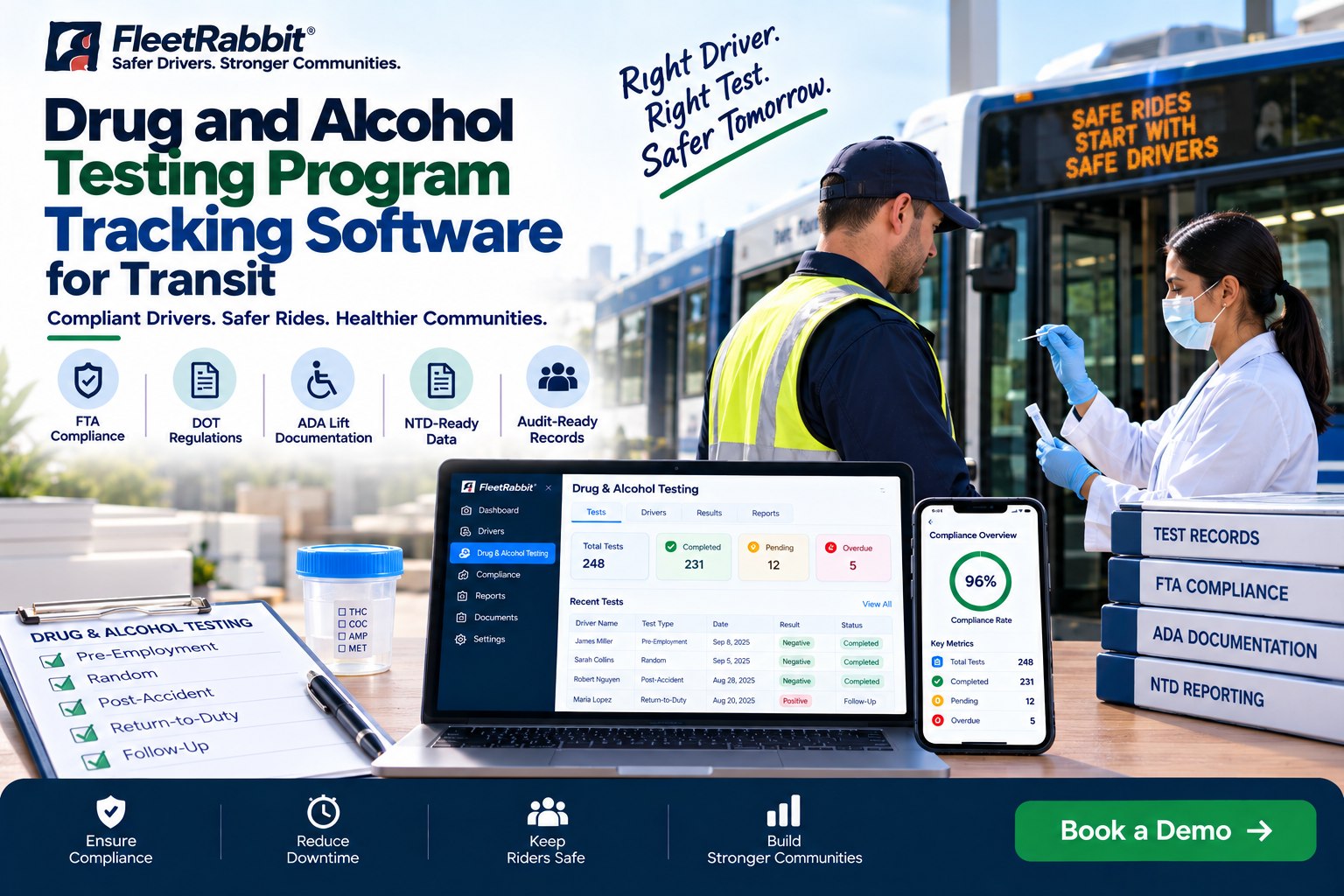
A transit agency's drug and alcohol testing program runs on rules that are easy to describe and surprisingly easy to fall behind on: six distinct testing circumstances, a random testing pool that has to hit an annual minimum rate, strict timing windows after an accident, and an annual Management Information System report due to the FTA whether the program ran smoothly or not. Under 49 CFR Part 655, this program covers every safety-sensitive employee, not just operators, and a Triennial Review team checks it as closely as any other part of the agency's safety record. FleetRabbit keeps the testing pool, the trigger events, and the documentation trail in one system, so the program runs on a schedule instead of a set of dates someone is trying to remember. You can sign up to see your own safety-sensitive roster mapped against its testing requirements.
Every Circumstance That Requires a Test
Each testing circumstance has its own trigger, and a program that only tracks one or two well tends to miss the others until an audit or an incident forces the question.
Pre-Employment
Required before a safety-sensitive employee performs any covered function for the first time.
Random
Unannounced testing drawn from a pool at a rate that meets or exceeds the FTA's minimum annual percentage.
Reasonable Suspicion
Triggered when a trained supervisor observes specific, documented signs consistent with drug or alcohol use.
Post-Accident
Required following accidents that meet specific criteria involving fatalities, citations, or disabling damage.
Return-to-Duty
Required before an employee who violated the program returns to performing a safety-sensitive function.
Follow-Up
A series of unannounced tests conducted over a period following a return-to-duty test, per the substance abuse professional's plan.
Tracking Progress Toward the Annual Minimum Rate
Random testing is not a one-time event, it is a running total that has to reach the FTA's minimum annual percentage across the full safety-sensitive pool by year end. Falling behind in the first two quarters means playing catch-up under pressure in the last two.
Teams that sign up for FleetRabbit get this running total updated automatically as each test is logged, instead of tallying it manually before the annual report is due.
Core Testing Program Features
Each feature below addresses a specific point in the program where manual tracking typically breaks down first. Fleets that sign up get all four running together from day one.
Random Selection Pool Management
Maintains the safety-sensitive employee pool and tracks progress toward the annual minimum random testing rate automatically.
Post-Accident Trigger Checklist
Walks a supervisor through the specific criteria that determine whether an accident requires drug and alcohol testing.
MIS Report Generation
Compiles the data needed for the annual Management Information System report directly from logged testing records.
Chain-of-Custody Documentation
Stores collection, custody, and result documentation for every test in a searchable digital record.
Run Your Testing Program on a Schedule, Not a Memory
Track all six testing circumstances, the random pool rate, and every collection record in one place.
When Does an Accident Actually Require Testing
Not every accident triggers a post-accident test, but the criteria are specific enough that guessing wrong in either direction creates a problem. You can book a demo to see how FleetRabbit walks a supervisor through this decision in the field.
| Accident Circumstance | Testing Generally Required |
|---|---|
| Fatality involved | Yes, for the surviving covered employee |
| Citation issued and someone required immediate medical treatment away from the scene | Yes |
| Citation issued and a vehicle required towing due to disabling damage | Yes |
| No citation issued and no disabling damage or transported injury | Generally no |
How Long Testing Records Need to Be Kept
| Record Type | Typical Retention Period |
|---|---|
| Positive test results, refusals, return-to-duty and follow-up plans | 5 years |
| Annual MIS reports | 5 years |
| Collection process documentation, calibration records | 2 years |
| Negative and cancelled test results | 1 year |
You can sign up to keep every one of these record types organized by retention period automatically, instead of tracking expiration dates by hand.
Where This Program Fits Broader Compliance
None of these programs treat drug and alcohol testing as a standalone record. You can book a demo to see how one testing record supports all three at once.
FTA Triennial Review
Reviewers check the testing program's records, random pool management, and MIS submission history as a standard review area.
FMCSA Drug and Alcohol Clearinghouse
Violations recorded under the testing program are reported to the Clearinghouse and cross-checked against annual driver queries.
National Transit Database Reporting
Testing program compliance supports the safety data agencies include as part of their annual NTD submissions.
Manual Program Tracking vs. FleetRabbit
| Task | Manual Tracking | FleetRabbit |
|---|---|---|
| Tracking random testing pool progress | Manually tallied against the annual target | Updated automatically as each test is logged |
| Determining if an accident requires testing | Judgment call based on memory of the rules | Guided checklist based on documented criteria |
| Preparing the annual MIS report | Compiled by hand from scattered records | Generated directly from logged testing data |
| Managing record retention periods | Tracked separately per record type | Organized automatically by required retention period |
Keep Your Drug and Alcohol Program Audit-Ready
Random pool tracking, post-accident guidance, MIS reporting, and full chain-of-custody documentation in one system.
Frequently Asked Questions
Which employees are covered under a transit drug and alcohol testing program
Coverage generally extends to safety-sensitive employees, which typically includes vehicle operators, mechanics who maintain revenue vehicles, and dispatchers who control the movement of those vehicles, not just drivers alone.
What is the random testing pool and why does the rate matter
The random testing pool is the group of safety-sensitive employees subject to unannounced testing throughout the year. The FTA sets a minimum annual percentage that must be tested across that pool, and agencies need to track progress toward that rate continuously rather than realizing they are behind near year end.
Does every accident require a post-accident drug and alcohol test
No. Testing is generally required only when specific criteria are met, such as a fatality, a citation combined with an injury requiring immediate treatment away from the scene, or a citation combined with disabling damage requiring a vehicle to be towed.
What is the annual MIS report
The Management Information System report is an annual submission to the FTA summarizing the agency's testing program activity for the year, including the number of tests conducted under each testing circumstance and any violations recorded.
How long do drug and alcohol testing records need to be kept
Retention periods vary by record type. Positive results, refusals, and return-to-duty records are typically kept for 5 years, collection process documentation for 2 years, and negative or cancelled results for 1 year.