Transit agency general managers, demand-response operations superintendents, and contracted paratransit directors face strict regulatory accountability: on-demand micro-transit vans operate under federal compliance rules that standard commercial fleets never encounter. Unlike fixed-route diesel buses with dedicated depot lanes or commercial delivery vans focused only on package drops, an on-demand micro-transit van or cutaway operates continuously in dense traffic, executing dozens of curbside passenger boardings, frequent wheelchair ramp deployments, and tight neighborhood pickups. When morning pull-out inspections rely on clipboards or generic paper Driver Vehicle Inspection Reports (DVIR), systemic compliance breakdowns follow. Drivers skip critical Americans with Disabilities Act (ADA) wheelchair lift operational tests, emergency door interlock inspections go unrecorded, and vehicles miss the strict 10% preventive maintenance variance window required under Federal Transit Administration (FTA) Triennial Reviews and 49 CFR Part 625 Transit Asset Management (TAM) rules. Failing an on-road state safety audit or stranding a mobility-impaired passenger at the curb triggers civil rights complaints, safety stand-downs, and lost formula grant apportionments. Fleet Rabbit delivers dedicated micro-transit van maintenance software engineered specifically for public transit agencies and contracted operators. Digitize morning yard pull-out clearances, automate hydraulic ADA lift cycle testing, track J1939 CAN-bus telemetry, and maintain audit-proof FTA compliance across every transit vehicle. Book a Demo to see our micro-transit van maintenance and pull-out readiness software live.
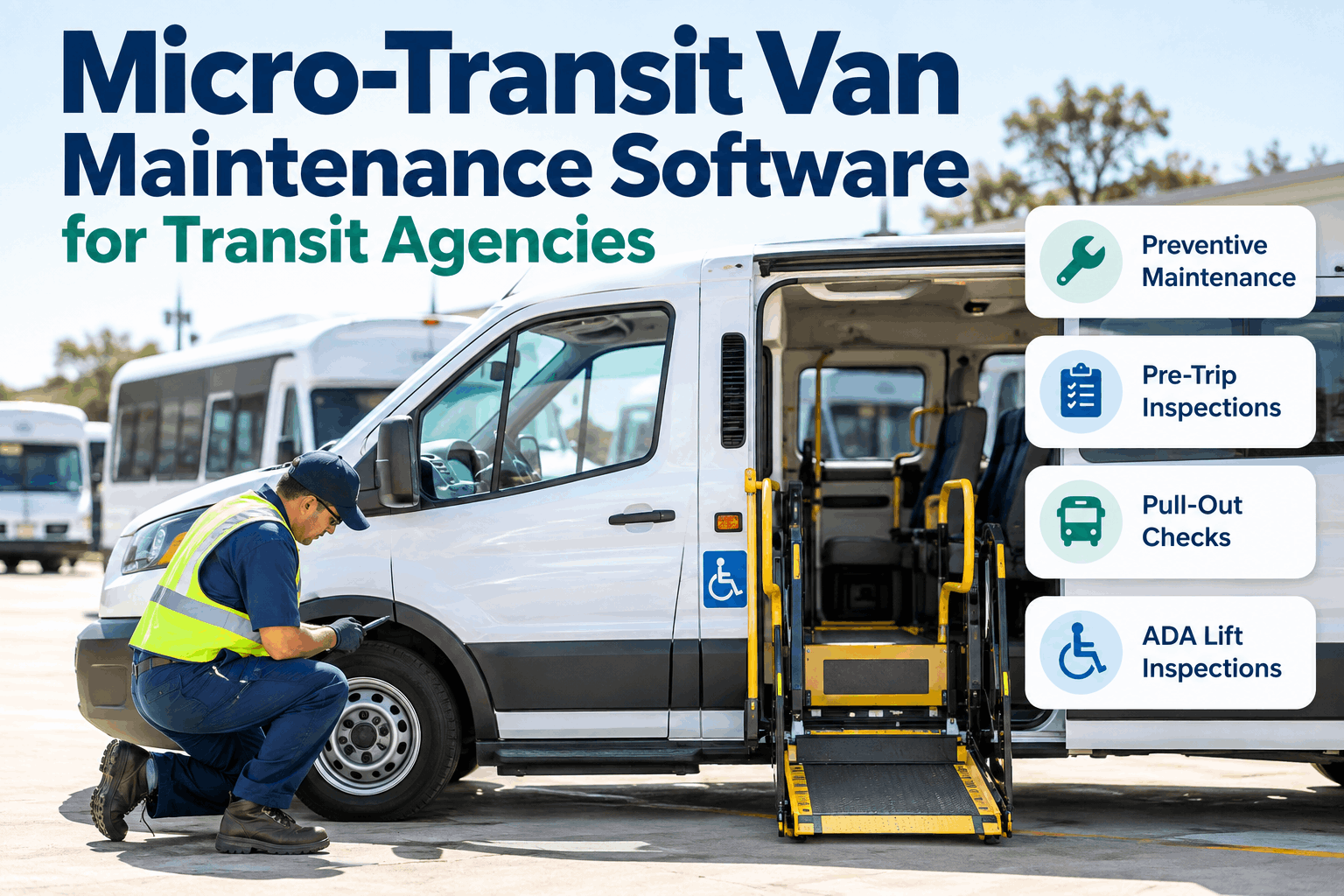
Micro-Transit Van Maintenance Software for Transit Agencies
The operational readiness and safety compliance blueprint for demand-response transit fleets: enforce photo-verified morning yard pull-out inspections, automate ADA hydraulic wheelchair lift cycling, track strict 10% FTA preventive maintenance windows, and eliminate missed passenger service runs.
The Costly Operational Realities of Demand-Response Transit Fleets
Micro-transit represents one of the fastest-growing sectors in public transportation, bridging first-mile/last-mile gaps in suburban zones and providing flexible mobility. However, managing high-roof cutaways and passenger transit vans with commercial parcel fleet software or paper checklists introduces critical transit-specific vulnerabilities. Sign up to modernize your agency's micro-transit inspection workflows.
The 4-Zone Micro-Transit Pull-Out Readiness Protocol
Fleet Rabbit replaces generic inspection sheets with a structured digital walkaround tailored specifically to passenger-carrying cutaways and transit vans. Book a demo to test our transit-specific mobile inspection modules.
- Mandatory Full Deployment Cycle: The app requires the driver to operate the lift to ground level, verify roll-stop barriers engage, and raise it back to stowed position.
- Manual Emergency Pump Backup: Visual check of the manual hydraulic hand pump and release valve handle for emergency deployment.
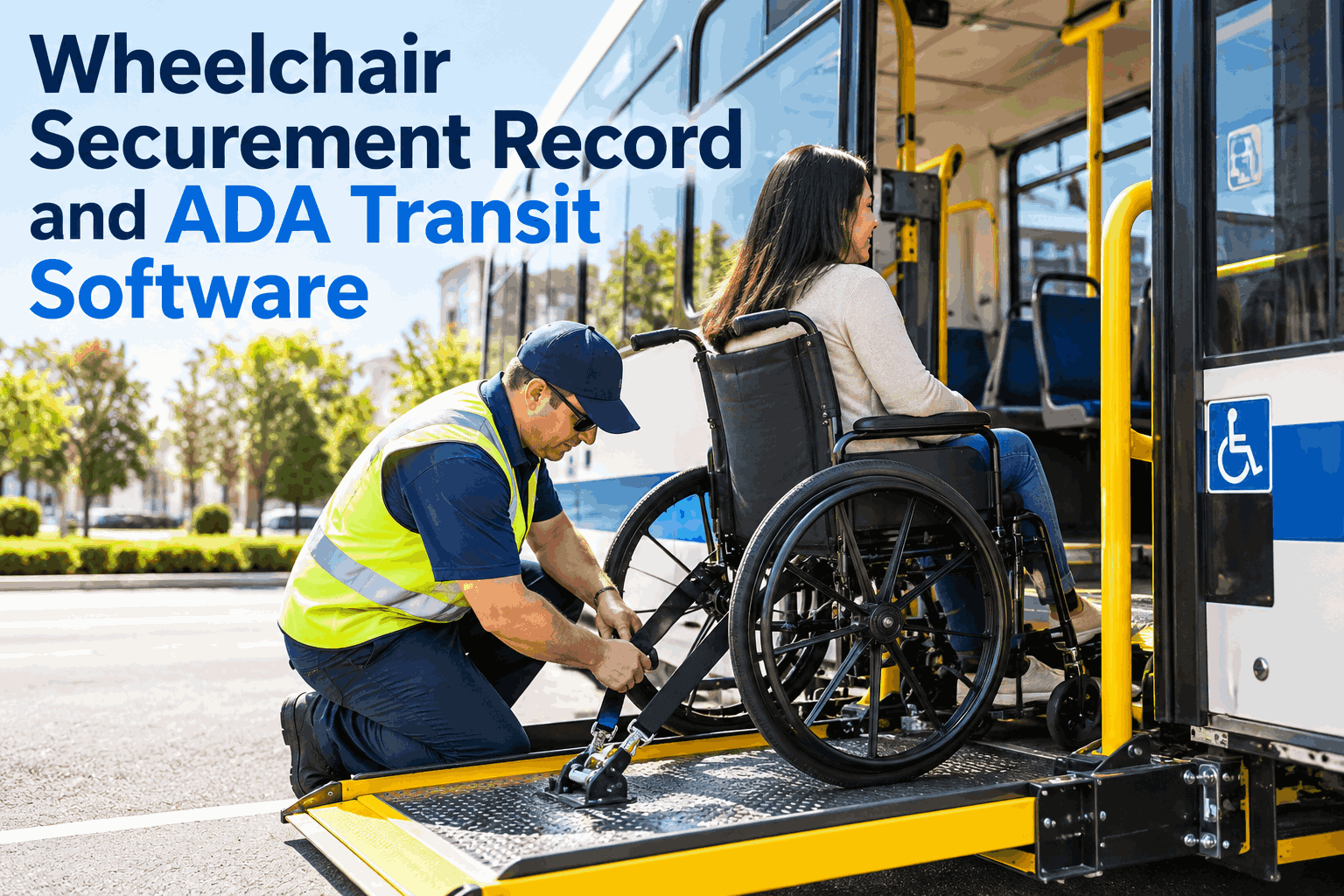
- Wheelchair Securement Tie-Downs: Physical audit of 4-point retractors, floor L-tracks, and occupant lap/shoulder belts for fraying or lock failure.
- Interlock Safety Verification: Verifying the vehicle transmission cannot be shifted out of park while the lift door is open or the lift is deployed. Sign up to automate digital ADA lift pre-trip checklists.
- Emergency Roof Hatch & Windows: Verifying release handles operate smoothly and red emergency exit indicator lights illuminate.
- Electric Passenger Door Operation: Testing open/close sensitivity, manual emergency release handles, and exterior key switches.
- Stepwell & Aisle Lighting: Ensuring illuminated grab handles and floor courtesy lights meet transit visibility thresholds.
- Biohazard Kit & Fire Suppression: Verifying sealed bloodborne pathogen kits, first-aid boxes, and inspection tags on 5 lb dry chemical fire extinguishers.
- CAN-Bus Fault Interrogation: Direct scanning of active and pending Diagnostic Trouble Codes (DTCs) from the engine and transmission ECUs.
- Brake System Operational Test: Dynamic pedal travel and parking brake hold verification before leaving the terminal gate.
- Tire Pressure & Lug Nut Check: Verifying commercial ply tire pressures, tread depth, and wheel hub oil levels.
- Auxiliary Dual-Alternator Check: Measuring high-output alternator charging voltage under full passenger cabin A/C load. Book a demo to see our J1939 diagnostic telematics integration.
- Digital Destination Sign (LED): Testing route code programming and external passenger public address (PA) speakers.
- Two-Way Radio & Mobile Data Terminal (MDT): Confirming cellular/CAD dispatch connectivity and emergency distress button function.
- Interior Vehicle Sanitation: Photo-verified inspection confirming passenger seats, handrails, and vinyl floors are sanitized and trash-free.
- Fare Collection & Validator Status: Verifying electronic smart card readers and onboard farebox validator power. Sign up to streamline transit pre-trip sanitation logging.
The Closed-Loop Morning Pull-Out & Shop Triage Workflow
A failed inspection item must not delay route service. See how Fleet Rabbit isolates defects and assigns backup rolling stock without dispatcher chaos. Book a demo to walk through our live yard pull-out triage workflow.
System Comparison: Generic Fleet Trackers vs. Fleet Rabbit Transit Suite
Compare the operational capabilities, regulatory safeguards, and transit-specific features between commercial delivery software and Fleet Rabbit’s public transit platform. Book a demo to evaluate your agency's transit compliance ROI.
| Transit Compliance Dimension | Fleet Rabbit Transit Suite | Paper DVIR Sheets & Clipboards | Generic Commercial Fleet GPS |
|---|---|---|---|
| Subscription Rate | $5 / asset / month | High administrative payroll & audit risk | $25 – $45 / vehicle / month |
| FTA 10% PM Window Monitoring | Automated live J1939 odometer tracking | Frequently violated on paper logs | Not supported (built for delivery) |
| ADA Wheelchair Lift Inspection | Mandatory digital cycle & interlock test | Subjective checkbox (unverified) | Not supported |
| Morning Pull-Out Gate Release | Instant digital clearance & lockout | Manual gatekeeper paper review | Vehicle location only (no gate lock) |
| Offline Data Reliability | 100% operational in concrete transit yards | Paper sheets easily damaged or lost | Fails when cellular signal drops |
| PTASP & TAM Audit Dossiers | 1-click exportable regulatory PDF | Boxes of physical paper inspection slips | Not compliant for transit grants |
| Procurement & Deployment | 14-day free trial, live in 14 days | Not applicable | 1 to 3-year auto-renewing contract |
Transit Agency Case Study: Valley Metro Regional Transit Authority
Learn how a regional transit agency deployed Fleet Rabbit across 44 demand-response micro-transit cutaway vans to eliminate missed morning pull-outs and clear federal safety reviews. Sign up to achieve similar transit operational reliability.
Operating 44 Ford E-450 cutaway vans providing on-demand curb-to-curb micro-transit and paratransit across three suburban zones, Valley Metro Regional Transit Authority faced compounding operational friction. During their previous FTA Triennial Review, federal auditors cited the agency for missed 10% preventive maintenance windows on six vehicles due to manual odometer reporting errors. Furthermore, drivers frequently rushed morning yard pull-outs, resulting in three curbside ADA wheelchair lift hydraulic failures during active passenger service that led to formal civil rights complaints.
By deploying Fleet Rabbit at $5/asset/month, the transit agency equipped operators with mobile pull-out inspection checklists requiring verified ADA lift cycles and passenger door interlock tests. J1939 telematics pulled true vehicle odometer readings directly from on-board ECUs, automatically scheduling 6,000-mile services precisely within the mandatory 10% FTA variance window. Over 12 months, on-time morning yard pull-out rates rose to 99.6%, curbside ADA lift failures dropped to zero, and the agency passed its subsequent FTA Triennial Review with zero maintenance deficiencies, while saving $68,000 in avoided overtime repairs and reduced administrative paperwork.