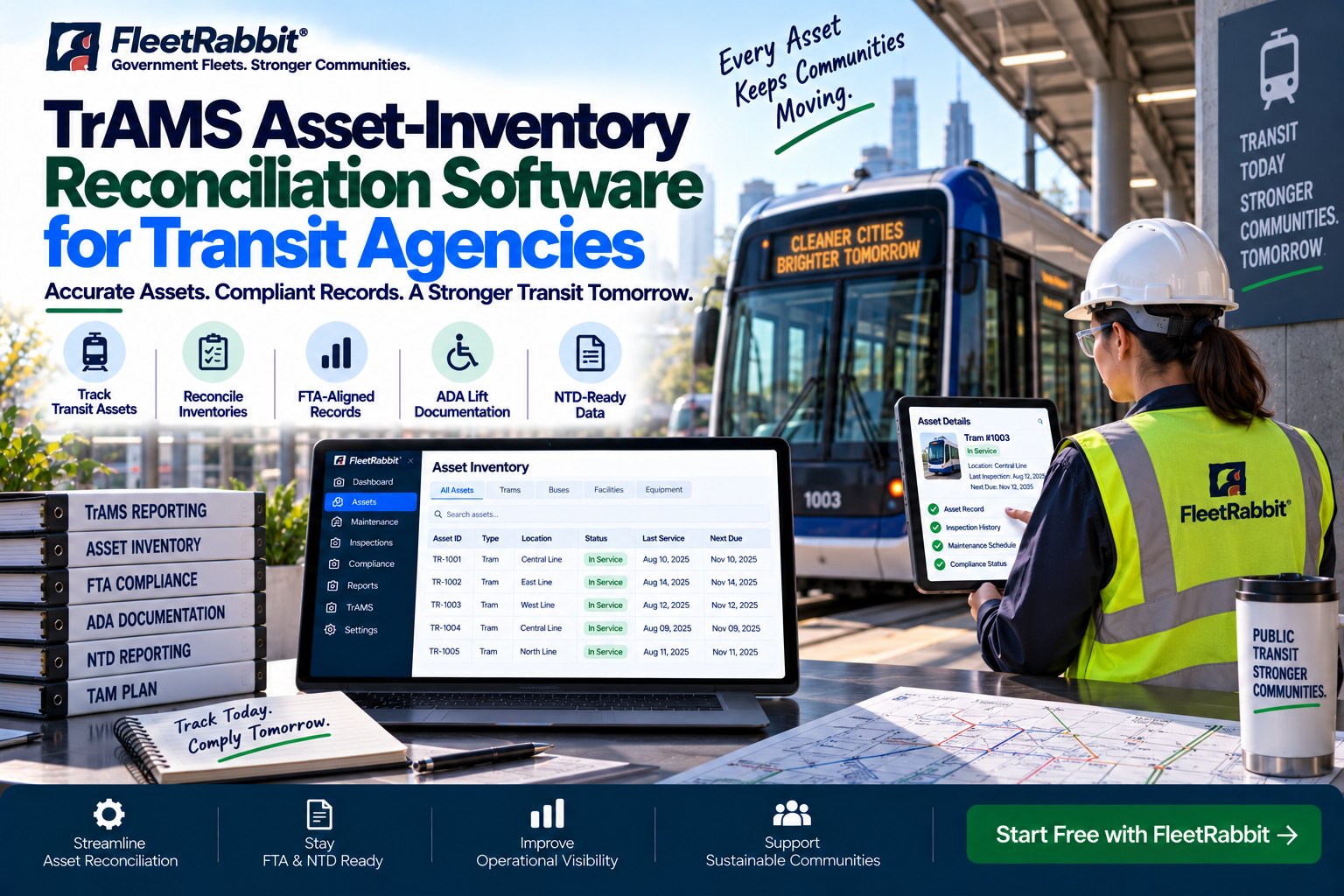
Every vehicle a transit agency owns technically exists in three separate places at once: as a funded asset inside the FTA's Transit Award Management System, as a line item in the annual National Transit Database Asset Inventory Module submission, and as an actual vehicle sitting on the property or long gone to salvage. Most of the time these three records agree with each other. The problem shows up in the gap between them, when a vehicle is scrapped but never removed from the grant record, or replaced but still counted in the NTD inventory, leaving the agency reporting federal interest in an asset that no longer physically exists. FleetRabbit keeps the physical fleet roster tied to the same record used for grant and NTD reporting, so a disposal or acquisition updates everywhere at once instead of three places on three different schedules. You can sign up to see your own fleet checked against this kind of three-way mismatch.
Where the Same Vehicle Gets Tracked Three Different Ways
Reconciliation problems rarely come from bad recordkeeping in any one system. They come from three systems that were never designed to update each other, each holding a piece of the same asset's story.
TrAMS Grant Record
Tracks which federal grant funded the asset, the useful life clock start date, and whether federal interest is still active on the vehicle.
NTD Asset Inventory Module
An annual certified submission covering vehicle, facility, and guideway inventory and condition, used to support Transit Asset Management performance reporting.
Physical Fleet Roster
The actual, current state of every vehicle the agency operates, in storage, or has already disposed of on the ground.
A cutaway paratransit van is scrapped in March. The maintenance shop updates its own local records, but the vehicle is never formally removed from the TrAMS grant record or flagged in the next NTD Asset Inventory submission. On paper, the agency is still reporting federal interest in a vehicle that has not physically existed for months, and that gap is exactly the kind of finding a Triennial Review team is trained to look for.
Why Vehicle Type Changes the Reconciliation Timeline
The FTA publishes default useful life benchmarks by vehicle type, and those benchmarks anchor when a vehicle becomes eligible for replacement funding and when federal interest is expected to end. A mismatch on a vehicle still well inside its benchmark carries very different weight than one on a vehicle that should have been retired years ago. Fleets that sign up can see these benchmarks applied automatically against their own vehicle types.
| Vehicle Type | Typical Benchmark Pattern | Why It Matters |
|---|---|---|
| Heavy-duty transit bus | Longer benchmark, often over a decade of service | Longer window for a reconciliation gap to go unnoticed |
| Cutaway or light-duty paratransit vehicle | Shorter benchmark, often just a few years | Faster turnover means more frequent disposal reporting |
| Rail vehicle or streetcar | Multi-decade benchmark spanning several reporting cycles | Small early errors compound across many years of reporting |
How FleetRabbit Keeps the Three Records Aligned
Asset Event Logged Once
An acquisition, transfer, or disposal is logged a single time against the vehicle's record, rather than re-entered separately for grant, NTD, and internal tracking purposes.
Federal Interest Status Updated
The vehicle's useful life benchmark progress and federal interest status update automatically based on the logged event and vehicle type.
Annual NTD Submission Prepared
When the annual Asset Inventory Module submission comes due, the current fleet roster is already reconciled and ready to export.
Discrepancies Flagged Early
Any vehicle whose grant record, NTD status, and physical status disagree is flagged well before a reviewer finds it first.
Fleets that sign up for FleetRabbit move from reconciling three records once a year under deadline pressure to keeping them aligned continuously.
Stop Reconciling Three Asset Records by Hand
One vehicle record feeding your TrAMS grant status, your NTD submission, and your actual fleet roster at the same time.
Core Asset Inventory Features
Each feature below exists to close the specific gap that typically causes a three-way mismatch in the first place. You can book a demo to see all four working against your own fleet data.
Unified Asset Record
Every vehicle's grant funding source, useful life status, and physical condition live on one record instead of three disconnected systems.
Disposal and Acquisition Logging
Field technicians log a vehicle's removal or addition once, and that event automatically updates federal interest and inventory status.
NTD Submission Export
Generate a fleet inventory export formatted for the annual Asset Inventory Module submission directly from current records.
Discrepancy Alerts
Get flagged automatically when a vehicle's grant record, NTD status, and physical status no longer agree with each other.
Where Asset Reconciliation Fits Broader Compliance
None of these programs treat the vehicle inventory as a once-a-year exercise. You can book a demo to see how FleetRabbit supports all three from the same underlying fleet data.
FTA Triennial Review
Reviewers check that assets purchased with federal funds are accounted for and properly disposed of when retired.
Transit Asset Management Plan
Accurate vehicle condition and age data feeds directly into the performance targets an agency reports under its TAM plan.
NTD Annual Reporting
The Asset Inventory Module submission depends on a fleet roster that matches what is actually in service.
Manual Reconciliation vs. FleetRabbit
| Task | Manual Reconciliation | FleetRabbit |
|---|---|---|
| Logging a vehicle disposal | Updated separately in shop records, grant files, and NTD prep sheets | Logged once and reflected everywhere automatically |
| Tracking federal interest status | Calculated manually against the useful life benchmark | Tracked automatically per vehicle type and acquisition date |
| Preparing the annual NTD submission | Assembled under deadline pressure once a year | Ready year-round from continuously reconciled records |
| Catching a three-way mismatch | Usually found by a reviewer, not the agency | Flagged automatically as soon as records disagree |
You can sign up to bring your grant, NTD, and physical fleet records onto one reconciled system.
Keep Your Asset Records in Agreement Year-Round
One vehicle record, three reporting obligations covered, and discrepancies flagged before a reviewer finds them first.
Frequently Asked Questions
What is TrAMS in the context of transit asset reporting
TrAMS is the FTA's Transit Award Management System, the platform agencies use to apply for and manage federal grants. Vehicles and equipment purchased with those grants are tracked in TrAMS as funded assets carrying federal interest.
Why can the same vehicle show up differently across systems
TrAMS, the NTD Asset Inventory Module, and an agency's own physical fleet roster are generally updated separately and on different schedules, so an event like a disposal or transfer can be reflected in one system well before it is updated in the others.
What is a useful life benchmark and why does it matter for reconciliation
A useful life benchmark is the FTA-published expected service life for a given vehicle type, used to determine when a vehicle becomes eligible for replacement funding and when federal interest is generally expected to end. It gives reconciliation efforts a reference point for whether a mismatch is a minor timing issue or a more serious gap.
What happens if a disposed vehicle is still listed as active in NTD reporting
An unreported disposal can result in the agency appearing to still hold federal interest in a vehicle that no longer exists, which is the kind of discrepancy an FTA Triennial Review team is specifically trained to look for.
Can FleetRabbit generate the annual NTD Asset Inventory Module submission directly
Yes. Because vehicle records are kept reconciled continuously, a fleet inventory export formatted for the annual submission can be generated directly from current data rather than assembled by hand each year.