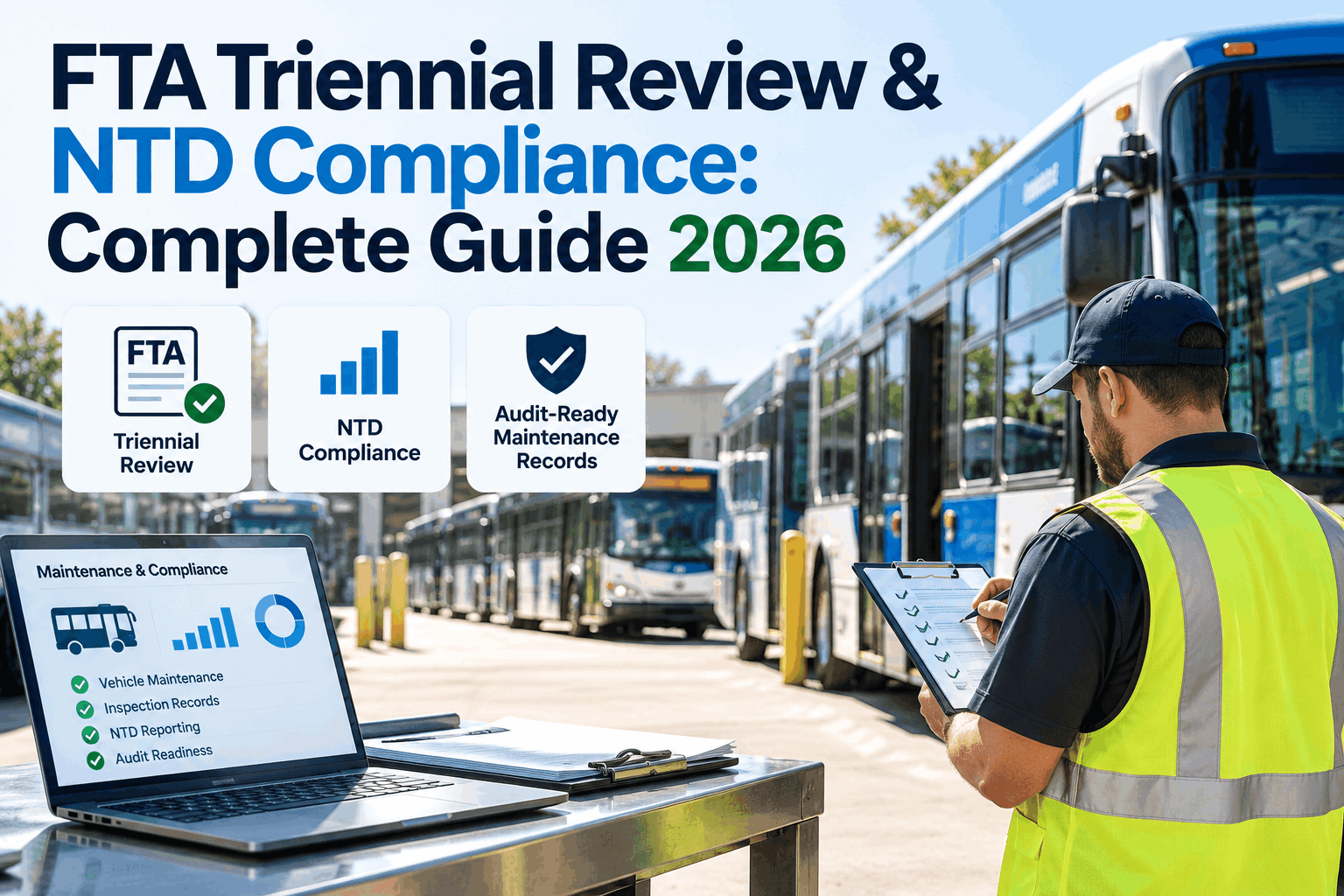
Executive directors, compliance officers, transit maintenance directors, and grant administrators across municipal and regional transit systems operate under constant federal accountability: receiving federal formula apportionments under 49 U.S.C. Chapter 53 while upholding strict rolling-stock roadworthiness directives enforced by the Federal Transit Administration (FTA) and DOT 49 CFR Part 396. At the core of federal transit oversight sits the FTA Triennial Review—a comprehensive statutory audit mandated under 49 U.S.C. § 5307(f)(2) that evaluates an agency's compliance across 23 distinct operational and administrative areas every three years. Alongside this evaluation, transit authorities must satisfy annual National Transit Database (NTD) compliance reporting, specifically documenting rolling stock and non-revenue support asset inventories, condition assessments, and Useful Life Benchmark (ULB) performance targets on NTD Forms A-30 and A-35 under Transit Asset Management (TAM) rules in 49 CFR Part 625. When transit agencies attempt to manage compliance using siloed spreadsheets, paper driver vehicle inspection reports (DVIRs), and disconnected garage work orders, triennial audit preparations become overwhelming. Maintenance records for revenue buses and cutaways are often missing mechanic corrective action signatures, curbside ADA wheelchair lift inspections under 49 CFR Part 38 lack verifiable date-and-time timestamps, and maintenance intervals exceed the agency's written 10% preventive maintenance (PM) scheduling threshold. When federal auditors discover systemic maintenance deficiencies, agencies receive formal audit findings, face mandatory Corrective Action Plans (CAPs), and risk the withholding or freezing of vital federal transit grant apportionments. FleetRabbit provides a dedicated transit maintenance compliance platform engineered specifically to keep municipal and regional transit agencies audit-ready every single day. By uniting automated J1939 and OBD-II CAN-bus engine-hour telemetry, digital pre-trip pull-out eDVIR checkouts, ADA lift verification forms, closed-loop work order repair archives, and 1-click NTD/TAM reporting exports into an all-inclusive system priced at a flat $5 per asset per month, FleetRabbit eliminates audit anxiety. Protect your federal funding streams, eliminate audit findings, and capture garage maintenance records completely offline inside reinforced concrete bus barns, underground passenger concourses, and rural depot staging yards with zero cellular reception. Discover how our compliance architecture prepares your transit authority for its next review when you book a demo or configure your transit asset roster immediately when you sign up for our platform.
Master the FTA Triennial Review process and eliminate audit findings across your transit authority. Streamline maintenance records, enforce ADA accessibility verifications, automate 49 CFR Part 625 Transit Asset Management ledgers, and export verified NTD Forms A-30/A-35 in seconds.
What Is an FTA Triennial Review? Structure & Scope
Mandated by Congress under 49 U.S.C. § 5307(f)(2), the FTA Triennial Review evaluates recipient performance across 23 operational areas; understanding the maintenance and asset core protects public transit grants.
Maintenance & Written PM Plan
Federal reviewers inspect written preventive maintenance plans, verifying that at least 90% of PMs are performed within established mileage or engine-hour intervals (enforcing a strict ±10% compliance window) and confirming that warranty claims are aggressively pursued.
Americans with Disabilities Act (ADA)
Reviews operational compliance under 49 CFR Part 38, inspecting daily pre-trip wheelchair lift cycle test records, securement system inspections, in-service lift repair turnaround times, and mandatory supervisor contingency logs.
Transit Asset Management (TAM)
Audits compliance with 49 CFR Part 625, verifying that the agency maintains a documented capital asset inventory, conducts annual condition assessments, calculates Useful Life Benchmark (ULB) targets, and adheres to a State of Good Repair (SGR) policy.
Title VI & Public Safety Oversight
Ensures transit service vehicles, route allocations, and safety mitigation workflows meet equitable transit service delivery standards and coordinate cleanly with Public Transportation Agency Safety Plans (PTASP under 49 CFR Part 673).
National Transit Database (NTD) Compliance: Form A-30 & Form A-35
In addition to triennial reviews, public transit systems must report capital inventory profiles annually to the National Transit Database; FleetRabbit automates these complex asset schedules.
Revenue Vehicle Inventory (RVI)
Documents all rolling stock used in passenger revenue operations (40-foot standard transit buses, articulated buses, paratransit cutaways, trolleybuses, and vans). Transit agencies must report:
- Agency fleet ID, vehicle make, model, model year, and VIN
- Active vs. inactive/emergency backup roster classification
- Funding source codes (e.g., FTA Section 5307, 5339, 5310, 5311)
- Actual cumulative vehicle mileage and annual operating hours
- Total passenger seating capacity and ADA wheelchair securement positions
- Ownership profile (owned outright, leased, true capital lease)
Service Vehicle Inventory (SVI)
Mandates comprehensive capital accounting for all non-revenue road supervisor utility vehicles, mobile incident command rigs, maintenance tow trucks, and supervisory pool cars. Agencies must document:
- Primary service duty role (supervisor pursuit, route relief, snow equipment)
- Useful Life Benchmark (ULB) default standards (typically 8 years for non-revenue autos)
- Current physical asset condition assessment rating (1.0 to 5.0 TERM scale)
- Agency capital responsibility percentage and municipal replacement plan
- Active status confirmation and historical disposal audit documentation
The 4 Most Common Triennial Maintenance Deficiencies (And Their Consequences)
Managing transit assets across paper inspection books and unmonitored maintenance spreadsheets leads directly to corrective action findings. Review our agency risk models when you book a demo or start testing our cloud tools directly when you sign up for immediate platform access.
Late Preventive Maintenance Past the 10% Window
FTA Circular 5010.1E requires that agencies complete preventive maintenance according to their written plan, enforcing an industry-standard ±10% interval buffer (e.g., a 6,000-mile inspection must occur between 5,400 and 6,600 miles). When an agency's on-time PM rate drops below 80% due to unmonitored garage scheduling, auditors issue a major deficiency finding requiring costly monthly monitoring.
Missing ADA Wheelchair Lift Inspection Records
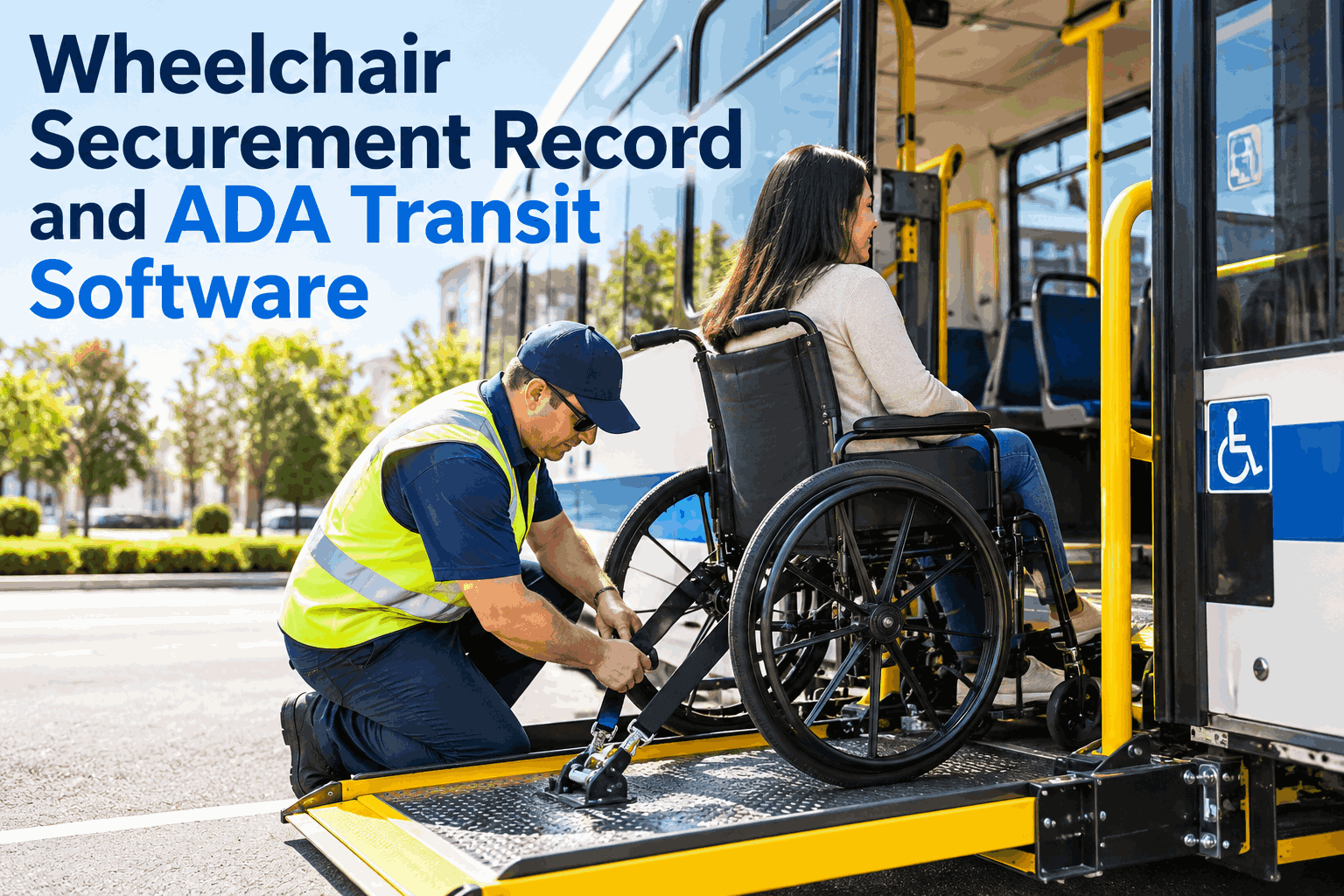
Under 49 CFR § 38.23 and § 38.31, wheelchair lifts, boarding ramps, and securement straps must be cycled and inspected during every pre-trip pull-out. When an agency cannot produce electronic, timestamped records proving that every deployed vehicle had an operable lift before revenue service, federal reviewers cite the agency for systemic civil rights non-compliance.
Unsigned Driver Defect Rectification Logs
Under DOT 49 CFR § 396.11 and § 396.13, when a transit operator notes a safety-critical defect on a pre-trip or post-trip walkaround (such as low air brake build-up or worn tires), a certified mechanic must sign off on the completed repair before the vehicle can roll again. Missing mechanic sign-offs are among the top findings cited during federal triennial site visits.
Concrete Bus Garages and Subterranean Terminal Dead Zones
Bus maintenance barns, automated wash facilities, and underground transit concourses are constructed with reinforced steel and concrete, creating cellular dead zones. Cloud-only tools crash, causing technicians to abandon digital inspection walkarounds and leaving public transit assets undocumented.
Built Specifically for Transit Authority Regulatory Compliance
FleetRabbit connects mobile pull-out walkarounds, auxiliary engine-hour tracking, garage work orders, and federal compliance reporting into a unified transit command platform. Discover how our software simplifies transit operations when you book a demo with our transit engineering specialists.
Automated 10% PM Window Tracking
Continuously tracks mileage and engine hours, alerting garage foremen 500 miles or 40 hours before an asset hits its 10% buffer to ensure agency PM compliance stays consistently above 95%.
Digital ADA Lift Pre-Trip Checkouts
Requires transit operators to execute and log wheelchair lift deployment tests, ramp interlock checks, and securement strap inspections during pre-trip pull-outs on their mobile devices.
Pull-Out Defect Dispatch Lockout
Vehicles tagged with critical mechanical defects on morning walkarounds—such as low air brake build-up pressure, steering play, or bald tires—are automatically blocked from service dispatch.
1-Click NTD Form A-30 & A-35 Dossiers
Compiles certified annual revenue and non-revenue service vehicle inventory reports, complete with Useful Life Benchmark (ULB) targets and condition ratings, in under 60 seconds.
Transit Depot Offline Mobile Sync
Technicians sign off work orders and drivers complete pre-trips inside reinforced steel bus garages with zero cellular reception; all diagnostic records auto-sync upon departure.
Triennial Review Binder Generator
Instantly compiles multi-year vehicle maintenance logs, mechanic certification sign-offs, warranty recovery records, and defect repair timelines formatted specifically for federal site auditors.
Direct Mapping to Federal Transit Administration Directives
Operating a transit agency maintenance facility under automated CMMS governance maintains strict compliance with federal asset management rules, accessibility standards, and safety directives.
Mandates that all federal funding recipients establish a Transit Asset Management plan containing capital asset inventories, condition assessments, analytical decision-support tools, and investment prioritization strategies.
Establishes accessibility standards for public transit vehicles: requires verified operating capability of wheelchair lifts, ramps, slip-resistant surfaces, priority seating signs, and mobility aid securement systems during daily transit operations.
Requires transit operators to implement Safety Management Systems (SMS), proactively identify safety hazards across rolling stock, execute preventive mitigations, and ensure frontline maintenance staff report mechanical defects.
Standardizes daily pre-trip and post-trip driver walkarounds (§ 396.11), qualified mechanic corrective action signatures (§ 396.13), and statutory 90-day electronic maintenance record retention across commercial support vehicles.
Transit Compliance & Maintenance Management Software Comparison
A feature-level comparison evaluating FTA compliance management depth, implementation pricing, and offline resilience as of 2026. Schedule a personalized walkthrough when you book a demo with our team.
| Compliance Dimension | FleetRabbit | Legacy Enterprise Transit CAD | Standard Telematics Portals | Paper Logs & Spreadsheets |
|---|---|---|---|---|
| Pricing (per asset/month) | $5/month flat | $45–$85/month | $20–$40/month | High risk of audit grant penalties |
| 10% PM Scheduling Buffer Enforcement | Automated threshold alerts | Requires custom database reports | Basic mileage alert only | Manual spreadsheet calculations |
| Digital ADA Wheelchair Lift Checkouts | Native mobile eDVIR forms | Separate paper audit book | Not supported | Loose paper check sheets |
| 1-Click NTD Form A-30 / A-35 Export | Built-in federal template generator | Custom consulting query ($5,000+) | Not supported | Weeks of manual data transcription |
| Transit Depot Offline Mobile Sync | Full store-and-forward | Network dependent | Data dropped offline | Paper logs only |
| Free Trial Access | 14 days, up to 3 assets | Sales demonstration only | Limited sandbox demo | None |
| Contract Terms & Procurement | Monthly or annual (No lock-in) | 3 to 5-year mandatory contract | 2 to 3-year contract | None |
5-Step FTA Audit Readiness Implementation Pathway
FleetRabbit embeds cleanly into your municipal transit maintenance garage, dispatch center, and supervisor mobile devices in under two weeks without operational disruptions. Begin testing immediately when you sign up for our free trial.
Transit Asset Master & Grant Mapping
Import transit buses, cutaways, paratransit vans, supervisor SUVs, acquisition dates, funding source codes (5307, 5339, 5311), and Useful Life Benchmarks (ULB) via automated CSV tools.
10% PM Buffer & Service Tier Configuration
Set up automated service schedules based on manufacturer guidelines: establish engine-hour PM thresholds (250-hour oil services) alongside mileage intervals to account for high stationary idling ratios.
Pull-Out & ADA Inspection Checklist Setup
Configure digital mobile inspection walkaround checklists tailored to transit vehicles, establishing automated dispatch lockouts for safety-critical defects and curbside ADA wheelchair lift audit forms.
Drivers & Shop Technicians Mobile Rollout
Equip transit operators and garage mechanics with the offline-first mobile app on standard iOS or Android smartphones for digital pre-trip eDVIR walkarounds and work order tracking.
Audit-Ready Command Go-Live
Activate live fleet status dashboards, automated shop work order queues, parts inventory reorder triggers, and 1-click FTA NTD Form A-35 compliance audit archives across all operational desks.
2-Week Deployment Plan & Milestones
A structured timeline designed to transition transit support operations from paper binders to digital maintenance governance with zero disruption to daily scheduled transit services. Review our full onboarding plan when you book a demo today.
Week 1: Vehicle Ingestion & Inspection Setup
- Audit paper work orders, auxiliary equipment upfit specs, and historical maintenance receipts
- Configure vehicle profiles with dual tracking: chassis mileage and auxiliary engine run-hours
- Set up digital morning pull-out checklists, emergency lighting tests, and ADA audit templates
- Assign user access permissions for Transit Operations Directors, Field Supervisors, and Shop Mechanics
Week 2: Depot Rollout & Live Verification
- Distribute mobile app to road supervisors and conduct 15-minute training on digital pull-out pre-trips
- Validate store-and-forward offline syncing inside concrete bus maintenance bays and underground depots
- Simulate an overdue engine-hour PM threshold to verify automated dispatch lockout gating and shop routing
- Launch live fleet management dashboard and 1-click FTA NTD Form A-35 export reporting archives
Documented Transit Authority Compliance Results
Operational improvements documented by regional transit authorities who deployed digital supervisor vehicle maintenance software. Review the complete transit case study when you book a demo with our team.
Zero Deficiencies on Triennial Maintenance Review Across 40 Buses
A regional transit authority with 40 fixed-route buses and paratransit cutaways previously received three findings during their prior triennial review due to late oil changes exceeding the 10% window. FleetRabbit deployed automated buffer alerts and digital pull-out checkouts, raising on-time PM compliance to 98.4% and passing their subsequent triennial review with zero maintenance deficiencies.
4 Weeks Saved on Annual NTD Reporting Across 60 Assets
A county transit agency operating 45 revenue cutaways and 15 supervisor vehicles previously spent a month every year manually assembling vehicle mileage, condition assessments, and Useful Life Benchmarks for NTD Forms A-30 and A-35. FleetRabbit automated the entire dataset, exporting certified NTD files in two clicks and saving 160 administrative staff hours annually.
If you have ever been through an FTA Triennial Review, you know that Area 10 Maintenance and Area 16 ADA are where agencies get torn apart. The federal contractors don't just ask if you service your buses; they ask for the exact work orders, they check whether your mileage was within ten percent of your written plan, and they demand proof that your mechanics signed off on every single defect reported by drivers. During our last review under our old paper system, we had three findings because we couldn't find signed work orders for two bus air-compressor repairs and our paratransit cutaways had gone eight hundred miles over their inspection intervals. It was humiliating, and we spent six months writing corrective action plans for the FTA. We deployed FleetRabbit specifically to make sure that never happened again. It automates our ten percent buffer warnings, forces our mechanics to sign off digitally before any bus can pull out, and lets us export our annual NTD A-30 and A-35 reports in literally two clicks. When federal auditors came back for our next triennial cycle, we handed them our FleetRabbit audit binder, and they didn't issue a single finding. It gave our leadership total peace of mind and protected our federal grant funding.
Frequently Asked Questions
Prepare for Your Next FTA Triennial Review in Less Than 2 Weeks
Enforce 10% PM compliance, automate daily ADA lift inspections, and generate 1-click NTD reporting at $5/asset/month with a 14-day free trial.