NTD reporting, decoded: what FTA collects, who files, and how to stay audit-ready
A plain-English map of the National Transit Database: the data areas, the reporting calendar, and the fleet records sitting behind every number you submit.
Who has to report, and how much
Congress requires annual NTD reporting from agencies that receive or benefit from Section 5307 or 5311 formula grants. How much you file depends on your reporter type. Whichever tier you're in, the fleet records underneath are the same, and you can sign up to see yours organized in one place.
The complete annual report, plus monthly statistics
Larger urban agencies file the full annual report and also submit monthly operating and safety statistics throughout the year.
A lighter annual reporting set
Urban systems operating 30 or fewer vehicles in maximum service, and rural systems such as State DOTs and Tribal transit programs, use a reduced reporting set.
Reports flow through the State DOT
In the rural program the State DOT submits the report, and subrecipients file their annual reports to the NTD through the State DOT.
Thresholds and exemptions change from year to year. Check the current NTD Reporting Policy Manual for your agency's category.
What NTD asks for: seven data areas and a sign-off
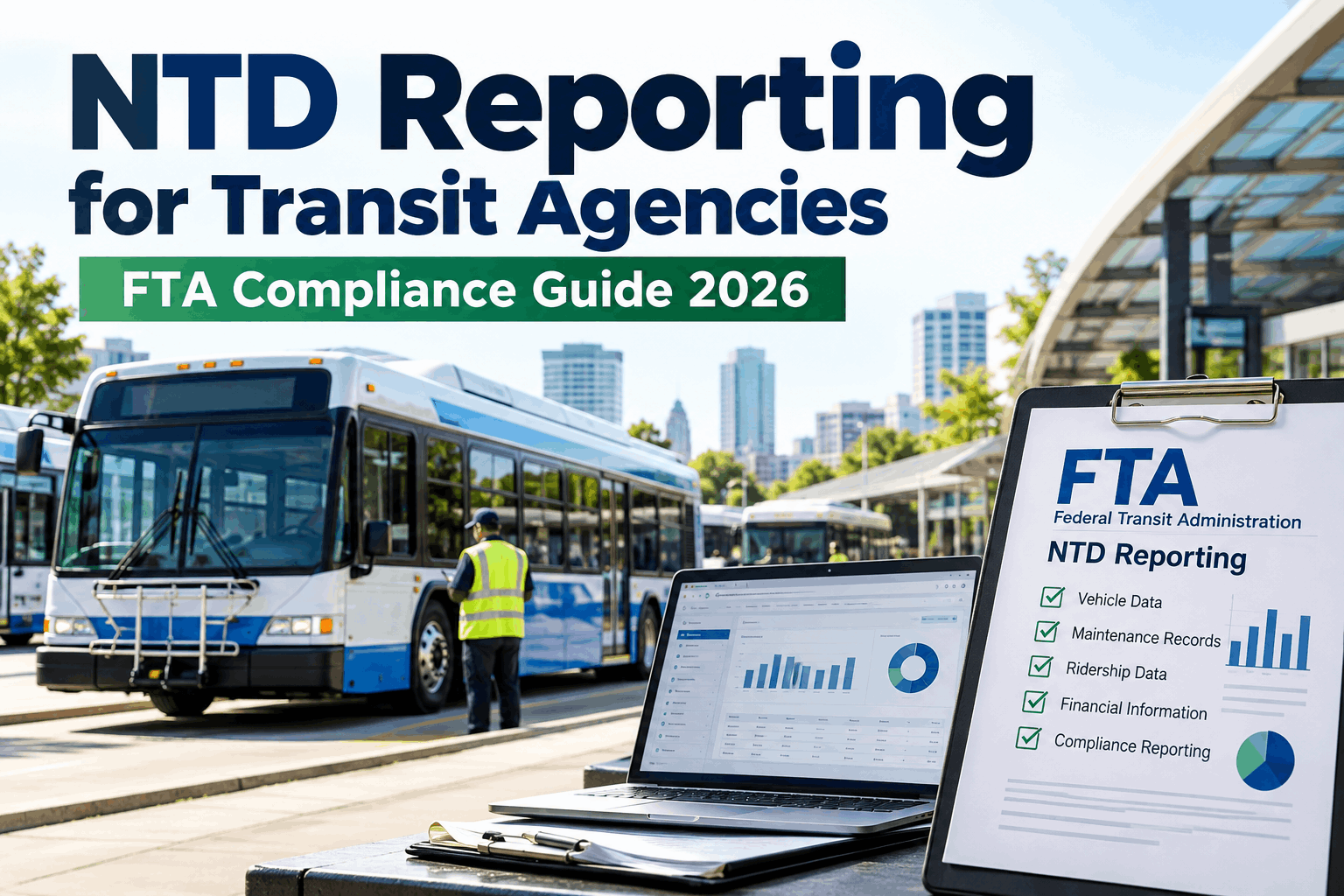
The NTD Reporting Policy Manual organizes the report into seven data areas plus formal declarations. Four of them are built almost entirely from fleet records, which is where most of the year-end scramble comes from. If yours are scattered, it's worth a book a demo conversation before the next reporting cycle.
Basic agency information
Who you are, who you serve, and which modes you operate.
Financial data
Operating and capital expenses and the funding sources behind them.
Service data
Vehicle revenue miles and hours, trips, and vehicles in maximum service.
Fleet dataSafety data
Major safety events and security events, reported on FTA's definitions.
Fleet dataAsset inventory
Revenue vehicles, service vehicles and facilities, with age and condition.
Fleet dataResource data
Energy consumption, such as fuel and electricity, plus employee data.
Fleet dataFederal funding data
How federal grants were applied across capital and operating costs.
Declarations and sign-off
Formal certification of the data you submit.
Stop rebuilding your fleet data every reporting year
FleetRabbit keeps vehicles, mileage, inspections, fuel and maintenance history current all year, so the numbers are already there when reporting opens.
The NTD reporting calendar
Your due date follows your own fiscal year. Agencies submit the annual report about four months after the fiscal year ends, and Full Reporters also file monthly statistics along the way.
Full Reporters submit monthly operating and safety statistics all year.
Your fiscal year closes, and that date sets your annual due date.
The annual report is due. Annual reporting opens December 15 for fiscal-year reporting.
NTD analysts review the data, and agencies correct and explain it until it's accepted.
What changed for report years 2025 and 2026
FTA finalized a set of NTD changes in a July 2025 Federal Register notice. Some apply from calendar year 2025, and others from report year 2025 or 2026. These are the seven areas it covered.
Additional GTFS data
More data drawn from publicly hosted General Transit Feed Specification datasets.
Stations and maintenance facilities
Reporting changes meant to reconcile station counts that differed between the A-10 and A-15 forms.
A-20 NTD/TERM alignment form
A form that aligns NTD data with FTA's TERM modeling.
Cybersecurity event reporting
Cyber security events are added to Safety and Security reporting.
Disabling damage
A disabling damage threshold replaces the substantial damage threshold for major safety events.
Rural reduced reporter exemption
An exemption for operators serving predominantly rural areas.
Voluntary reporter tag
A tag that identifies agencies that report voluntarily.
Where your fleet records turn into NTD data
Four of the data areas depend on records a fleet system already captures as vehicles run. Keeping those records in one place is the difference between pulling a report and reconstructing one, and you can sign up to connect your own vehicles and see how it lines up.
| NTD data area | Records behind it | What FleetRabbit organizes |
|---|---|---|
| Service data | Vehicle miles, run-time and stops | GPS and telematics mileage and hours per vehicle |
| Asset inventory | Vehicle specs, age, odometer, status, retirement | A vehicle registry with full history per asset |
| Safety data | Inspection defects, incidents, out-of-service events | DVIR inspections and incident records with timestamps |
| Resource data | Fuel or energy used per vehicle | Fuel tracking per vehicle |
| Condition and audit support | PM history, repairs, work orders | Preventive maintenance schedules and work-order history |
FleetRabbit organizes the underlying records and makes them easy to export. Agencies still submit their reports through FTA's NTD system.
An NTD reporting checklist
Most NTD pain is timing. The work splits into what should happen continuously and what only happens once the fiscal year closes, and it's worth a book a demo walkthrough if the first list is currently being done in the second.
Clean records all year beat a scramble every year-end
NTD data is expected to follow FTA's prescribed procedures, and FTA can question anything that looks unreasonable or inaccurate. Agencies are expected to be able to explain their numbers, which is far easier when every figure traces back to a dated record instead of a spreadsheet someone rebuilt in a hurry.
See what that looks like for your own fleet. Sign up to connect your vehicles, or book a demo and we'll walk through your current reporting process together.
Sources: FTA National Transit Database, 2026 NTD Reporting Policy Manual and NTD Annual Reporting User Guide; Federal Register notice on NTD reporting changes for report years 2025 and 2026 (July 2025). Always confirm requirements against the current manual.
Make your next NTD report the easy one
Start free and get your fleet records in order today, or see it live with our team first.