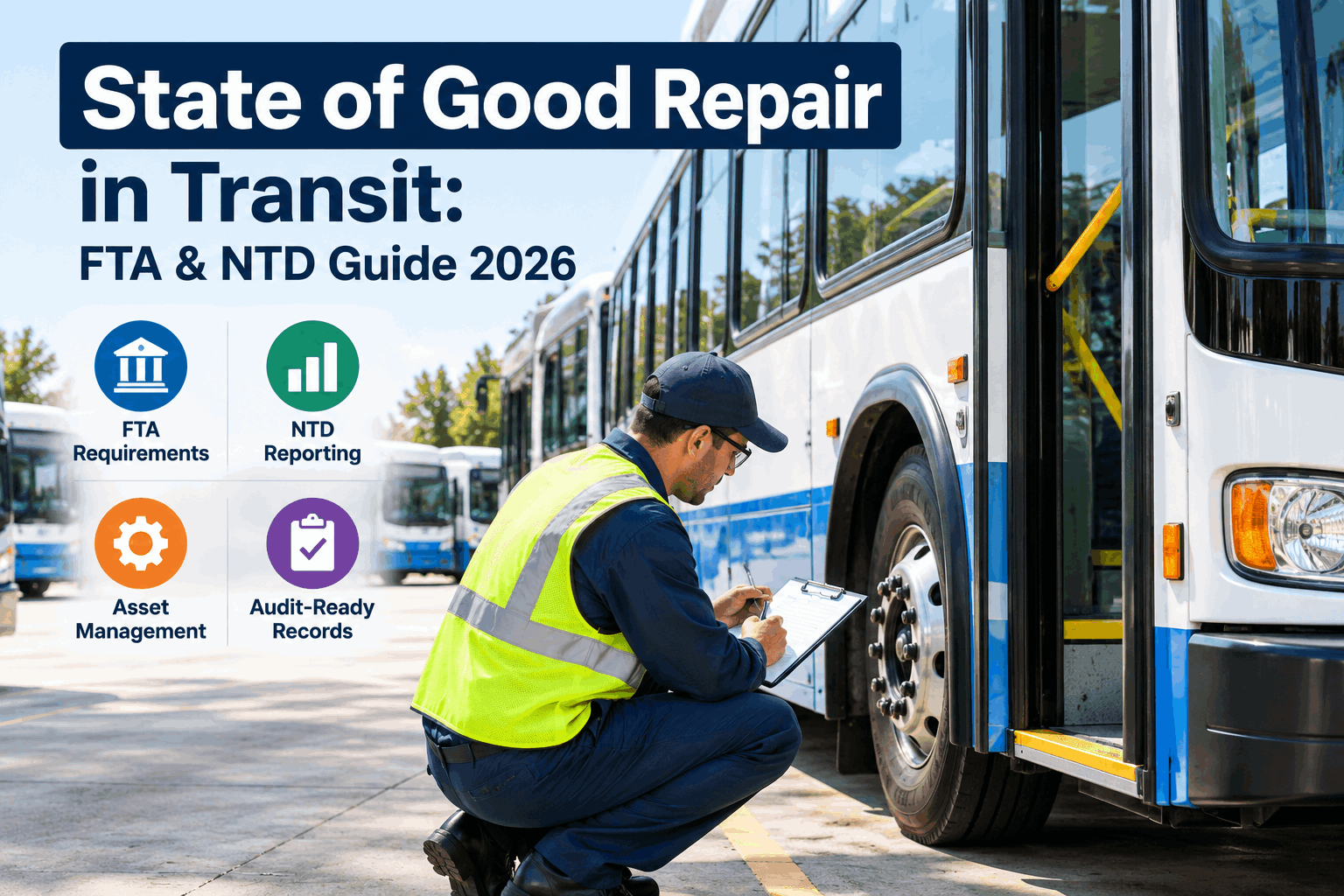
State of Good Repair, explained: what FTA measures, who has to report it, and how to prove it
How the TAM rule turns "our fleet is in good shape" into measurable targets, and the asset records that back up every number.
What "State of Good Repair" actually means
FTA's TAM rule, 49 CFR Part 625, defines state of good repair as the condition in which a capital asset is able to operate at a full level of performance. The rule then turns that sentence into objective standards an asset has to meet. If you want to see where each of your own assets stands against them, you can sign up and load your fleet.
It can do its job
The asset is able to perform its designed function.
It isn't a known safety risk
Using it in its current condition doesn't pose a known unacceptable safety risk.
Its lifecycle investments were made
Scheduled maintenance, rehabilitation and replacement investments have been met or recovered.
FTA's 23rd Conditions and Performance Report estimated the national transit state-of-good-repair backlog at $98.8 billion. FTA updates the estimate periodically, but the direction is why the TAM rule exists.
Four asset classes, four performance measures
Agencies set annual targets for each asset class they own, using measures FTA defines. Only the classes you actually operate apply to you.
Useful Life Benchmark (ULB): the expected life cycle or acceptable period of use in service for an asset, as determined by the provider or taken from FTA's default benchmark.
Know which vehicles are near their benchmark before the target is due
FleetRabbit keeps the age, mileage, inspection and maintenance history behind every vehicle in one place.
Tier I or Tier II: which one are you?
The rule applies to recipients and subrecipients of federal transit funds that own, operate or manage capital assets used in public transportation. It sorts them into two tiers, and the tier decides how much your TAM plan has to include.
Operates rail, or 101 or more vehicles
Rail fixed guideway operators, providers with 101 or more vehicles across all fixed-route modes, or 101 or more vehicles in one non-fixed-route mode.
Plan: nine required elementsSmaller providers and subrecipients
Section 5311 subrecipients, American Indian Tribes, and providers with 100 or fewer vehicles across all fixed-route modes or in one non-fixed-route mode.
Plan: four core elementsTier II providers can also join a group TAM plan developed by a sponsor such as a State. Either way, the underlying asset records don't change, and a quick book a demo call is a good way to check yours against the plan elements.
The TAM cycle, step by step
Every TAM plan comes down to four core elements. Tier I plans add policy, implementation strategy, key annual activities, resources and an evaluation plan on top of these.
Inventory
List every capital asset you own or operate.
Assess condition
Rate the condition of each asset.
Use decision tools
Apply tools that support repair-or-replace choices.
Prioritize investment
Rank projects against the funding you expect to have.
What goes to NTD every year
The TAM rule ties directly into National Transit Database reporting. Each year an agency submits a package built from the same asset records the plan relies on, and teams that book a demo often start by checking how quickly those records can be pulled.
Your capital assets by class, reported through the NTD Asset Inventory Module.
Where each measure landed this year, for every asset class you operate.
Projected performance targets for the coming fiscal year, by asset class.
A report on changes in system condition and progress made during the year.
Making State of Good Repair provable
Each SGR question has a record that answers it. The agencies that get through reviews calmly are usually the ones whose answers already exist as dated entries, not a spreadsheet rebuilt at the last minute. It's worth a sign up to see those records line up for your own vehicles.
FleetRabbit organizes the underlying records. Condition ratings, performance targets and NTD submission stay with the agency.
Good repair is easier to prove when the records keep themselves
State of Good Repair is really a question about the last ten years of decisions on each asset: what was maintained, when, and what it cost. Agencies that can answer from a single history spend their reporting season reviewing numbers instead of hunting for them.
See what that looks like for your fleet. Sign up to connect your vehicles, or book a demo and bring your current asset list to walk through together.
Sources: 49 CFR Part 625 (Transit Asset Management), FTA TAM performance measure guidance, and FTA TAM data snapshot. Confirm requirements against the current rule and FTA guidance.
Turn asset records into proof, not paperwork
Start free and get your vehicle history in order today, or see it live with our team first.