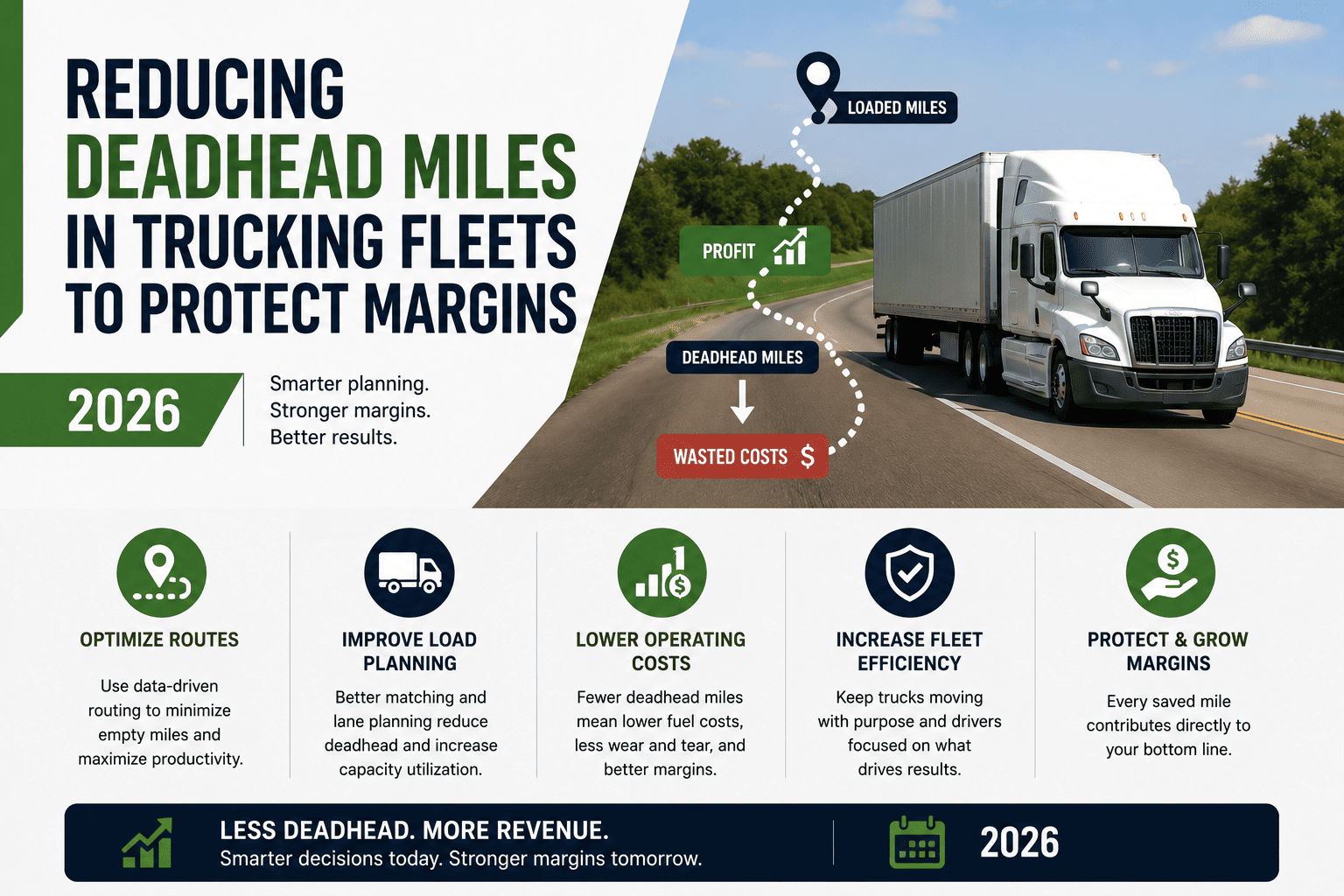
Every trucking margin conversation eventually runs into the same quiet culprit: miles that cost money but never get paid for. Deadhead miles don't show up as a dramatic line-item disaster. They show up as a margin that's a little thinner than it should be, year after year, until someone finally runs the math and realizes exactly how much profit has been driving around empty.
In a freight market where operating margins are already razor thin, deadhead isn't a minor inefficiency. It's often the single largest controllable drag on profitability that most fleets have never actually measured. This guide breaks down where deadhead really comes from, what it costs in plain numbers, and how fleets are protecting margin against it in 2026.
Deadhead's Real Bite Out Of Margin
Why Deadhead Hurts More Than It Looks Like It Should
A deadhead mile isn't a neutral event. It is a mile where every operating cost still applies, fuel, driver pay, maintenance wear, insurance, depreciation, but zero revenue comes back to offset any of it. On a loaded mile, those same costs are covered by freight revenue with margin left over. On an empty mile, the carrier simply absorbs the full cost alone. That asymmetry is why a deadhead rate that looks like "just a number" on a report can quietly consume an entire year's profit when you multiply it across a real fleet.
What That Gap Looks Like At Fleet Scale
That $2.00 swing between a loaded mile and a deadhead mile feels small in isolation. It stops feeling small the moment it's multiplied across a real fleet's annual mileage. A 100-truck fleet running 120,000 miles per truck a year at a 30 percent deadhead rate is putting 3.6 million miles on the road with zero revenue attached. At roughly $0.80 in pure cost per empty mile, that is well over two million dollars a year disappearing into miles nobody paid for.
Turn Deadhead Into A Measured, Manageable Number
FleetRabbit gives dispatchers real-time vehicle position and delivery completion timing, so backhaul search can start before a truck ever sits idle. Sign up free and see your deadhead exposure in a single dashboard.
Where Deadhead Actually Hides In Your Operation
Deadhead rarely comes from one obvious cause. It accumulates quietly from a handful of recurring patterns, each one easy to miss individually but expensive in aggregate.
Four Ways To Close The Gap
None of these require rebuilding your network from scratch. They are practical shifts in timing, visibility, and prioritization that most fleets can put in place within a single quarter.
Start The Backhaul Search Earlier
Begin looking for return freight while the outbound delivery is still in progress, not after the truck is already sitting empty. Even an hour of head start meaningfully shrinks the radius of available backhaul options.
See Every Truck's Position In One View
Dispatchers can only assign the truly closest available vehicle if they can see every truck's location and hours at once, not piece it together from memory and phone calls.
Track Trailer Dwell Time
A trailer sitting at a customer lot past its expected window should trigger a flag, so retrieval gets scheduled alongside nearby freight instead of becoming its own dedicated empty trip.
Measure Deadhead As A Standing Metric
Track empty miles by lane and by dispatcher on an ongoing basis. A number reviewed every week gets managed. A number nobody looks at quietly grows.
Match The Right Truck To The Right Load, Every Time
FleetRabbit shows vehicle position, hours of service, and maintenance status together, so dispatchers can assign the genuinely closest available truck instead of guessing. Book a free demo to see it on your own fleet's lanes.
What A One-Point Improvement Is Actually Worth
Deadhead reduction doesn't need to be dramatic to matter. Because every empty mile removed converts almost directly into margin, even small percentage improvements compound into real money at fleet scale.
| Fleet Size | Annual Miles | 1-Point Deadhead Cut | Approx. Margin Recovered |
|---|---|---|---|
| 25 Trucks | 3,000,000 miles | 30,000 miles | $24,000 / year |
| 75 Trucks | 9,000,000 miles | 90,000 miles | $72,000 / year |
| 150 Trucks | 18,000,000 miles | 180,000 miles | $144,000 / year |
| 300 Trucks | 36,000,000 miles | 360,000 miles | $288,000 / year |
These figures use a conservative $0.80 per mile pure cost recovery estimate. Fleets that cut deadhead by 5 to 10 points, a realistic target for carriers currently running above the 28 percent range, recover proportionally larger amounts every single year, not just once.
Why Margin-Focused Carriers Treat This As A Standing Priority
Fuel prices and freight rates are largely outside a carrier's control. Deadhead rate is one of the few major cost levers a fleet actually controls directly, through scheduling, dispatch discipline, and visibility. That is exactly why fleets serious about protecting margin treat deadhead reduction as an ongoing operating discipline, not a one-time project.
Frequently Asked Questions
The Bottom Line
Deadhead miles don't announce themselves the way a blown engine or a missed delivery does. They quietly erode margin one unpaid mile at a time, and in a freight market already running thin, that erosion adds up fast. The fix isn't complicated. Start the backhaul search earlier, give dispatchers full visibility into every available truck, and measure the number consistently so it can't keep hiding in plain sight.
Protect Your Margin From Every Unpaid Mile
FleetRabbit gives dispatchers the real-time visibility they need to fill more miles with paying freight and gives operations leaders the data to track deadhead as a standing performance metric, not an afterthought. Get started in minutes, no credit card required.