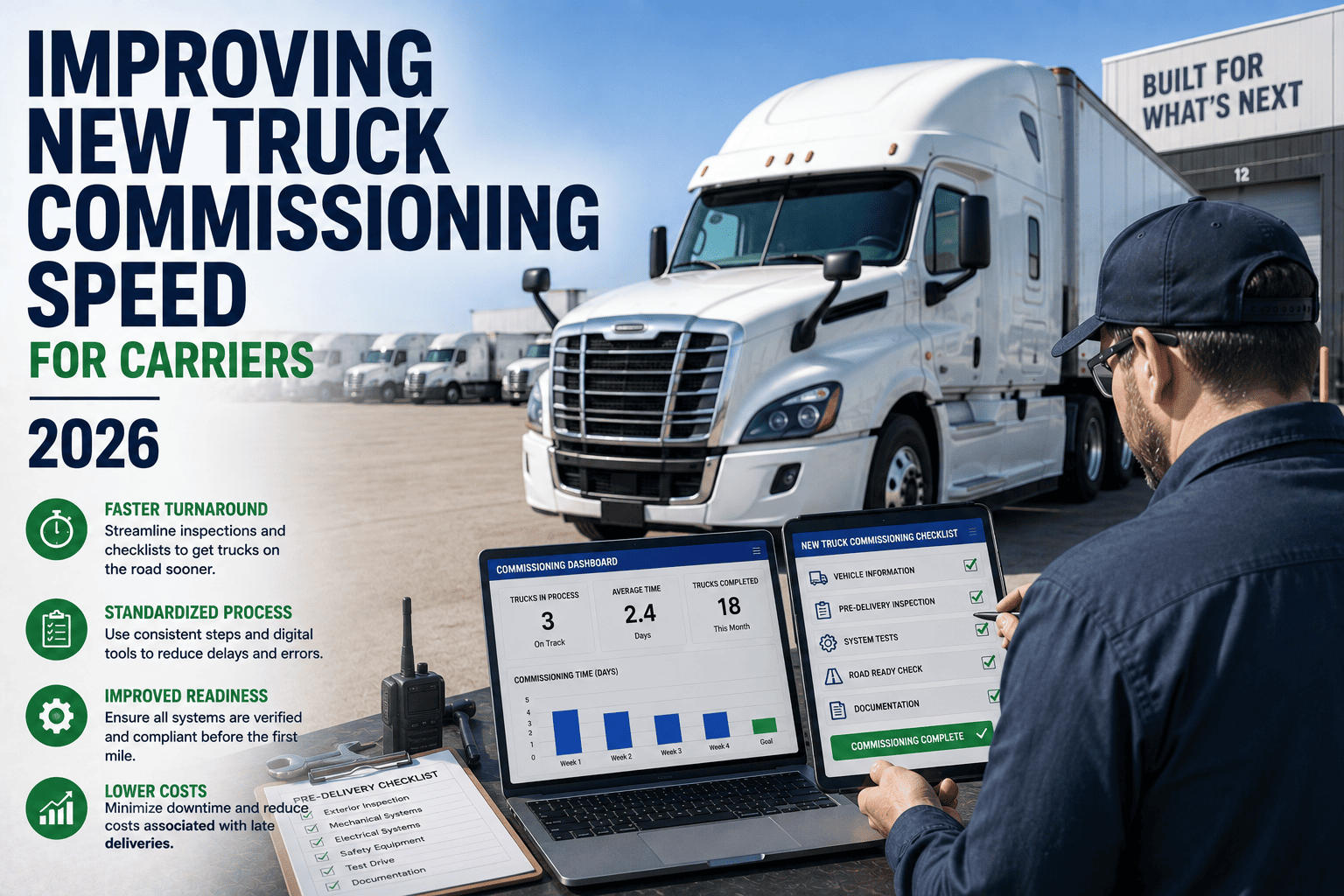
A new truck sitting in the yard for three weeks before its first dispatch is not just idle capital. It is a truck accumulating mileage without a service record, running without a fuel card assignment, and operating outside telematics visibility the moment someone finally pushes it onto the road without finishing the paperwork. A new vehicle arriving at a fleet depot without a structured commissioning process is a compliance liability, a telematics blind spot, and a maintenance data gap from its very first day of service. Improving commissioning speed is not about cutting corners. It is about running every step in the right order so nothing gets skipped under pressure.
Faster truck commissioning comes from replacing scattered manual steps, paper registration checks, separate telematics installs, disconnected PM setup, with a single guided digital workflow. Fleets running a structured onboarding process have brought commissioning down to about 25 minutes per vehicle, with VIN scanned, documents uploaded, PM schedule configured, telematics live, and fuel card assigned before the truck leaves the intake bay.
What Happens When Commissioning Gets Skipped
Missing a single step in commissioning rarely causes an immediate problem. That is exactly what makes it dangerous. The gaps compound quietly for weeks before anyone notices the truck was never fully set up.
The Six Items Every Commissioning Workflow Must Complete
At minimum, a specific set of items has to be confirmed before a truck is dispatched for the first time. Missing any single one of these creates an immediate compliance gap or an out-of-service risk the first time the truck is inspected.
FleetRabbit walks your team through every commissioning step in sequence, VIN scan, document upload, PM schedule, telematics confirmation, and fuel card assignment, so nothing gets skipped under pressure. Sign up to see your first truck commissioned end to end.
From Delivery To Dispatch: The Commissioning Sequence
Speed does not come from rushing individual steps. It comes from running them in the right order so nothing has to be redone later. A structured sequence gets a truck from delivery to active dispatch without any step blocking the next one.
Why Digital Setup Has To Happen Before Dispatch, Not After
The most common mistake fleets make is dispatching a truck first and finishing the paperwork later, planning to circle back once things calm down. That plan rarely survives contact with a busy dispatch board. The truck starts accumulating mileage immediately, and every day it runs without a configured PM schedule or confirmed telematics is a day of data the fleet can never recover.
Why A Single Digital Record Beats Scattered Systems
When registration lives in one filing cabinet, telematics setup lives with an installer, and PM scheduling lives in a separate spreadsheet, commissioning naturally slows down because someone has to manually reconcile all three. A single digital record tied to the VIN removes that reconciliation step entirely, since every piece of the commissioning process updates the same asset file.
FleetRabbit ties every commissioning step, delivery verification through active dispatch, to a single digital record per VIN, so nothing has to be reconciled across separate systems later. Book a demo to see the full sequence run start to finish on a truck like yours.
Getting To 25 Minutes Per Vehicle
Fleets that have compressed commissioning down to roughly 25 minutes per truck did not get there by skipping steps. They got there by removing the friction between steps.
Scan the VIN once, populate everywhere
Scanning the VIN a single time and having it populate registration, insurance, telematics, and PM records automatically removes the repeated manual entry that eats up most of the time in a paper-based process.
Confirm telematics live, not just installed
Installation is not the same as confirmation. Building a verification step that checks live data is actually transmitting before the truck is marked ready prevents the blind spot of a truck that appears set up but is not reporting anything.
Pre-load PM schedules from manufacturer baselines
Configuring preventive maintenance intervals from standard manufacturer baselines at commissioning, rather than waiting for a first service reminder to trigger manual setup, keeps the truck maintenance-ready from its very first mile.
Frequently Asked Questions
Key Takeaways
A new truck sitting unconfigured in the yard, or worse, dispatched with commissioning half-finished, is not a paperwork problem. It is a compliance liability, a telematics blind spot, and a maintenance data gap compounding quietly from day one. The six baseline items, registration, insurance, inspection, ELD linkage, telematics confirmation, and PM scheduling, all have to be complete before the truck's first mile, not caught up later once someone notices a gap.
Speed comes from sequence and structure, not from skipping steps. Scanning a VIN once and populating every downstream system automatically, confirming telematics data is actually live rather than just installed, and pre-loading PM schedules from manufacturer baselines are what compress commissioning from days down to about 25 minutes per truck. The fleets that get this right put every new asset into active service fully documented and fully visible from its very first dispatch.
FleetRabbit's guided commissioning workflow ties every step, delivery verification through active dispatch, to a single digital record per VIN. Sign up free and commission your next truck in one guided pass, or book a demo to see the full workflow built around your fleet's onboarding volume.