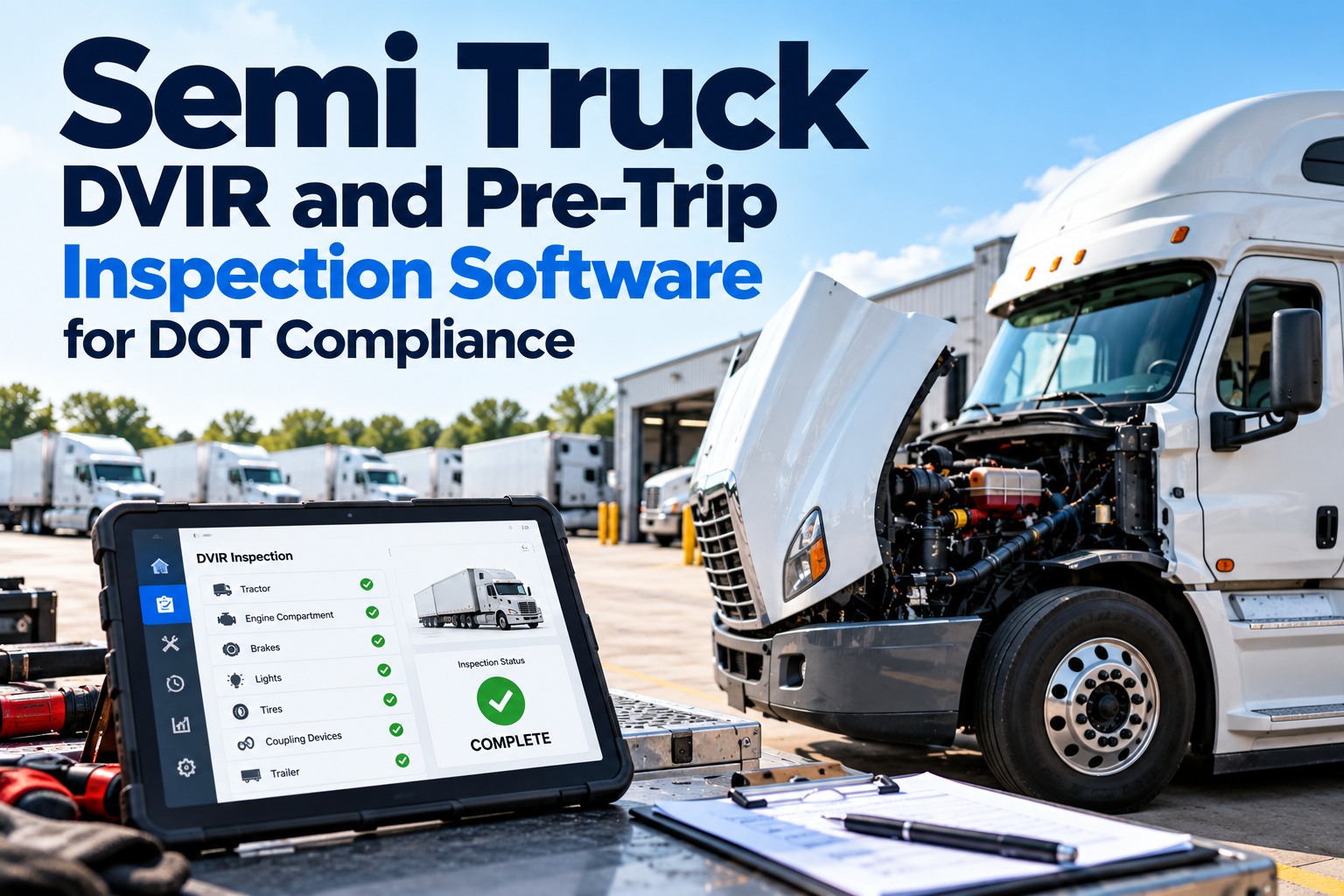
Semi truck DVIR inspection software has to do more than replace a paper pad. Three FMCSA rules govern what a driver checks before driving, what gets written at the end of the day, and what the next driver reviews. Every reported defect then needs a repair certification before the truck rolls again. This guide walks through each rule, the defects inspectors cite most, how trailers and owner-operators fit in, and how a defect turns back into uptime. Start free with FleetRabbit eDVIRs on up to three trucks.
Transportation & logistics · Driver vehicle inspection reports
A DVIR is a loop, not a form: inspect, report, repair, certify, review. Break any link and the truck is either unsafe or out of compliance.
For carriers, safety managers and owner-operators running tractors and trailers under FMCSA rules.
→
→
Repair certified
§396.11(a)(3)
→
Next driver reviews
§396.13
Pre-Trip, Post-Trip and Driver Review: The Three FMCSA Rules Behind Every Semi Truck DVIR
Carriers often call all of this "the DVIR," but the rules come from two parts of the regulations and happen at different times of day. Mapping them onto a driver's shift shows where each one fits.
Before driving
On the road
End of the workday
§392.7 · Pre-trip
The driver must be satisfied that 11 parts and accessories are in good working order before driving, from service brakes and trailer brake connections to coupling devices and emergency equipment.
No written report required
§396.13 · Driver review
Before driving, the driver reviews the last report and, if defects were listed, signs to acknowledge the repair certification.
Signature on the prior DVIR
§396.11 · Post-trip report
At the end of each workday, a written report for each vehicle operated, listing any defect found or reported. Property carriers don't need a report when nothing is wrong.
Keep 3 months, with repair and review certifications
Because the review step depends on yesterday's report, a missing or unsigned DVIR breaks the next morning's compliance too. Keeping all three steps on one DVIR record per truck is what makes the loop easy to audit.
Lamps, Tires and Brake Hoses Led 2025's Roadside Violations, and Every One Is on the DVIR List
J. J. Keller's count of 2025 roadside violations, drawn from nearly 2 million inspections, reads like the §392.7 checklist. Here are the DVIR items alongside the violations inspectors wrote against them.
✓
Lighting devices and reflectors
660,792 lamp violations · #1
✓
Service brakes, trailer connections
✓
Parking brake · steering · horn · mirrors · coupling devices · wheels and rims
The rest of the §392.7 list
Paperwork, not parts
"No proof of annual inspection" (§396.17) ranked #4, with 227,662 violations.
J. J. Keller Compliance Network, "Top 20 commercial vehicle violations of 2025" (January 2026).
A good pre-trip catches most of these in a few minutes. The difference software makes is that a dead marker lamp becomes a photographed defect and a work order, not a note someone meant to mention. You can see that flow in a 20-minute demo.
Tractor + trailer
One report per vehicle operated — including the trailer you hooked this morning
Pooled and Swapped Trailers Need Their Own DVIR History, Not Just the Tractor's
Section 396.11 asks for a report on each vehicle a driver operates that day. In pooled-trailer operations, a trailer may change hands several times a week, so a defect has to follow the trailer number, not the tractor or the driver. Intermodal chassis have their own rules: the driver checks them under §392.7(b) and reports damage to the equipment provider under §396.11(b).
Tractor 2207
Driver A this week
Brakes, steering, lights, tires, mirrors, horn, wipers
Fifth wheel and coupling devices
History follows the tractor
Trailer 53-118
Three tractors this week
Trailer brake connections, glad hands, air lines
Lights, conspicuity tape, tires, wheels, landing gear
History follows the trailer
If a trailer's open defect only lives on the tractor's report, the next driver who hooks it never sees it. Tracking trailers as their own units, with their own defects and preventive maintenance schedules, closes that gap.
DVIR Rules for Owner-Operators: What Changes When You Are Both the Driver and the Carrier
Owner-operators ask this more than anyone, and the answer depends on how you run.
How are you operating?
Leased onto a carrier
You follow the carrier's DVIR program, and the carrier keeps the records and certifies repairs, often through its own app or forms.
Own authority, one truck
§396.11(a)(5) exempts carriers operating only one commercial motor vehicle from the written post-trip report. The §392.7 pre-trip, §396.3 maintenance records and the annual inspection still apply.
Own authority, two or more trucks
Full §396.11 applies: a report per vehicle when defects are found, your own repair certification, and three months of records.
Even single-truck operators who are exempt often keep DVIRs anyway, because a dated defect and repair history helps at roadside inspections, at resale and when growing into a second truck. You can start keeping one free.
From DVIR Defect to Back in Service: How the Repair Certification Protects Semi Truck Uptime
Before the truck runs again, every defect on the report needs a certification that it was repaired or that repair is unnecessary. How fast that loop closes decides how long the truck sits.
Driver
Reports defect with photo
Next driver reviews and signs
Shop
Triage: safety-affecting or not
Repairs, then certifies on the report
Defects likely to affect safety must be repaired before the truck operates. The certification is required for every listed defect.
When the photo arrives with the report, the shop can triage before the truck pulls in and have parts waiting. Repeat defects on the same truck are also the best signal for what to add to its next PM.
How FleetRabbit Runs FMCSA-Ready Semi Truck DVIRs From Pre-Trip to Signed Repair
FleetRabbit puts the whole loop on drivers' phones and the shop's screen, and keeps the result as the report an auditor expects to see.
Driver Vehicle Inspection Report
Sample · eDVIR under §390.32
Vehicle
Tractor 2207 + Trailer 53-118
Defect
Trailer right rear marker lamp out · photo
Repair certified
M. Chen, shop
Wed 05:20 · lamp replaced
Retained 3 months · searchable by tractor or trailer
DOT-compliant eDVIRs
Pre- and post-trip items set to §392.7 and §396.11, with photos and signatures
Tractors and trailers
Separate units with separate histories, linked on the day they're coupled
Defect to work order
Safety-affecting defects flag the truck and reach the shop instantly
A/B/C-service PM
Repeat DVIR defects feed the truck's next scheduled service
What the 20-minute demo covers
A pre-trip on a phone, with a photo defect
The shop certifying the repair
The next driver's review and signature
A trailer's history across three tractors
Semi Truck DVIR Inspection Software: Questions Drivers and Carriers Ask
Is an electronic DVIR DOT compliant?
Yes. FMCSA's final rule effective March 23, 2026 confirms DVIRs and driver reviews may be completed and kept electronically under 49 CFR 390.32. Paper is still allowed.
Do I need a DVIR if nothing is wrong with the truck?
For property-carrying trucks, no. Section 396.11 doesn't require a post-trip report when no defect is found or reported. Many carriers still record a no-defect inspection as proof the check happened.
What's the difference between a pre-trip and a DVIR?
The pre-trip (§392.7) is the driver confirming parts work before driving. The DVIR (§396.11) is the written end-of-day report of defects, which the carrier must certify and the next driver must review.
Do owner-operators need to complete DVIRs?
A carrier operating only one commercial motor vehicle is exempt from the §396.11(a) written report. Leased owner-operators follow their carrier's program. Pre-trip, maintenance records and annual inspections still apply.
Does the trailer need its own DVIR?
The report must cover each vehicle operated, so trailer defects must be recorded against the trailer. Intermodal chassis defects are reported to the equipment provider.
How long must DVIRs be kept?
Inspect · Report · Repair · Certify · Review
Close Every Semi Truck DVIR Loop Before the Truck Rolls Again
Pre-trips on the phone, defects with photos, repairs certified by the shop and reviewed by the next driver, all on one audit-ready record.
Free for up to 3 trucks · No credit card required
October 22, 2026
By Sam Parker
All Posts