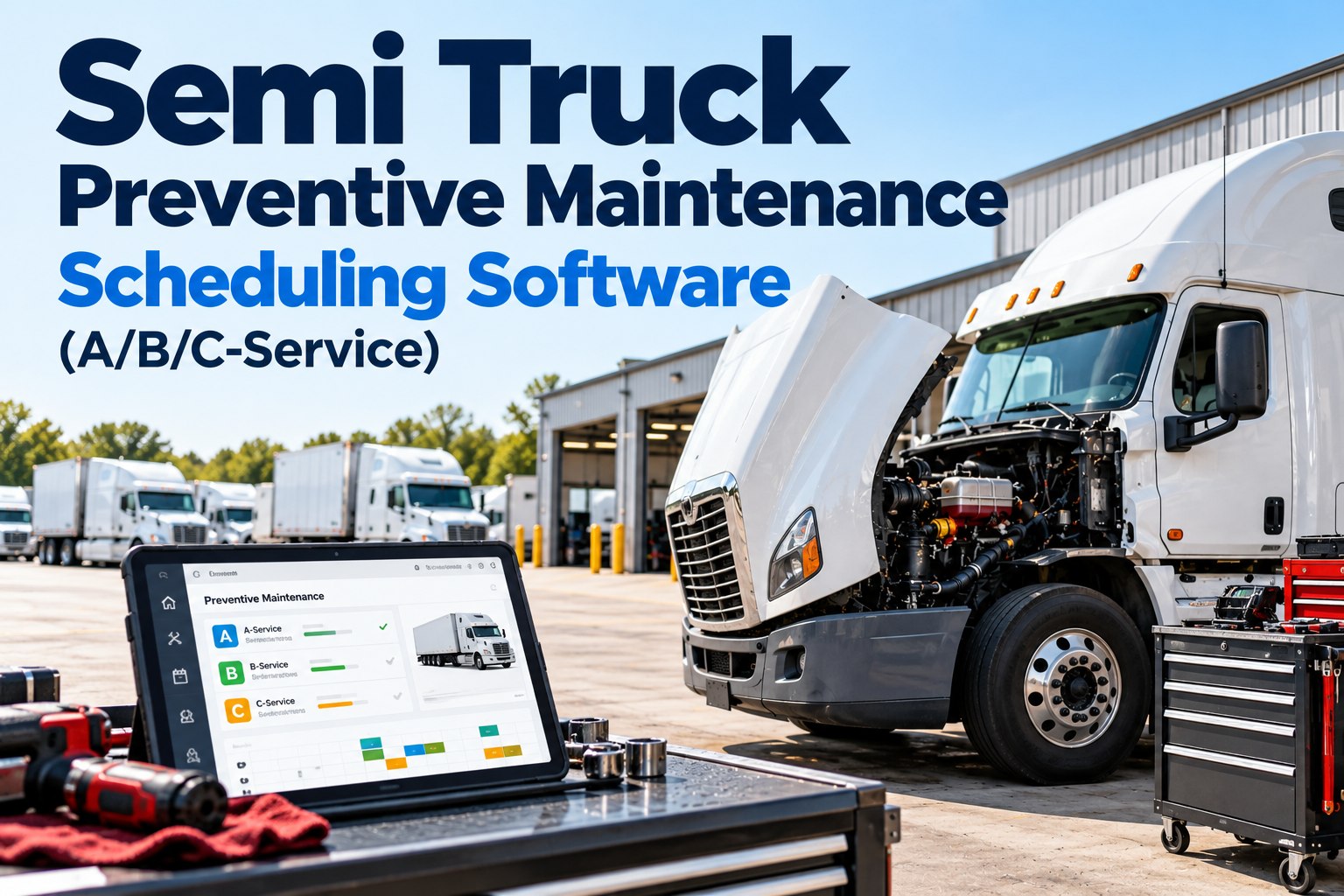
Semi truck preventive maintenance software exists to answer one question for every tractor: which service is due next, and when? A/B/C-service scheduling answers it by nesting three service levels and triggering each on miles, engine hours or time, whichever comes first. This guide shows how to build the ladder, set intervals by duty cycle, keep the shop from overloading, and fold in the annual inspection. Start free with FleetRabbit and set up your first three trucks today.
Transportation & logistics · Tractor PM scheduling
Every B-service includes an A. Every C-service includes a B. Get the nesting right and the schedule mostly runs itself.
For maintenance managers and shop leads scheduling Class 8 tractors across long-haul, regional and local work.
C-service
Major items + annual inspection
B-service
Oil, filters, fluids
A-service
Inspect, lube, adjust
FMCSA Expects a PM Schedule, Not Just Repair Records: What §396.3 Actually Requires
Many carriers think of FMCSA maintenance rules as record-keeping after the fact. Section 396.3 goes further: alongside each vehicle's identification and its repair history, the carrier must keep "a means to indicate the nature and due date of the various inspection and maintenance operations to be performed." In other words, a schedule.
(b)(1)
Vehicle identification: company number, make, serial number, year
Truck profile
(b)(2)
The nature and due date of each inspection and maintenance operation
Your A/B/C schedule
(b)(3)
A record of inspections, repairs and maintenance, with date and nature
Completed work orders
(c)
Kept where the truck is housed or maintained for 1 year, and 6 months after it leaves your control
Retention
A whiteboard of due dates technically counts, but it can't show an auditor what was due, what was done and when. A preventive maintenance schedule that stores all three on the truck's record answers (b)(2) and (b)(3) together.
How A, B and C Services Nest: The Semi Truck PM Ladder Most Fleets Start From
Tier contents vary by fleet and OEM, but the structure is consistent: each tier adds tasks on top of the one below, so a truck that gets a C has also had everything in its B and its A. That means you only ever schedule the highest tier due.
Chassis lube
Brake adjustment and lining check
Tires and wheel ends
Fluid levels
Lights and air leaks
Open DVIR defects closed
Engine oil and filter
Fuel filters
Coolant test
Belts and hoses
Air dryer check
Transmission and axle fluids per OEM
Aftertreatment service per OEM
Major component inspection
Annual DOT inspection (§396.17)
A typical starting ladder. Your engine, transmission and axle makers set the actual tasks and intervals.
FleetRabbit's guide to PM-A vs PM-B vs PM-C covers task lists and bay times in more depth. If you want to see this ladder built as templates on your own trucks, book a short walkthrough.
The Same Engine Can Need Its Oil Changed at 35,000 or 75,000 Miles: Set B-Service by Duty Cycle
Engine makers set oil drain intervals by fuel economy, because mpg reflects how hard the engine works. Chevron's published summary of OEM drain intervals shows how wide the range is for the same engine on approved oils.
Detroit DD15 oil drain interval by duty cycle
GHG '17 and '21 · approved oils
Efficient long haul
Over 7.0 mpg
Detroit's mpg figures include idle time. Cummins' 2021 X15 runs from 25,000 miles (severe) to 75,000 (light) on the same guide.
Chevron Delo OEM Drain Intervals guide (2022). Confirm current intervals with your engine maker.
Put a severe-duty interval on a long-haul tractor and you change oil twice as often as you need to. Put a long-haul interval on an idle-heavy local tractor and you run it well past its limit. Assigning each truck its own duty cycle, and reviewing it when the truck's work changes, is what keeps B-services honest. You can set per-truck intervals free.
Miles, Engine Hours or Months: Which Trigger Brings Each Semi Truck to the Shop First
Using the DD15 intervals above, here is how long three tractors take to reach a B-service at their typical weekly mileage. The local truck shows why a calendar limit matters too.
Long haul
2,500 mi/week · 60,000 mi interval
Miles hit first · week 24
Regional
1,500 mi/week · 45,000 mi interval
Miles hit first · week 30
Local, idle-heavy
600 mi/week · 35,000 mi interval
Miles would take 58 weeks — the calendar limit hits first
Illustrative weekly mileage. Use your OEM's hour and month limits where it sets them, plus your own policy.
That's the reason to trigger every tier on whichever comes first. A schedule built on miles alone quietly lets low-mileage trucks drift past their service limits.
Let each truck's own miles, hours and calendar decide when its next service is due
Whichever-comes-first triggers on every A, B and C service, per truck.
Forecast the Next 8 Weeks of A/B/C Services So the Shop Never Gets 5 Trucks in a 3-Bay Week
Once every truck has a due date, you can see the shop's load before it arrives. In the sample below, week 5 has five services against three bays. Pulling two of them forward a week — both are within their interval — levels the load without a single overdue truck.
Swipe sideways to see all 8 weeks
Truck
Wk 1
Wk 2
Wk 3
Wk 4
Wk 5
Wk 6
Wk 7
Wk 8
Load / 3 bays
2
1
1
0 → 2
5 → 3
1
1
1
A
Original slot, moved earlier
Pull work forward, never push it back past its interval. A forecast like this also gives dispatch a week's notice, so a truck due for a B can be routed home instead of out on a long run. If you want to see this forecast on your fleet, a 20-minute demo builds it live.
Fold the Annual DOT Inspection Into the C-Service and Save a Shop Visit Every Year
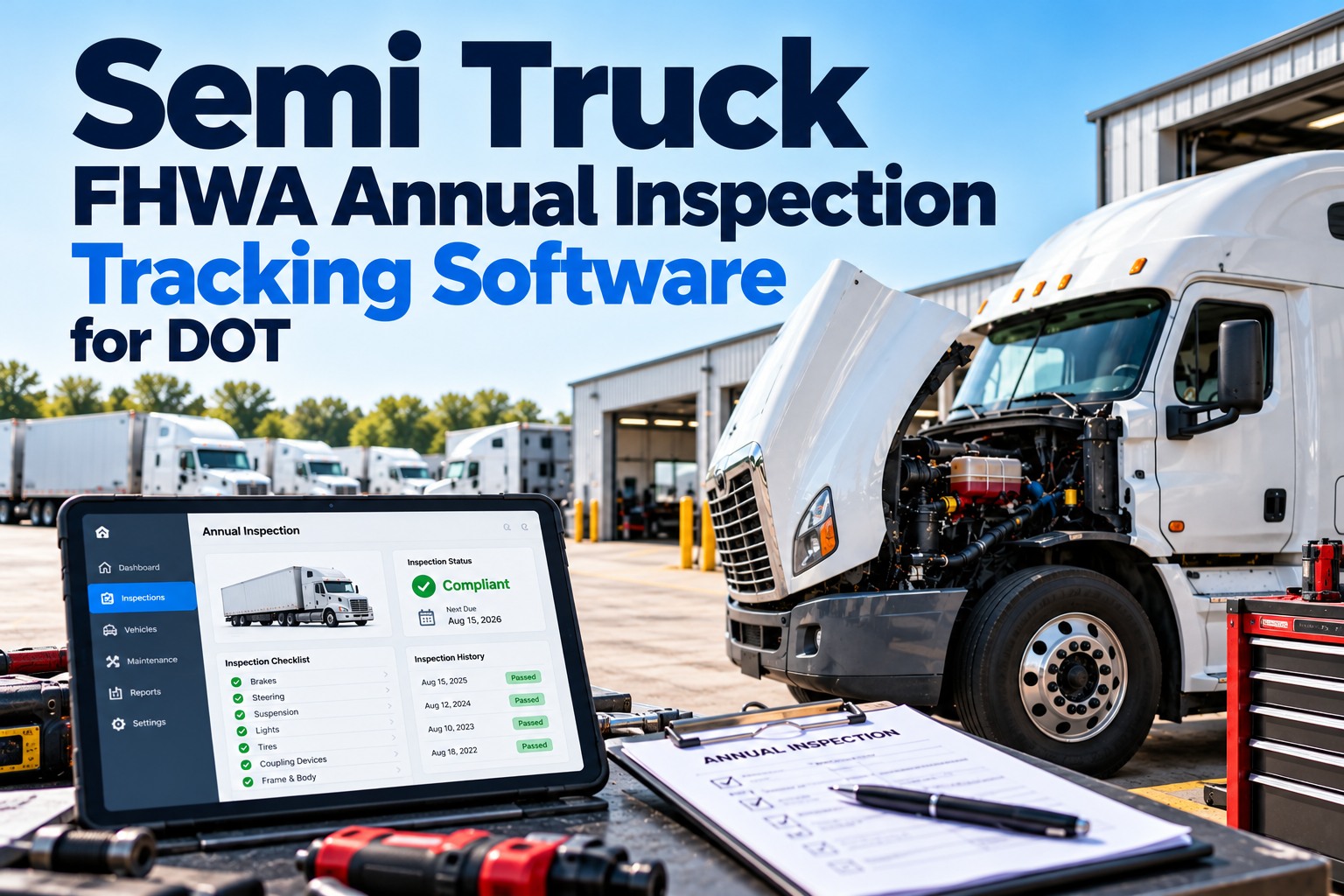
Section 396.17 requires every truck to pass a periodic inspection at least once every 12 months, and §396.21 requires the report to be kept for 14 months. If that date is tracked separately from your PM schedule, the truck comes in twice. Line them up and it comes in once.
C-service
Due on miles, hours or calendar
Annual inspection
Due every 12 months, §396.17
⟶
One visit
Schedule the C when the annual comes due, or move the annual forward to meet the C. Either way, one bay day and one record.
The inspection still needs a qualified inspector and its own report, but the truck only comes off the road once. Linking the annual's due date to the truck's PM record is a small setup step that removes one of the most common audit findings.
Tune Your A/B/C Intervals With Evidence: Four Signals That a Semi Truck Schedule Is Off
Intervals aren't set once. Chevron's guide recommends used oil analysis before extending drains, and your own repair history will show whether the schedule fits the work.
You see
Breakdowns between B-services on the same trucks
Adjust
Shorten A intervals or add the failing item to the A list
You see
Oil analysis consistently clean at drain
Adjust
Consider extending B, within the OEM's duty-cycle limit
You see
A truck's mpg has slipped into a harsher band
Adjust
Move it to the matching duty cycle and shorter interval
You see
DVIRs repeatedly reporting the same defect
Adjust
Add a check for it to the next tier due
The last signal only works if drivers' DVIR records sit on the same truck record as its PM history, so repeat defects are visible to whoever plans the next service.
How FleetRabbit Schedules A/B/C-Service PM for Every Semi Truck in Your Fleet
FleetRabbit tracks each tractor's position on its own ladder and tells the shop and dispatch what's coming.
Truck 1108 · long haul
Sample · next due: C-service
A-service
Done 2 weeks ago
B-service
Covered by the C
C-service + annual
Due in 1,900 mi or 11 days
Trigger: calendar (annual inspection) before miles
Nested templates
Build A, B and C once; a C automatically resets the B and A clocks
Whichever-first triggers
Miles, engine hours and calendar on every tier, per truck and duty cycle
Forecast and leveling
See upcoming services by week and pull work forward before bays overload
FMCSA-ready records
DVIRs, PM history and annual inspections on one audit-ready file
What the 20-minute demo covers
Your A/B/C ladder built from your OEM intervals
Duty cycles assigned per truck
An 8-week forecast with a busy week leveled
A C-service lined up with the annual inspection
Semi Truck Preventive Maintenance Scheduling: Questions Fleets Ask
What is the difference between A, B and C service on a semi truck?
They are nested service levels. A is a regular inspection, lube and adjustment; B adds the oil and filter change and related items; C adds major fluid and component work and often the annual inspection. Each higher tier includes everything in the tiers below it.
How often should a semi truck get an oil change?
It depends on the engine and duty cycle. Published OEM intervals for a Detroit DD15 range from 35,000 miles in severe service to 75,000 in highly efficient long haul on approved oils. Check your engine maker's current guidance.
Should PM be scheduled on miles or engine hours?
Both, plus a calendar limit, with whichever comes first triggering the service. Low-mileage and idle-heavy trucks can reach hour or time limits long before their miles.
Does FMCSA require a PM schedule?
Section 396.3(b)(2) requires a means to indicate the nature and due date of inspection and maintenance operations, along with records of work done.
Can the annual inspection be done during a PM?
Yes, as long as it's done by a qualified inspector and documented as required by §396.17 and §396.21. Many fleets line it up with the C-service.
How long does setup take?
Put Every Semi Truck on Its Own A/B/C Ladder and Stop Guessing What's Due Next
Nested services, whichever-first triggers, a shop calendar you can see coming, and one record that satisfies §396.3.
Free for up to 3 trucks · No credit card required
October 22, 2026
By Alex Rowan
All Posts