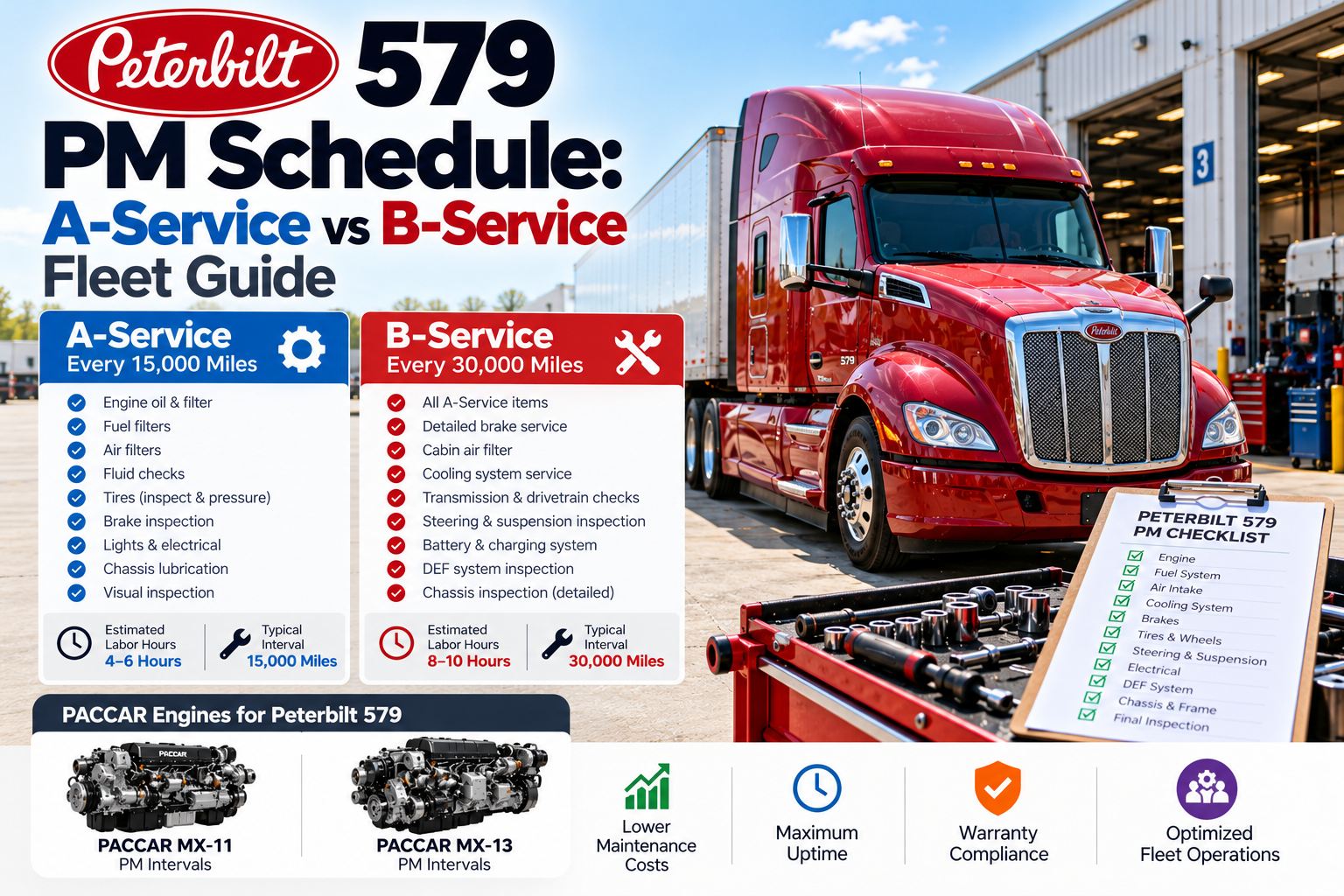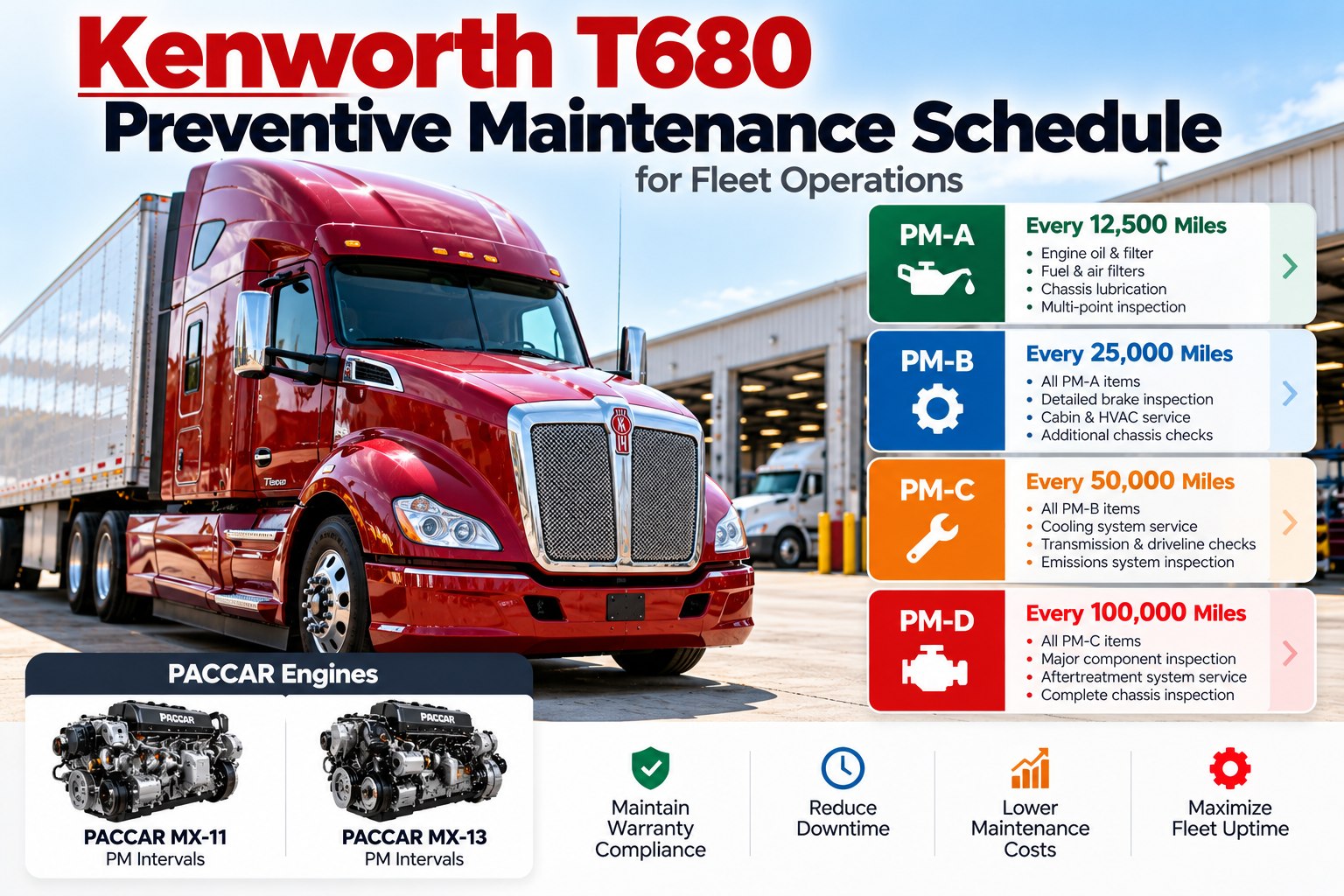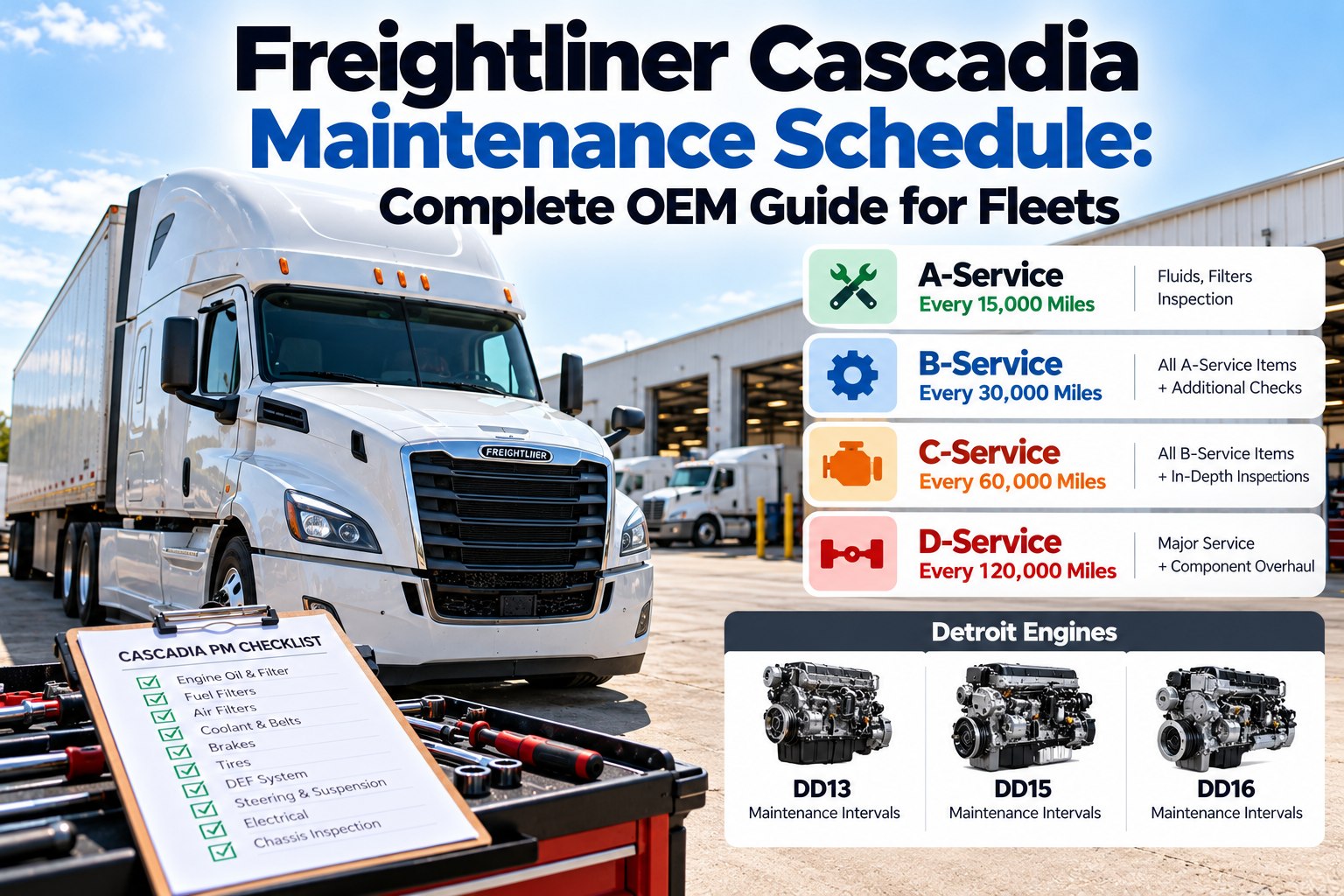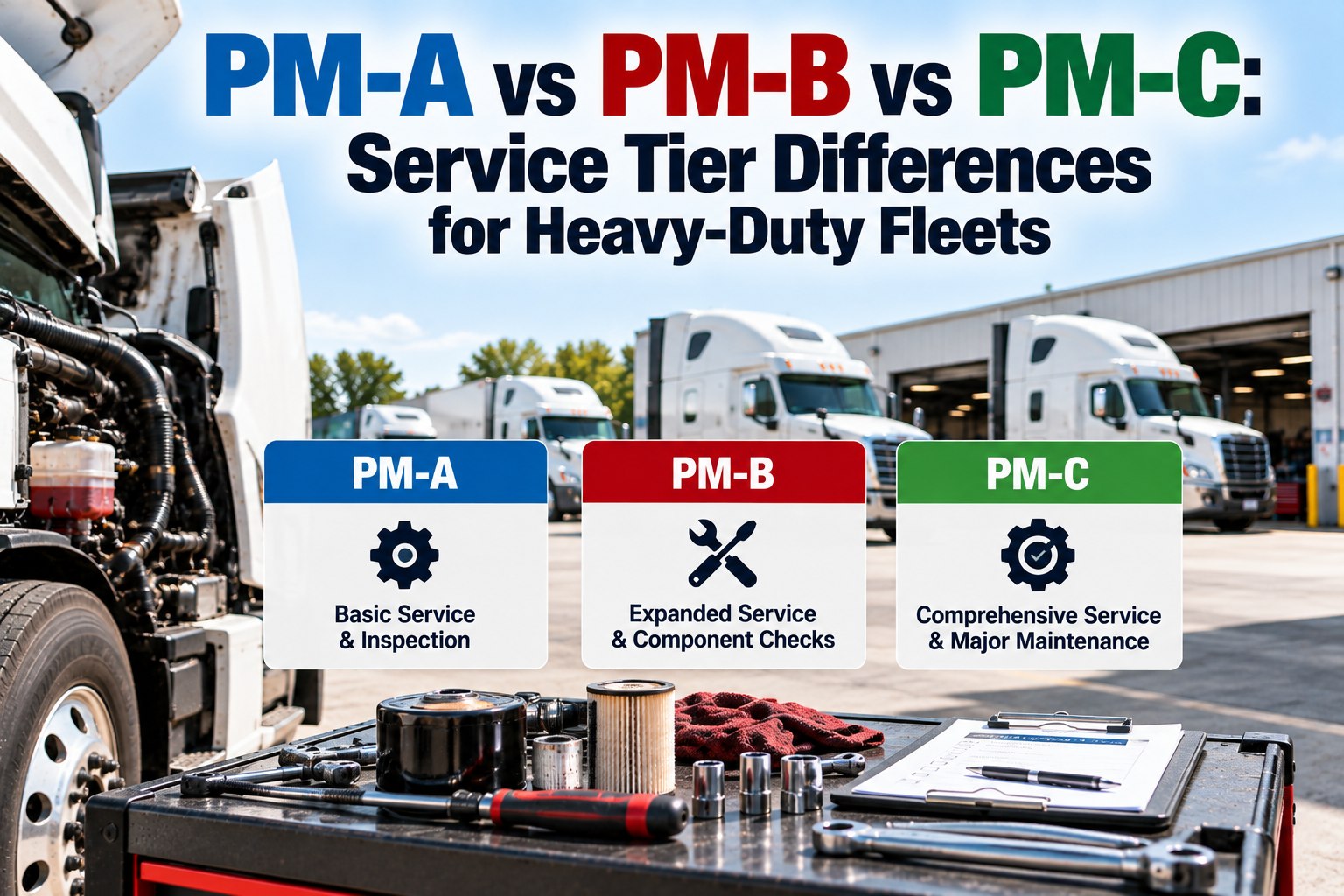
PM-A, PM-B and PM-C are the three service levels most heavy-duty fleets run: a light, frequent service; an intermediate one that adds filters, brake measurement and system checks; and a comprehensive one that adds driveline fluids, wheel ends and the deeper inspections that carry a truck through its annual. The names are only labels — what decides whether the program works is which tasks sit in each tier, what triggers each tier for each engine and duty cycle, and whether the same template gets used on every truck, every time. Cummins publishes X15 oil drain intervals ranging from 25,000 miles on severe duty to 60,000 on light duty, with 500-hour and 12-month limits alongside them, which is why a single fleet-wide mileage number quietly under-services half a mixed fleet. This guide compares the three tiers task by task, shows how to set intervals from the manufacturer's own tables, works through shop capacity and cost, and covers the compliance records each tier should produce. Book a 30-minute demo to see your own trucks loaded onto tiered schedules, or start free with 3 vehicles.
Service levels compared · Heavy-duty fleets
Three Service Levels, One Question: Is Every Truck Getting the Right One at the Right Time?
For maintenance managers, shop leads and fleet owners running mixed equipment: what belongs in PM-A, PM-B and PM-C, how to set intervals per engine and duty cycle, and how to keep the templates identical across every bay.
Oil, filters, fluids, tires, lights, brake visual, fault codes
1–2 hours in the bayAll of PM-A plus fuel and air filters, brake measurement, steering, suspension, battery and coolant tests
2–3 hours in the bayAll of PM-B plus driveline fluids, wheel ends, chassis lubrication and annual-inspection items
4–6 hours in the bayBay times shown are planning estimates for a typical Class 8 tractor; measure your own.
How Tiered Preventive Maintenance Works and Why the Tiers Nest Inside Each Other
A tiered schedule spreads inspection depth across the year so the shop isn't doing everything at every visit. Each tier includes every task in the tiers below it, so when a truck reaches its PM-C threshold it gets PM-A and PM-B work in the same appointment and all three interval clocks reset from that date. Nesting is what stops a tiered program becoming a stream of small, disruptive visits — and it's the first thing that breaks when schedules live in a spreadsheet. You can set nested tiers up on three trucks with a free account.
When the higher tier completes, reset the lower clocks with it or trucks come back for work that was already done.
Each tier needs a mileage trigger, an hours trigger and a calendar limit. The first one reached is the one that counts.
Fleets use A/B/C, others use 1/2/3 or by mileage. What matters is the task list behind each name, written down.
PM-A vs PM-B vs PM-C: What Each Service Level Actually Covers
This is the comparison most fleets never write down, which is why the same truck gets a different "PM-B" depending on who is in the bay. Use it as the starting point for your own templates, then add the tasks your equipment and duty cycle demand. We'll turn this into your three templates during the demo. Swipe the table on mobile.
| Task | PM-A | PM-B | PM-C |
|---|---|---|---|
| Engine oil and filter change | |||
| Fluid levels topped and checked | |||
| Tire pressure, tread and irregular wear | |||
| Lights, reflectors and electrical check | |||
| Brake visual inspection | |||
| Fault codes read, active and inactive | |||
| Fuel filter replacement | |||
| Air filter by restriction indicator | |||
| Brake lining measurement and adjustment | |||
| Steering and suspension inspection | |||
| Battery load and charging system test | |||
| Coolant test: SCA, freeze point, condition | |||
| Driveline, U-joints and slack adjusters | |||
| Transmission and differential service | |||
| Wheel-end inspection, seals and hub oil | |||
| Full chassis lubrication | |||
| Aftertreatment review: regen history, DEF quality | |||
| Annual inspection items, Appendix G |
A representative task split for Class 7–8 tractors, our assessment — not a manufacturer standard. Confirm every item against your OEM service information and your own failure history.
Where PM Intervals Really Come From: Duty Cycle, Not the Tier Name
Engine makers publish intervals by duty cycle, not by tier label. Cummins, for example, bands X15 duty cycle by fuel economy and sets very different oil and fuel filter intervals for each band, with hours and months alongside the miles. The gap between severe and light duty on a single engine family is more than double — so one fleet-wide oil interval is either wasting money or shortening engine life, depending on the truck. Set per-model intervals free on 3 vehicles. Swipe the table on mobile.
| Cummins X15 service | Severe (3–4.9 mpg) | Short haul (5–5.9) | Normal (6–6.9) | Light (7+) |
|---|---|---|---|---|
| Oil drain and filter | 25,000 mi | 40,000 mi | 50,000 mi | 60,000 mi |
| Fuel filters | 25,000 mi | 40,000 mi | 50,000 mi | 60,000 mi |
| Coolant SCA check | 30,000 mi / 1,000 hr / 6 months | 30,000 mi / 1,000 hr / 6 months | 30,000 mi / 1,000 hr / 6 months | 30,000 mi / 1,000 hr / 6 months |
| DEF filter | 300,000 mi / 6,750 hr | 300,000 mi / 6,750 hr | 300,000 mi / 6,750 hr | 300,000 mi / 6,750 hr |
| Overhead (valve) adjustment | 500,000 mi / 10,000 hr / 60 months | 500,000 mi / 10,000 hr / 60 months | 500,000 mi / 10,000 hr / 60 months | 500,000 mi / 10,000 hr / 60 months |
From a Cummins X15 quick reference guide published by Cummins. Intervals also carry a 500-hour and 12-month limit, and an extreme severe band below 3 mpg drops the oil interval to 4,500 miles, 500 hours or 12 months, whichever comes first. Figures vary by engine series and model year — always use the guide for your exact engine.
Intervals move, and your schedule should move with them
At the 2026 TMC Annual Meeting, Valvoline and Cummins announced an approved oil drain interval of up to 100,000 miles for 2021–2026 X15 engines running Valvoline Premium Blue One Solution Gen 2 — an extension of up to 25,000 miles over previous recommendations. Fleets on oil analysis programs have had similar extensions available for years. None of that value reaches the shop floor if intervals are hard-coded in a spreadsheet nobody revisits.
Why Mileage-Only Tiers Under-Service Vocational and Stop-Start Trucks
Engine hours accumulate whether or not the odometer moves. A truck that idles, works a PTO or crawls through city routes reaches its hour limit long before its mileage limit — and Cummins lists a 500-hour limit alongside its mileage intervals for exactly that reason. Run the arithmetic for your own routes before assuming miles are enough. We can score each unit's duty cycle with you in a demo.
500 engine hours arrives at roughly 27,500 miles — well after a 25,000-mile severe interval and close to a normal one.
500 engine hours arrives at roughly 11,000 miles. A 25,000-mile schedule runs the oil more than twice its hour limit.
Hours climb while the truck is stationary, so mileage badly understates wear. Some applications need an hours-only trigger.
Simple arithmetic at the stated average speeds, shown to illustrate the gap. Use each truck's real telematics data rather than an assumed average.
What we'll actually do in the demo
- Load a sample of your units with their engines, duty cycles and current meters
- Build PM-A, PM-B and PM-C templates from your task lists
- Set mileage, hour and calendar triggers per model and show which trucks are already overdue
- Show the next 90 days of PM load against your bay capacity
Making PM-A, PM-B and PM-C Mean the Same Thing in Every Bay
The biggest difference between fleets that get value from tiers and fleets that don't isn't the interval — it's whether the template is identical every time. A tier that drifts from technician to technician can't be measured, can't be compared across trucks, and can't prove a systematic maintenance program. Six rules keep templates honest. Build standard templates free on 3 vehicles.
A day cab and a vocational chassis need different PM-B lists even if both say "PM-B" on the work order.
Measurements — lining thickness, tread depth, battery voltage — turn a checklist into trend data.
A defect found and not scheduled is the most expensive line on a PM sheet.
Deferred work needs evidence and a due date, not a note in a margin.
When you add a task, the change should be dated so you know which trucks got which version.
Without them you can't cost a tier or compare shops and vendors.
Planning Bay Capacity Around the Three Tiers Before the Backlog Starts
A schedule with no capacity behind it becomes a backlog inside a month, and backlogged PMs are how fleets end up doing unplanned repairs anyway. The arithmetic is simple enough to do on a whiteboard: annual mileage divided by interval gives services per truck per year, multiplied by bay hours per tier gives the shop load. We'll run this against your own fleet in the demo.
Worked example: 40 tractors, 110,000 miles a year each
What the number is for
It tells you whether your own shop can carry the program or whether some tiers belong with a vendor — and it shows what happens when PMs slip: the hours don't disappear, they come back as unplanned work at a worse time and a higher rate.
Illustrative arithmetic with example intervals and bay times. Substitute your own.
Where the Tiers Meet Federal Requirements and the Records You Must Keep
Federal rules require carriers to systematically inspect, repair and maintain the vehicles under their control, and to keep records proving it. A tiered program is the easiest way to show that system exists — provided each service produces a record. Most fleets align the annual inspection with their PM-C or an annual tier, and keep driver inspection reports feeding the same work order stream. Keep every record with its retention date free.
The rule your tiered schedule satisfies. Maintenance records are kept one year, plus six months after the vehicle leaves your control.
Kept three months. Defects reported here should pull a truck's next tier forward when they repeat.
Every vehicle inspected annually to the Appendix G standard; the report is kept 14 months. Schedule it with your deepest tier.
What Tiered PM Costs Against What an Unplanned Failure Costs
PM is the only maintenance you can schedule around freight. Everything else happens when the truck decides. Industry benchmarking puts unplanned downtime at about $448 to $760 per truck per day before towing and repair; CCJ reports unplanned repairs costing fleets $700 to $1,500 in lost revenue per day; Eaton cites a possible $800-plus daily downtime cost and potential savings of two days of downtime on connected components; and ATRI puts 2025 repair and maintenance cost at $0.215 per mile, up 8.6%. Estimate your own exposure with our team.
Relative cost, illustrative. The gap is labor rate, towing, lost revenue and the repairs that the failure causes downstream.
The Numbers That Tell You Whether Your Tiers Are Set Correctly
Tiers are a hypothesis about how fast your trucks wear. These five measures test it, and they're the reason to keep PM findings as data rather than paper, reviewed beside your preventive maintenance schedule. Start tracking them free.
Six Mistakes That Make Tiered PM Programs Fail in Mixed Fleets
Each of these is common, and each shows up as either wasted labor or a breakdown that the schedule should have caught. We'll check your program against these in the demo.
Severe-duty intervals differ by engine family. A single fleet-wide number under-services some trucks every drain.
High-idle and stop-start trucks blow past hour limits long before the odometer catches up.
Separate visits for PM-A and PM-C in the same month waste bay time and driver hours.
If PM-B means something different in each bay, none of the data compares.
The deferred defect is the one that strands the truck.
Approved extensions and duty-cycle changes both move the right interval. Review yearly.
PM-A, PM-B and PM-C Questions Heavy-Duty Fleets Ask Most
What is the difference between PM-A, PM-B and PM-C?
PM-A is the light, frequent service covering oil, fluids, tires, lights, brake visual checks and fault codes. PM-B adds fuel and air filters, brake measurement, steering, suspension, battery and coolant testing. PM-C adds driveline fluids, wheel ends, chassis lubrication and the deeper inspection items, and each tier includes everything below it. See all three built on your trucks.
What mileage should each PM tier use?
Take the intervals from the engine and vehicle maker for your exact model and duty cycle, then set mileage, hour and calendar triggers together. Cummins, for example, publishes X15 oil intervals from 25,000 miles on severe duty up to 60,000 on light duty, with 500-hour and 12-month limits. Set per-model intervals free.
Should we schedule by miles or engine hours?
Use whichever comes first per unit. Highway tractors usually hit mileage first; stop-start and vocational trucks hit hours far sooner, which is why hour limits exist alongside mileage in manufacturer tables. Score your duty cycles with us.
Do PM tiers satisfy federal maintenance requirements?
A tiered program is how most carriers demonstrate the systematic inspection, repair and maintenance the rules require — provided each service produces a record and the annual inspection is scheduled and kept. Keep the records free.
How long does each tier take in the bay?
Plan roughly one to two hours for PM-A, two to three for PM-B and four to six for PM-C on a Class 8 tractor, then measure your own and use those numbers for capacity planning. Run the capacity math with our team.
How do we keep every bay running the same PM template?
One template per tier per model family, every item pass, fail or measured, failed items opening work orders automatically, and version control when the list changes. That's exactly what maintenance software is for. Build your templates free.
See PM-A, PM-B and PM-C Running on Your Own Fleet Before You Commit to Anything
Most fleets already know roughly what belongs in each tier. What they don't have is a schedule that triggers on miles, hours and dates per model, templates that stay identical in every bay, and records that prove the program. That's the demo.
No credit card required. Bring a unit list and your current intervals.