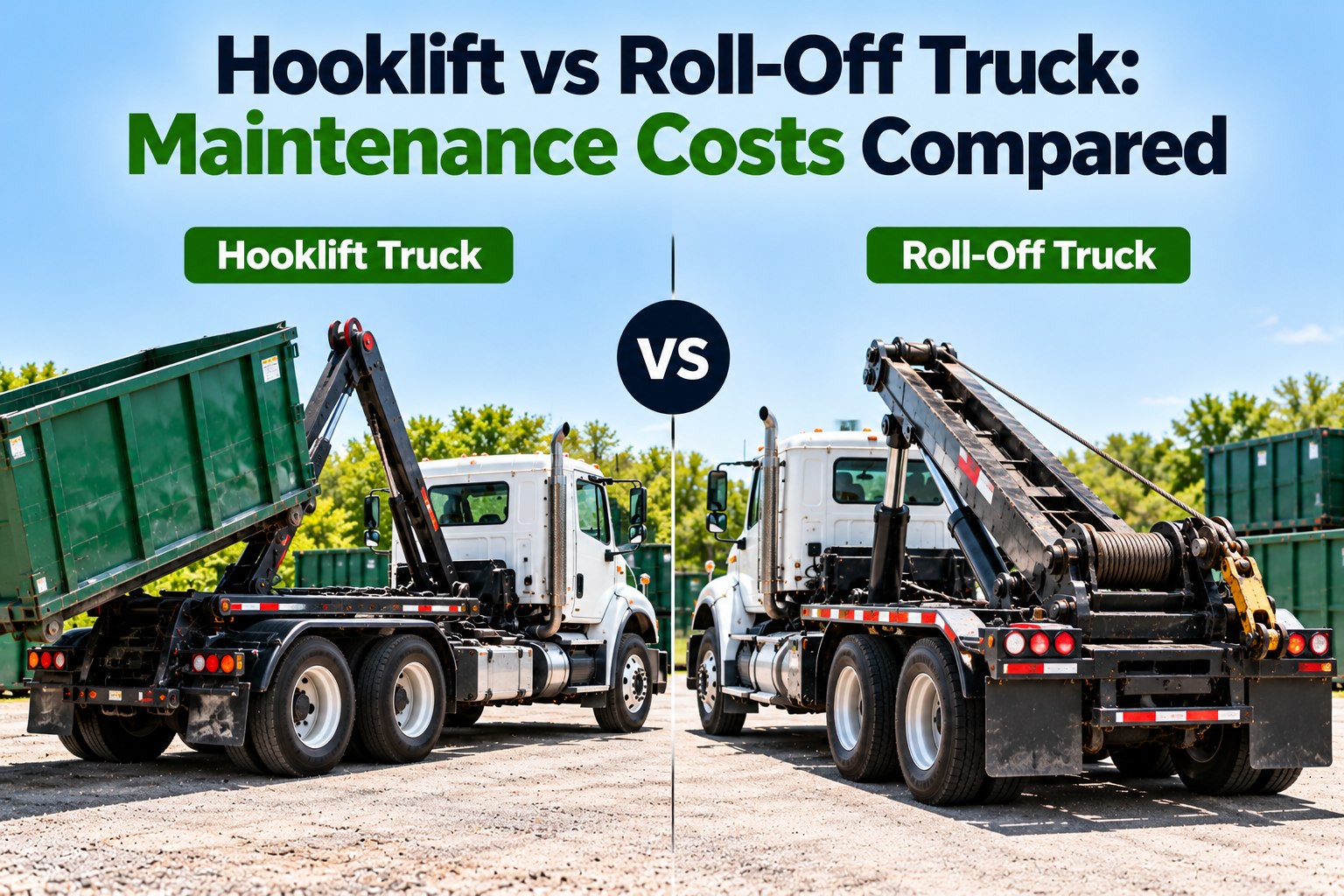
Hooklift vs roll-off is usually argued on speed and container cost, but maintenance is where the two systems split the most. A cable roll-off truck lives on its cable, sheaves and rollers; a hooklift trades all of that for an arm, a hook and a few pivots. This guide compares hooklift truck maintenance and roll-off truck maintenance on wear points, grease, hydraulic service and inspection time, so you can spec the next unit with the long-run cost in view. Schedule a call to compare your hooklift and cable trucks in FleetRabbit.
Container truck buying guide
Same container work, two very different maintenance bills. Know which one you're signing up for.
Hooklift
Arm, hook and a few pivots
About 8 to 10 grease points
No cable to replace
Cable roll-off
Cable, sheaves and rollers
About 15 to 20 grease points
Better suited to heavy loads
Grease point counts from Palfinger, as told to Waste Today in 2023.
Hooklift vs Roll-Off Truck Maintenance Side by Side: Wear Points, Grease, Hydraulics and Cables
Both systems run on truck hydraulics and both need daily checks. The difference is how many moving parts sit between the cylinder and the container, and how much of the job happens outside the cab.
Swipe sideways to see every column
Main wear parts
Hook, arm pivots, rollers, center locks
Cable, cable ends and clamps, sheaves, side rollers, locks
Grease points
About 8 to 10
About 15 to 20
Greasing interval
Every 75 hours on one maker's chart
Weekly or every 40 hours; one to two weeks on traditional units
Cable replacement
None
Two to five hours when a cable breaks
Hydraulic service
Oil, filters, hoses and cylinders
Oil, filters, hoses and cylinders; pump and PTO wear when overloaded
Driver out of cab
Not needed to hook on
At least twice per container
Container pickup
Can engage up to 30 degrees off-center
Needs alignment with the container's front wheels
Heavy loads
Options at 60,000 lb and below
Favored for heavy work; 60,000 and 75,000 lb hoists common
Sources: Palfinger via Waste Today (2023); PALFINGER North America via Waste Advantage (2024); JOAB hooklift service manual; Redbox+ via Waste Advantage (2017).
Hooklift vs Cable Hoist Service Burden: Grease Points, Greasing Time and Cable Repairs Compared
Put the published figures side by side and the cable hoist carries roughly twice the routine lubrication work, plus a repair job hooklifts never see.
Driver exits per container
Hours to replace a broken cable
Greasing a Cable Hoist Takes 30 to 45 Minutes
Palfinger's James Hanson told Waste Today a full cable hoist grease job runs 30 to 45 minutes, every one to two weeks on traditional units. Some newer hoists, including Palfinger's HT 160, are designed to run without grease, which narrows the gap.
Run Hooklift and Roll-Off Truck Maintenance on the Right Intervals Automatically
Separate PM plans for each body type, grease due on engine hours and every cable change on record.
Hooklift Inspection and Cable Hoist Inspection: Two Maintenance Routines on One Calendar
The daily walk-around looks similar; the periodic work doesn't. Here's how the routines line up, from JOAB's hooklift service manual and PALFINGER's cable hoist guidance.
When
Hooklift
Cable roll-off
Daily
Oil level, hoses and pipes for leaks or trapping, arm for cracks or deformation, debris between parts, lights
Cable for broken wires, kinks and flat spots, clamps and ends, sheaves and rollers turning, locks, alarms and lights
By hours
Grease every 75 hours, or confirm the central greaser is working
Grease weekly or every 40 hours: shoe, pins, side rollers
Periodic
Oil filter and full service every 12 months
Full-length cable check, lock wear, sub-frame mounts and welds on your shop's cycle
Longer
Hydraulic oil every 2 years on mineral oil, yearly on bio oil
Cable replaced when it meets removal criteria or breaks
Neither Truck Skips the Basics
Hooklifts still carry hydraulic hoses, cylinders and locks that fail when they're ignored, and both bodies sit on a chassis that needs the same brake, tire and DVIR checks. The body type changes what's on the list, not whether the list gets done.
Roll-Off Truck Cost Over the Long Run: Containers, Labor Time and Repairs
Maintenance is one line in the total cost. Before you spec the next unit, weigh these four together.
Containers
Converting a cable-box fleet to hooklift is costly, Stellar's sales team notes, so hooklifts usually suit new operators or full fleet swaps. Dual-purpose boxes carry a small surcharge.
Driver time
Hanson puts the hooklift saving at 1 to 1.5 minutes per container. At eight containers a day, that's up to an hour a week per truck.
Shop labor
Fewer grease points and no cable changes cut routine shop hours on hooklifts.
Load range
If your work needs heavy hoists, a cable unit may be the only fit, whatever the maintenance saving.
Choose a Hooklift If, Choose a Cable Roll-Off If: Matching the Truck to the Work
Choose a hooklift if
You're starting a container fleet or replacing it wholesale
One truck needs to carry several body types
Drivers make many swaps a day and you want them in the cab
You want fewer grease points and no cable changes
Choose a cable roll-off if
Your container inventory is already built for cable
You haul heavy loads that need 60,000 to 75,000 lb hoists
Your shop already stocks cables, sheaves and roller parts
Your routes run fewer, heavier pulls per day
A Quick Decision Path Before You Spec the Next Unit
1
Are most of your containers cable boxes you plan to keep?
Yes: lean cable roll-off
2
Do your heaviest loads need more than a 60,000 lb hoist?
Yes: cable roll-off
3
Will one truck carry more than one kind of body?
Yes: lean hooklift
4
Is cutting grease and cable work in the shop a priority?
Yes: hooklift
Three Mixed-Fleet Maintenance Problems and How to Stop Them
Cable trucks greased on the hooklift schedule
Separate PM plans per body type, so cable hoists come due at 40 hours and hooklifts at their own interval.
Schedule a call on body-specific PMThe same truck keeps snapping cables
Each cable change logged against the truck shows which units need sheave, roller or driver attention.
Log cable changes per truck freeNo data to settle the next purchase
Repair and maintenance cost by truck lets you compare hooklift and cable units on your own numbers.
See cost by truck type on a call
How FleetRabbit Tracks Hooklift and Roll-Off Truck Maintenance in One Fleet
PM by body type
Hooklift and cable hoist service plans on engine hours, miles or dates.
Hoist checks in the DVIR
Cable, sheave, hook and lock checks on drivers' phones, with photos.
Repair history
Cable changes, cylinder repairs and hose jobs on each truck's record.
Cost per truck
Maintenance spend by unit, so you can compare the two systems on your own data.
What the call covers
Your hooklift and cable trucks with their own PM plans
A failed hoist check turning into a work order
Maintenance cost side by side for both truck types
Schedule My Mixed-Fleet Walkthrough
Compare Hooklift and Roll-Off Truck Costs on Your Own Fleet's Maintenance Data
PM plans for each body type, hoist checks on every pre-trip and a cost history that settles the next purchase.
Free for up to 3 assets · No credit card needed
Hooklift vs Roll-Off: Questions Fleet Managers Ask Before They Buy
Is a hooklift cheaper to maintain than a cable roll-off?
Usually, on routine work. Palfinger puts typical hooklifts at about 8 to 10 grease points against 15 to 20 on cable hoists, and hooklifts have no cable to replace. Hydraulic, chassis and lock maintenance still apply to both.
Schedule a call to compare your trucks.
How often should a cable roll-off hoist be greased?
PALFINGER recommends at least once a week or every 40 operating hours, covering the top of the shoe, the pins and the side rollers. A full grease job on a traditional cable hoist takes about 30 to 45 minutes, according to Palfinger's sales director.
How often does a hooklift need service?
It depends on the maker. JOAB's manual calls for daily checks, greasing every 75 hours, a yearly filter change and service, and hydraulic oil every two years on mineral oil. Follow your hooklift maker's chart, scheduled on engine or PTO hours.
Can a hooklift carry roll-off containers?
Only containers built or converted for hooklift use, or dual-purpose boxes with both a hook bar and cable fittings. Converting a whole cable-box inventory is costly, so many haulers keep cable trucks for existing boxes and add hooklifts for new work.
Which is safer for drivers, a hooklift or a cable hoist?
Hooklift drivers can load from the cab, while cable hoist drivers leave the cab at least twice per container and handle a 30 to 35 lb cable hook. A snapped cable can also recoil toward the cab, so cable inspection matters on every shift.
How do I compare hooklift and roll-off costs in my own fleet?
Track maintenance cost, downtime and repairs per truck for a year, grouped by body type. FleetRabbit keeps that history on each unit so the comparison uses your own repair numbers and downtime, not brochure claims.
Schedule a call to set it up.
October 26, 2026
By Emily Parker
All Articles