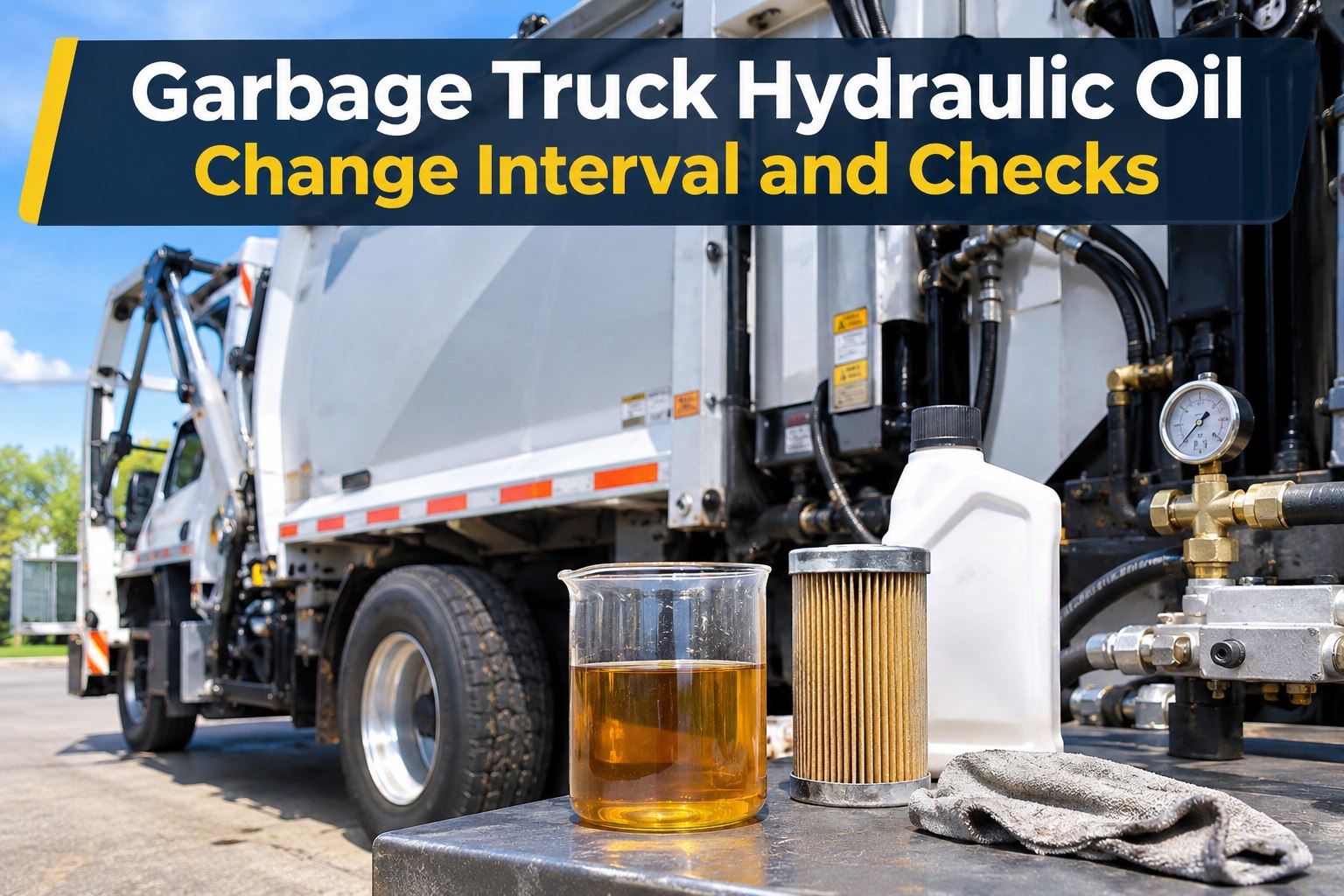
Garbage truck hydraulic oil change intervals are set by hours and condition, not by one universal number, and the routine that prevents failures is sampling, filters and watching for heat. This guide shows what suppliers and fleets say about intervals, how to read contamination and heat damage, and a filter and sampling routine you can track. Schedule a call to set your hydraulic PM schedule.
Garbage Truck Hydraulic Oil Change Interval: Why There Is No Single Number and How to Set Yours
Suppliers point to hours and condition, and your OEM manual sets the baseline
We found no independent standard for how often to change hydraulic oil on refuse trucks. One lubricant supplier says most solid waste trucks change oil by hours, not miles. Another point agreed across sources is that severe duty and heat shorten oil life. Start from your truck and body manufacturer interval, then let sampling decide whether to shorten or extend it.
| Source | What it says about interval | Caveat |
|---|---|---|
| Shell Lubricants, in Waste Today | Most solid waste trucks change oil by hours, not miles, often coordinated with engine and transmission service schedules | One supplier view, no number given |
| Waste Today, other suppliers | Severe duty and high heat shorten oil life, and water speeds oxidation | Qualitative only |
| Waste360 article | Change the oil when it shows failure: dark, opaque, burnt smell, gritty or milky | Published in 1995; no hour interval |
| FleetRabbit refuse articles | Full flush and replacement as an annual task, with fluid analysis every 250 hours | Not attributed to an OEM or a study |
How to Spot Hydraulic Contamination and Heat Damage on a Garbage Truck: Color, Smell, Feel and Sludge
Look at the oil every week, and sample it when anything looks wrong
| What you see | What it usually means | What to do |
|---|---|---|
| Dark or opaque oil, burnt smell | Oxidation or overheating | Sample it, find the heat source and change it if confirmed |
| Milky or white oil | Water has emulsified with the oil | Replace it and find where water is entering |
| Gritty or sticky feel | Particles or varnish | Sample for particle count and check filters |
| Varnish sludge at the bottom of the reservoir | Heat damage | Check cooler, fluid level and duty cycle |
| Foaming or pump noise | Air or blended fluids; pump cavitation warning | Check level, fluid type and suction side |
| Pump housing very hot | Wear or cavitation warning | Check pressure, fluid and filters |
One older article cites a supplier limit of 180 degrees Fahrenheit for continuous oil temperature, with normal operation near 130 degrees. Treat those as one source and check your manufacturer specification.
A Hydraulic Filter and Oil Sampling Routine for Refuse Trucks: Daily, Weekly, Hourly and Annual Checks
A schedule you can track by truck, using engine or PTO hours
The schedule below comes from FleetRabbit refuse truck articles. The 250 and 500 hour intervals are not attributed to an OEM or a study, so confirm them against your manual. For filtering, one older article recommends return line filters rated at 10 microns or finer, and asks for an ISO particle count because most contamination failures involve small particles.
| Check | Frequency in FleetRabbit articles | Notes |
|---|---|---|
| Fluid level, hoses, rods, oil pooling | Daily | Part of the pre-trip |
| Fluid color and hose routing | Weekly | Milky or dark fluid is treated as contamination |
| Hydraulic filter | Every 250 hours | Not OEM-attributed |
| Fluid analysis kit | Every 250 hours | Particle check |
| Suction filter | Every 500 hours, or sooner if restricted | Not OEM-attributed |
| Full fluid flush and relief valve check | Annual | Follow the truck manufacturer if different |
What to ask the lab for matters. Suppliers quoted in Waste Today suggest trending water content, viscosity and appearance over time, and checking the acid number to see whether oil is degrading. Metals testing can show additive content and foreign material such as dirt. Trending results across a fleet or by location can reveal patterns a single truck would not show.
Fluid choice affects the interval too. The same suppliers say a viscosity that is too high in severe cold can damage pumps, multi-grade oils work across a wider temperature range, and synthetic fluids offer longer oxidation life than mineral oils. Check the choice against your manufacturer before switching.
Why Refuse Truck Hydraulic Oil Gets Dirty: Seals, Breathers, Water and Blended Fluids
Three entry points cause most contamination
How FleetRabbit Handles Garbage Truck Hydraulic Maintenance: Hour-Based PMs, Findings and Reminders
What FleetRabbit says its tools track for hydraulic systems
| Hydraulic need | What FleetRabbit pages describe |
|---|---|
| PM schedules | FleetRabbit says it tracks PM schedules, including fluid change intervals |
| Inspection findings | Hydraulic inspection findings and defects can open work orders |
| Reminders | FleetRabbit says it sends PM reminders before service windows are missed |
| History | Service history stays with the truck for each service |
FleetRabbit pages describe PM tracking and work orders but do not describe oil analysis results being stored, so ask how sample results are recorded and who sees them.
Garbage Truck Hydraulic Oil FAQs: Change Interval, Contamination, Filters and Sampling
Short answers for refuse shop managers
How often should I change hydraulic oil on a garbage truck?
We found no universal interval. One lubricant supplier says refuse trucks change oil by hours, often coordinated with engine and transmission schedules, and FleetRabbit lists an annual flush. Follow your manufacturer manual and let regular oil sampling decide whether to shorten or extend it.
How do I know the oil is contaminated?
Dark or opaque oil, a burnt smell, a gritty feel, milky color from water or varnish sludge in the reservoir all point to trouble. Take a sample for a particle count and water check, and find the source before you change the oil.
What temperature is too hot for hydraulic oil?
One older article cites a supplier limit of 180 degrees Fahrenheit continuous, with normal operation near 130. That is a single source, so check your truck and fluid specification. Rising pump housing temperature is also treated as a wear and cavitation warning.
How often should I change hydraulic filters?
FleetRabbit articles list the hydraulic filter at 250 hours and the suction filter at 500 hours, or sooner if restricted. Those intervals are not attributed to an OEM, so confirm them in your manual and change filters sooner if a service signal shows.
Why is oil sampling worth it?
Sampling shows particle counts, water and degradation before a pump or cylinder fails, and trended results can justify shortening or extending an interval. Compare trucks across the fleet to find patterns that one truck would not show, and record every result against the truck so the trend is visible.
Where do I start with FleetRabbit?
Start by loading each truck with engine or PTO hours and setting hydraulic PMs for filters, sampling and the annual flush. Ask how sample results are recorded and how reminders are sent before you roll it out to the whole fleet. Try hydraulic PM tracking in FleetRabbit.