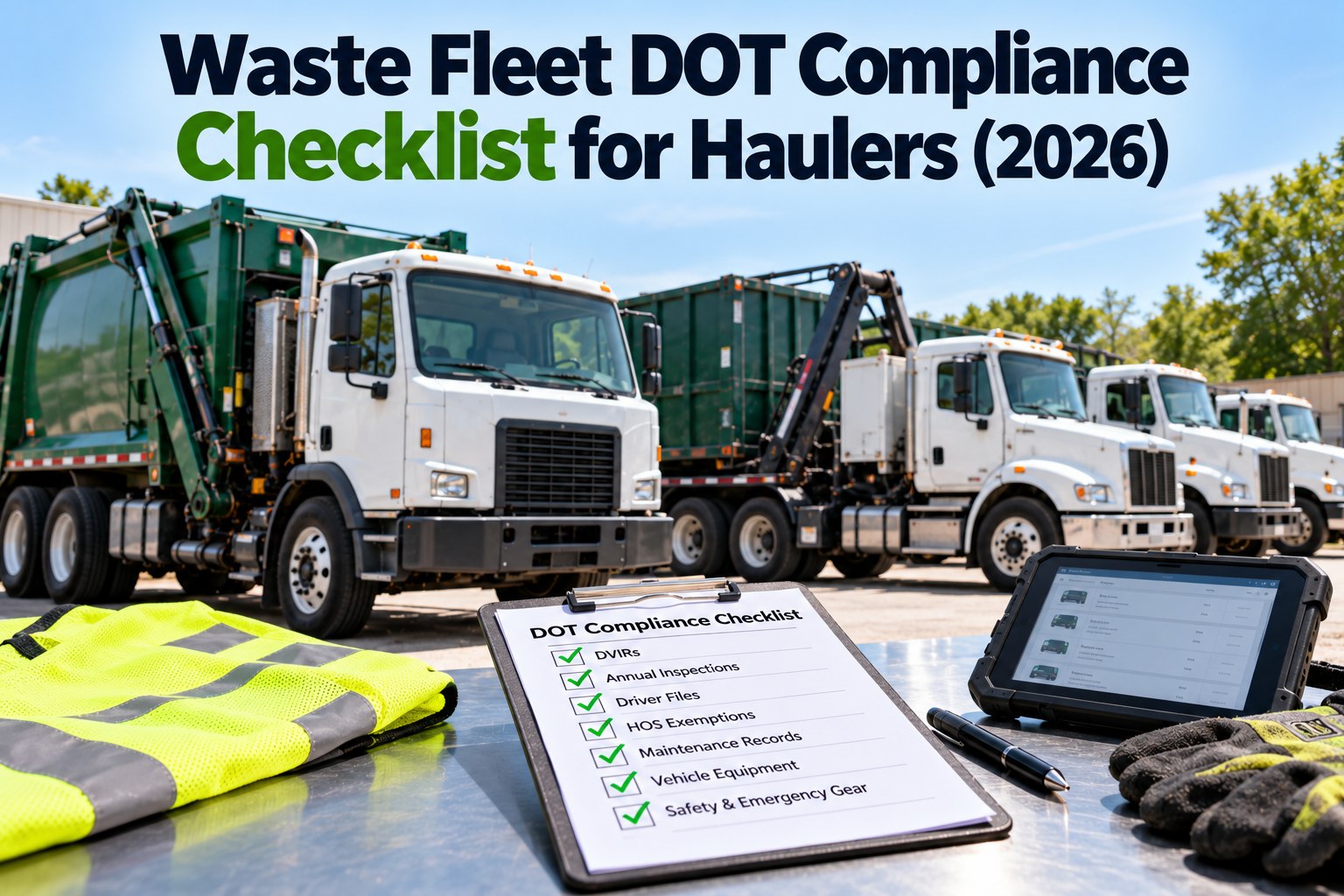
Waste fleet DOT compliance comes down to records. When an FMCSA investigator or state officer reviews a refuse or roll-off operation, they ask for DVIRs, annual inspection reports, maintenance files, driver qualification files, drug and alcohol records and hours-of-service time records, then check each against the rules. This checklist covers all six areas, with retention periods, the hours-of-service rules waste haulers work under in 2026, and what puts trucks and drivers out of service at roadside. Schedule a call to see your waste fleet's DOT records organized in FleetRabbit.
Waste fleets · DOT audit ready
Six record areas, one checklist, and no scramble when the auditor calls.
Everything a garbage truck or roll-off fleet is asked to produce, grouped the way an audit works through it.
Annual inspections
49 CFR 396.17
Maintenance records
49 CFR 396.3
Driver files
49 CFR 391.51
Drug and alcohol
49 CFR Part 382
Hours of service
49 CFR Part 395
Waste Fleet DOT Compliance Checklist: The Vehicle, Driver and Record Items Auditors Check First
Tick each line against your own files. Anything you can't tick is a gap to close before a compliance review, not during one.
Property-carrying fleets don't need a DVIR on days with no defects found. Since March 23, 2026, FMCSA's final rule confirms DVIRs can be completed and kept electronically.
Garbage Truck DOT Requirements by Frequency: Every Trip, Every Year and Every Two Years
Most compliance gaps are timing gaps: a medical card that ran out, an annual inspection that slipped a month, a roadside report nobody returned. Sort the duties by how often they fall due.
Every trip
Pre-trip check of brakes, tires, lights and hoist
DVIR when a defect is found
Short-haul time record
Within 15 days
Certify roadside inspection violations fixed and return the report
Pull a new driver's MVR within 30 days of hire
Every year
Annual inspection on every truck
MVR review for every driver
Clearinghouse query for every CDL driver
Up to 24 months
Driver medical certificate renewal, sooner if the examiner sets a shorter date
Put Annual Inspections on a Calendar, Not a Memory
An annual inspection that lapses by a day leaves the truck without valid proof of inspection. Spreading inspections across the year, rather than doing the whole fleet in one month, also keeps shop capacity free for breakdowns.
Keep Waste Fleet DOT Compliance Current Without Chasing Paper
DVIRs on drivers' phones, annual inspections due on each truck and every repair on file for the auditor.
How Long to Keep Waste Fleet Records: DOT Retention Periods by Document
Auditors look back over set periods. Keep each record at least as long as shown here, as summarized from FMCSA rules by J. J. Keller.
Swipe sideways to see every column
DVIRs with repair certification
3 months
Principal place of business or where the truck is kept
Annual inspection report
14 months
Where the truck is housed or maintained
Proof of annual inspection
On the truck
Report, sticker or decal carried at all times
Maintenance records
1 year, plus 6 months after the truck leaves
Where the truck is housed or maintained
Roadside inspection reports
12 months
Principal place of business or where the truck is kept
Inspector and brake inspector qualifications
1 year after they stop inspecting
Principal place of business or where they're based
Driver qualification file
3 years after the driver leaves
Principal place of business
Medical certificate and annual MVR review
3 years from the date issued
In the driver qualification file
Hours of Service for Waste Haulers in 2026: The Short-Haul Exception After Industry Exemptions Expired
Collection drivers usually start and finish at the same yard, so most work under the short-haul exception in 49 CFR 395.1(e)(1). Since September 29, 2020, it has allowed a 150 air-mile radius and a 14-hour duty period, with time records in place of logs. Waste-specific exemptions that once stretched the old 12-hour limit have now ended.
Oct 2018
Waste Management drivers granted a 14-hour short-haul exemption
Nov 2019
Same relief granted to NWRA member companies
Sep 2020
Short-haul exception widened to 150 air miles and 14 hours for all carriers
Oct 2023
Waste Management exemption expires
Nov 2024
NWRA exemption expires
Exemption dates from CVSA's expired exemptions list; rule date from the U.S. DOT's 2020 hours-of-service final rule.
What Breaks the Short-Haul Exception on a Collection Route
A driver who goes past 14 hours, or runs a transfer or landfill trip beyond 150 air miles, loses the exception for that day and needs a record of duty status. Long-haul transfer trailers and drivers who regularly fall outside the exception belong on ELDs.
What Puts Waste Truck Drivers Out of Service at Roadside: Hours, Licenses and Medical Cards
In CVSA's 2025 International Roadcheck, 5.9% of drivers inspected were placed out of service. These five categories led the driver violations, and every one is a paperwork problem a qualification file or time record should catch.
Share of driver out-of-service violations, CVSA 2025 International Roadcheck, U.S. and Canada. Vehicles were placed out of service at 18.1%, led by brake systems and tires.
Stop, Fix This Week or Fix Before the Audit? Severity Levels for Compliance Gaps
Not every gap is equal. A safety defect or an unqualified driver stops work now; a missing signature can wait for the weekly file review. Agree the levels with your safety director.
Out of service now
Truck or driver doesn't run
Unrepaired safety defect on a DVIR
Expired annual inspection
Expired medical card or no CDL
Driver flagged in the Clearinghouse
Fix this week
Deadline-driven gaps
Roadside report not yet certified
New driver's MVR not yet pulled
DVIR repair not signed off
Short-haul time record missing
Log and fix
Before the next file review
Incomplete maintenance entry
Annual MVR review unsigned
Inspector qualification copy missing
Old records past retention not archived
Paper vs Digital DOT Records for Refuse Truck Compliance: Three Gaps Auditors Find
Paper files
DVIRs in a cab, a desk and a binder
Annual due dates on a wall calendar
Repairs written on the back of the DVIR
Digital records
Every DVIR searchable by truck and date
Annual inspections due automatically per truck
Repairs linked to the defect that started them
How FleetRabbit Keeps the Vehicle Side of Waste Fleet DOT Compliance Audit-Ready
Driver files and drug testing usually live with HR or a compliance provider. FleetRabbit covers the vehicle records auditors ask for, on one record per truck.
Electronic DVIRs
Drivers inspect on their phones with photos, including hoist and body checks.
Defect to repair
Failed items open work orders, and the repair is signed off on the same record.
Annual inspection tracking
Due dates per truck, with the report stored against the unit.
Maintenance history
Every inspection, repair and PM dated and searchable for the auditor.
What the call covers
Your trucks loaded with DVIR and annual inspection status
A failed DVIR item turned into a signed-off repair
One truck's full maintenance file, as an auditor would see it
Schedule My DOT Records Walkthrough
Be Ready for Your Next Waste Hauler DOT Audit With Records That Keep Themselves
Electronic DVIRs, annual inspection reminders and a complete maintenance file for every garbage and roll-off truck.
Free for up to 3 assets · No credit card needed
Waste Fleet DOT Compliance: Questions Haulers Ask
Do garbage trucks have to follow DOT regulations?
Yes. Refuse and roll-off trucks used in commerce are commercial motor vehicles, so FMCSA rules on inspections, maintenance records, driver qualification, drug and alcohol testing and hours of service apply. City-run fleets are exempt from many FMCSA rules, but CDL and drug testing rules still apply, and states often add their own.
What records does a DOT audit check for a waste fleet?
Expect requests for DVIRs, annual inspection reports, maintenance and repair records, driver qualification files, drug and alcohol testing records and hours-of-service time records or logs. Roadside inspection reports and proof that violations were corrected are often reviewed too.
Schedule a call to see audit-ready records.
Do garbage truck drivers need ELDs?
Usually not, if they qualify for the short-haul exception: staying within 150 air miles of the work reporting location and returning within 14 hours. The carrier keeps time records instead. Drivers who regularly fall outside the exception need ELDs or logs for those days.
How long must DVIRs be kept for refuse trucks?
Three months from the date of the report, together with the repair certification and the next driver's review. Since March 23, 2026, FMCSA's final rule confirms DVIRs can be completed and kept electronically, which makes retrieval during an audit much faster.
How often does a garbage truck need a DOT annual inspection?
At least once every 12 months, by a qualified inspector, under 49 CFR 396.17. Keep the inspection report for 14 months where the truck is housed or maintained, and carry proof of the inspection, such as a sticker or a copy of the report, on the truck.
Can software keep a waste fleet DOT compliant?
Software keeps the records complete and on time. FleetRabbit runs electronic DVIRs, tracks annual inspections per truck and keeps every repair on file, so the vehicle side of an audit is ready to export.
Schedule a call to see it with your trucks.
October 26, 2026
By Alex Rowan
All Articles