When an FMCSA auditor calls, most fleets do not fail because they broke the rules. They fail because the proof of following the rules is scattered across five different logins, a filing cabinet, and a maintenance manager's inbox. Only a small fraction of motor carriers pass a DOT compliance review without a single violation, and disorganized or inaccessible records are one of the most common reasons the rest do not. The problem is rarely a missing document. It is a missing system to find it fast enough.
Roughly 93 percent of motor carriers face at least one violation during a DOT compliance review, and many audits give carriers as little as 48 hours to produce requested records. Fleets that keep maintenance records, DVIRs, HOS logs, and driver qualification files spread across separate systems routinely lose that window to searching instead of submitting. Unifying that data into one record turns an audit from a scramble into a export.
The Six Places Auditors Look, and Why They Never Live Together
Every DOT compliance review examines the same core categories of records, and almost every fleet stores each category in a different place. That fragmentation is the real audit risk.
Driver Qualification Files
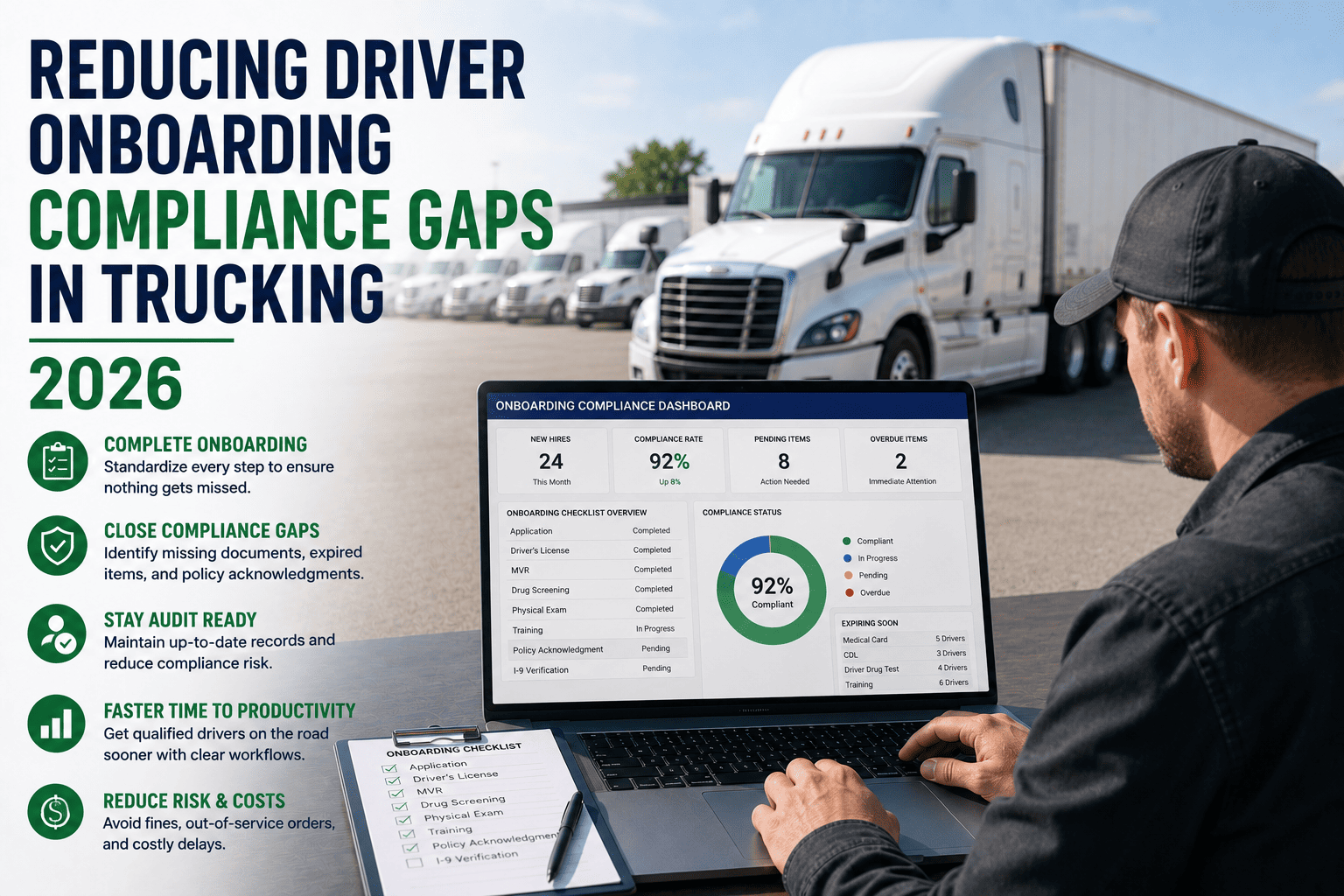
Applications, employment history checks, medical certificates, and MVRs, often kept in physical folders or an HR system with no link to safety data.
Hours of Service Logs
ELD data covering months of driving history, stored in a telematics dashboard that rarely talks to maintenance or HR software.
DVIRs and Inspections
Daily vehicle inspection reports, sometimes still on paper, sometimes in an app that does not connect to the shop's repair history.
Maintenance and Repair Records
Annual inspections, brake service, and repair orders tracked in shop software or spreadsheets separate from everything else.
Drug and Alcohol Clearinghouse
Testing records and Clearinghouse queries, frequently managed by a third-party consortium with its own separate portal and login.
Insurance and Registration
Coverage certificates, permits, and vehicle registration documents, usually filed with a broker or insurer instead of the fleet's own systems.
The Real Cost of Scattered Data When the Auditor Calls
Compliance reviews rarely announce themselves months in advance. A serious crash, a pattern of roadside violations, or a data inconsistency in FMCSA's Safety Measurement System can trigger a request with a short production deadline. When your driver qualification files sit in one login, your HOS data sits in another, and your maintenance history sits in a third, the clock runs out on searching long before it runs out on submitting. The average settlement for a violation runs into the thousands of dollars, and fines for a single out-of-service violation can reach into the tens of thousands. Multiply that across a fleet with several scattered gaps and the exposure grows fast.
Why Disorganization Costs More Than the Missing Document Itself
An auditor who cannot get a clean answer quickly tends to dig deeper. A fleet that produces a complete driver file within minutes signals a functioning safety management program. A fleet that needs three days and four phone calls to assemble the same file signals the opposite, even if every document technically exists somewhere. Consolidating your records is one of the fastest ways to build an audit-ready system before the call ever comes.
FleetRabbit brings maintenance records, DVIRs, HOS data, driver qualification files, and compliance documents into a single platform, so any request can be answered in minutes instead of days. Start your free trial with 3 vehicles today.
Siloed Systems vs. a Unified Fleet Record
The difference between a stressful audit and a routine one usually comes down to how the data was stored long before the request arrived.
| Audit Moment | Data in Separate Systems | Data in One Unified Platform |
|---|---|---|
| Auditor requests 10 DQ files | HR pulls paper folders, cross-checks against a spreadsheet, and hopes nothing is missing | Files export directly from the platform with every required document already attached |
| Auditor cross-references HOS with DVIRs | Two logins, two exports, and manual matching of dates and drivers by hand | Records are already linked by driver and date, ready to view side by side |
| Auditor asks about a specific vehicle's maintenance history | Shop software shows repairs, but annual inspection paperwork lives in a separate binder | Full vehicle history, from inspection to repair to DVIR, appears in one profile |
| Internal mock audit before the real one | Takes days to assemble records from multiple departments and systems | Gaps surface automatically, often before anyone has to go looking for them |
What a Unified Compliance Record Actually Looks Like
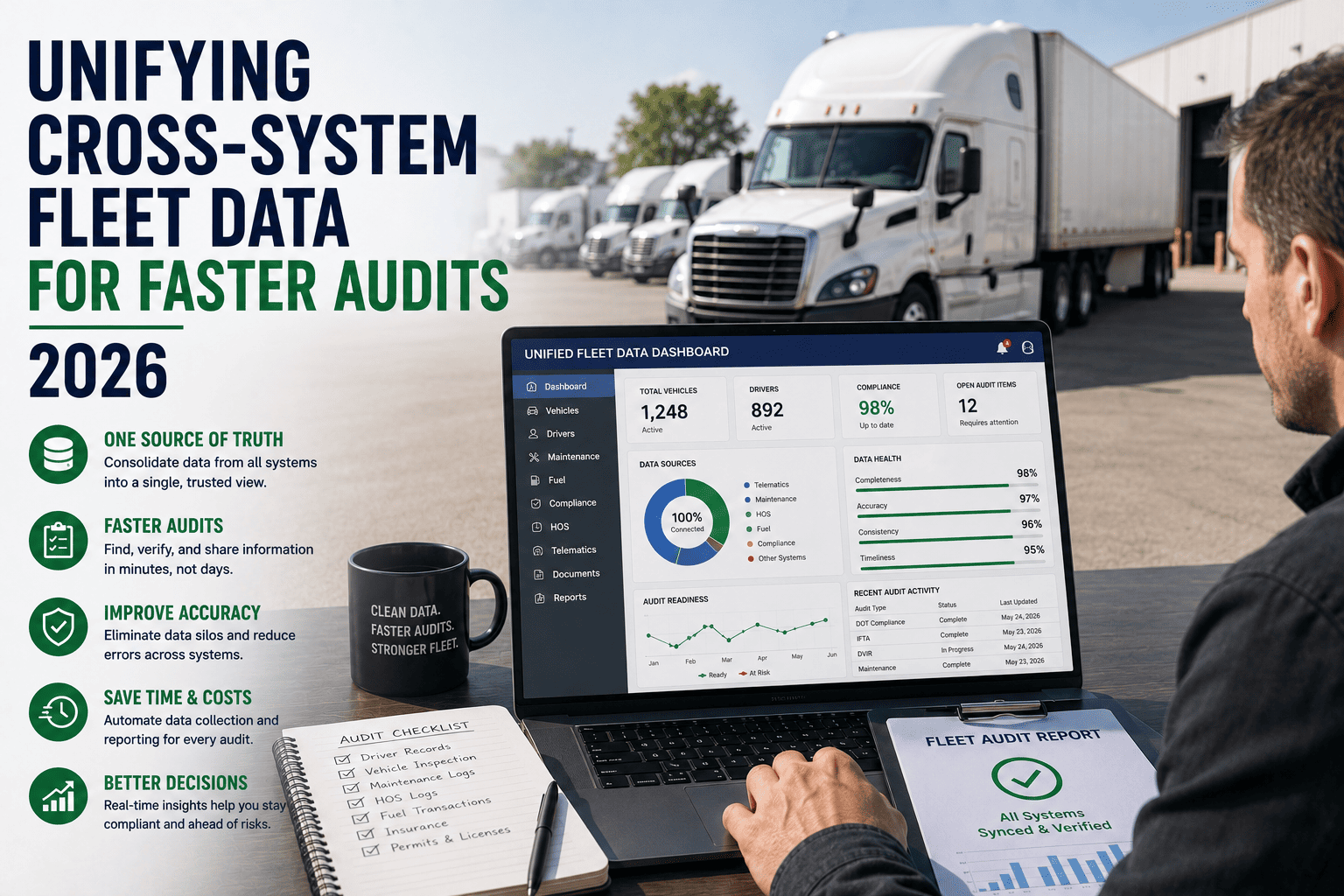
Unifying fleet data is not about replacing every existing tool. It is about giving every record a single home that connects to the others automatically.
Centralized Document Vault
Every driver file, inspection report, repair order, and compliance document lives in one searchable place, organized by driver, vehicle, and date so nothing depends on remembering which folder it was filed under.
Why a Single Vault Changes Audit Behavior
When a request comes in, the response becomes a search and an export instead of a multi-department scavenger hunt. That speed alone changes how an auditor perceives the fleet's overall safety management controls.
Automatic Cross-Referencing
A unified system links HOS logs to the vehicles and drivers involved, ties DVIRs to the maintenance records that followed them, and connects Clearinghouse status to each driver's qualification file, so nothing has to be manually matched under time pressure.
Real-Time Gap Alerts
Instead of discovering a missing medical certificate during the audit itself, a unified platform flags the gap the moment it appears, giving fleets weeks or months to fix it instead of hours.
Turning Gaps Into a Routine Fix, Not a Crisis
A missing document caught during a normal week is a quick correction. The same gap discovered mid-audit is a citation. Continuous visibility is what separates the two outcomes.
Tracking Your Own Audit-Readiness Score
Fleets that stay ahead of compliance reviews tend to track a few simple numbers year-round. Document completion rate measures the percentage of driver and vehicle files with every required record present. Time-to-produce measures how quickly the fleet could assemble a full file for any driver or vehicle if asked today. Open-gap count tracks how many missing or expiring documents exist at any given moment. Fleets that keep these numbers visible consistently move toward a shorter, calmer audit experience, because most of the work happens well before the request ever arrives. Seeing how this looks in practice is easiest with a short walkthrough, so feel free to book a demo and bring your own audit questions.
Compliance reviews do not wait for a convenient time. FleetRabbit unifies every record an auditor could ask for into one searchable platform, so your team spends the audit answering questions instead of hunting for paperwork.