Nobody sets out to miss a maintenance appointment. An oil change gets pushed back a week because the truck is needed on a run, a brake inspection slips past its mileage trigger because nobody happened to check the odometer that day, and a coolant flush sits three weeks overdue simply because it never made it onto anyone's calendar. None of these moments feel like a crisis in the moment. But preventive maintenance compliance is the single strongest predictor of whether your fleet spends 2026 in the shop unexpectedly or on the road as planned.
Fleets relying on manual tracking, memory, or spreadsheets average roughly 62 percent PM compliance, while fleets using automated scheduling routinely exceed 94 percent. That gap is not cosmetic. Fleets sitting below 85 percent compliance experience significantly higher breakdown rates, and missing two consecutive scheduled services on the same vehicle statistically doubles its breakdown risk.
Manual Tracking vs. Automated Scheduling, Side by Side
The difference between a fleet that hits its maintenance windows and one that constantly plays catch-up usually is not effort, it is process. Manual tracking depends on someone remembering to check mileage against a schedule during an already busy week, and that step is exactly the one that gets skipped.
Why the Gap Is So Wide
Automated systems pull live odometer and engine-hour data directly from the vehicle, so a service trigger fires the moment it is due rather than waiting for someone to notice. Removing that single manual checkpoint is usually enough to close most of the gap between a reactive fleet and a reliable one.
FleetRabbit pulls live mileage and engine-hour data automatically and generates work orders before a service window is ever missed. Sign up for free and set mileage and hour triggers for your whole fleet in under a day.
What Happens When Compliance Slips
PM compliance does not fail gradually and gently, it compounds. A single missed service raises breakdown probability, and a second consecutive miss on the same vehicle does not just add to that risk, it roughly doubles it. This is why fleet managers who track compliance closely treat two missed services on one truck as an immediate scheduling emergency rather than a scheduling backlog.
The 10 Percent Rule
Leading fleets use a simple guardrail: a scheduled service must be completed within 10 percent of its interval to count as on-time. A 30-day PM has roughly a 3-day grace window, and a 10,000 mile service has roughly a 1,000 mile window. Anything completed outside that window should be logged and reviewed, not quietly counted as compliant.
A Fast Way to Check Your Own Fleet Right Now
Pull your last 90 days of completed PM work orders and compare completion dates against original due dates. If a meaningful share fall outside the 10 percent window, your reported compliance rate is likely higher than your real one.
Building a Schedule That Actually Gets Followed
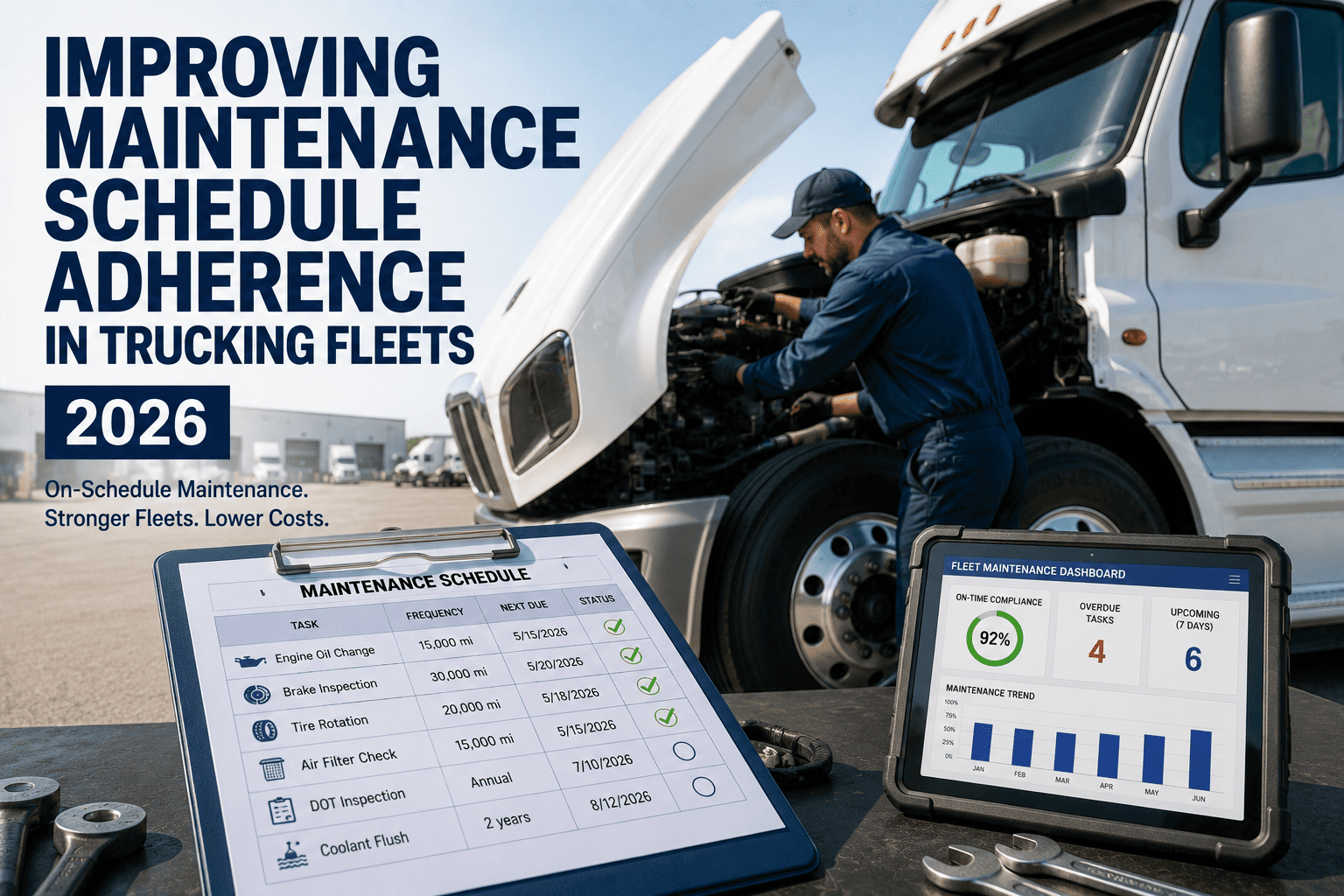
A maintenance schedule only works if it survives contact with a busy dispatch board. That means triggers based on real vehicle data rather than a fixed calendar alone, work orders that generate automatically before the window opens, and a dashboard that flags overdue vehicles before they become invisible in a spreadsheet.
| PM Category | Typical Trigger | Compliance Target |
|---|---|---|
| Oil and Filter Service | Every 7,500 to 25,000 miles depending on vehicle class | 95%+ fleet-wide |
| Brake Inspection | Mileage-based, tied to pad wear patterns | 98%+ for critical vehicle classes |
| Transmission Service | Roughly every 1,200 engine hours | 95%+ fleet-wide |
| Annual DOT Inspection | Calendar-based, fixed annual window | 100% completion required |
From Reactive Backlog to Predictable Rhythm
Fleets running structured, automated PM programs see roughly 45 percent fewer breakdowns and 28 percent lower repair costs compared to fleets relying on memory or paper logs. The shift is not about doing more maintenance, it is about doing the maintenance you already planned, on time, every time, without depending on someone remembering to check an odometer during a busy week.
Seeing your own fleet's real compliance number, not the one on paper, is usually the moment this becomes a priority. Book a demo and get a live look at how many of your vehicles are actually inside their service windows today.
Maintenance schedule adherence is rarely a discipline problem, it is a visibility problem. The fleets running at 95 percent compliance in 2026 are not working harder than everyone else, they simply built a system where a due service cannot quietly slip past unnoticed. Closing that gap is one of the fastest, highest-return changes a fleet manager can make this year.
FleetRabbit tracks mileage, engine hours, and calendar triggers automatically for every vehicle, generating work orders before a window is ever missed. Get started free with no credit card required.