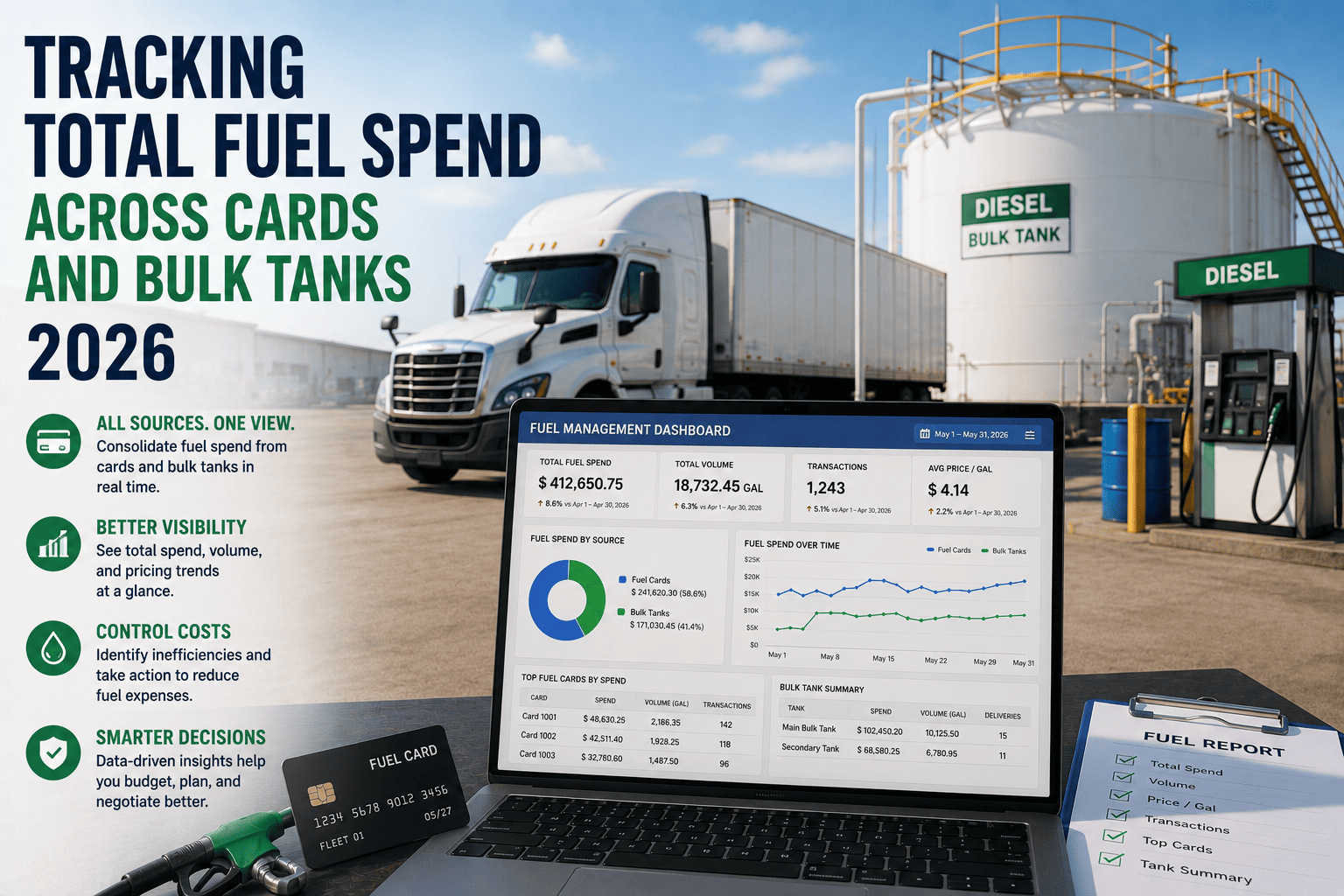
Ask most fleet managers what they spent on fuel last month and they can give you a number fast. Ask them to break that number down by vehicle, by card, and by the bulk tank sitting in their own yard, and the confident answer usually slows down. Fuel is typically the second largest cost in a fleet's budget after driver wages, yet it is often the least scrutinized, split across two systems that rarely talk to each other until someone sits down at month end to reconcile them by hand.
Industry estimates consistently put fuel theft, fraud, and unmonitored waste at 6 to 15 percent of a fleet's annual fuel budget, disappearing before a single productive mile is driven. Structured reconciliation programs that unify card and bulk tank data routinely uncover 4 to 8 percent of total fuel spend as recoverable, and fleets switching to real-time tracking commonly find 8,000 to 22,000 dollars in previously undetected losses within the first week alone.
Two Systems, One Number You Actually Need
Fuel cards and bulk tanks are usually managed as two completely separate processes. Card transactions flow in from every truck stop and travel center a driver visits, while bulk tank fills happen quietly in your own yard, tracked on a clipboard or a separate spreadsheet if they are tracked at all. Total fuel spend only becomes a real, trustworthy number once both sources feed into the same place.
Why Splitting the Data Costs You Money
When card data and tank data live in separate systems, nobody can easily answer a simple question: is this truck's total fuel consumption normal for the miles it drove this month, regardless of where it filled up? Without that combined view, waste and fraud in either system hide behind the other one.
The Real Cost of Waiting for Month End
Most fleets still reconcile fuel spend once a month, alongside the rest of accounts payable. By the time a discrepancy surfaces in that report, it has often already repeated itself twenty or thirty times, quietly growing the whole way there.
A small daily anomaly is easy to dismiss as noise. Left unreconciled for a full billing cycle, it becomes a repeated, compounding loss that a monthly report only reveals after the fact.
FleetRabbit unifies fuel card transactions and bulk tank fills into a single dashboard, flagging anomalies the day they happen instead of the month they get discovered. Sign up for free and see your combined fuel picture this week.
The Rules That Catch Most Fuel Losses
Fuel loss rarely announces itself as an obvious theft. It usually looks like a handful of small, repeated patterns that are easy to catch once you know exactly what to compare against what.
Rules That Work Across Both Cards and Tanks
A Quick Check for Your Own Fuel Program
Pull last month's fuel report and ask whether every single transaction, card and tank combined, is tied to a specific vehicle, driver, and mileage reading. Any transaction that cannot be attributed this way is an immediate reconciliation gap worth investigating today.
Bulk Tanks Deserve the Same Scrutiny as Cards
On-site bulk fuel tanks are frequently the least monitored part of the entire fuel picture, tracked through a logbook rather than a sensor. Tank-level sensors and dispenser flow meters can log every yard fill against a vehicle, driver, and quantity automatically, creating the exact same reconciliation trail that a fuel card transaction already generates at a retail pump.
Fleets that bring card and bulk tank data into one system are not just catching fraud faster, they are finally answering a question that used to take days to research: what did this fleet actually spend on fuel this month, and where did every gallon go. Ready to see your own fleet's number? Book a demo and walk through a live reconciliation of your card and tank data together.
Total fuel spend is only as trustworthy as the systems feeding it, and right now, most fleets are running two separate systems that were never designed to agree with each other. Bringing fuel cards and bulk tanks into one dashboard does not just tidy up a spreadsheet, it closes the exact gap where waste, fraud, and simple human error have been quietly hiding all along.
FleetRabbit unifies fuel card transactions and bulk tank data into a single, real-time view, so nothing gets buried until month end. Get started free with no credit card required.