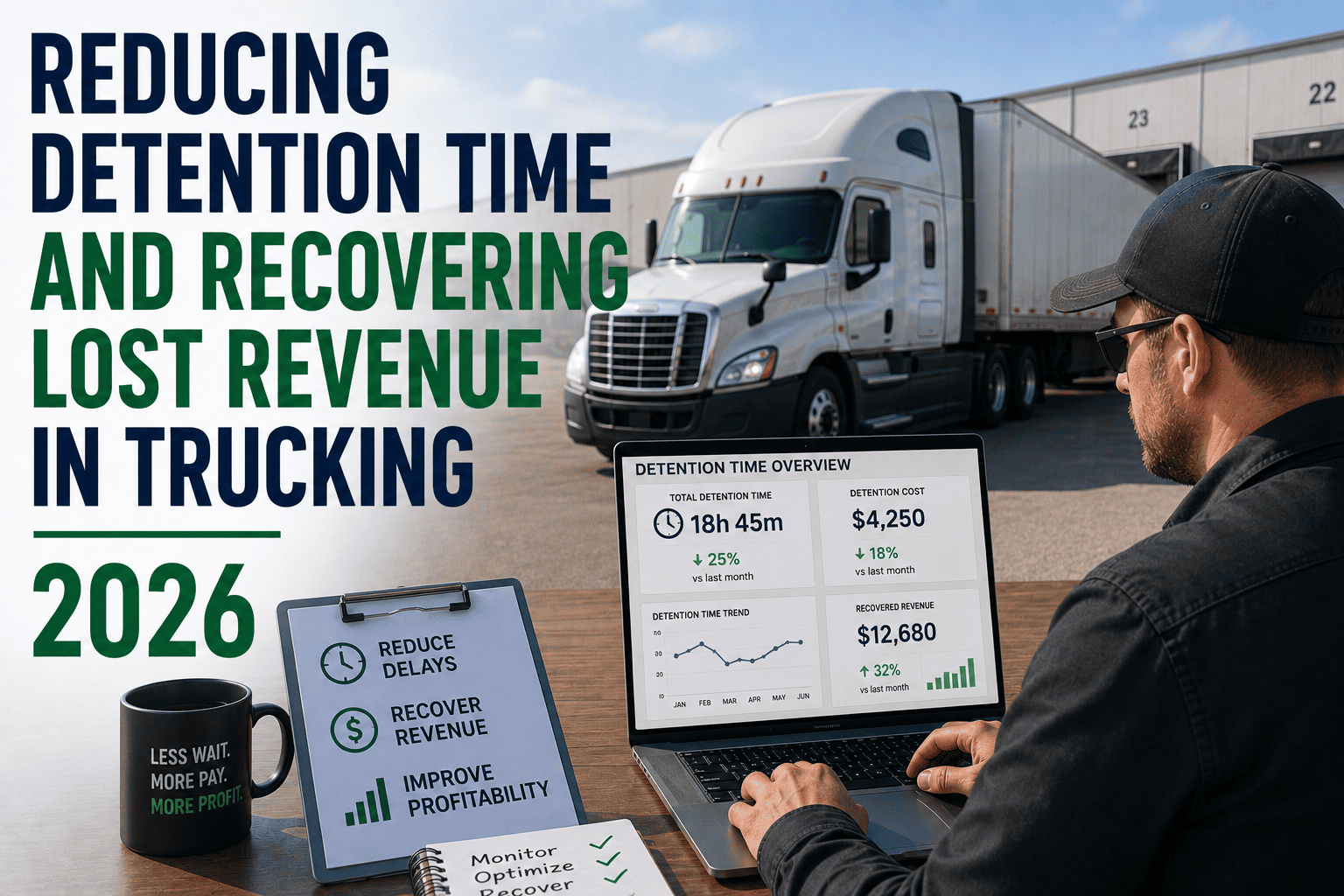
Reducing Detention Time and Recovering Lost Revenue in Trucking in 2026

reducing-detention-time-and-recovering-lost-revenue-in-trucking,-2026

Somewhere between a driver's truck rolling to a stop at the dock and finally rolling back out loaded, revenue quietly disappears. Not because anyone stole it. Because nobody timestamped it, nobody invoiced it, or nobody followed up when the invoice went unpaid. Detention time is one of the only costs in trucking that is genuinely recoverable, the contract usually already allows for it, and most fleets still leave a large share of it on the table every single month.

This guide breaks down why detention revenue leaks out so easily, what proof actually holds up when you ask to get paid for it, and how fleets are closing that gap in 2026.

2026 Snapshot

The Scale Of The Detention Revenue Gap

$15.1B
lost industry-wide to detention every year, according to ATRI research
<50%
of detention invoices submitted by carriers actually get paid
2 hrs
is the typical free-time window before detention pay should begin accruing

Detention Isn't A Cost. It's Unbilled Revenue.

It helps to reframe detention from the start. Most fleets talk about it as a cost of doing business, the price of dealing with slow docks. But detention time is built into most rate agreements as a billable line item. When a driver sits two extra hours at a receiver because the dock was backed up, that time is contractually owed, the same way a loaded mile is owed. The difference is that loaded miles get invoiced automatically every time. Detention has to be caught, timestamped, and chased, and that extra step is exactly where the revenue disappears.

Owed
100%
Logged By Driver
~78%
Invoiced To Shipper
~60%
Actually Collected
<50%

Every step in this chain is a place revenue can quietly fall out. The gap between "owed" and "collected" is the opportunity most fleets haven't fully captured yet.

Why The Gap Is So Wide

Three things consistently widen this gap: detention time that's never recorded at all because nobody was tracking the clock, detention that's recorded but never formally invoiced because it felt like too much paperwork for the dollar amount, and detention that's invoiced but disputed because the carrier's only proof was a driver's word against the shipper's.

Stop Losing Revenue To Untracked Detention

Automatic Timestamps From Arrival To Departure

FleetRabbit records the exact moment a vehicle arrives and leaves every facility, building the documentation trail detention claims need without relying on a driver's memory. Sign up free and see your detention exposure laid out automatically.

$15.1B
Lost To Detention Annually
<50%
Of Claims Get Paid

What Actually Holds Up When You File A Claim

The single biggest reason detention claims get denied isn't that the wait didn't happen. It's that the carrier couldn't prove it well enough to win the disagreement. A clear, timestamped paper trail turns a "he said, she said" dispute into a straightforward, fast-to-resolve invoice.

GPS-Verified Arrival Time

An automatic geofence timestamp carries far more weight than a driver writing down a time from memory after the fact.

GPS-Verified Departure Time

The exit timestamp closes the loop, establishing exactly how long the vehicle was actually stationary at the facility.

Signed Rate Confirmation Terms

Detention terms need to be clear and agreed to before the load, not negotiated retroactively after a dispute has already started.

Check-In Confirmation

A guard log, dock check-in record, or facility sign-in corroborates the GPS timestamp and removes any ambiguity about which truck was where.

Photo Or Note Documentation

A quick photo of the dock queue or a note on the reason for delay adds context that strengthens a claim when a shipper pushes back.

A Consistent Submission Pattern

Shippers take detention claims more seriously from carriers who invoice every qualifying event consistently, rather than only occasionally when it feels worth the effort.

Detention Recovered: A Realistic Before And After

The clearest way to see the size of this opportunity is to compare a fleet running on manual, driver-reported detention against the same fleet once arrival and departure times are captured automatically and invoiced consistently.

What Changes Manual, Driver-Reported Process Automated, Timestamped Process
Detention Events Captured Only the ones a driver remembers to report Every qualifying stop, flagged automatically
Proof Of Wait Time Driver's written estimate after the fact GPS-verified arrival and departure timestamps
Time To Invoice Days later, often after the detail is forgotten Same day, while the record is still fresh
Dispute Outcome Frequently denied for lack of proof Resolved faster with objective records
Claim Submission Rate Inconsistent, depends on driver effort Consistent, every qualifying event flagged
Turn Dock Delays Into Documented Revenue

Detention Tracking That Stands Up To A Dispute

FleetRabbit flags detention automatically the moment free time expires, giving dispatchers the timestamped proof needed to invoice with confidence. Book a free demo to see exactly how a claim gets built from arrival to invoice.

↑ Capture
Every Qualifying Event Flagged
Same Day
Invoicing Turnaround

Not All Shippers Are Equal: Why Performance Tracking Matters

Detention rarely happens evenly across your customer list. A small number of locations are usually responsible for a disproportionate share of total wait time. Tracking detention by shipper, not just fleet-wide, turns a vague frustration into a specific, addressable pattern.

1

Identify The Repeat Offenders

A shipper who causes detention occasionally is a one-off. A shipper who causes it on most visits is a pattern worth a direct conversation, or a rate adjustment.

2

Bring Data, Not Frustration

A specific number, average wait time of two hours and forty minutes across the last twelve visits, lands very differently than a general complaint about slow docks.

3

Use It In Rate Negotiations

Lanes with chronic detention issues deserve rate terms that reflect that real cost, instead of being priced the same as a lane with reliably fast turnarounds.

The Quiet Upside Of Tracking This Closely

Shippers who know their detention patterns are being tracked tend to improve their own scheduling and dock efficiency over time. Visibility alone often becomes its own form of accountability, even before a single dispute ever needs to be filed.

Frequently Asked Questions

QHow much detention time should a carrier realistically expect to recover?
It varies by lane and shipper mix, but fleets that move from inconsistent manual reporting to automatic, timestamped tracking typically recover meaningfully more than they were previously collecting, often because a large share of qualifying events simply weren't being invoiced at all before.
QWhat is the standard free-time window before detention should start accruing?
Two hours is the most common industry standard, though specific terms always depend on what's written into the rate confirmation or contract with that particular shipper or broker.
QWhy do so many detention claims get denied even when the wait genuinely happened?
The most common reason is insufficient proof. A driver's recollection alone is easy to dispute, while a GPS-verified arrival and departure timestamp paired with clear contract terms is much harder to argue against.
QShould small fleets bother chasing detention pay if the dollar amounts per claim are modest?
Yes. Individual claims may look small, but consistently captured and invoiced over a year, detention revenue often adds up to a meaningful amount, especially once the documentation process is automated rather than manual.
QHow can a fleet tell which shippers are causing the most detention?
Tracking average dwell time by individual shipper location, rather than only fleet-wide, reveals which specific docks are driving most of the wait time so conversations and rate adjustments can be targeted where they matter most. Sign up for a free trial to see this breakdown for your own lanes.
QWhat is the fastest first step toward recovering more detention revenue?
Start capturing arrival and departure timestamps automatically instead of relying on driver memory. That single change closes the largest part of the gap between detention owed and detention actually collected. Book a demo to see how that documentation comes together automatically.

The Bottom Line

Detention pay isn't a favor a shipper grants you. It is revenue your contract already promises, the moment a wait crosses the agreed free-time window. The fleets recovering the most of it aren't necessarily fighting harder, they're simply capturing the proof automatically, invoicing consistently, and tracking which shippers cost them the most time so the conversation is backed by data instead of frustration.

Recover The Revenue Already Owed To You

FleetRabbit captures arrival and departure timestamps automatically, flags detention the moment free time expires, and gives you the shipper-level data to invoice with confidence and negotiate from a position of proof. Get started in minutes, no credit card required.

Detention Management Revenue Recovery Dock Wait Tracking Shipper Performance Fleet Profitability

June 20, 2026 By John
All Posts

Reducing Detention Time and Recovering Lost Revenue in Trucking in 2026

reducing-detention-time-and-recovering-lost-revenue-in-trucking-2026

Somewhere between a driver's truck rolling to a stop at the dock and finally rolling back out loaded, revenue quietly disappears. Not because anyone stole it. Because nobody timestamped it, nobody invoiced it, or nobody followed up when the invoice went unpaid. Detention time is one of the only costs in trucking that is genuinely recoverable, the contract usually already allows for it, and most fleets still leave a large share of it on the table every single month.

This guide breaks down why detention revenue leaks out so easily, what proof actually holds up when you ask to get paid for it, and how fleets are closing that gap in 2026.

2026 Snapshot

The Scale Of The Detention Revenue Gap

$15.1B
lost industry-wide to detention every year, according to ATRI research
<50%
of detention invoices submitted by carriers actually get paid
2 hrs
is the typical free-time window before detention pay should begin accruing

Detention Isn't A Cost. It's Unbilled Revenue.

It helps to reframe detention from the start. Most fleets talk about it as a cost of doing business, the price of dealing with slow docks. But detention time is built into most rate agreements as a billable line item. When a driver sits two extra hours at a receiver because the dock was backed up, that time is contractually owed, the same way a loaded mile is owed. The difference is that loaded miles get invoiced automatically every time. Detention has to be caught, timestamped, and chased, and that extra step is exactly where the revenue disappears.

Owed
100%
Logged By Driver
~78%
Invoiced To Shipper
~60%
Actually Collected
<50%

Every step in this chain is a place revenue can quietly fall out. The gap between "owed" and "collected" is the opportunity most fleets haven't fully captured yet.

Why The Gap Is So Wide

Three things consistently widen this gap: detention time that's never recorded at all because nobody was tracking the clock, detention that's recorded but never formally invoiced because it felt like too much paperwork for the dollar amount, and detention that's invoiced but disputed because the carrier's only proof was a driver's word against the shipper's.

Stop Losing Revenue To Untracked Detention

Automatic Timestamps From Arrival To Departure

FleetRabbit records the exact moment a vehicle arrives and leaves every facility, building the documentation trail detention claims need without relying on a driver's memory. Sign up free and see your detention exposure laid out automatically.

$15.1B
Lost To Detention Annually
<50%
Of Claims Get Paid

What Actually Holds Up When You File A Claim

The single biggest reason detention claims get denied isn't that the wait didn't happen. It's that the carrier couldn't prove it well enough to win the disagreement. A clear, timestamped paper trail turns a "he said, she said" dispute into a straightforward, fast-to-resolve invoice.

GPS-Verified Arrival Time

An automatic geofence timestamp carries far more weight than a driver writing down a time from memory after the fact.

GPS-Verified Departure Time

The exit timestamp closes the loop, establishing exactly how long the vehicle was actually stationary at the facility.

Signed Rate Confirmation Terms

Detention terms need to be clear and agreed to before the load, not negotiated retroactively after a dispute has already started.

Check-In Confirmation

A guard log, dock check-in record, or facility sign-in corroborates the GPS timestamp and removes any ambiguity about which truck was where.

Photo Or Note Documentation

A quick photo of the dock queue or a note on the reason for delay adds context that strengthens a claim when a shipper pushes back.

A Consistent Submission Pattern

Shippers take detention claims more seriously from carriers who invoice every qualifying event consistently, rather than only occasionally when it feels worth the effort.

Detention Recovered: A Realistic Before And After

The clearest way to see the size of this opportunity is to compare a fleet running on manual, driver-reported detention against the same fleet once arrival and departure times are captured automatically and invoiced consistently.

What Changes Manual, Driver-Reported Process Automated, Timestamped Process
Detention Events Captured Only the ones a driver remembers to report Every qualifying stop, flagged automatically
Proof Of Wait Time Driver's written estimate after the fact GPS-verified arrival and departure timestamps
Time To Invoice Days later, often after the detail is forgotten Same day, while the record is still fresh
Dispute Outcome Frequently denied for lack of proof Resolved faster with objective records
Claim Submission Rate Inconsistent, depends on driver effort Consistent, every qualifying event flagged
Turn Dock Delays Into Documented Revenue

Detention Tracking That Stands Up To A Dispute

FleetRabbit flags detention automatically the moment free time expires, giving dispatchers the timestamped proof needed to invoice with confidence. Book a free demo to see exactly how a claim gets built from arrival to invoice.

↑ Capture
Every Qualifying Event Flagged
Same Day
Invoicing Turnaround

Not All Shippers Are Equal: Why Performance Tracking Matters

Detention rarely happens evenly across your customer list. A small number of locations are usually responsible for a disproportionate share of total wait time. Tracking detention by shipper, not just fleet-wide, turns a vague frustration into a specific, addressable pattern.

1

Identify The Repeat Offenders

A shipper who causes detention occasionally is a one-off. A shipper who causes it on most visits is a pattern worth a direct conversation, or a rate adjustment.

2

Bring Data, Not Frustration

A specific number, average wait time of two hours and forty minutes across the last twelve visits, lands very differently than a general complaint about slow docks.

3

Use It In Rate Negotiations

Lanes with chronic detention issues deserve rate terms that reflect that real cost, instead of being priced the same as a lane with reliably fast turnarounds.

The Quiet Upside Of Tracking This Closely

Shippers who know their detention patterns are being tracked tend to improve their own scheduling and dock efficiency over time. Visibility alone often becomes its own form of accountability, even before a single dispute ever needs to be filed.

Frequently Asked Questions

QHow much detention time should a carrier realistically expect to recover?
It varies by lane and shipper mix, but fleets that move from inconsistent manual reporting to automatic, timestamped tracking typically recover meaningfully more than they were previously collecting, often because a large share of qualifying events simply weren't being invoiced at all before.
QWhat is the standard free-time window before detention should start accruing?
Two hours is the most common industry standard, though specific terms always depend on what's written into the rate confirmation or contract with that particular shipper or broker.
QWhy do so many detention claims get denied even when the wait genuinely happened?
The most common reason is insufficient proof. A driver's recollection alone is easy to dispute, while a GPS-verified arrival and departure timestamp paired with clear contract terms is much harder to argue against.
QShould small fleets bother chasing detention pay if the dollar amounts per claim are modest?
Yes. Individual claims may look small, but consistently captured and invoiced over a year, detention revenue often adds up to a meaningful amount, especially once the documentation process is automated rather than manual.
QHow can a fleet tell which shippers are causing the most detention?
Tracking average dwell time by individual shipper location, rather than only fleet-wide, reveals which specific docks are driving most of the wait time so conversations and rate adjustments can be targeted where they matter most. Sign up for a free trial to see this breakdown for your own lanes.
QWhat is the fastest first step toward recovering more detention revenue?
Start capturing arrival and departure timestamps automatically instead of relying on driver memory. That single change closes the largest part of the gap between detention owed and detention actually collected. Book a demo to see how that documentation comes together automatically.

The Bottom Line

Detention pay isn't a favor a shipper grants you. It is revenue your contract already promises, the moment a wait crosses the agreed free-time window. The fleets recovering the most of it aren't necessarily fighting harder, they're simply capturing the proof automatically, invoicing consistently, and tracking which shippers cost them the most time so the conversation is backed by data instead of frustration.

Recover The Revenue Already Owed To You

FleetRabbit captures arrival and departure timestamps automatically, flags detention the moment free time expires, and gives you the shipper-level data to invoice with confidence and negotiate from a position of proof. Get started in minutes, no credit card required.

Detention Management Revenue Recovery Dock Wait Tracking Shipper Performance Fleet Profitability

June 21, 2026 By John
All Posts

Share This Story, Choose Your Platform!

Latest Posts

Scroll