A vendor promising “40 languages” is usually telling the truth about one thing and leaving out three. Modern speech models really can recognise dozens of languages from a single build, which is why the number is so easy to quote. Whether a technician can describe a trailer brake job in Polish or Portuguese and get a correct, structured work order is a different question. That depends on shop vocabulary, noise, numbers and how the record is stored. This guide explains why multilingual speech is now built in rather than bolted on, where it still breaks on tractor, trailer and chassis work, and how to test it before you roll it out across your shops. To see FleetRabbit’s voice work orders, book a short demo with our team.
Multilingual voice AI · fleet workshops
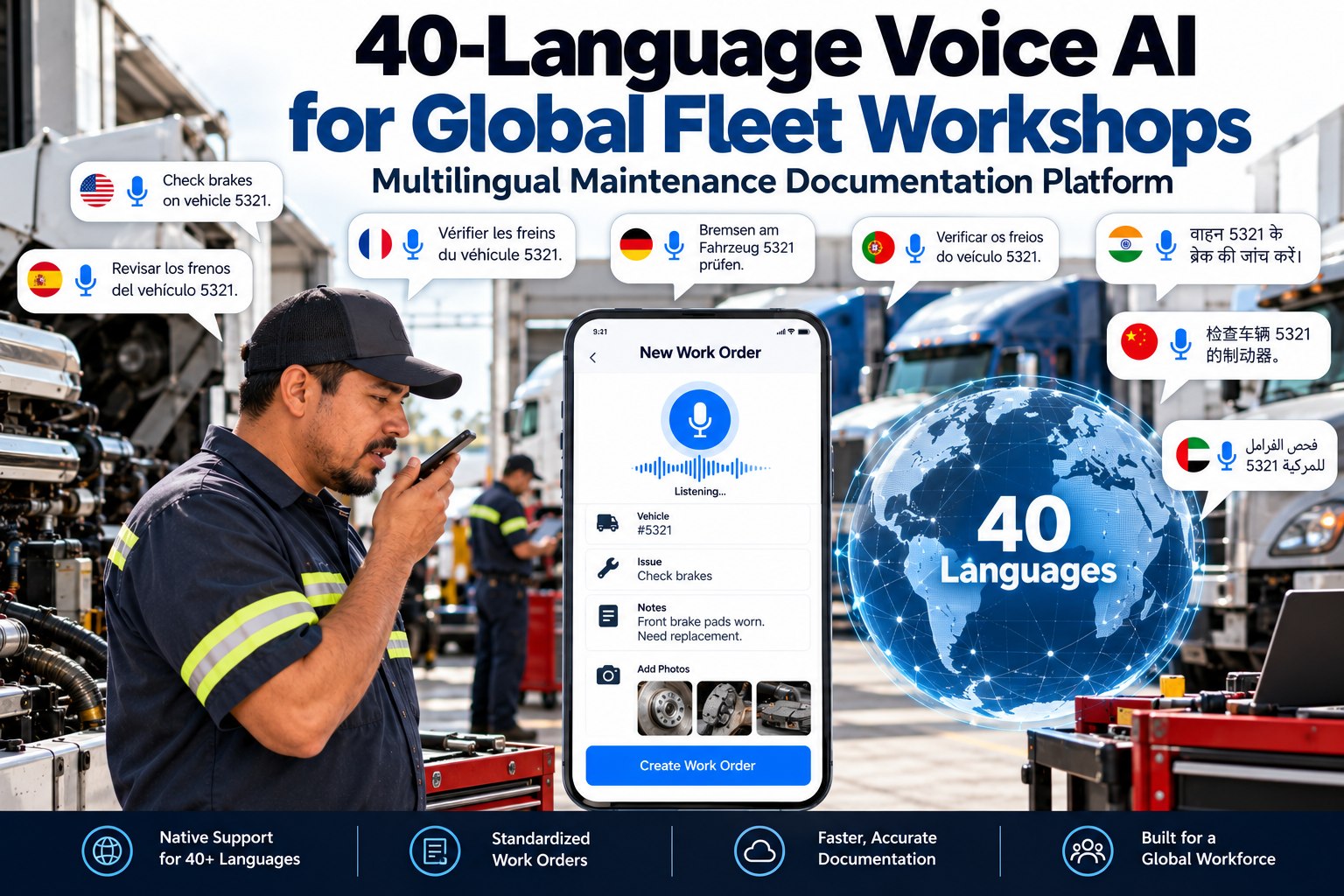
Five languages, one brake job, one work order your whole fleet can read
The same tractor air leak described by five technicians in five first languages. What makes the record useful is not the language count but the fields and codes it ends up in.
ES
“Fuga de aire en la cámara de freno, eje trasero”
FR
“Fuite d’air à la chambre de frein, essieu arrière”
PT
“Vazamento de ar na câmara de freio, eixo traseiro”
PL
“Wyciek powietrza z siłownika hamulca, tylna oś”
DE
“Luftleck am Bremszylinder, Hinterachse”
→
Work order
Representative example · sample data
Complaint
Air leak, brake chamber, rear axle
Transcript
Original language kept
“40 languages” usually describes one layer of a voice tool, not the whole workflow
A voice work order passes through four layers, and each has its own language coverage. Asking which layer a number refers to is the fastest way to understand what a multilingual claim is worth in your shop.
Hear
Speech recognition
Turns audio into text. This is the layer most “40 languages” claims describe, because it comes with the underlying model.
Wide
Understand
Field extraction
Pulls the unit, component, complaint, cause and correction out of the text. It needs shop vocabulary in each language, not just general speech.
Narrower
Record
Stored work order
The language the work order is saved in, usually one working language per fleet, ideally with codes that need no translation.
One or two
Display
App interface
Menus, buttons and prompts. This is a separate localization job, and often covers far fewer languages than the speech layer.
Narrowest
The gap between the top and bottom layers is normal. Speech coverage comes with the model; interface translation is work someone has to do for each language. A tool can hear Polish well and still show its buttons only in English, and for a technician who just needs to talk, that is often fine.
Why one speech model can cover dozens of languages without a build per language
Older speech systems were built language by language: a separate acoustic model, pronunciation dictionary and language model for each. Adding a language was a project. Today’s models are trained on audio from many languages at once and learn them together. OpenAI’s Whisper, released in 2022, was trained on 680,000 hours of audio, 117,000 of them across 96 languages other than English. Meta’s Massively Multilingual Speech project, announced in May 2023, extended speech recognition to about 1,100 languages and language identification to more than 4,000.
| Question | Per-language build | Multilingual model |
|---|
| How a language is added | Separate acoustic model, pronunciation lexicon and language model, built and tuned per language | One model trained on audio from many languages at once; coverage comes with the model |
| Cost of the next language | A new project each time | Close to zero for languages the model already knows |
| Mixed-language speech | Usually fails when a tech switches language mid-sentence | Often handles it, but accuracy varies and needs testing |
| Accuracy across languages | Even, where a language was built | Uneven: strongest where the training data was largest |
| Shop vocabulary | Added per language, by hand | Still needs work: part names, slang and codes aren’t in general training audio |
That is the honest case for “dozens of languages natively”: the coverage is real and cheap. The catch is in the last two rows.
More languages isn’t the same as equal accuracy in each one
Multilingual models are not equally good in every language they list. Whisper’s training audio was mostly English, and the paper notes that most of its other languages had less than 1,000 hours each. Meta reported that many languages in its project had only around 32 hours of labelled audio, and cautioned that the models sometimes transcribe words incorrectly.
Whisper’s 680,000 training hours, English vs all other languages combined
English, about 563,000 h (82.8%)
96 other languages, 117,000 h (17.2%)
Source: Radford et al., “Robust Speech Recognition via Large-Scale Weak Supervision”, OpenAI, 2022. English figure is the remainder.
For a fleet, the practical rule is simple: treat each language as its own rollout. Widely spoken languages such as Spanish, French, German and Portuguese usually have far more training audio. A language spoken by two technicians in one shop may not, and should be tested before anyone depends on it.
Bring your languages
Test the languages your technicians actually speak, on real tractor, trailer and chassis jobs
In a 20-minute demo we’ll run a voice work order and show you exactly what is documented today.
Where multilingual voice breaks on a tractor, trailer or chassis job
General speech models are trained on podcasts, videos and audiobooks. A truck shop is none of those. These four failure points show up first, and most of them are worse outside English.
Tractor · trailer
Unit numbers and readings
“Trailer five-three-oh-two”, “four thirty-seconds” of tread, a pushrod stroke in inches. Numbers spoken in one language with units from another are a common miss.
Tractor · trailer
English loanwords
Many techs say “glad hand”, “slack adjuster” or “fifth wheel” in English inside a Spanish or Polish sentence. A model has to keep the loanword, not translate it badly.
Chassis
Chassis and container terms
Twist locks, locking pins, sliders and container numbers are niche even in English. They are among the words least likely to appear in general training audio.
All units
Shop-floor noise
Impact wrenches and compressors drown out quiet consonants. Accuracy that holds in an office often drops in a bay, and drops further in lower-resource languages.
None of these is a reason to avoid multilingual voice. They are the reason to keep read-back on, so the technician hears the summary and confirms it before the ticket is saved.
VMRS codes are the shared language a multilingual work order needs
The most useful part of a work order in a multilingual fleet is the part that needs no translation. VMRS, the Vehicle Maintenance Reporting Standards developed in 1970 and maintained by ATA’s Technology & Maintenance Council, codes systems, components, failures and the work accomplished. Its failure code key alone has more than 90 codes, such as bent, worn or noisy. When the voice layer maps a description to codes, a brake job described in Portuguese and one described in English roll up into the same cost report.
Travels across languages unchanged
Unit ID: Trailer 5302
VMRS system: brakes
Failure: leaking
Work accomplished: replace
Part number
Measured values and labour time
Needs translation or a working language
Complaint narrative
Technician’s notes on cause
Instructions to the next shift
The more of the record that lands in the left column, the less the language count matters. That is also what keeps fleet maintenance records comparable across shops.
Three shop setups, and which language the record should be kept in
There is no single right record language. It depends on who reads the work order after the technician, and where.
Bilingual shop, one country
Two languages on the floor, one in the office
Record rule
Record in the office language. Keep the original transcript so a lead can check a disputed note.
Cross-border fleet
U.S., Canadian and Mexican shops on the same units
Record rule
Pick one record language for the fleet, and lean on codes so a tractor repaired in Laredo reads the same in Toronto.
Multinational fleet
Shops in several countries with local staff
Record rule
Keep local-language records where regulators expect them, and roll up on codes, not text.
For U.S. operations, one constraint doesn’t move: drivers must be able to make entries on reports and records in English under 49 CFR 391.11(b)(2), so DVIR and DOT inspection records stay in English even where shop work orders don’t.
A 20-job test for every language before you roll it out
Vendor benchmarks are measured on clean audio. Your test should be measured on your jobs. This takes about a week per shop.
1
Collect
Twenty real jobs per language, split across tractor, trailer and chassis work, spoken by your own technicians.
2
Record in the bay
Run them where the work happens, with the usual noise, not in a quiet office.
3
Score the fields
Check unit, component, severity and parts on every ticket. A wrong field matters more than a wrong word.
4
Decide per language
Roll out the languages that pass. Keep the rest on read-back and review until they do.
Score fields, not words. A transcript can get a word wrong and still produce the right work order; a transcript that is 95% right can still put the leak on the wrong axle. Once a language passes, the tickets it produces can feed preventive maintenance scheduling like any other.
Six questions to put to any vendor claiming 40-plus languages
?
Which of the four layers does the language count refer to?
?
Which languages have you tested on shop-floor audio, and can we see the results?
?
Can a technician speak one language and get a work order in another?
?
What happens when a technician mixes two languages in one sentence?
?
Is the original recording or transcript kept with the work order?
?
Which fields come out as codes rather than free text?
What FleetRabbit documents about voice today, and what to test in a demo
Documented on fleetrabbit.com
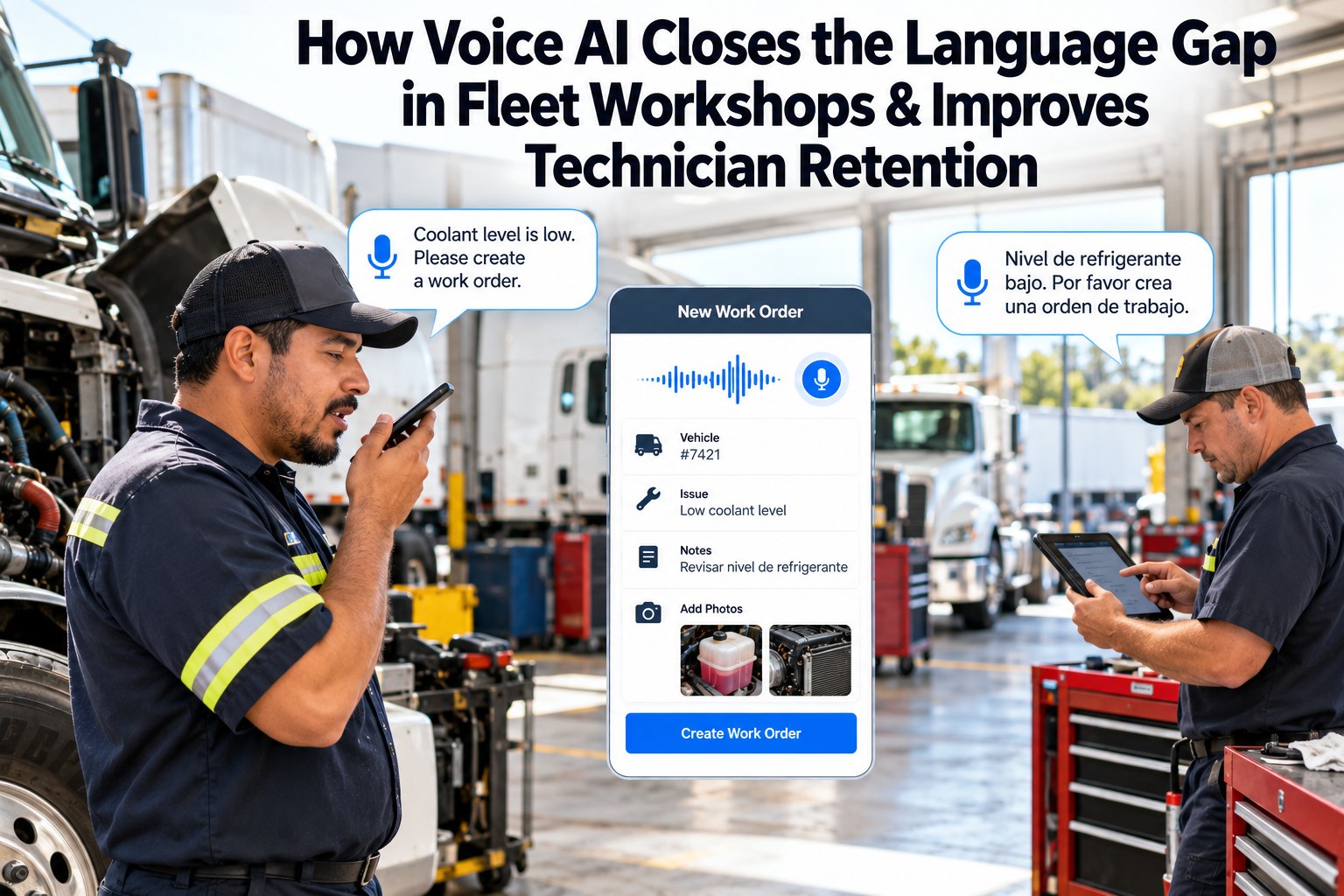
Spoken repair descriptions turned into work orders with complaint, cause and correction
Parts, labour and VMRS codes captured from the description
Noise-cancelling recognition and offline use on the shop floor
Runs on technicians’ existing phones
Not documented, so test it
A list of supported languages, or a 40-language figure
Speaking in one language and saving in another
Interface languages other than English
FleetRabbit voice work orders
Spoken repair descriptions, structured into codes your whole fleet can compare
Voice to work order
Complaint, cause and correction from one spoken description.
VMRS coding
Systems and parts captured as codes, not just text.
Built for the bay
Noise-cancelling, works offline, on phones techs already carry.
What the 20-minute demo covers
A voice ticket on a trailer brake job
How VMRS codes are filled
Your technicians’ languages, tested live
Free plan for 3 vehicles and paid plans
Multilingual voice AI questions from fleet maintenance leaders
Why can one speech model handle dozens of languages?
Modern models are trained on audio from many languages at once. OpenAI’s Whisper was trained on 680,000 hours, 117,000 of them in 96 languages other than English, so coverage comes with the model rather than a separate build.
Is accuracy the same in every language?
No. Accuracy tends to follow the amount of training audio. Whisper’s training data was mostly English, and most other languages had under 1,000 hours.
Does a 40-language claim mean the app is in 40 languages?
Not necessarily. The count usually refers to speech recognition. Field extraction, the stored record and the app’s menus can each cover fewer languages.
Which languages does FleetRabbit’s voice work order support?
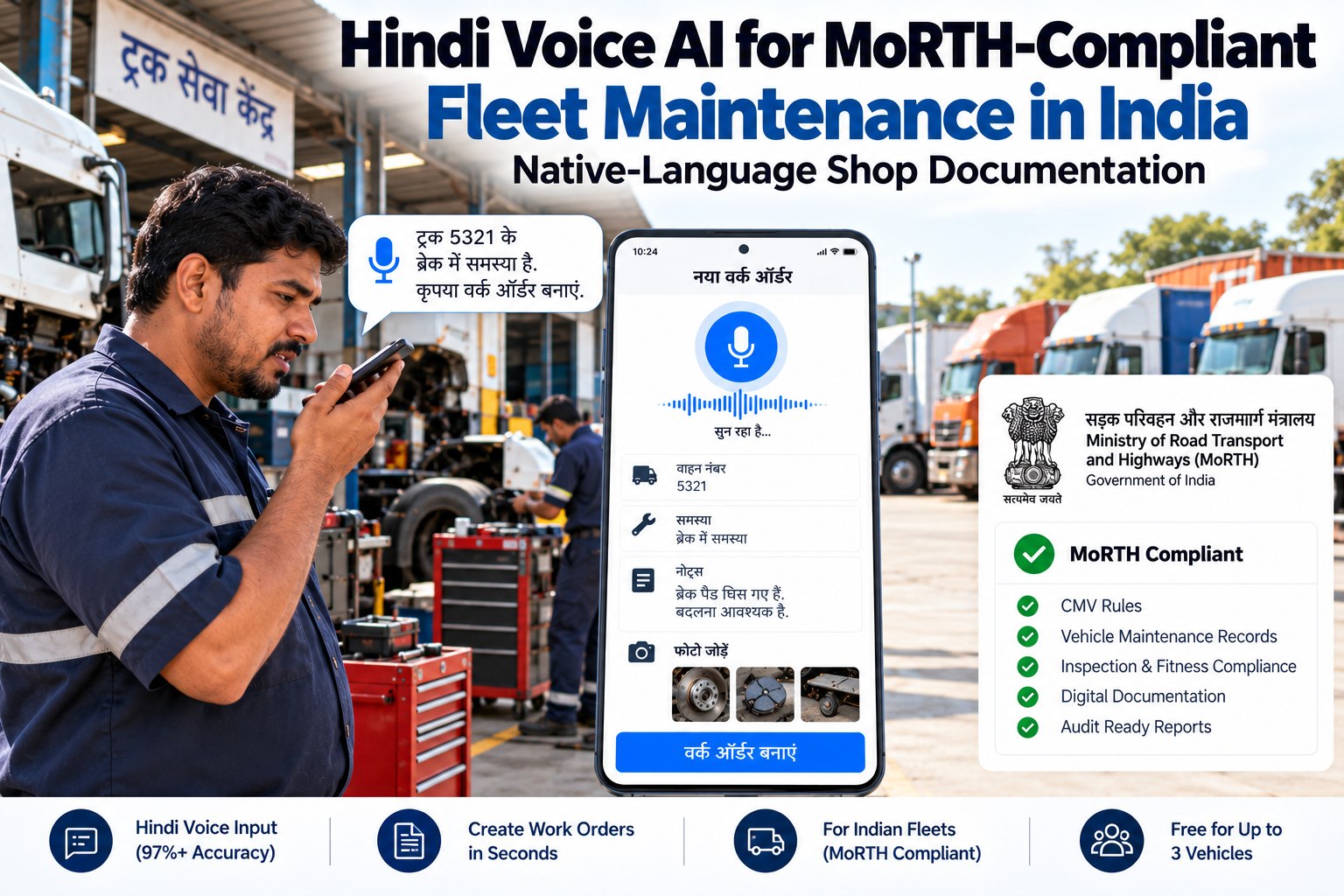
FleetRabbit’s published voice pages don’t list languages. Bring your technicians’ languages to a demo and test them on real jobs.
Why do VMRS codes matter for multilingual shops?
VMRS, maintained by ATA’s Technology & Maintenance Council, codes systems, failures and work done. A code reads the same whatever language the job was described in.
Should drivers’ DVIRs be multilingual too?
Prompts can be, but U.S. drivers must still be able to make entries on reports and records in English under 49 CFR 391.11(b)(2).
Pick the languages your shops need, prove them on real jobs, then roll them out
One structured record per job, whichever language the technician thinks in.
October 19, 2026By Emily Parker
All Blogs