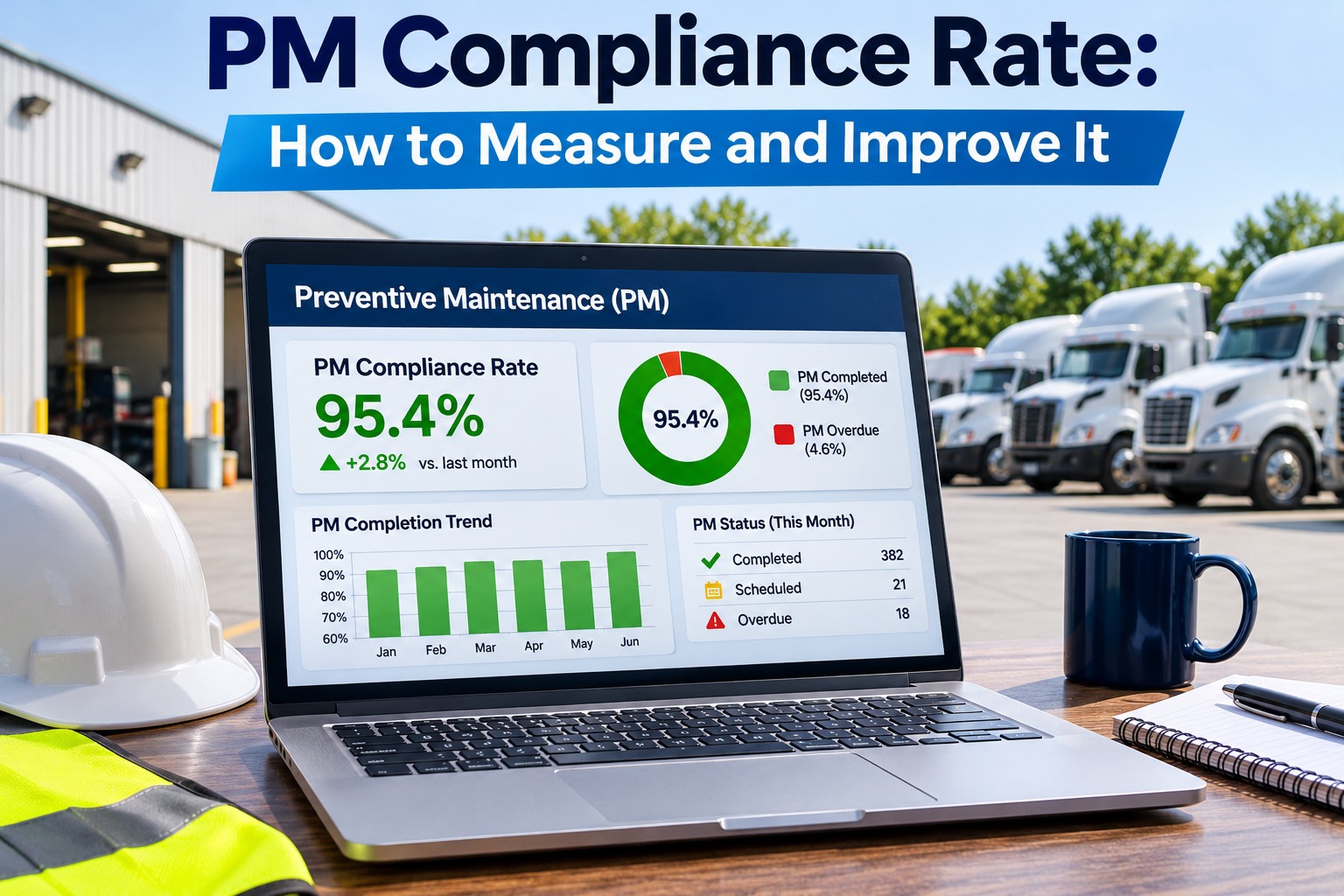
PM compliance rate is the share of preventive maintenance services completed on time, and it is the first number to check when trucks break down between services. This guide shows the formula, a worked example, what published sources call good and how to fix the scheduling gaps that let services slip past due. Schedule a call to review your PM schedule.
PM Compliance Rate Explained: The Formula, the On-Time Window and a Worked Example
Divide PMs completed on time by PMs scheduled, then multiply by 100
If 40 services came due last quarter and 34 were finished on time, the PM compliance rate is 34 divided by 40, or 85 percent. The formula is simple, but the answer depends on how you define scheduled and on time, so write both down before you compare numbers over time.
| Definition choice | Option to pick | Why it matters |
|---|---|---|
| What counts as scheduled | PMs that came due in the period | Including PMs not yet due inflates the base |
| What counts as on time | Done within a set window of the due point | One guide uses within 10 percent of the interval, so a 30-day PM is on time within 3 days |
| Early completion | Decide if it counts and for how long | The sources we reviewed do not say |
| Meter-based PMs | Apply the same window to miles or hours | A 10 percent rule on 10,000 miles is 1,000 miles, our arithmetic |
| Skipped or cancelled PMs | Count them as missed unless the unit left service | Removing them hides problems |
One reliability guide calls PM compliance a leading indicator: when services are missed, failures that could have been caught go undetected, and time between failures tends to fall. That is the guide opinion, not a measured result, but it explains why the rate is worth watching before breakdowns start to climb.
Track the rate by month and by unit class, not only fleet wide. A strong fleet average can hide one depot or one vehicle type that is always late, and the overdue list by unit shows where to look first.
What Is a Good PM Compliance Rate: Targets From Published Sources and Why They Differ
Targets run from 90 to 95 percent, and none of the sources names its data
Treat these as a sanity check. Your own three-month baseline and your own on-time definition matter more than a number from a blog.
| Source | What it says is good | Caveat |
|---|---|---|
| Maintainly | 90 percent or more; below 80 percent suggests an unrealistic schedule or poor prioritization | Vendor blog, no source |
| Reliability magazine article | 95 percent or more, with on time meaning within about 10 percent of the interval | Rule of thumb, no source |
| HVI | 95 percent or more; below 90 percent hurts reliability | Vendor blog, no source |
| FleetRabbit government page | Top group 94 to 98, average 82 to 88, lagging below 75 percent | Attributed to unnamed standards |
Why PMs Slip Past Due: Five Scheduling Gaps That Lower Your PM Compliance Rate
Most overdue services come from the schedule and the setup, not from lazy technicians
Look at the causes in this order, because the first two are the cheapest to fix and affect the most services. A schedule that overloads the shop will produce overdue PMs no matter how hard the team works, and a late meter reading can make a PM look on time when it is not.
| Cause | What it looks like | Fix |
|---|---|---|
| Unrealistic schedule | More PMs due than the shop has bays or hours for | Schedule 80 to 85 percent of crew capacity, as one guide suggests |
| Meter readings not updated | Mileage or hours triggers fire late | Capture meter readings at inspections and fueling |
| Parts or bay unavailable | PM sits waiting on filters or a free bay | Reserve parts when the PM is created |
| No early alert | The first anyone sees is the overdue list | Alert before the due point, not after |
| No owner | Overdue PMs belong to everyone | Name an owner and review weekly |
How to Improve PM Compliance Rate in Five Steps: Window, Triggers, Alerts, Capacity and Weekly Review
Fix the definition first, then the schedule, then the habit
What to Do With an Overdue PM: Triage by How Late It Is and How Risky the System Is
Our suggested response by lateness; adjust it to your own policy
How FleetRabbit Handles PM Compliance: Interval Triggers, Automatic Work Orders and Overdue Dashboards
What FleetRabbit says its PM scheduling does
| PM need | What FleetRabbit pages describe |
|---|---|
| Interval types | PMs can be scheduled by mileage, engine hours or calendar dates, tracked for each vehicle at the same time |
| Auto work orders | When an interval threshold is reached, FleetRabbit generates work orders from customizable templates |
| Overdue view | Dashboards show upcoming, overdue and in-service vehicles with color-coded alerts |
| Compliance reporting | Reports support analysis of maintenance costs, compliance rates and technician productivity |
| Formula | FleetRabbit defines PM compliance as completed on-time PMs divided by total scheduled PMs times 100 |
FleetRabbit pages do not say whether triggers fire on whichever threshold comes first, or what counts as an on-time window, so settle both in a demo.
PM Compliance Rate FAQs: Formula, Good Targets, Overdue Services and Scheduling
Short answers for fleet and shop managers
How do you calculate PM compliance rate?
Divide the number of preventive maintenance services completed on time by the number scheduled in the period, then multiply by 100. For example, 34 on time out of 40 scheduled is 85 percent. Define scheduled and on time in writing so the number stays comparable.
What is a good PM compliance rate?
Published sources range from 90 percent or more to 95 percent or more, and FleetRabbit lists 94 to 98 percent for top fleets and below 75 percent as lagging. None names its data, so use your own baseline and definition.
What counts as on time for a PM?
Definitions vary. One guide says a PM is on time within about 10 percent of its interval, so a 30-day PM is on time within 3 days. The sources we reviewed do not say whether early completion counts, so decide and document it.
Why do PMs go overdue?
Common causes are an unrealistic schedule, meter readings that are not updated, parts or bays not available, no alert before the due point and no clear owner. Fix those in that order before blaming technicians or drivers, and review each overdue service to see which cause it was.
Should I trigger PMs by mileage or time?
Use whichever suits the equipment, and many fleets use both so the first to arrive triggers service. Engine hours matter for idling equipment. Check that your software handles each type and fires on whichever comes first if that is your rule.
Where do I start with FleetRabbit?
Load your PM intervals and units, then look at the overdue view and the compliance rate. Ask how triggers fire, how the on-time window is defined and when alerts are sent before you move the whole fleet. Try PM scheduling in FleetRabbit.