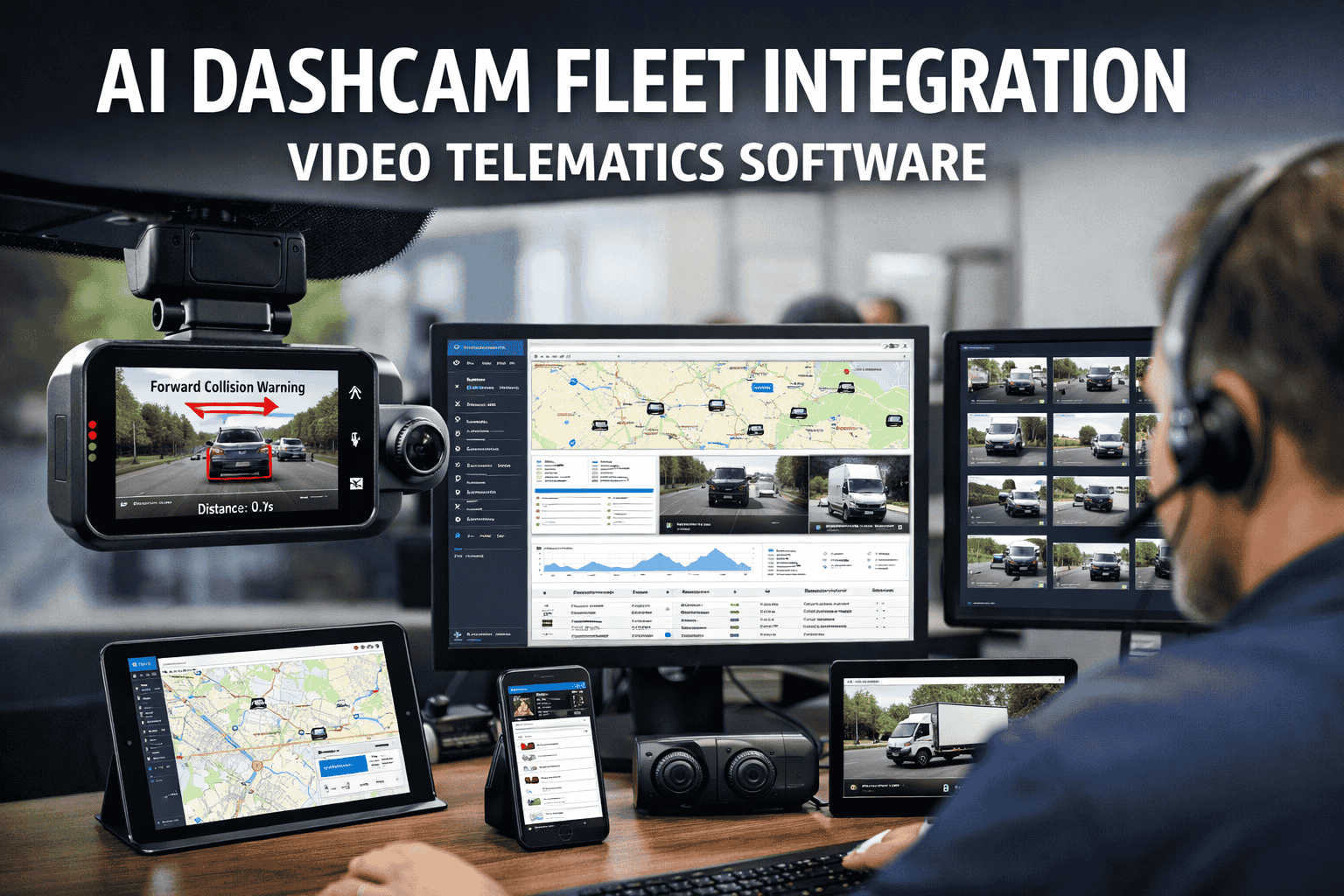
AI dashcam fleet integration software for video telematics, driver safety, incident detection and automated coaching. Fleets using AI video telematics report up to 80% reduction in distracted driving incidents 52% fewer accidents, and insurance premium savings that often exceed the entire system cost. This guide covers how AI dashcam integration works what behaviors get detected, how video data connects to route optimization and driver coaching, and how to evaluate systems for your US commercial fleet in 2026.
AI Dashcam Fleet Integration Software — Why 2026 Is the Year Fleets Upgrade
There's a version of fleet management where you find out about an accident after it happens. The driver calls in, you pull the incident report, and you spend the next two weeks managing the claim — hoping your driver's account holds up and praying there's no lawsuit. That's how most fleets still operate. And it costs the average US commercial fleet $148,000 per injury crash — a figure that doesn't include legal fees, lost productivity, or the driver you might lose over the incident.
AI dashcam fleet integration changes that entire dynamic. Modern AI cameras don't just record — they detect, alert, and coach in real time. When a driver starts to drift drowsy, the system fires an in-cab alert before the lane departure happens. When harsh braking occurs, the clip is automatically uploaded with GPS context, vehicle diagnostics, and driver history attached. And when a fraudulent "staged accident" claim comes in, your fleet manager pulls timestamped dual-facing HD video and resolves it in minutes instead of months.
FleetRabbit's AI dashcam integration connects video telematics directly to route optimization, driver performance profiles, and maintenance data — giving you unified fleet intelligence instead of yet another disconnected tool. Book a demo to see it live on your fleet.
Traditional Dashcam vs. AI Dashcam — What's Actually Different
Most fleet managers know they need cameras. The question in 2026 isn't whether to deploy dashcams — it's whether you're getting AI-powered intelligence or just recording footage that sits unwatched on an SD card until something goes wrong.
Want to see how FleetRabbit connects AI dashcam data with route optimization? Start a free trial — free up to 3 vehicles, from $3/vehicle/month.
What AI Dashcams Actually Detect — The Full Behavior List
Modern AI dashcam systems run 30+ neural network models simultaneously on-device. Here's what today's systems detect in real time — and what triggers an in-cab alert vs. a manager notification.
Eye closure duration, head drooping, blinking frequency — alert fires before lane departure occurs
Hand-held phone detection while vehicle in motion — both texting and calling captured
Road-facing AI tracks lane markings — detects drift without turn signal activation
G-sensor triggers + video clip auto-uploaded with location, speed, and vehicle diagnostics
AI calculates following distance based on speed and road conditions — alerts at unsafe thresholds
Driver-facing camera detects absent seatbelt — flag added to driver's safety profile
GPS-referenced speed limits trigger contextual alerts — not just overall speed thresholds
Cumulative distraction index per shift — feeds into driver safety profile and coaching priority queue
Driver-facing AI flags smoking events — documented for policy compliance and insurance reporting
Video events correlated with GPS route data — identify whether routing decisions contribute to unsafe driving
Aggregate behavior scores across all drivers — identify high-risk vehicles and shifts for targeted intervention
See AI dashcam detection live on your fleet
FleetRabbit integrates AI video telematics with route optimization and driver profiles — all in one platform. Free up to 3 vehicles, from $3/vehicle/month, no contracts.
How AI Dashcam Integration Works — From Camera to Coaching
Integration is what separates a dashcam from a video telematics system. A camera that records to SD card and a camera whose data flows automatically into your fleet management platform are completely different tools — even if the hardware looks identical.
Dual-Facing Camera Captures Road + Driver
Road-facing lens records forward traffic, road conditions, near-misses, and external incidents in 1080p HD with a 140°+ field of view. Driver-facing lens monitors eye movement, head position, hand placement, and facial expressions simultaneously. Both streams are analyzed by on-device AI in real time — not sent to the cloud for processing, which would introduce unacceptable latency for safety alerts.
On-Device AI Runs 30+ Detection Models in Real Time
The camera's edge processor (next-gen Qualcomm Dragonwing class chips) runs over 30 neural network models simultaneously — detecting drowsiness, phone use, lane departure, forward collision risk, tailgating, seatbelt compliance, and more. When a risky behavior is detected, the in-cab alert fires within 200 milliseconds — fast enough to interrupt the behavior before an incident occurs. This on-device processing means the system works even when cellular connectivity is poor or absent.
Event Clip Uploaded to Cloud With Full Context
When an event is flagged — either by AI detection or G-sensor trigger from harsh braking or collision — a 30–60 second clip is automatically uploaded to the cloud via LTE/4G. Crucially, the clip arrives in the fleet dashboard already tagged with: GPS coordinates, vehicle speed, driver ID, event type, severity rating, and vehicle diagnostic data from the connected telematics device. Managers don't need to manually correlate data across systems — the context is already assembled.
Automated Driver Coaching — Prioritized by Risk
The platform auto-generates coaching sessions from flagged clips — ranked by severity and frequency. Managers receive a daily coaching queue: not "review 240 hours of footage" but "review these 7 flagged events, prioritized by risk score." Each coaching session shows the driver the exact clip, the behavior detected, the severity, and the corrective action. Driver safety scores update automatically — creating a documented improvement record that satisfies insurance underwriters.
Video Data Feeds Into Route Optimization & Fleet Intelligence
This is where FleetRabbit's integration creates value beyond standalone dashcam systems. Video events are correlated with route data — if drivers consistently show harsh braking on a specific road segment, the routing engine can flag that segment for re-evaluation. Driver safety scores feed into shift assignments. Incident frequency by time-of-day feeds into HOS-aware scheduling. The video telematics system stops being a safety tool and becomes operational intelligence that improves every fleet decision.
Ready to connect your dashcam data to route optimization? Book a FleetRabbit demo and see unified fleet intelligence in action.
The Real ROI — What AI Dashcam Integration Saves Per Year
The business case for AI dashcam fleet integration is no longer theoretical. One prevented injury crash saves $148,279 on average — enough to justify cameras on 50+ vehicles. Here's the full ROI picture for a typical US commercial fleet.
Key Features to Demand from Fleet Dashcam Integration Software
Not all "AI dashcam" systems deliver the same intelligence. These are the features that separate a genuinely integrated video telematics platform from a dashcam with a cloud login.
Dual-Facing HD Cameras
Road-facing and driver-facing lenses recording simultaneously in 1080p minimum, with IR night vision and wide-angle coverage. Non-negotiable for both safety monitoring and fraud protection.
Must-HaveReal-Time In-Cab Alerts
Audio and visual alerts that fire within 200ms of detecting risky behavior — before the incident occurs. The alert must interrupt the behavior, not log it for later review. Response speed is everything here.
Must-HaveGPS + Telematics Integration
Video events must arrive pre-tagged with GPS location, vehicle speed, and diagnostic data. If your system requires manual cross-referencing between the video dashboard and GPS platform, you're working with a disconnected system.
Must-HaveAutomated Driver Coaching Workflow
Auto-generated coaching queue prioritized by risk score, not chronological order. Managers need to know which 7 events to review today — not wade through 240 hours of footage looking for teachable moments.
Must-HaveCloud Storage + Instant Retrieval
All event footage stored in the cloud — searchable by driver, date, event type, or route. When a claim comes in at 11pm, your team pulls the relevant clip in under 2 minutes. Not "we're waiting for the SD card to arrive."
Must-HaveDriver Safety Scoring
Individual driver safety scores that track behavior trends over time — not just per-incident flags. Scores that integrate with performance reviews, route assignments, and insurance renewal documentation are the gold standard.
High ValueExoneration Video & Fraud Protection
Timestamped, court-admissible dual-facing footage automatically stored for every trip. When a fraudulent claim arrives, your legal team accesses the clip before the plaintiff's attorney has filed paperwork.
High ValueRoute Optimization Feedback Loop
Video incidents correlated with route segments, time of day, and traffic conditions — feeding back into routing decisions. This is what FleetRabbit's integration uniquely delivers: safety data improving operational efficiency.
FleetRabbit AdvantageAI dashcam data that improves routes, not just safety reports
FleetRabbit connects video telematics to route optimization — incident patterns on specific roads feed back into smarter routing decisions. It's the only platform where dashcam data actively reduces both accidents and operational costs.
Who Needs AI Dashcam Fleet Integration — Use Cases by Fleet Type
AI dashcam integration isn't one-size-fits-all. Here's how different fleet types see specific, measurable benefits from video telematics deployment.
Long-Haul Trucking
Drowsiness detection is the primary use case — drivers on 10+ hour shifts are at highest fatigue risk. AI monitoring fires alerts at early signs of microsleep, preventing the accidents that generate the industry's highest-value insurance claims. Exoneration video is critical for multi-vehicle accidents on high-speed highways where blame is frequently disputed.
Local Delivery Fleets
High stop-frequency routes in urban environments generate the most harsh braking and pedestrian proximity events. AI dashcams capture near-miss incidents that never get reported — the events most predictive of future accidents. Automated coaching on the specific behaviors generated in urban environments reduces claim frequency where insurance costs are highest.
Waste & Municipal Fleets
Residential collection routes involve constant pedestrian proximity, reversing operations, and interaction with cyclists. Driver-facing monitoring catches distraction and phone use during the low-speed, high-risk operations where waste fleet accidents are most common. Container load cameras document bin condition at pickup — protecting against customer claims of pre-existing damage.
Emergency & Medical Transport
High-urgency driving behavior, frequent lane changes, and time pressure create elevated accident risk. AI monitoring provides objective documentation of emergency driving conditions — critical when incidents occur and the response was medically justified. Exoneration evidence is particularly valuable when emergency vehicles are involved in collisions during active responses.
Waste fleet operator? FleetRabbit is purpose-built for waste and municipal fleets — AI dashcam integration connects directly to route optimization and container tracking in one platform.
Why FleetRabbit for AI Dashcam Fleet Integration
There are standalone dashcam platforms and there are fleet management platforms that bolted on a camera feature. FleetRabbit was built from the ground up to connect safety data, operational data, and route intelligence into a single unified fleet platform — and that difference shows in every workflow your safety team, dispatch team, and drivers use every day.
AI dashcam events, GPS tracking, route optimization, container monitoring, and driver HOS data in a single dashboard. No tab-switching, no manual data correlation, no integration maintenance.
Incident patterns on specific road segments influence future route recommendations. Driver risk scores feed into shift assignments. The safety system actively improves operational efficiency — not just generates reports.
The platform generates daily coaching queues, driver performance reports, and documented improvement records automatically. Small fleets without dedicated safety staff get enterprise-grade safety programs.
Declining event frequency, coaching session records, driver safety score trends — all exportable in the format insurers request at renewal. Built to help you make the case for a 10–30% premium reduction.
Free for up to 3 vehicles, paid plans from $3/vehicle/month — no 12-month lock-in, no per-user fees, no hardware mandates. Try it on your highest-risk vehicles first, scale when you see results.
Camera hardware installs in under 15 minutes per vehicle. Platform setup and driver profile configuration typically completes in 2–3 days. Most fleets have AI-powered safety monitoring running within one working week.
Frequently Asked Questions
What is AI dashcam fleet integration software?
AI dashcam fleet integration software connects in-vehicle cameras with AI-powered analysis, cloud storage, and fleet management platforms to create a unified safety and operational intelligence system. Unlike basic dashcams that record passively to SD cards, integrated AI systems detect risky behaviors in real time, fire in-cab driver alerts within 200 milliseconds, automatically upload flagged clips to the cloud with GPS and diagnostic context attached, and generate automated coaching workflows for fleet managers. When fully integrated — as with FleetRabbit — video telematics data also feeds back into route optimization, driver scheduling, and insurance documentation workflows.
How much can AI dashcam integration reduce insurance premiums?
Insurers in 2026 offer 10–30% premium reductions for fleets with active AI dashcam programs — but the key word is "active." Simply installing cameras isn't enough. Insurers want documented proof that you're using coaching data to reduce risky behavior: declining event frequency over time, completed coaching sessions, driver safety score improvements, and exoneration statistics. Fleets that package this data into a safety improvement narrative at renewal time achieve the highest discounts. Some commercial carriers now require dashcam programs for coverage eligibility. FleetRabbit automatically generates insurance-ready safety documentation.
What driving behaviors do AI dashcam systems detect in 2026?
Modern AI dashcam systems run 30+ neural network models simultaneously, detecting: drowsiness and microsleep (eye closure duration, head drooping), mobile phone use while driving, forward collision risk, lane departure and swerving, tailgating and unsafe following distance, harsh braking and acceleration, seatbelt non-compliance, speeding in school zones, smoking, and distraction events. Critical behaviors trigger immediate in-cab audio and visual alerts — designed to interrupt the behavior before an incident occurs. All events are automatically flagged with severity scores and uploaded to the fleet dashboard with GPS, speed, and vehicle diagnostic data attached for context.
How does AI dashcam data connect to route optimization?
In a truly integrated fleet platform like FleetRabbit, video incident data is correlated with route information to identify patterns: specific road segments with high harsh braking frequency, time-of-day windows where distraction events spike, and driver behavior differences between route types. This data feeds back into route planning — flagging high-risk segments for re-evaluation, informing shift scheduling based on driver fatigue patterns, and optimizing stop sequences to reduce the operational pressure that drives risky driving behavior. Standalone dashcam systems generate safety reports but don't improve routes. FleetRabbit closes that loop. Start a free trial to see the integration live.
How quickly can I deploy AI dashcam integration across my fleet?
Most AI dashcam hardware installs in 10–15 minutes per vehicle — plug into the OBD-II port or hardwire to power, mount the camera on the windshield, done. Platform configuration, driver profile setup, and alert threshold calibration typically takes 1–2 days. Most FleetRabbit customers are operating with live AI-powered safety monitoring within one working week of starting deployment. We recommend beginning with your highest-risk vehicles — typically long-haul trucks or urban delivery vehicles — then scaling once you've validated the system on your specific fleet and route types. Start your free trial or book a demo to walk through the setup process.