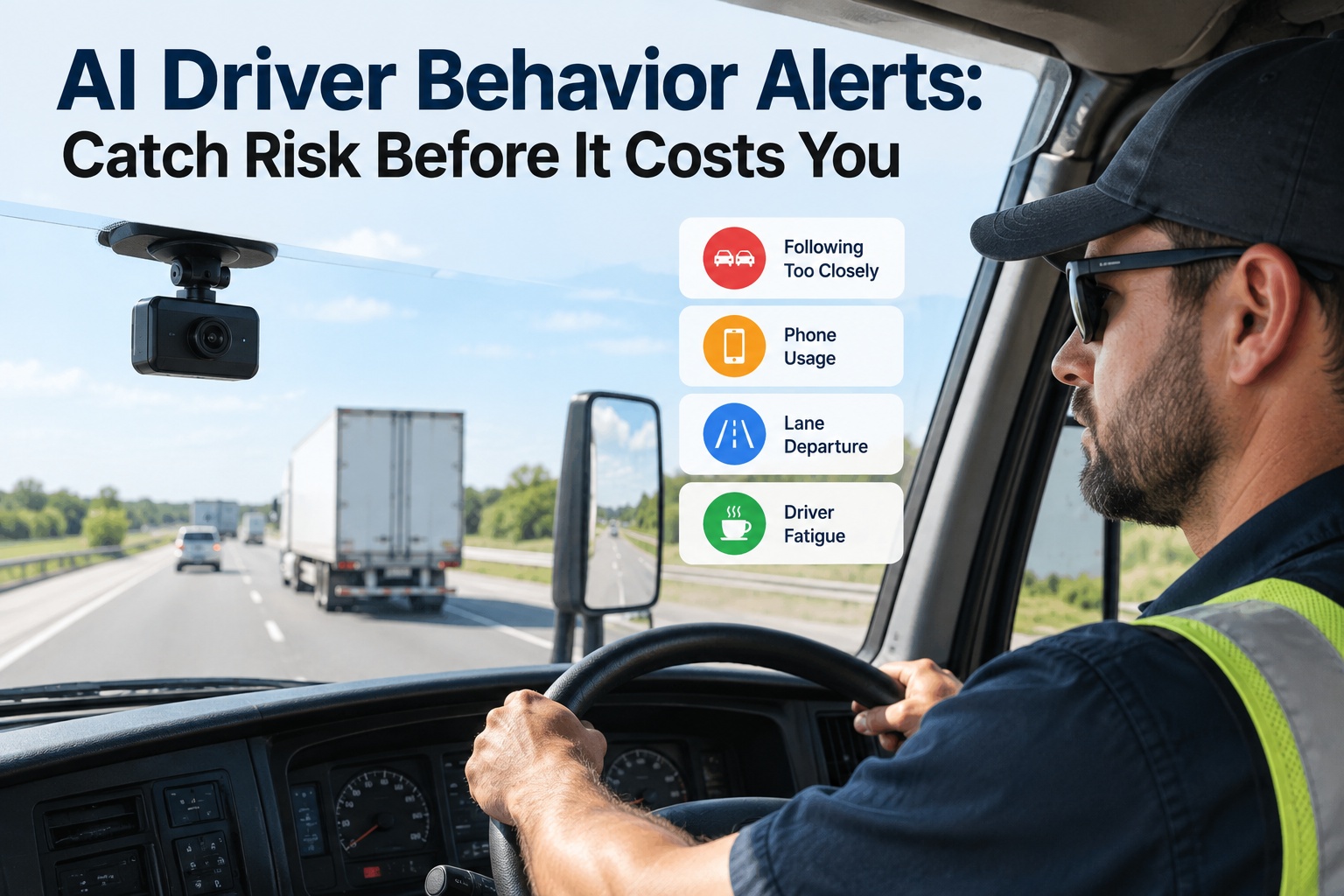
An alert tells you what happened. It does not tell you why — and that gap is where most driver behaviour programmes quietly fail. Three harsh braking events on the same driver could be a skills gap, a deliberate policy choice about following distance, fatigue accumulating across a long rotation, or a brake problem on that specific vehicle. Four causes, one alert, four completely different correct responses. Coach the driver for a mechanical fault and you have wasted the conversation, damaged your credibility and left the actual hazard on the road. Published coaching guidance is explicit that effective intervention requires distinguishing between capability gaps, policy violations and fatigue-related readiness issues, because the same unsafe behaviour stems from different root causes. Most platforms surface the event and leave the diagnosis to whoever opens the dashboard. Spend thirty minutes with us on a week of your own alerts and we'll sort them by which of the four they actually are.
Fleet Safety · Driver Behaviour Alerts
AI Driver Behavior Alerts That Tell You What To Do
Triage every event by cause before anyone books a coaching session, route the mechanical ones into maintenance instead of a conversation, and keep alert volume low enough that managers still read them in month six.
One alert: harsh braking, three times this week
Skills gapCoach
Policy choiceClarify the rule
FatigueChange the schedule
Brake faultRaise a work order
The Fourth Cause Nobody Checks
Three of the four causes are well documented in safety guidance. The fourth sits outside the safety system entirely, which is exactly why it gets missed.
The three everyone knows
Capability gaps, policy violations and fatigue-related readiness issues. Each needs a different intervention — training, a rule conversation, or a schedule change — and treating them identically is why so much coaching produces no measurable change.
The one that is not a driver problem at all
A vehicle fault. Brake fade, worn pads, a sticking caliper or a tyre pressure issue all produce longer stopping distances, which produce exactly the deceleration signature an accelerometer logs as harsh braking. The driver braked normally. The vehicle did not stop normally.
How you tell the difference
By asking whether the pattern follows the driver or the vehicle. A driver whose events disappear when they change trucks was never the problem — and that question is unanswerable unless your behaviour data and your vehicle data sit on the same record.
This is the single most valuable question to be able to ask of an alert, and it is almost never asked because behaviour data lives in a safety platform and maintenance history lives somewhere else.
Does this pattern follow the driver or the vehicle? If you cannot answer it in under a minute, you are coaching on incomplete information.
Ask us to run that split on your last month of events — it usually takes one session and it changes how a safety team spends its week.
Alert Fatigue Is the Programme Killer
Not a minor annoyance. It is the mechanism by which a well-funded safety programme becomes a dashboard nobody opens.
What happens by default
Everything alerts, so nothing does
Reactive programmes that review events after they occur create alert backlogs. Once a manager opens a queue of two hundred events with no ranking, the rational response is to stop opening it — and from that point the system is recording risk rather than reducing it.
What has to happen instead
Tune thresholds so managers only see what matters
A severe event reaches a manager immediately. A minor speeding event gets logged and held for the next coaching session rather than interrupting anyone. Two tiers, two destinations — and the second tier is where most of the volume belongs.
Threshold design is worth real attention because it is the difference between a programme that survives and one that gets switched off. A workable pattern from published practice:
an alert fires when a driver exceeds a safe speed threshold three times within one shift, reaching both driver and manager — rather than pinging on the first occurrence, which is noise, or waiting for a monthly report, which is history.
Bring your current alert volume to a working session and we'll tune the thresholds against what your managers can realistically action.
What Gets Detected, and What Each Signal Means
The physical signatures behind the categories, because knowing what triggers an event tells you how to interpret it.
Swipe to see all columns
Notice how often the right-hand column points somewhere other than the driver. Roughly half of these categories have a plausible non-driver explanation that a safety platform alone cannot test — and each one, if missed, produces a coaching conversation that is not only wasted but actively corrosive to the programme's standing with drivers.
Contextual Beats Absolute
A speeding alert against a posted limit is the crudest possible version of the measurement, and it misses the events that actually matter.
01Legal is not the same as safeDriving at 55 in a 60 zone is legal and can still be dangerous in heavy rain or dense traffic. Advanced monitoring compares speed against real-time weather and traffic to judge whether the driver was operating safely for the conditions rather than merely within the sign.
02Location changes the thresholdGeofencing lets you trigger different behaviour thresholds in high-risk zones — a warehouse yard, a school district, a customer site. The same 20 mph means something different in each, and a single fleet-wide rule cannot express that.
03Normalise by distance, not by countRaw event counts penalise your highest-mileage drivers automatically. Events per hundred kilometres is the comparable figure — a published example describes a driver at nine harsh-braking events per hundred kilometres alongside a 27 per cent idle rate, which is a diagnosis rather than a total.
Worth testing
Is your speeding alert measuring conditions or just signs?
Most fleets discover their speeding volume is dominated by marginal overages on open road while the genuinely risky events — wet-weather closing speed, yard manoeuvres, urban following distance — never trigger at all. Send us a week of events and we'll show you the split.
Coach the Outliers, With Specifics
Two rules that do more for outcomes than any threshold setting.
Spend your time on the bottom fifth
Published practice is direct about this: focus coaching effort on the bottom 20 per cent. Attempting to coach the whole fleet exhausts your manager capacity, dilutes the message and produces the smallest improvement per hour invested. The outliers are where the risk and the headroom both sit.
Coach from timestamped events, never from opinion
"Three harsh-braking events on the ring road on Tuesday" lands completely differently from "drive more carefully." The first is a factual conversation the driver can engage with and act on. The second is an accusation with no route to improvement, and every driver has heard it before.
Then record what you did
Event, coaching action, date, outcome. This is what turns a coaching programme into evidence — for insurance renewal, for a liability claim, and for demonstrating internally that the investment produced something other than a dashboard.
The worked example from published practice is worth copying as a template. A delivery van driver in a 25-vehicle fleet ran nine harsh-braking events per hundred kilometres, a 27 per cent idle rate and regular speeding of 15 to 20 km/h over — producing a behaviour score of 46, in the red.
The manager coached from those three specific numbers rather than from a general impression, which is the entire difference between a conversation that changes behaviour and one that generates resentment.
See what your own bottom-20% list looks like before you decide how much coaching capacity you actually need.
Predict Rather Than Review
The shift that separates a documenting programme from a preventing one.
Reactive
Review events after they happen
Creates alert backlogs and coaches behaviour that has already produced whatever risk it was going to produce. Necessary, but it is documentation rather than prevention.
Predictive
Adjust the shift before it starts
Fatigue forecasting up to eighteen hours ahead lets dispatchers change schedules and assignments before a high-risk shift begins. One pilot reported a 42 per cent reduction in fatigue-linked telematics events — achieved by changing the roster rather than by coaching anybody.
That last point deserves emphasis because it reframes what a behaviour programme is for. The largest single reduction in that pilot came from a dispatch decision, not a driver conversation — which means the most valuable output of your alert data may be a scheduling change rather than a coaching session. Fleets that route telematics, camera, hours-of-service and fatigue data into one supervisor decision point are described as shifting from documenting risk to preventing it.
Inside Fleet Rabbit: How the Alerts Become Actions
Six things the platform does with a behaviour event, and the second is the one that separates it from a safety-only tool.
01Events land on the vehicle and the driver, not just oneEvery alert attaches to both records, so you can ask whether a pattern follows the driver or the truck. That single capability answers the four-causes question that a driver-only view cannot.
02Mechanical patterns raise a work order automaticallyBecause Fleet Rabbit already holds your inspections, preventive schedules and repair history, a braking pattern concentrated on one vehicle becomes a brake inspection rather than a coaching session. No standalone behaviour platform can make that call, because it does not know when those brakes were last serviced.
03Two-tier routing out of the boxSevere events reach a named person immediately; minor ones queue for the next coaching session. Thresholds are yours to set, which is what keeps the immediate channel credible enough that people still respond to it in month six.
04Coaching actions recorded against eventsEvent, action taken, date, outcome — captured as it happens. That log is what insurers read as evidence of management rather than observation, and it is the part nobody can reconstruct at renewal.
05Rates per distance, not raw totalsEvents normalised per hundred kilometres so your long-distance drivers are compared fairly against your urban ones, with rolling scores rather than monthly snapshots.
06Works with the hardware you already haveHardware-agnostic integration with existing telematics, camera and ELD providers. If the alerts already exist and nobody acts on them, the missing piece is the routing and the record — not more devices.
If you take one thing from this section, make it the second item.
A behaviour platform can tell you a driver braked hard eleven times. Only a system holding the maintenance record can tell you whether the brakes were the problem — and getting that wrong is how safety programmes lose the goodwill they depend on.
Walk through how that routing would work on your fleet — it takes about twenty minutes to see on real data.
What to Measure, By Category
Four groups, because a single blended score hides which lever you are actually pulling.
SafetyHarsh braking, sharp cornering and seatbelt use. The collision-predictive set, and the one your insurer will ask about.
EfficiencyIdle time, rapid acceleration and out-of-route miles. These pay for the programme in fuel long before the safety benefit shows up in claims.
ComplianceHours-of-service violations and unauthorised vehicle use. Regulators are moving toward technology-driven compliance metrics including real-time violations and telematics-triggered alerts.
RiskDistracted driving and fatigue detection. The leading indicators — and the two most likely to be a scheduling or workload problem rather than a driver one.
Send us a week of alerts and we'll tell you what they actually mean
We'll take your raw event data and split it four ways — genuine coaching opportunities, policy questions, fatigue and scheduling signals, and the ones that look like a vehicle problem. Then we'll normalise by distance so your bottom 20 per cent is a real list rather than a reflection of who drives furthest. You keep the analysis whether or not anything follows, and most operations find at least one vehicle in there that needed a workshop rather than a conversation.
Setting It Up So It Survives
Six steps. The first two determine whether managers are still reading alerts six months from now.
1Baseline before you tune anythingRun two weeks at default thresholds and count the volume per manager per day. If it is more than a handful, your thresholds are wrong for your operation regardless of what the defaults say.
2Split immediate from queued on day oneDecide which events justify interrupting someone and which belong in a coaching queue. Getting this wrong in either direction kills the programme — too many interruptions and people stop looking, too few and genuine emergencies sit unread.
3Normalise by distance before ranking anyoneYour first outlier list built on raw counts will be your highest-mileage drivers, and coaching them is both unfair and unproductive. Events per hundred kilometres fixes it in one configuration change.
4Check the vehicle before booking the conversationFor any braking or cornering pattern concentrated on one unit, look at the maintenance history first. This costs a few seconds and prevents the most damaging mistake in the whole programme.
5Coach from specifics, and record the outcomeNamed events, named roads, named days — and a recorded result. Events without a logged action are events your insurer will not credit and your drivers will experience as monitoring.
6Review thresholds quarterlyAs behaviour improves, the volume at your original thresholds falls — which is the moment to tighten them rather than to declare victory. A threshold set once is a programme that plateaus.
Worth saying plainly to whoever owns the budget:
the programme's success is measured by falling event rates, which means a well-run system produces less to look at over time. That can read as declining engagement if nobody has explained it in advance.
Talk it through with us before you present the business case — the framing matters more than the technology.
Frequently Asked Questions
Why isn't our coaching changing anything?Most often because the same alert is being treated as one problem when it is several. Effective coaching requires distinguishing between capability gaps, policy violations and fatigue-related readiness issues, since the same unsafe behaviour stems from different causes needing different interventions — training, a rule conversation, or a schedule change. Add the fourth possibility, a vehicle fault, and you have four causes producing one event. Coaching a driver for any of the other three produces no change and costs you credibility.
How do we stop managers ignoring the alerts?Tune thresholds so they only see events that matter, and split routing into two tiers — severe events reaching a person immediately, minor ones logged and held for the next coaching session. Reactive programmes that review everything after the fact create alert backlogs, and once a manager faces an unranked queue of two hundred events the rational response is to stop opening it. A workable pattern is alerting when a threshold is breached three times in a shift rather than on first occurrence.
Could a harsh braking alert be a vehicle problem?Yes, and it is the possibility most programmes never test. Brake fade, worn pads, a sticking caliper or tyre condition all extend stopping distance, producing exactly the deceleration signature an accelerometer records as harsh braking — while the driver braked entirely normally. The diagnostic question is whether the pattern follows the driver or the vehicle, and answering it requires behaviour data and maintenance history on the same record. Have us run that split on your data and see how many of your events move column.
Who should we actually be coaching?The bottom 20 per cent, using specific timestamped events. Attempting to coach the whole fleet exhausts manager capacity and produces the least improvement per hour invested. And the specificity matters enormously — "three harsh-braking events on the ring road on Tuesday" is a conversation a driver can act on, while "drive more carefully" is an accusation with no route to improvement. Normalise events per hundred kilometres first, or your outlier list will simply be your highest-mileage drivers.
Is speeding against the posted limit enough?It is the crudest version of the measurement. Driving at 55 in a 60 zone is legal and can still be dangerous in heavy rain or dense traffic, which is why contextual monitoring compares speed against real-time weather and traffic conditions. Geofencing adds another layer, letting you set different thresholds in high-risk zones such as yards, customer sites and school districts. Most fleets find their speeding volume is dominated by marginal open-road overages while the genuinely risky events never trigger.
What is the difference between reactive and predictive?Reactive reviews events after they happen, which documents risk. Predictive uses fatigue forecasting up to eighteen hours ahead so dispatchers can adjust schedules and assignments before a high-risk shift begins. One pilot reported a 42 per cent reduction in fatigue-linked telematics events — achieved through rostering rather than coaching, which is worth noting because it means your most valuable output may be a dispatch decision rather than a driver conversation.
Do we need new hardware?Usually not. Fleet Rabbit integrates with existing telematics, camera and ELD providers, so if the alerts already exist and nobody acts on them, what is missing is the routing, the triage and the record rather than more devices. Connect three vehicles free and see how your existing events behave once they land on both the driver and the vehicle record.
Triage First, Coach Second
Ask whether the pattern follows the driver or the truck before anyone books a conversation, split severe alerts from queued ones on day one so the immediate channel stays credible, normalise by distance so your outlier list is real, coach the bottom fifth from named events on named days, and record the outcome — because an alert that produces no decision is a cost, and one that produces the wrong decision is worse than none.
Detection thresholds, event definitions and reported outcomes vary by provider, vehicle type and operating environment. Figures cited are drawn from published 2026 industry sources and pilot reporting — validate against your own baseline before building a business case.