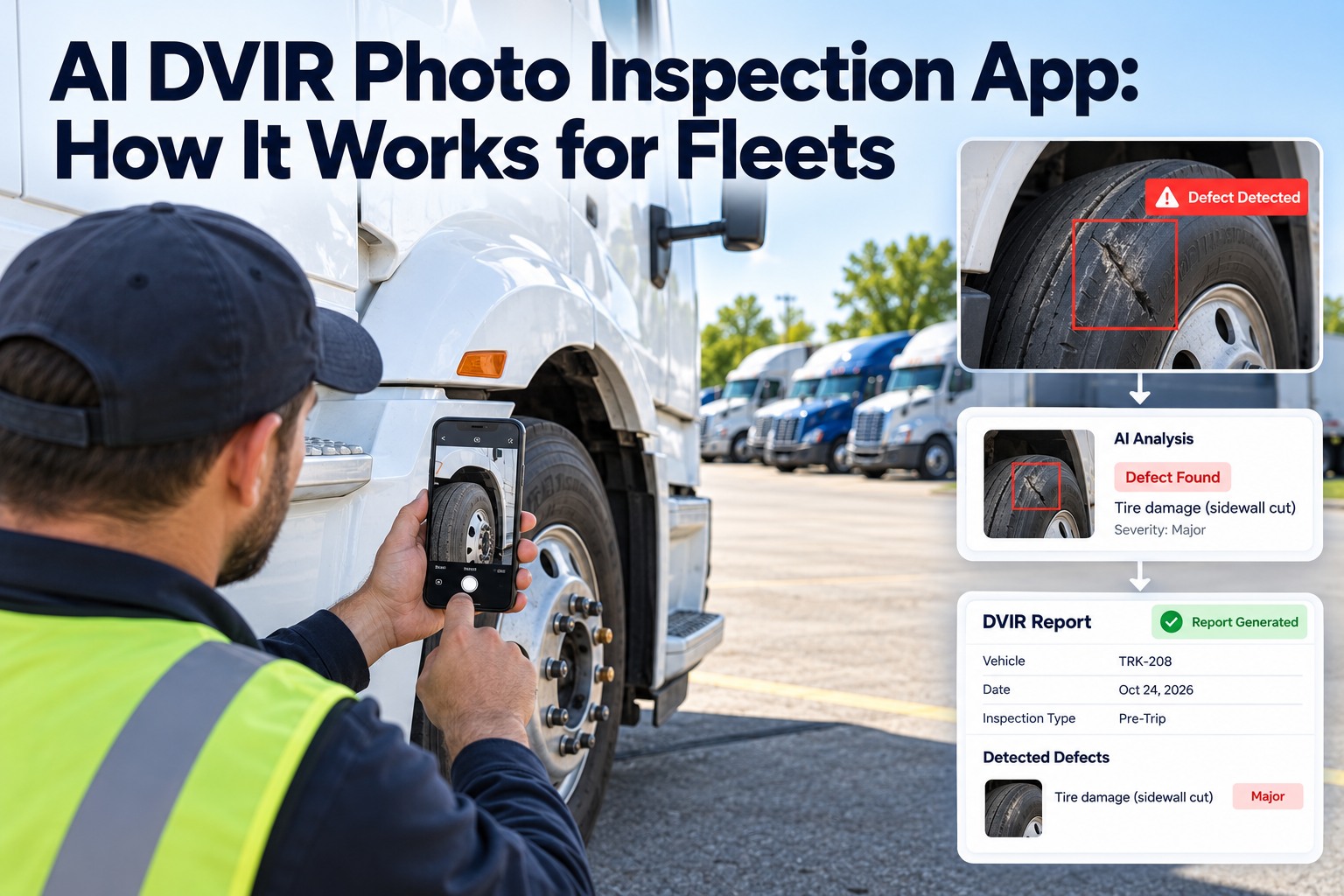
An AI DVIR photo inspection app asks the driver to photograph the truck during the walkaround, then uses image analysis to check the photos and flag likely defects for the shop. The promise is a faster walkaround and clear evidence for every repair. The open question is how well it works. This page explains how AI photo review works, what the DVIR rule requires, what AI can and cannot judge and what accuracy evidence exists. Schedule a call to see photo DVIRs on your trucks.
What the DVIR Rule Requires, and Where a Photo Walkaround Fits Into It
The rule sets what the report must contain, and electronic formats are allowed, so photos add evidence without changing the duty
| What 49 CFR 396.11 and 396.13 say | Plain meaning |
|---|---|
| Written report at the end of each workday | One report per vehicle driven, listing defects |
| At least 11 areas covered | Brakes, steering, lighting, tires, horn, wipers, mirrors, couplings, wheels, emergency equipment and more |
| Driver signs | A signature is still the driver's statement |
| Safety defects repaired and certified before the vehicle runs again | The repair has to be recorded on the report |
| Retain report and certifications three months | Keep photo evidence with the same record |
| Electronic reports allowed under 49 CFR 390.32 | A photo DVIR is a format choice, not a rule change |
These points come from 49 CFR 396.11 and 396.13 as published by Cornell's Legal Information Institute. FMCSA's final rule published February 19, 2026 and effective March 23, 2026 makes explicit that DVIRs may be completed electronically, and its summary describes no mandate. Under 396.13 the driver must still be satisfied that the vehicle is in safe operating condition, so a photo tool supports the driver and does not replace that judgment.
How an AI DVIR Photo Inspection App Works, From Guided Photos to a Flagged Defect and a Work Order
Vendors describe a five-step flow: guided capture, frame and light check, defect flags, severity and a routed work order
Two vendors describe the flow in similar terms. Switchlabs says the driver follows a guided walkaround, the AI checks the right part of the vehicle is in frame and the lighting is adequate, flags known defect classes and routes critical defects with an AI severity score. Heavy Vehicle Inspection describes severity classes of safety-critical, scheduled and monitor. Both pages are vendor descriptions with no independent testing.
What AI Can and Cannot Judge From a Truck Photo: Visible Defects Versus Things a Person Must Check
Visible damage suits image analysis, while performance, sound and hidden wear still need hands and tools
| Better suited to a photo | Needs a person or a tool |
|---|---|
| Cracked or missing lights and reflectors | Brake feel and stopping performance |
| Visible tire damage and sidewall bulges | Air leaks you can hear, steering play |
| Fluid stains and drips under the unit | Internal wear and anything out of frame |
| Missing mud flaps, damaged body panels | Fault codes and engine behaviour |
| Visible hoses, belts and wiring problems | Anything the driver cannot photograph safely |
The left column reflects the defect examples vendors name, such as cracked lights, tire damage, fluid leaks and missing mud flaps. The right column is our own reasoning, because none of the vendors we read publish a list of what their AI cannot detect. Heavy Vehicle Inspection says nothing about limits, false positives or false negatives.
How Accurate Is AI Defect Detection on Truck Photos? The Evidence Is Thinner Than the Marketing
One study reports 78 to 91 percent on vehicle damage, while vendor figures come with no method
| Source | Figure | What we can say about it |
|---|---|---|
| Peer-reviewed conference abstract, 2024 | CNN 91%, DNN 84%, GAN 78% accuracy on vehicle damage | Dataset size and source not described; vehicles, not fleet DVIR items |
| Heavy Vehicle Inspection, Apr 2026 | 95 to 99% detection accuracy | Unsourced vendor figure; no study or dataset named |
| Switchlabs, undated | 92% defect-photo match rate | Vendor-reported, no methodology |
| DAMAGE iD, May 2026 | No figure given | Says AI works best as a support tool, not a replacement |
The chart plots only what the sources state. The three study figures come from one 2024 conference abstract comparing model types on vehicle damage, and the two vendor figures have no stated method, so they are not comparable with each other or with your fleet.
Piloting an AI Photo Inspection App: Test Flags Against Your Mechanics Before You Trust Them
Count false alarms and missed defects on your own trucks, then decide who reviews each flag
What the Shop Gets From a Photo DVIR That a Paper Defect Note Never Provided
A defect arrives with a picture, a unit, a severity and a place, so the technician starts informed
| What the shop receives | Why it speeds the repair |
|---|---|
| Photo of the defect | The technician sees it before the truck arrives |
| Vehicle ID and component | The work order starts on the right unit and part |
| Severity class | Critical defects are handled first |
| Time and GPS location | Shows when and where it was found |
| Driver signature and repair certification | Closes the loop the rule requires |
What AI Photo Inspection Costs: Per-Inspection Pricing Compared With Per-Vehicle Pricing
One vendor charges per completed inspection, so cost scales with how often you inspect, not with fleet size
Switchlabs lists $0.50 per completed inspection for the first 1,000 a month, $0.40 from 1,001 to 5,000 and $0.35 above that, with up to 15 retained photos. As an illustration, 50 trucks inspected 22 days a month is 1,100 inspections, or about $540 a month at those rates. That is our arithmetic and excludes the vendor's other charges. FleetRabbit is free for up to 3 vehicles, then $5 per vehicle per month, which for 50 vehicles is $235, before any add-ons.
How FleetRabbit Handles DVIR Photos, Signatures and Defect-to-Work-Order Routing
Photographed defects reach the shop as work orders, and you confirm what AI analysis is included on a call
FleetRabbit's DVIR page says defects are captured with photos, drivers sign, shops certify repairs, the next driver reviews and signs, and a photographed defect becomes a work order, with safety-affecting defects flagging the truck. It also says repeat defects feed the next service. The page does not describe AI image analysis, voice or offline use for DVIRs, so confirm what AI review does, and how it is tested, in a demo. Free for up to 3 vehicles, then $5 per vehicle per month.