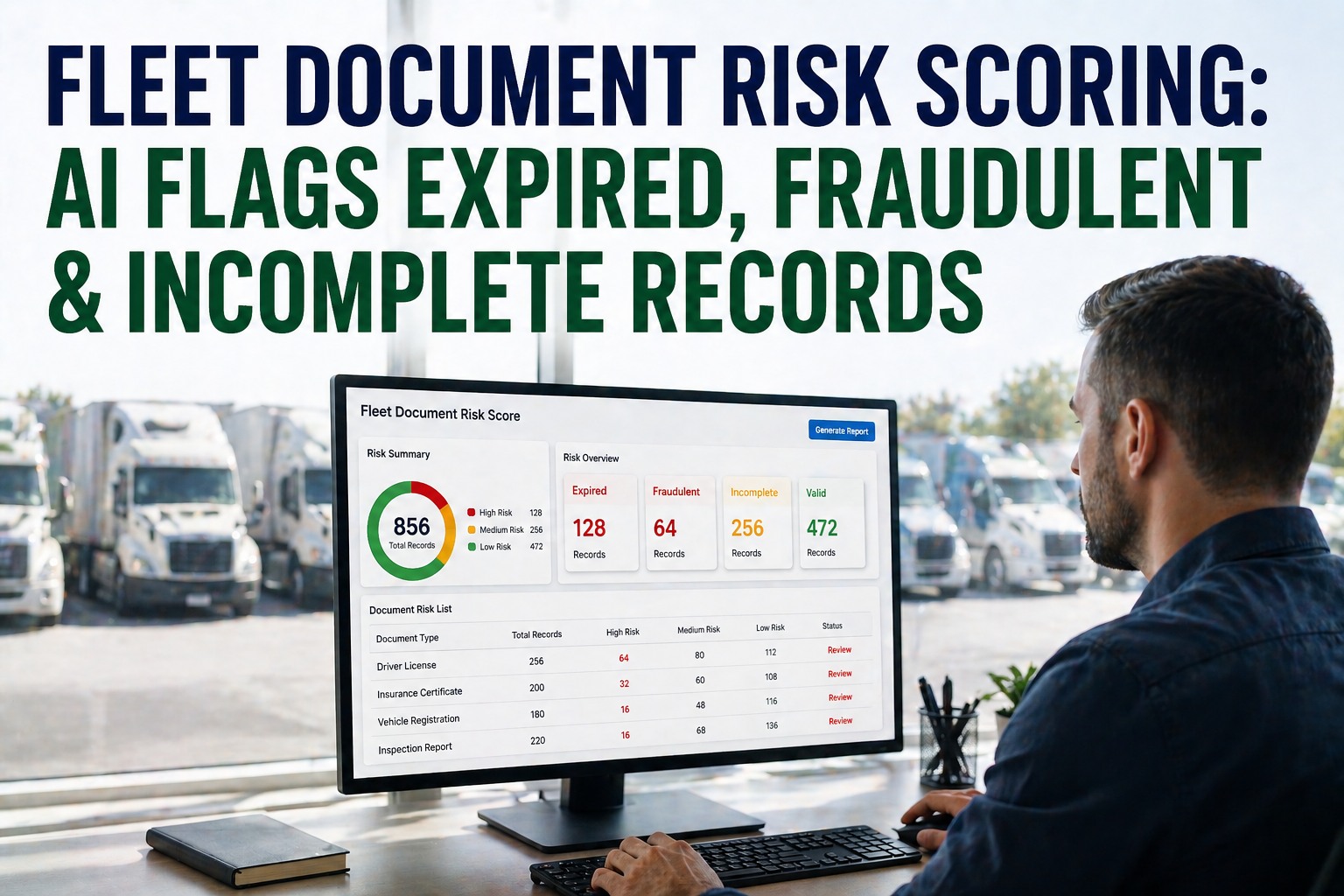
1 in 16 fleet documents now contains some form of forgery, alteration, or fraud signal. AI-generated and template-based fraud rose 5× between April and December 2025. Manual document review — the way most fleets process Driver Qualification Files, medical certificates, MVRs, insurance certificates, and CDLs has become the weakest link in compliance. A safety manager scanning 200 driver files annually for expirations and inconsistencies will miss something. A regulator pulling those same files during an audit will not. The gap between human review and AI-grade scrutiny is now wide enough that document risk scoring has shifted from a luxury feature to compliance infrastructure. Fleet Rabbit's AI Document Risk Scoring evaluates every uploaded record across three dimensions — expiration risk, fraud signals, and completeness — and assigns each document a 0-100 score with a confidence rating. Documents above 80 pass automatically. Documents below 40 route to human review with the specific risk signals highlighted. This guide explains exactly how the scoring works, what each score band means, the 12 fraud signals the model checks, and how the system catches the documents that paper-based and spreadsheet workflows let slip through.
1 in 16 Fleet Documents Has a Fraud Signal. Manual Review Catches Maybe 1 in 50.
Score every Driver Qualification File, medical certificate, MVR, insurance cert, and CDL automatically. Three signals: expiration, fraud, completeness. One unified 0-100 score. Documents that fail get flagged before they reach an auditor — not after.
The Document Fraud Reality — What 2026 Audit Trails Look Like
The 2026 fraud landscape is a step change. Generative AI created counterfeit medical certificates that pass casual inspection. Template-based forgery tools produce inspection certificates with valid-looking layouts. Photoshopped expiration dates on real documents. The math has changed — and so have the audit consequences.
The 3 Risk Dimensions — How Every Document Is Scored
One document. Three independent risk evaluations. Each dimension scores 0-100, then weighted and combined into a single composite. No black-box decisions — every flag is explainable and traceable for audit defense.
Document validity dates extracted via OCR + structured parsing. Compared to current date and operational windows. Flags docs already expired, expiring within 30/60/90 days, or with malformed/missing date fields.
File integrity, image manipulation traces, font inconsistency, EXIF metadata anomalies, template duplication across drivers, and cross-document reference mismatches. The dimension where AI catches what humans miss.
Each document type has required fields (e.g. CDL requires class, endorsements, restrictions, photo, signature). Missing fields, illegible regions, partial scans all reduce the score. Catches "passed but incomplete" submissions.
The Score Bands — What 87 vs 47 Actually Means
Every document lands in one of four score bands. Each band has a defined action — automated approval, supervised review, mandatory re-upload, or block. No subjective judgment, no inconsistent application across the safety team.
High confidence, all dimensions clean. Document filed without human review. Safety manager notified for awareness only.
Acceptable but minor flags (e.g. nearing expiration, partial scan quality). Brief manager review with one-click approve/reject.
Multiple risk signals. Driver/document held in pending state until safety manager reviews flagged dimensions and decides.
High fraud probability or critical missing fields. Document rejected. Driver re-upload required. Incident logged for compliance audit trail.
The auto-approve threshold (85+) handles roughly 70-80% of incoming documents in typical fleets — freeing the safety team to focus the remaining 20-30% on cases that actually need human judgment. See Live Score Bands on Real Documents →
The 12 Fraud Signals the AI Checks — Every Time
Each fraud signal scores independently, then weights into the fraud dimension score. The signals are explainable: any flag generates a human-readable reason, with the location on the document highlighted for the safety manager to verify.
Edits to dates, names, or signatures show as compression mismatches at edge boundaries.
Real scans carry scanner/camera metadata. Synthesized PDFs and Photoshop exports often don't.
Tampered text uses different fonts than the surrounding form. Visually similar, computationally distinct.
Issue date after expiration date. Future-dated expirations beyond regulatory maximums (e.g. CDL beyond 8 years).
Same medical examiner certificate template submitted by multiple drivers in suspicious time clusters.
DOB on CDL doesn't match DOB on application. Address inconsistencies across same driver's file set.
Doctor signature on Medical Examiner Certificate doesn't match registered National Registry pattern.
State-issued docs typically have security features. Missing or simulated features score as fraud signal.
Optical character recognition can't reliably read fields. Either poor scan quality or deliberate obfuscation.
Docs claiming recent issuance that show paper aging signals (yellowing, fold lines) inconsistent with date.
Field positions deviate from canonical template positions for that document type. Forged forms drift.
Statistical signatures of AI-generated images (LLM-produced text, diffusion model artifacts) flagged.
Catch the 1-in-16 Document. Defend the Other 15-in-16 With Confidence.
The fleets that pass FMCSA audits with zero DQF findings aren't lucky. They're using AI document risk scoring that flags problem files weeks before the auditor calls.
Document Types Covered — Full DQF and Fleet Compliance Library
Risk scoring runs natively on every standard fleet document. Each type has tailored field validation, regulatory rules, and fraud-signal calibration based on FMCSA requirements and historical fraud patterns specific to that document.
- Driver Qualification File (DQF)
- Commercial Driver License (CDL)
- Medical Examiner Certificate (MEC)
- Motor Vehicle Record (MVR)
- Application + Prior Employment
- Road Test Certificate
- Annual Driver Review
- Annual Inspection Certificate
- State Registration
- Insurance Certificate
- VIN / Title Documents
- IFTA / IRP Credentials
- Permit Documentation
- Emission Compliance Records
- Daily DVIR (with photos)
- Bill of Lading (BOL)
- Hazmat Documentation
- Drug & Alcohol Test Results
- Clearinghouse Query Receipts
- Training Certificates
- Incident / Accident Reports
Every document type follows the same 3-dimension scoring model. New document types added quarterly based on customer requests. Schedule a Walkthrough on Your Document Stack →
How Fleet Rabbit's AI Risk Scoring Compares to Manual Review
Manual review isn't bad. It's just structurally outmatched by 2026 fraud sophistication and document volume. The numbers below come from internal Fleet Rabbit benchmarks comparing automated scoring against safety-manager spot-check baselines.
| Capability | Manual Review | AI Risk Scoring |
|---|---|---|
| Time per document | 3-5 minutes | ~15 seconds |
| Fraud signal detection rate | ~10-20% (spot-check) | ~95% (12-signal model) |
| Expiration tracking | Spreadsheet, error-prone | Auto-extracted, tiered alerts |
| Cross-document matching | Rare, manual | Automatic, every upload |
| Audit trail per document | "Reviewed by Sarah, OK" | Full signal log + score history |
| False positive rate | N/A (under-detects) | ~3% (calibrated) |
| Cost per 1,000 documents | $200-400 in labor | Included in subscription |
| Consistency across team | Variable by reviewer | Identical, every time |
Frequently Asked Questions
No. The AI handles volume — automatically passing the ~80% of documents that are clean, and flagging the ~20% that need human judgment. Your safety manager focuses on the cases that actually require human review (genuine ambiguity, edge cases, driver follow-up). Throughput goes up; expertise focus goes deeper.
The document enters a pending queue with the specific risk signals highlighted (e.g. "Image tampering at expiration date region · Confidence 76%"). The safety manager reviews the flagged regions, decides accept/reject/re-upload, and the decision is logged with timestamp + user for full audit trail. See a Flagged Document Walkthrough →
Yes — driver portal shows their document status (Pass/Watch/Flag) but not the underlying signal details (which would help bad actors learn to evade detection). Drivers see what they need to fix; only safety managers see the full risk reasoning. Role-based access is enforced.
The fraud detection model is retrained quarterly on emerging fraud patterns observed across the customer base. New AI-generated forgery techniques (deepfakes, diffusion-model artifacts, template variants) are added to the detection library as they emerge in the field.
Yes — every score generates an explainable audit trail: which signals triggered, where on the document, what the human reviewer decided, when, and why. This documentation is materially stronger than "we reviewed it manually and it looked fine" and provides a defensible record for General Duty Clause and DQF compliance defense.
Yes — included in the $3/vehicle/month subscription. No per-document fee, no per-scan charge, no separate AI module pricing. Free tier (up to 3 assets) includes risk scoring for testing purposes. Book a Demo to See Pricing →
The Audit Defense You Can't Build Manually.
Three risk dimensions. Twelve fraud signals. Fifteen-second per-document scoring. Four explicit score bands with defined actions. Full audit trail per document — who reviewed, what was flagged, what the AI saw, what the human decided. Used by fleets to catch the 1-in-16 fraudulent documents that paper and spreadsheet workflows let through. Free tier supports up to 3 assets indefinitely.