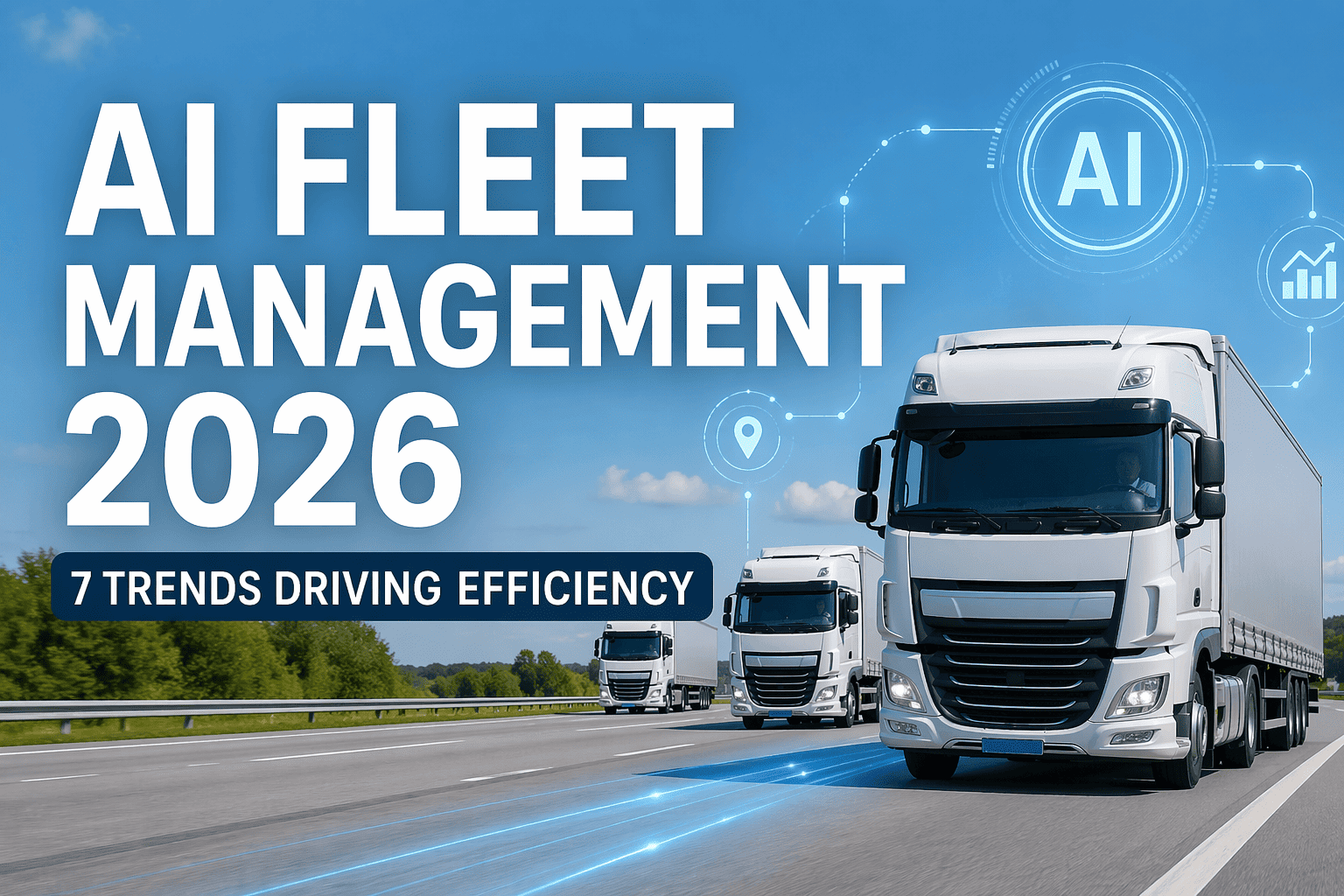
The AI fleet management conversation shifted in 2026 not from "should we consider AI?" but from "how quickly can we deploy it before our competitors do?" 65% of fleet maintenance teams plan AI adoption by end of 2026, yet only 27% have deployed it. That 38-point gap isn't indecision — it's a competitive window closing fast. The fleets that move now are reporting 45% fewer breakdowns, 25% lower maintenance costs, and ROI payback in under 6 months. The ones waiting are watching their cost-per-mile diverge from industry leaders every quarter. This guide covers the seven AI capabilities that are delivering the most measurable impact in 2026 — and how each one works in practice.
The AI Adoption Gap — Where Fleets Stand Right Now
7 AI Capabilities Transforming Fleet Operations in 2026
Predictive Maintenance
adoption
AI predictive maintenance is the highest-ROI, most proven AI application in fleet operations — and in 2026, it's crossing from early-adopter to mainstream. The mechanism is straightforward: ML models analyse engine diagnostic codes, vibration patterns, temperature data, fluid levels, and component age to identify failure signals 14–30 days before breakdown. The economic case is devastating for anyone still running reactive maintenance: planned PM costs $400–$800 on average; roadside emergency repair on the same component averages $3,200 — plus $448–$760/day in downtime. Predictive maintenance converts nearly all of the latter into the former.
AI-Powered Route Optimisation
users
2026 AI routing goes far beyond "shortest path." Modern ML routing engines simultaneously optimise for traffic, fuel consumption, delivery windows, driver HOS availability, vehicle payload, and weather — recalculating every route every 2–5 minutes as conditions change across the entire active fleet. Industry data shows organisations achieve 15–20% fuel reductions from AI routing, and the difference between AI and human dispatcher performance compounds as fleet size grows.
AI Safety Scoring & Video Telematics
telematics
AI dashcam and driver scoring adoption jumped 10 percentage points since 2023, reaching 46% of fleet professionals in 2026. AI video analysis identifies distracted driving, phone use, seat belt violations, and drowsiness in real time — issuing in-cab audio alerts before incidents occur. Combined with telematics-based composite safety scores, fleets deploying full AI safety solutions are reporting 60% accident reduction and 86% lower accident-related costs.
Real-Time Fleet Analytics & Reporting
penetration
Real-time analytics has reached 68% fleet penetration in 2026 — the most widely deployed AI capability in fleet management. The shift from monthly reports to live operational dashboards is transforming fleet manager decision-making: from reviewing what happened to acting on what's happening. AI-driven analytics replace the 11+ hours/week that fleet managers spend on manual report compilation with automated dashboards that surface the 3–5 items requiring attention today.
AI Compliance Automation
compliance
FMCSA conducted over 8,300 investigations in 2025 and found violations at 93% of audited carriers — most from documentation gaps that automated compliance systems would have caught and closed months earlier. AI compliance automation monitors HOS in real time (firing pre-violation alerts), tracks document expiry dates across driver files and vehicle records, and generates complete DOT audit packages in under a minute from command to download.
Generative AI Fleet Assistants
adopters
The newest entrant in the fleet AI stack, generative AI assistants are entering production deployment in 2026. Fleet managers can now type "Show me which trucks are overdue for PM and sort by breakdown risk" in plain English — and receive a structured, actionable response in seconds. GenAI automates compliance documentation drafting, generates custom maintenance procedures, answers operator questions about regulations, and creates weekly fleet performance summaries without manual data compilation.
Unified Fleet Operations Platform
deployed
The era of separate tools for GPS, maintenance, safety, compliance, fuel, and dispatch is ending. In 2026, the most sophisticated fleets are building a "Fleet Operations OS" — a single platform where every AI capability shares a unified data layer, eliminating the intelligence gaps that occur when predictive maintenance data doesn't inform dispatch decisions, and safety scores don't feed into insurance documentation. Only 5.6% of fleets have achieved full multi-function deployment — but those fleets report the highest ROI and most durable competitive advantages.
Predictive maintenance is the highest-ROI entry point for AI fleet management. See how FleetRabbit AI Predictive Maintenance uses engine fault codes, vibration data, and maintenance history to predict failures 14–30 days out — with automatic work order creation and 45% fewer breakdown events.
Where to Start: AI Deployment Prioritised by ROI
Not all AI capabilities deliver equal returns. This priority framework matches deployment sequence to ROI speed — starting with the highest-impact, lowest-friction capabilities and building toward the full unified platform:
Predictive Maintenance + Real-Time Analytics
Fastest ROI. Connects to existing telematics hardware. No driver workflow changes. Delivers measurable results within 30–60 days of deployment. Average payback: under 6 months.
Driver Safety Scoring + Compliance Automation
Add driver safety scorecards and automated HOS/DVIR compliance. Directly reduces insurance premiums and eliminates violation penalties. Insurance documentation begins building immediately.
Route Optimisation + Fuel Analytics
Once behaviour and maintenance baselines are established, add AI routing to attack the fuel cost line. Driver coaching scorecards already built — routing improvements are additive.
Unified Platform + GenAI Assistant
Consolidate all capabilities into a single platform with shared data layer. GenAI fleet assistant enables natural language management. This is where the 5.6% who've made the full deployment are reporting the highest compound ROI.
Driver safety scoring is step 2 in the AI deployment ladder — and delivers results before any coaching session happens, simply through visibility. See how FleetRabbit Driver Performance Dashboards surface the specific behaviours and events that move safety scores, and how weekly scorecards drive 60–70% of total safety improvement through self-correction alone.
FleetRabbit: All 7 AI Capabilities. One Platform. $3/Vehicle/Month.
Predictive Maintenance
14–30 day failure prediction. Auto work orders. 45% fewer breakdowns.
AI Route Optimisation
6-variable simultaneous optimisation. Real-time rerouting. 15–20% fuel reduction.
Driver Safety Scoring
6-behaviour composite scores. Weekly coaching scorecards. 60% accident reduction.
Real-Time Fleet Analytics
Live cost-per-mile. Automated KPI reports. Replaces 11+ hrs/week of manual work.
Compliance Automation
HOS monitoring. Document expiry tracking. Audit packages in 47 seconds.
AI Fuel Analytics
Idle attribution. Fraud detection. MPG trending per driver. 8–15% fuel reduction.
The unified analytics layer is what makes AI fleet management compounding rather than additive. See how FleetRabbit Fleet Analytics and Reporting connects predictive maintenance data, fuel efficiency, driver scores, and compliance metrics into a single dashboard — the operational picture that replaces 5 separate tools.
Frequently Asked Questions
38% of Fleets Are Planning AI Deployment. 27% Have Already Started Saving.
The fleets that deployed predictive maintenance and real-time analytics first are now 6–12 months ahead on the cost curve. Every quarter of delay is a quarter of 45% fewer breakdowns, 25% lower maintenance costs, and 15–20% fuel savings that your operation didn't capture. FleetRabbit gives you all 7 AI capabilities at $3/vehicle/month — with a free 3-vehicle tier that delivers your first AI insights in under a week.