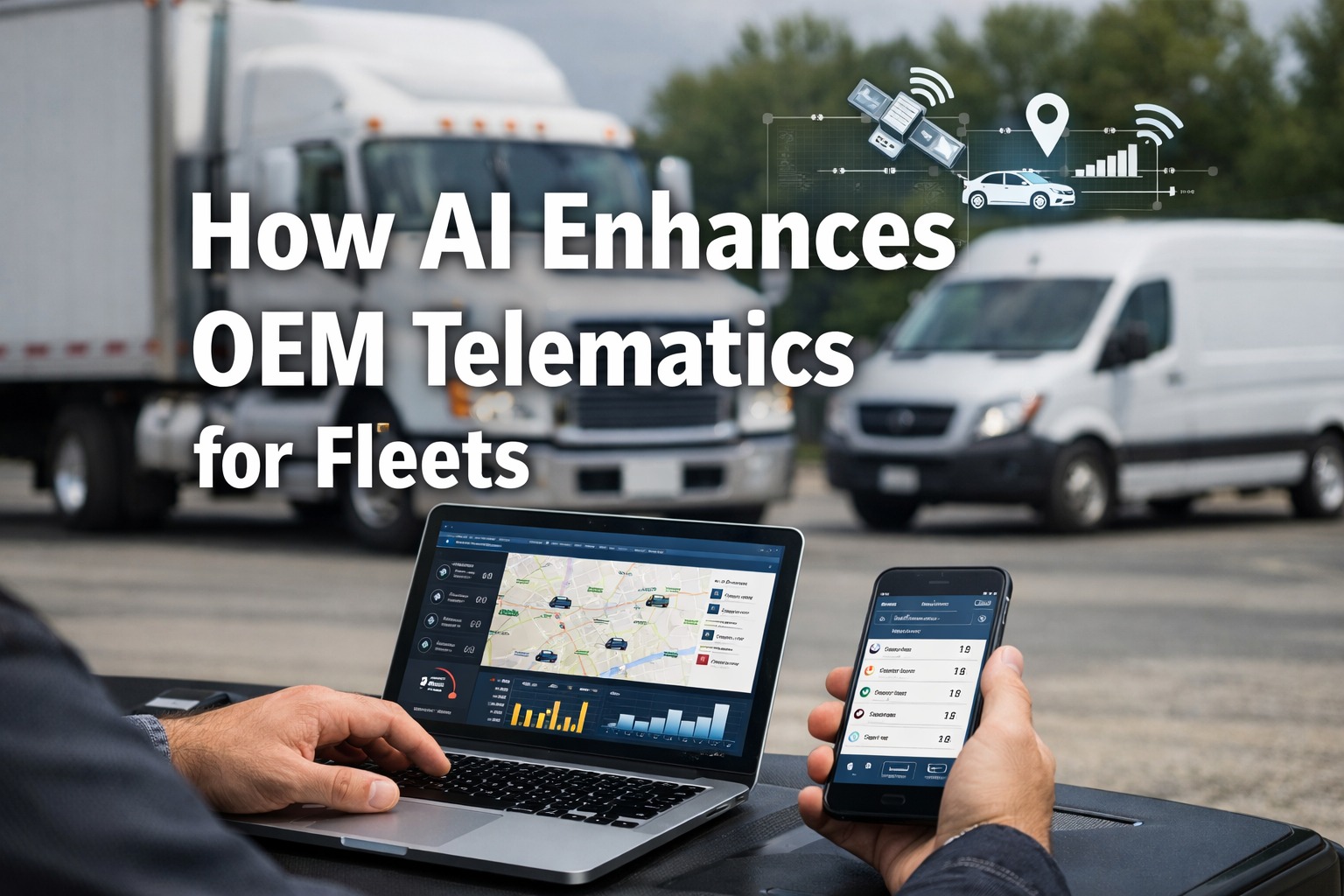
Your trucks are already talking. Every second, the engine control unit broadcasts hundreds of data points across the J1939 buscoolant temperatures, fuel rail pressures, turbo boost levels, exhaust gas readings. The question isn't whether this data exists. It's whether anyone is actually listening.
By 2026, over 90% of commercial vehicles will ship with factory-embedded telematics. That's not a prediction—it's already happening. Ford, GM, Volvo, Stellantis, Mercedes-Benz, and Rivian have all partnered with major telematics platforms to stream vehicle data directly from the factory. But raw data isn't intelligence. The difference between fleets that prevent breakdowns and fleets that react to them comes down to one thing: AI that can interpret what the vehicle is actually saying.
The OEM Telematics Transformation
A single heavy-duty truck generates approximately 25 gigabytes of diagnostic data daily. Traditional monitoring captures maybe 5% of actionable insights. AI-powered interpretation unlocks the other 95%—the patterns, correlations, and early warnings that prevent $10,000 roadside repairs.
See what your trucks are really telling you →The Architecture of Modern OEM Telematics
Understanding how AI enhances OEM telematics requires understanding what's actually happening under the hood—literally. Modern commercial vehicles contain dozens of electronic control units (ECUs) communicating over standardized protocols, primarily SAE J1939 for heavy-duty applications. This isn't abstract technology; it's the nervous system of every truck in your fleet.
Inside the J1939 Data Stream
The SAE J1939 protocol standardizes how heavy-duty vehicles report diagnostic information. Every message contains a Parameter Group Number (PGN) that identifies the data type, and Suspect Parameter Numbers (SPNs) that specify individual readings. When your engine broadcasts PGN 65263 (Engine Fluid Level/Pressure), it's simultaneously reporting fuel delivery pressure, oil pressure, coolant level, and crankcase pressure in a single 8-byte message.
What J1939 Actually Broadcasts
Engine Performance
- Engine speed (RPM)
- Engine load percentage
- Throttle position
- Turbo boost pressure
- Fuel rate (L/hour)
- Intake manifold temperature
Fluid Systems
- Oil pressure and temperature
- Coolant temperature and level
- Fuel pressure and temperature
- DEF level and quality
- Transmission fluid temp
- Hydraulic system pressure
Emissions & Aftertreatment
- DPF soot loading
- SCR catalyst temperature
- NOx sensor readings
- EGR valve position
- Regeneration status
- DEF dosing rate
Diagnostic Alerts
- Active fault codes (DM1)
- Previously active codes (DM2)
- Emission-related DTCs
- Freeze frame data
- Lamp status (MIL, CEL)
- Failure mode indicators
Traditional telematics captures this data and displays it on dashboards. AI-powered systems do something fundamentally different: they correlate readings across time, compare patterns across your entire fleet, and identify degradation curves that predict failures weeks before they trigger diagnostic trouble codes.
The OEM Integration Advantage
OEM-embedded telematics provides access to data streams that aftermarket devices simply cannot match. When a Telematics Control Unit (TCU) is installed at the factory, it connects directly to the vehicle's CAN bus architecture—not through a diagnostic port adapter. This means higher sampling rates, deeper system access, and manufacturer-validated data interpretation.
OEM vs. Aftermarket Telematics: Data Access Comparison
| Capability | OEM Embedded | Aftermarket OBD | Why It Matters |
|---|---|---|---|
| Sampling frequency | 100+ Hz for critical systems | 1-10 Hz typical | Cold-start predictions require 100+ voltage samples/second |
| ECU access depth | Full manufacturer access | Standard PGNs only | Proprietary parameters reveal hidden degradation patterns |
| Installation impact | Zero downtime | Hours per vehicle | Fleet-wide deployment without operational disruption |
| Tamper resistance | Factory-integrated security | Easily removed/bypassed | Reliable data for warranty and compliance |
| OTA updates | Continuous capability expansion | Limited or none | New predictive models deployed without hardware changes |
| Warranty validation | Manufacturer-endorsed | May void warranty | Critical for new vehicle acquisitions |
Unlock Your OEM Data Advantage
Stop installing hardware when your vehicles are already equipped. Connect your factory telematics to AI-powered analytics and see what your fleet has been trying to tell you.
How AI Transforms Raw Telematics Into Predictive Intelligence
The breakthrough in AI-powered fleet diagnostics isn't collecting more data—fleets are already drowning in data. The breakthrough is teaching machines to think like master technicians who've seen thousands of failures across millions of miles.
Pattern Recognition at Scale
A human technician might notice that coolant temperature spikes tend to precede water pump failures. An AI system trained on billions of data points can identify that when coolant temperature variance increases by 12% while the vehicle is operating in ambient temperatures above 85°F, combined with a 3% decrease in coolant pressure response time, there's a 94% probability of water pump failure within 21 days. That's not intuition—it's pattern recognition across more failure cases than any human could analyze in a lifetime.
AI Diagnostic Capabilities: From Data to Decision
Anomaly Detection
Machine learning algorithms establish baseline operating parameters for each vehicle, then flag deviations that indicate developing issues—even when readings remain within "normal" ranges.
Correlation Analysis
AI discovers hidden relationships between seemingly unrelated parameters—how driver behavior affects brake wear rates, how route terrain impacts DPF regeneration cycles, how load patterns accelerate drivetrain degradation.
Remaining Useful Life Prediction
Component-specific models forecast exactly when parts will require replacement, enabling parts ordering weeks in advance and scheduled maintenance during planned downtime.
Fleet Benchmarking
Compare individual vehicle performance against fleet averages and OEM specifications to identify underperformers, optimize maintenance intervals, and validate repair effectiveness.
The Digital Twin Revolution
Leading AI platforms now create digital twins—virtual replicas of each vehicle that simulate real-world behavior based on telematics data. These models continuously update as new data streams in, enabling "what-if" analysis that was previously impossible.
Digital Twin Applications in Fleet Maintenance
- Virtual component testing: Simulate stress on brake systems, suspension, or drivetrain based on planned routes and loads before dispatching
- Maintenance scenario modeling: Compare outcomes of repairing now vs. deferring maintenance based on predicted failure probability curves
- Fuel efficiency optimization: Identify vehicles consuming more fuel than their digital baseline predicts, indicating hidden mechanical issues
- Driver coaching integration: Correlate driving patterns with vehicle wear to provide personalized coaching that extends component life
- Warranty claim validation: Document operating conditions and maintenance history to support or dispute warranty claims with objective data
Real-World Impact: Case Studies in AI-Powered Diagnostics
Theory matters less than results. Here's what happens when fleets connect AI to their OEM telematics data.
Early Engine Fault Detection Delivers $450K Annual Savings
A North American long-haul fleet connected their Class 8 trucks to AI-powered OEM telematics analysis. Within six months, the system identified engine fault patterns that preceded injector failures—flagging issues 23 days before traditional diagnostic codes appeared.
Radiator Clog Prediction Prevents Engine Failures
Waste collection vehicles operate in extreme conditions—constant stop-and-go, heavy loads, debris exposure. AI analysis of coolant system data detected subtle patterns indicating radiator clogging before any warning lights triggered.
Hydraulic System Intelligence Transforms Uptime
Mining and construction equipment deployed with J1939-based telematics began streaming hydraulic pressure, temperature, and flow data to AI analysis. The system identified degradation patterns in hydraulic pumps that human analysis consistently missed.
The OEM Partnership Ecosystem
The telematics landscape has fundamentally shifted. Major manufacturers aren't just building connected vehicles—they're building data ecosystems. Understanding these partnerships determines how effectively your fleet can leverage OEM data.
Major OEM Telematics Partnerships (2024-2025)
Ford's commercial vehicle division offers integrated telematics across Transit vans, F-Series trucks, and E-Transit electric vehicles. Partners with Geotab and MiX by Powerfleet for enhanced fleet management.
Full API access availableOnStar telematics embedded across Chevrolet, GMC, Buick, and Cadillac commercial vehicles. Data integration available through major fleet management platforms.
North American fleet integration activeVolvo Connected Vehicle platform with AEMP 2.0 API compliance. December 2024 partnership with Geotab enables unified dashboard management for mixed fleets.
ISO 15143-3 standardized dataFree2move and Mobilisights platforms cover Ram, Dodge, Jeep, Chrysler (North America) and Opel, Fiat, Alfa Romeo, Citroën, Peugeot (Europe).
Multi-brand integrationMercedes-Benz Uptime uses AI to monitor truck components and deliver early failure warnings. Integration with major telematics platforms for fleet-wide visibility.
AI-powered diagnostics includedElectric delivery vans with native telematics, battery health monitoring, and charging optimization. Geotab partnership announced late 2024.
EV-specific analyticsThe Mixed Fleet Reality
Most fleets don't operate a single brand. The competitive advantage goes to platforms that aggregate OEM telematics from multiple manufacturers into unified dashboards—eliminating the "multiple portal" problem that fragments visibility across your operation. Modern integration platforms normalize data from Ford, GM, Volvo, Stellantis, and others into consistent formats, enabling fleet-wide analysis regardless of vehicle mix.
Discuss your mixed fleet integration →Implementing AI-Enhanced OEM Telematics
Moving from traditional telematics to AI-powered intelligence isn't a rip-and-replace project. It's a systematic capability build that generates ROI at each stage.
Phase 1: Data Foundation (Weeks 1-4)
Key Activities
- Inventory existing OEM telematics capabilities across fleet
- Activate OEM data services on vehicles where available but dormant
- Connect OEM APIs to centralized analytics platform
- Establish data quality baselines and identify gaps
- Configure alert thresholds based on current maintenance patterns
Expected Outcomes
- Unified visibility across previously siloed vehicle data
- Immediate alerts on active fault codes and critical readings
- Historical data collection begins for AI model training
Phase 2: Predictive Enablement (Weeks 5-12)
Key Activities
- Deploy AI models for high-impact failure modes (engine, transmission, brakes)
- Integrate maintenance management system for automated work order creation
- Train maintenance team on interpreting AI-generated recommendations
- Establish feedback loops to improve prediction accuracy
- Connect parts inventory to predicted failure timelines
Expected Outcomes
- First prevented breakdowns from AI predictions
- Reduction in emergency parts procurement
- Maintenance scheduling optimized around predictions
Phase 3: Operational Intelligence (Months 3-6)
Key Activities
- Expand AI coverage to full vehicle systems
- Implement driver behavior correlation to maintenance outcomes
- Deploy digital twin models for critical assets
- Integrate with route planning for maintenance-aware dispatching
- Establish ROI tracking and executive reporting
Expected Outcomes
- 70-75% reduction in unplanned breakdowns
- 18-25% reduction in total maintenance costs
- 5-15% improvement in vehicle availability
Critical Success Factors
AI-powered telematics fails when fleets treat it as a technology project instead of an operational transformation. The technology works. What determines success is organizational readiness.
- Data quality commitment: Bad data produces bad predictions. Invest in accurate sensor calibration and consistent data collection.
- Technician buy-in: AI should augment master technicians, not replace them. Position predictions as diagnostic assistance, not mandates.
- Process integration: Predictions without action are worthless. Connect AI outputs directly to work order systems and parts procurement.
- Continuous learning: AI models improve with feedback. Build mechanisms for technicians to validate or dispute predictions.
The ROI Reality: What AI-Enhanced OEM Telematics Actually Delivers
Claims of transformational savings require evidence. Here's what the data shows across fleets that have fully implemented AI-powered OEM telematics integration.
Documented Results Across Industry Studies
Total Cost of Ownership: AI Telematics Investment
| Fleet Size | Monthly Platform Cost | Annual Savings (Conservative) | Net Annual Benefit | ROI Timeline |
|---|---|---|---|---|
| 10 vehicles | $150-500 | $15,000-25,000 | $13,000-23,000 | 2-4 months |
| 25 vehicles | $375-1,250 | $37,500-62,500 | $32,000-57,000 | 2-3 months |
| 50 vehicles | $750-2,500 | $75,000-125,000 | $66,000-115,000 | 2-3 months |
| 100 vehicles | $1,500-5,000 | $150,000-250,000 | $132,000-232,000 | 2-3 months |
Savings calculated at $1,500-2,500/vehicle/year based on prevented breakdowns, reduced emergency repairs, extended component life, and optimized maintenance scheduling. Actual results vary based on fleet age, operating conditions, and baseline maintenance maturity.
What's Next: The 2026 Horizon
The gap between "planning to adopt AI" and "actually operational" is where competitive advantage lives in 2026. Industry surveys show 65% of maintenance teams plan to use AI by year-end, but only 27% of fleets currently use predictive maintenance. That gap represents the window for early adopters to establish operational superiority.
Emerging Capabilities on the Horizon
On-Vehicle Processing
AI moving from cloud to vehicle enables instant diagnostic decisions without connectivity dependencies. Critical for remote operations and real-time safety interventions.
Technician Augmentation
AI systems that guide diagnostics, suggest troubleshooting steps, estimate repair times, and surface tribal knowledge from thousands of previous repairs—addressing the technician shortage by amplifying existing expertise.
Self-Diagnosing Vehicles
Vehicles that detect issues, schedule their own service appointments, order required parts, and route themselves to maintenance facilities during off-hours.
Predictive Procurement
AI-predicted failures automatically trigger parts orders weeks in advance, eliminating emergency procurement and enabling bulk purchasing at standard pricing.
Your Trucks Are Already Talking. Start Listening.
Connect your OEM telematics to AI-powered analytics and transform raw vehicle data into prevented breakdowns, optimized maintenance, and measurable cost savings.
Technical Reference: J1939 Parameter Groups for Fleet Diagnostics
For fleet managers and technicians working directly with J1939 data streams, understanding key Parameter Group Numbers (PGNs) accelerates diagnostic interpretation and custom alert configuration.
Critical PGNs for Predictive Maintenance
| PGN | Description | Key SPNs | Predictive Application |
|---|---|---|---|
| 65262 | Engine Temperature | Coolant temp, Fuel temp, Oil temp | Cooling system health, thermostat function |
| 65263 | Fluid Levels/Pressure | Fuel pressure, Oil pressure, Coolant level | Pump wear, leak detection, filter condition |
| 61444 | Electronic Engine Controller 1 | Engine speed, Load, Torque | Performance degradation, injector health |
| 65270 | Inlet/Exhaust Conditions | Boost pressure, EGR data, Intake temp | Turbo health, EGR valve function |
| 65253 | Engine Hours/Revolutions | Total hours, Total revolutions | Maintenance interval tracking |
| 65226 | Diagnostic Message 1 | Active DTCs, SPN, FMI | Active fault identification |
| 65227 | Diagnostic Message 2 | Previously active DTCs | Intermittent fault history |
| 64947 | Aftertreatment Status | DPF status, SCR status, DEF quality | Emissions system health |