Every fleet manager knows the sinking feeling: a truck breaks down mid-route, a driver calls in stranded, and an entire day's deliveries suddenly hang in the balance. The American Trucking Associations reports that a single roadside breakdown costs between $450 and $760 in direct repair costs but when you factor in lost productivity, driver downtime, and emergency towing, that number climbs past $1,900 per incident. For commercial fleets, unplanned maintenance isn't just an inconvenience — it's a profit killer that erodes margins and damages customer relationships. Book a demo to see how AI predictive maintenance fleet technology can transform your operations.
But here's the critical insight reshaping the trucking industry in 2026: most breakdowns are predictable. AI predictive maintenance fleet systems analyze real-time sensor data, historical repair records, and machine learning algorithms to forecast exactly when components will fail — often 2-4 weeks before breakdown occurs. The technology has matured beyond pilot programs into a proven operational advantage. Deloitte research confirms that predictive maintenance increases productivity by 25%, reduces breakdowns by 70%, and lowers maintenance costs by up to 25%. For trucking and logistics companies still running calendar-based maintenance or reactive repair cycles, the competitive gap is widening every quarter. Start your free trial and see results within 72 hours.
What is AI Predictive Maintenance for Fleets
AI predictive maintenance for fleets represents a fundamental shift from asking "what broke?" to "what's about to break, and when should we fix it?" Unlike traditional maintenance approaches that rely on fixed schedules or wait for failures to occur, predictive maintenance fleet management uses artificial intelligence to continuously monitor vehicle health and anticipate problems before they disrupt operations. Schedule a consultation to learn how this technology applies to your fleet.
At its core, an AI fleet maintenance system ingests data from multiple sources: OBD-II and J1939 diagnostic ports, IoT sensors monitoring vibration, temperature, and pressure, telematics devices tracking vehicle location and performance, and historical maintenance records documenting past repairs. Machine learning algorithms analyze these data streams to identify patterns that precede specific failure modes — detecting subtle changes in engine behavior, brake wear, battery degradation, or cooling system stress that human technicians might miss. Try it free for 3 vehicles and experience the difference.
How Truck Failure Prediction Software Works
Modern fleet predictive analytics software processes thousands of data points per vehicle daily, comparing real-time readings against established baselines and known failure signatures. When the system detects anomalies indicating developing problems, it generates prioritized alerts and can automatically create work orders — ensuring repairs happen during planned downtime rather than on the roadside at 2 AM.
The sophistication of today's predictive maintenance trucking platforms means fleets no longer need dedicated data scientists to interpret results. Leading AI fleet maintenance systems translate complex analytics into actionable recommendations: "Vehicle 247 shows brake pad wear consistent with replacement needed within 2,100 miles — schedule service before next long-haul assignment."
Why Fleet Companies Need Predictive Maintenance
The economics of fleet maintenance have shifted dramatically. Fortune 500 fleets lose $2.8 billion annually to unplanned downtime — representing 11% of total revenue erased by failures that modern technology can predict and prevent. For smaller operators, the impact is proportionally even more severe: a single catastrophic breakdown can wipe out weeks of profit margin. Book a free ROI analysis to see your potential savings.
Several converging factors make commercial fleet predictive maintenance essential rather than optional in 2026:
Rising Breakdown Costs
The average per-hour cost of unplanned equipment downtime roughly doubled between 2019 and 2024. Roadside assistance alone runs $350-$700 per call, while replacement rentals can exceed $3,000 monthly.
Technician Shortage
Qualified diesel technicians are increasingly difficult to find and retain. Predictive systems help existing teams prioritize high-impact work rather than constantly playing catch-up on emergencies.
Compliance Pressure
DOT regulations and CSA inspection requirements demand meticulous maintenance documentation. AI systems generate compliance records automatically as a byproduct of daily operations.
Customer Expectations
On-time delivery rates directly impact contract retention. Fleet downtime prevention software protects service levels by keeping trucks operational when customers need them.
The competitive reality is stark: fleets implementing AI-powered predictive maintenance report 35% less downtime, 30% lower maintenance costs, and 60% fewer emergency repairs. Those still running reactive maintenance models are falling behind on every measurable KPI. Start preventing breakdowns today — free for up to 3 vehicles.
How AI Predicts Truck Failures Before They Happen
Understanding how predictive maintenance logistics fleet systems actually work helps fleet managers evaluate solutions and set realistic expectations. The process follows a continuous intelligence cycle that improves accuracy over time. See a live demo of the prediction workflow.
Continuous Data Collection
IoT sensors and telematics hardware stream engine temperature, oil pressure, brake wear, tire pressure, voltage, and fuel consumption data to cloud platforms. A typical commercial truck generates thousands of data points daily — AI processes all of them in real time.
Pattern Recognition
Machine learning models compare current readings against historical fleet data and manufacturer benchmarks. The algorithms identify combinations of signals that have preceded specific failures in the past — learning which patterns truly indicate problems versus normal operational variation.
Failure Prediction
When risk thresholds are exceeded, the system generates prioritized alerts with specific failure predictions and recommended actions. Leading platforms achieve 90%+ accuracy for common failure modes and provide 14-30 days advance warning before breakdown.
Automated Scheduling
The CMMS auto-generates work orders, assigns the right technician, checks parts inventory, and schedules repairs during low-impact windows. No manual triage required — the truck gets fixed before it ever breaks down on route.
A critical advantage of IoT predictive maintenance trucks technology is noise reduction. A single truck might generate 300-400 fault codes monthly — far too many for technicians to meaningfully evaluate. AI systems filter this noise, reducing thousands of codes to just 5-10 actionable issues per vehicle annually. This allows maintenance teams to focus on problems that actually require attention. Experience intelligent fault filtering with your fleet data.
Key Technologies Powering Fleet Predictive Analytics
Effective smart fleet maintenance analytics depends on integrating several technology layers. Understanding these components helps fleet operators assess vendor capabilities and implementation requirements. Schedule a technology assessment to evaluate your current infrastructure.
IoT Sensors
Connected sensors monitor vibration, temperature, pressure, fuel consumption, and operating hours. Modern platforms offer plug-and-play installation with pre-trained AI models specific to commercial truck components.
Telematics Integration
GPS fleet tracking combined with engine control module (ECM) data provides location context plus detailed diagnostic information. Most predictive platforms integrate with existing telematics providers via API.
OBD/J1939 Data
On-board diagnostics capture engine codes, emissions data, and performance parameters directly from the vehicle's computer systems. This data feeds directly into predictive models for real-time health monitoring.
Machine Learning Models
AI algorithms trained on billions of miles of real-world fleet data identify failure patterns across vehicle makes, models, and operating conditions. Models improve continuously as they process more data from your specific fleet.
The good news for fleet operators: most modern commercial trucks already have the necessary diagnostic ports and sensor infrastructure. Over 90% of new vehicles ship with factory-installed telematics that predictive platforms can leverage without additional hardware investment. Connect your existing telematics and start predicting failures immediately.
Benefits of AI Predictive Maintenance for Trucking and Logistics
The operational impact of predictive vehicle maintenance systems extends across every aspect of fleet operations. Industry data documents consistent results across diverse fleet types and sizes. Calculate your potential savings with a personalized ROI analysis.
AI catches developing failures weeks before they strand drivers, keeping trucks on the road and routes on schedule.
Replacing parts based on actual condition eliminates unnecessary work orders and extends component lifespan.
Planned repairs during scheduled maintenance windows replace unexpected roadside emergencies.
Combined fuel efficiency gains, reduced emergency repairs, and optimized parts inventory add up quickly.
Real-world results validate these benchmarks. A food and beverage fleet operating 50,000 vehicles documented converting $50,000 engine replacement catastrophes into manageable $3,000 planned repairs across 80 trucks — saving $1 million in just four months. A leading LTL fleet deploying AI maintenance across 2,000 trucks achieved 23% reduction in roadside breakdowns and 15% drop in total maintenance costs within 18 months. Join fleets saving millions with predictive maintenance.
Predictive Maintenance vs Preventive Maintenance: Key Differences
Understanding how predictive maintenance compares to traditional preventive approaches helps fleet managers make informed technology decisions. Both strategies aim to avoid reactive (run-to-failure) maintenance, but they take fundamentally different paths. Discuss which approach fits your fleet with our maintenance experts.
| Factor | Preventive Maintenance | Predictive Maintenance |
|---|---|---|
| Approach | Fixed schedules based on time, mileage, or engine hours | Condition-based service triggered by real-time data analysis |
| Data Source | Manufacturer recommendations and historical patterns | Live sensor readings, telematics, and ML analytics |
| Parts Replacement | Often replaces parts with 40% useful life remaining | Replaces parts at optimal timing based on actual wear |
| Failure Detection | May miss issues outside scheduled inspection windows | Continuous monitoring catches problems as they develop |
| Upfront Cost | Lower — requires calendar and checklists | Higher — requires sensors and analytics platform |
| Long-term Cost | 12-18% savings vs. reactive maintenance | 25-40% savings vs. reactive maintenance |
| Downtime Reduction | Moderate improvement over reactive | 30-50% reduction vs. preventive approaches |
| ROI Timeline | Immediate but limited ceiling | 3-6 months to payback, 200-500% annual returns |
Industry consensus in 2026 points toward a hybrid approach: preventive maintenance for standard assets with predictable wear patterns, predictive maintenance for critical assets where failure causes significant revenue loss or safety risk. Approximately 66% of leading fleets now combine both strategies, applying sophisticated analytics to their most valuable vehicles while maintaining cost-effective scheduled service on routine assets. Start with a free pilot on your highest-value vehicles.
Real-World Fleet Use Cases
Predictive maintenance delivers measurable results across diverse fleet types and operating conditions. These documented examples illustrate practical applications of the technology. See case studies from your industry during a personalized demo.
Long-Haul Trucking
A national carrier implemented predictive analytics across its Class 8 fleet, monitoring engine temperature, coolant pressure, and turbocharger performance. The system identified developing EGR valve failures an average of 22 days before breakdown, allowing scheduled repairs at company terminals rather than expensive roadside service calls. Result: 28% reduction in unplanned downtime and $847 average savings per prevented breakdown.
Last-Mile Delivery
An e-commerce delivery fleet deployed predictive maintenance on its medium-duty vehicles, focusing on brake systems, alternators, and batteries — the components most likely to strand drivers mid-route. AI monitoring detected voltage degradation patterns that preceded battery failure, enabling proactive replacements during overnight charging. Result: 45% fewer roadside assistance calls and 99.2% on-time departure rate.
Regional LTL Operations
A less-than-truckload carrier rolled out AI maintenance across 2,000 trucks. The platform analyzed fault code combinations alongside sensor data to identify cylinder head issues before catastrophic failure. What would have been $50,000 engine replacements became $3,000 planned repairs. Result: $1.2 million annual savings and 23% breakdown reduction.
ROI and Cost Savings Analysis
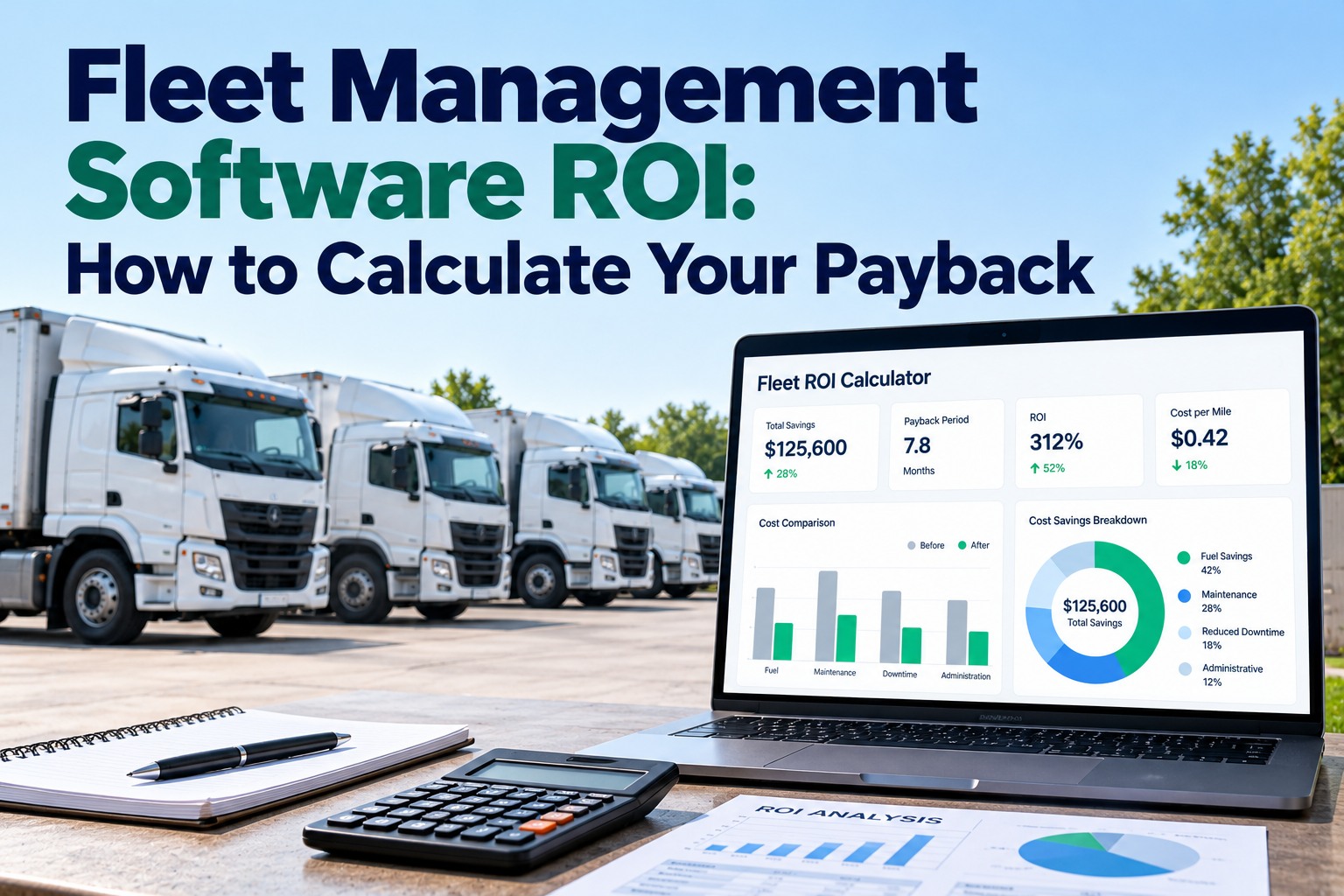
The business case for AI predictive maintenance is compelling when you examine the full cost picture. Beyond direct repair savings, predictive systems impact revenue protection, asset utilization, and operational efficiency. Get a custom ROI projection based on your fleet size and current maintenance spend.
Typical Fleet ROI Calculation (50-Vehicle Fleet)
Eliminating 45 roadside incidents at $1,900 average total cost
Extending component lifespan 20% by replacing based on condition
Technician time saved through prioritized work queues
8-15% improvement from properly maintained engines
Most fleets achieve 3-6 month payback with 200-500% annual ROI
McKinsey research confirms that leading organizations achieve 10:1 to 30:1 ROI ratios within 12-18 months of implementation. The savings scale with fleet size — a 25-unit fleet saves approximately $1.075 million annually, while a 100-unit operation can realize $4+ million in combined cost reductions and revenue protection. Start capturing these savings with a free trial.
How to Implement AI Predictive Maintenance Software
Successful predictive maintenance deployment follows a phased approach that minimizes risk while building organizational capability. Fleet operators should expect 3-6 months for full implementation, though pilot programs can be operational within 4-6 weeks. Plan your implementation with our deployment specialists.
Assess Current State
Audit existing maintenance practices, data collection capabilities, and technology infrastructure. Identify high-priority vehicles where breakdown costs are highest. Establish baseline metrics for comparison.
Start with a Pilot
Deploy predictive monitoring on 10-20% of your fleet — typically your highest-value or highest-utilization vehicles. This validates the technology and develops internal processes before full rollout. Most pilots demonstrate clear ROI within 60-90 days.
Integrate Systems
Connect the predictive platform with existing telematics, CMMS, and parts inventory systems. Leading solutions offer API integrations with major providers like Geotab, Samsara, and Fleetio without requiring new hardware.
Train Your Team
Invest in training for technicians, fleet managers, and dispatchers. Address skepticism by sharing early wins and involving teams in the rollout. The technology only delivers value when people trust and act on its recommendations.
Scale and Optimize
Expand across the entire fleet while continuously monitoring prediction accuracy and adjusting alert thresholds. The AI models improve as they accumulate more data from your specific vehicles and operating conditions.
Stop Reacting to Breakdowns — Start Preventing Them
FleetRabbit's AI predictive maintenance platform connects to your existing telematics and delivers failure predictions within 72 hours. See how your fleet can cut unplanned downtime by 45%.
Frequently Asked Questions
Transform Your Fleet Maintenance from Reactive to Predictive
AI predictive maintenance fleet technology has moved beyond experimental pilots into proven operational infrastructure. The fleets still running calendar-based maintenance or reactive repair cycles are paying a premium every month in emergency repairs, missed uptime, and competitive disadvantage. With 70% of breakdowns now predictable using AI analytics, the question isn't whether to adopt predictive maintenance — it's how quickly you can implement it. Book your demo today and see your fleet's prediction potential.
The technology integrates with existing telematics, requires minimal hardware investment, and delivers measurable ROI within months. Whether you operate 15 trucks or 1,500, predictive maintenance provides the foundation for sustainable cost reduction and operational excellence. Get started free — no credit card required.
Your Next Breakdown is Predictable. Prevent It.
FleetRabbit delivers AI-powered failure prediction, automated PM scheduling, and real-time fleet health monitoring in one unified platform. First predictions in 72 hours.
Free for 3 vehicles - No hardware required - Works with 200+ telematics providers