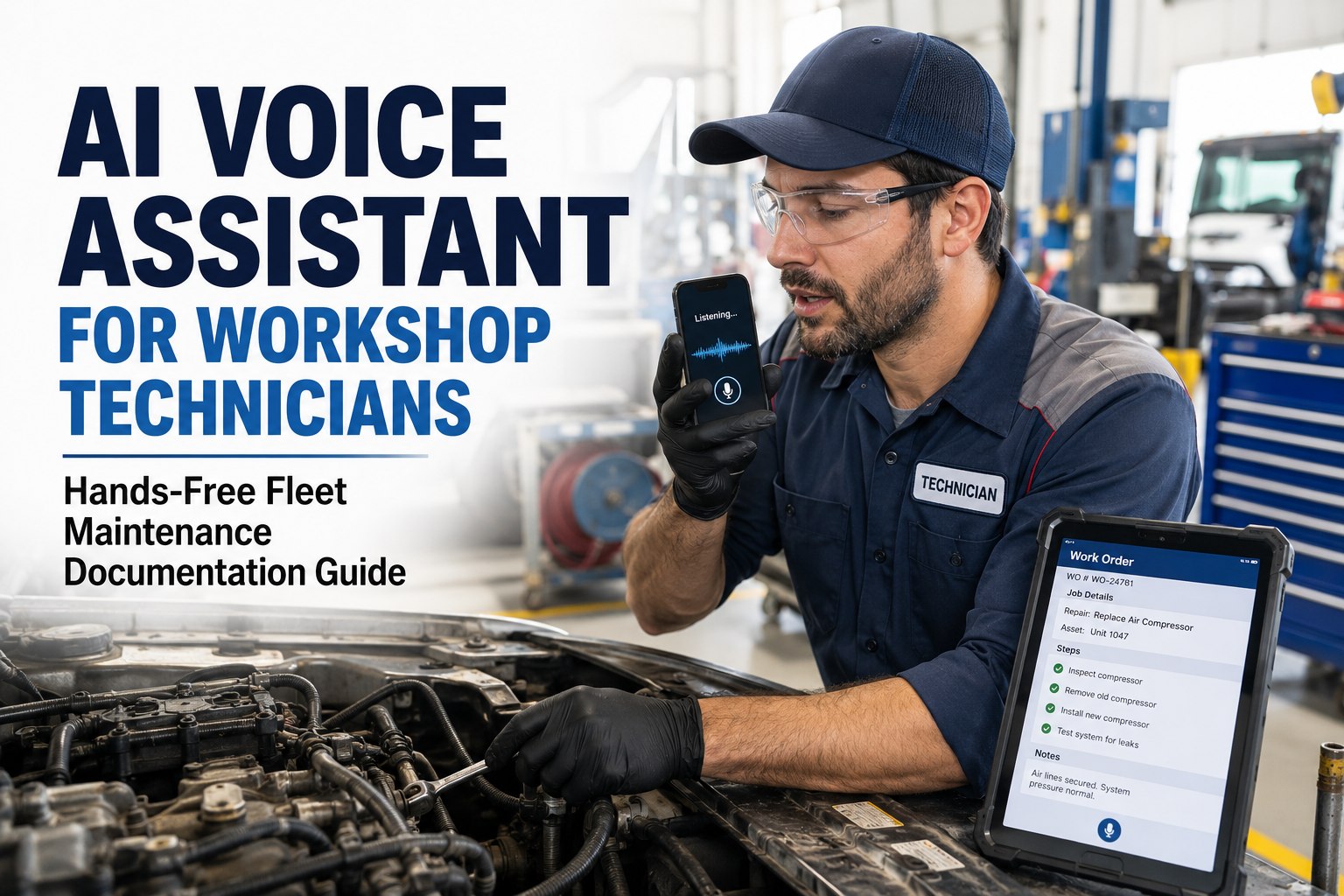
The most skilled diesel technician in your shop loses roughly a quarter of every day to something that has nothing to do with turning wrenches: writing it all down. Paper and manual processes consume around 25% of technician productivity, cost the average shop more than twenty thousand dollars a year in hidden waste, and pull your highest-value people off the vehicle to hunt for a field on a screen. An AI voice assistant flips that. The technician narrates the repair as they work — the complaint, what they found, what they did, the parts and the labor — and the assistant turns those spoken words into a complete, structured repair order without a glove ever coming off. This is the shop-floor use case driving voice into workshops in 2026: the voice recognition market is set to grow from $18.39 billion in 2025 to $61.71 billion by 2031, and workshop documentation is exactly the kind of hands-busy, eyes-on-the-work task it was built for. This guide covers how repair-order narration works, the documentation standard it captures, what it's worth to a shop, and why Fleet Rabbit is built for this use case. Start a free trial or book a demo to put a hands-free assistant in your bays.
WORKSHOP TECHNOLOGY · AI VOICE ASSISTANT
AI Voice Assistant for Workshop Technicians: Narrate the Repair, Skip the Keyboard
Your best technician shouldn't spend a quarter of the day typing. With an AI voice assistant, they narrate the job as they work and it becomes a complete, structured repair order — hands on the vehicle, eyes on the work, documentation done by the time the bay clears.
The Voice Recognition Market Is Scaling Fast
Speech-driven documentation has crossed from consumer novelty to enterprise infrastructure, and the workshop is one of the clearest fits.
22.38% CAGR through 2031
Voice recognition market size, per Mordor Intelligence (January 2026), driven by NLP advances, on-device processing, and enterprise adoption across automotive and other sectors.
25%
Of technician productivity consumed by paper and manual processes
$20,000+
Hidden annual cost of paper-based workflows per shop
7.5%
Of paper records lost during normal operations
25%
Job-time reduction shops report after going digital
The Shop-Floor Use Case, Precisely
A workshop AI voice assistant is speech recognition purpose-built for the repair bay. The technician narrates the job out loud while working, and the assistant captures each spoken element and files it into the correct repair-order field — no screen, no gloves off, no stopping. It's not consumer dictation; it understands the structure of a repair order and populates it as the technician talks.
The technician says, hands still on the truck:
"Customer says truck's down on power on grades. Found a split charge pipe at the intercooler and a soft turbo boost hose. Replaced both hoses and the clamps, road-tested, boost back to spec. One hour twenty labor."
the assistant structures it into
Complaint
Down on power on grades
Cause
Split charge pipe at intercooler; soft turbo boost hose
Correction
Replaced both hoses and clamps; road-tested; boost to spec
i
Why the structure matters as much as the speed: that breakdown is the industry-standard "3 C's" of a repair order — Complaint, Cause, and Correction — the documentation chain that runs from the customer's concern through diagnosis to resolution. Shops that apply the 3 C's consistently to every repair order reduce customer disputes, improve warranty-claim success rates, and build a searchable record that protects them in an audit. The trouble is that disciplined 3 C's documentation is exactly what gets skipped when a busy technician is thumb-typing between jobs. Voice makes the thorough version the fast version.
See the 3 C's captured automatically from speech.
What Paperwork Really Costs a Shop
The productivity leak from manual documentation is larger and better-measured than most shops realize, and it lands squarely on your most expensive labor. Here's what the numbers say, and what voice recovers. Swipe the table horizontally on mobile.
← Swipe to see all columns →
Every hour a master tech spends typing is an hour of diagnostic skill you're paying for and not using.
Fleet Rabbit lets that technician narrate the job and keep working, turning documentation from a productivity tax into a background process that completes itself.
From Spoken Word to Structured Repair Order
The assistant does four things between the technician speaking and a finished record. Each step is what separates a purpose-built workshop assistant from generic dictation software.
1
Capture Through the Noise
Noise-cancelling recognition picks up the technician's voice over air tools, compressors, and running engines, so the bay environment doesn't degrade the capture.
2
Understand Shop Language
It recognizes components, symptoms, parts, and labor from natural speech — knowing that "split charge pipe" is a cause and "one hour twenty" is labor time.
3
Structure Into Fields
The spoken narration is sorted into Complaint, Cause, Correction, parts, and labor rather than dumped as one block of raw text to clean up later.
4
File and Route Instantly
The completed repair order is saved, timestamped, and linked to the vehicle and technician, ready for the service advisor and the invoice the moment the job ends.
Why Fleet Rabbit Is Built for This Use Case
Plenty of tools claim "voice." Most are generic dictation with a logo, or diagnostic assistants that don't touch your documentation. Fleet Rabbit is fleet-native: voice, DVIR, work orders, and compliance in one platform, priced for real shops. Here's how it compares. Swipe the table horizontally on mobile.
← Swipe to see all columns →
One Platform: Voice, DVIR, Work Orders, and Compliance
Fleet Rabbit isn't a voice add-on bolted onto someone else's software — it's a fleet maintenance platform with hands-free voice capture built in. Technicians narrate repairs into structured work orders, drivers complete voice DVIRs, defects route automatically, and every record is searchable and compliant. Deploy at $5/vehicle/month, no hardware, live within 72 hours.
Repair-order narration
3 C's captured automatically
Voice DVIR & routing
Searchable history
What a Shop Gains
The recovered typing time is the headline, but the deeper value is what changes across the whole operation when documentation stops being a bottleneck.
01
Higher Technician Efficiency
Recovered documentation time turns straight into billable labor hours, lifting the jobs-per-day and labor-hours-per-RO numbers that drive shop profit.
02
Thorough 3 C's on Every RO
When documenting is effortless, the complete Complaint-Cause-Correction record gets captured every time, not just when there's a spare minute.
03
Fewer Comebacks
Detailed, searchable repair history means the next technician sees exactly what was done, cutting the repeat repairs that quietly erode margin.
04
Stronger Warranty Claims
A complete documentation chain on every job improves warranty-claim success and protects the shop when a record is questioned.
05
Faster Onboarding
New technicians narrate naturally instead of learning form navigation, reaching full productivity sooner with far less software training.
06
No More Scavenger Hunts
Every repair order lives in one searchable system instead of scattered across paper, email, and drives, so records are found in seconds.
Frequently Asked Questions
What is an AI voice assistant for workshop technicians?
It's speech recognition purpose-built for the repair bay: a technician narrates the job out loud while working, and the assistant captures each spoken element and files it into the correct repair-order field without a screen or a glove coming off. Unlike consumer dictation, it understands the structure of a repair order — complaint, cause, correction, parts, and labor — and populates each field as the technician talks. Seeing that structured capture on a real job is exactly what you can
book a demo to watch.
How much time does voice documentation actually save?
The savings are large because paper and manual processes consume around 25% of technician productivity, and shops that move to digital documentation report job-time reductions of up to 25%. On top of that, paper-based workflows carry hidden costs exceeding $20,000 a year per shop and lose about 7.5% of records in normal operation. Voice recovers most of that lost time by making documentation happen during the work rather than after it, and running that math against your own shop is something you can
book a demo to work through.
What are the "3 C's" and why do they matter?
The 3 C's are the industry-standard structure of a repair order — Complaint, Cause, and Correction — providing a clear documentation chain from the customer's concern through diagnosis to resolution. Shops that apply them consistently reduce disputes, improve warranty-claim success rates, and create a searchable record that protects them during audits. The problem is that thorough 3 C's documentation is exactly what a busy technician skips when typing between jobs, so having voice capture the full structure automatically is something you can
book a demo to see in practice.
Does voice recognition work over shop noise?
Yes, when the system is purpose-built for it. Workshop-grade voice recognition uses noise-cancelling audio processing designed to pick up the technician's voice over air tools, compressors, and running engines, and fleet-tuned systems have demonstrated high accuracy in exactly these high-ambient-noise conditions. It's engineered for the bay rather than adapted from quiet-office consumer software, and testing that accuracy in your own shop is something you can
book a demo to do firsthand.
How is this different from generic dictation apps?
Generic dictation transcribes speech into a block of text and leaves you to sort it into fields; a purpose-built workshop assistant understands the repair order it's building. It recognizes which words are the complaint, which are the cause, which describe the correction, and which are parts and labor, then populates each field directly. It's the difference between a transcript you have to clean up and a finished, structured repair order, and comparing that maintenance-aware parsing to raw transcription is exactly what you can
book a demo to see side by side.
Why choose Fleet Rabbit for workshop voice documentation?
Because it's fleet-native rather than a voice add-on bolted onto other software. Fleet Rabbit builds voice capture, hands-free DVIR, automatic defect-to-work-order routing, searchable per-vehicle history, and compliance into one platform, priced at $5 per vehicle per month with no hardware and deployment live within 72 hours. Generic dictation apps charge per-seat voice fees and produce raw text, and diagnostic-only AI tools don't capture documentation at all. Seeing how the pieces fit together for your operation is something you can
book a demo to explore.
Do technicians need much training to use it?
Very little, which is part of the appeal. Narrating a job the way a technician would naturally describe it is far closer to how they already communicate than navigating software forms and dropdowns, so the learning curve is short and new hires reach productivity faster. The best systems let technicians speak conversationally rather than memorize rigid commands, and gauging how quickly your own crew adapts is something you can
book a demo to try with your team.
Is the workshop voice market actually growing, or is this hype?
It's growing on hard numbers. The voice recognition market is projected to grow from $18.39 billion in 2025 to $61.71 billion by 2031 at a 22.38% CAGR, driven by natural language processing advances, on-device processing, and enterprise adoption across sectors including automotive. In the shop specifically, the pairing of that maturing technology with the measured 25% productivity drag of paperwork is what makes the payback real rather than speculative, and evaluating that fit for your shop is exactly what you can
book a demo to do.
Give Your Bays a Voice. Give Your Techs Their Time Back.
Fleet Rabbit turns spoken repair narration into complete, structured, 3 C's repair orders — captured hands-free while the technician works, filed and searchable the moment the job ends. Voice, DVIR, work orders, and compliance in one fleet-native platform, integrated with your existing systems in 5–7 working days, at $5/vehicle/month, with no new hardware required.
Free tier for up to 3 vehicles · No credit card required · No hardware installation
July 29, 2026By Emily Davis
All Blogs