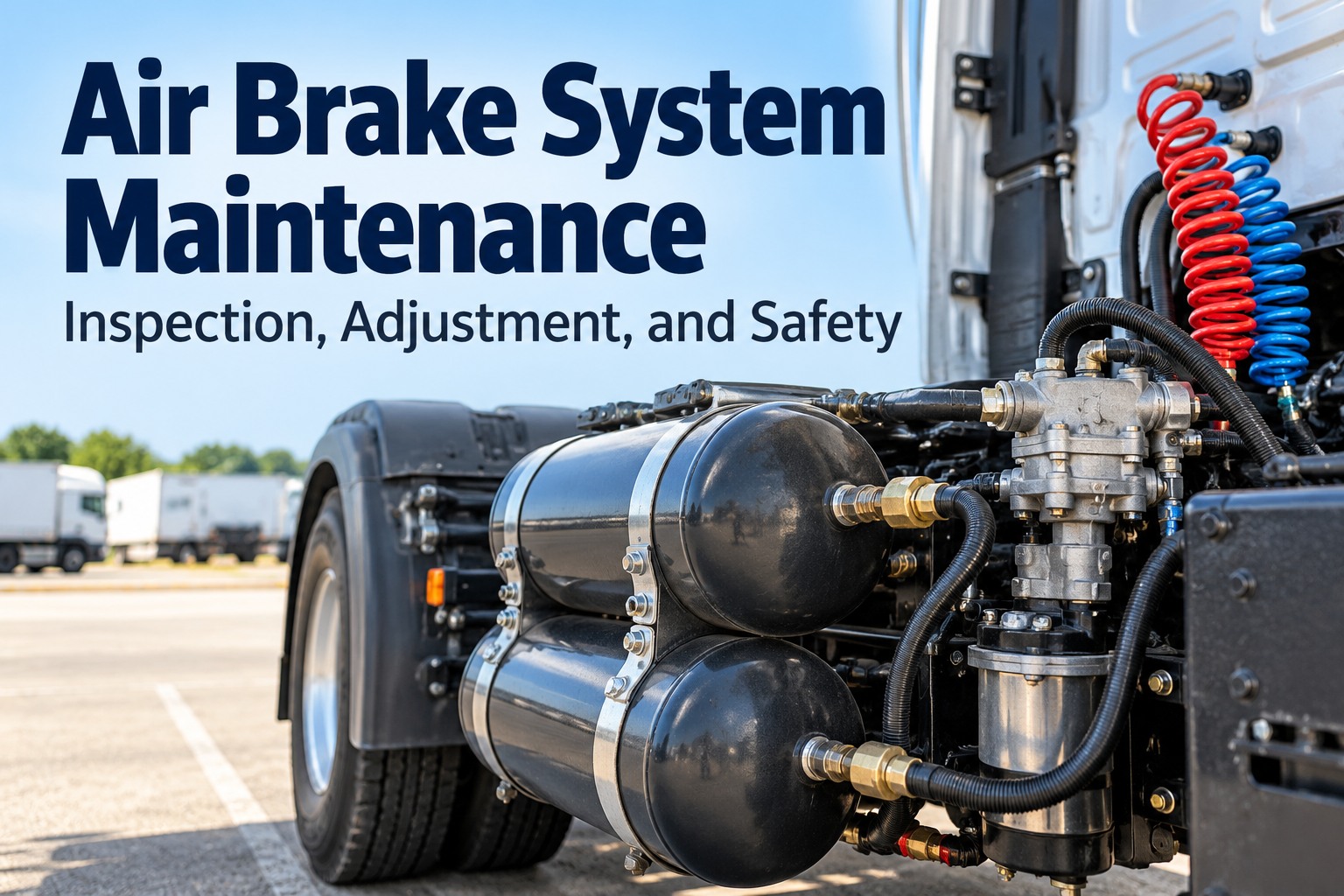
Air brakes are the system most likely to put a truck out of service, and the reason is almost always maintenance rather than a sudden failure. CVSA states it plainly: failure to properly service brake systems is the most common reason drivers and motor carriers are issued vehicle out-of-service orders, and the most effective check of a drum foundation brake is measuring pushrod stroke against the federal limits. Those limits are specific by chamber type — a standard Type 30 is 2 inches, a long-stroke Type 30 is 2½ — and so is the procedure: CVSA's Level I method builds the system to 90 to 100 psi with the engine off before a full brake application, while the periodic inspection standard in Appendix A to Part 396 specifies 80 to 90 psi. Measure at the wrong pressure and you get the wrong answer. This guide covers how the system works, the stroke limits by chamber, the in-cab test, what moisture does, the failure patterns worth catching early, and the PM schedule that keeps brakes in adjustment between services. Book a 30-minute demo to see brake measurements tracked per wheel end, or start free with 3 vehicles.
Brakes Don't Usually Fail Suddenly. They Drift Out of Adjustment, and Nobody Measures Until an Inspector Does.
For fleet mechanics, shop leads and maintenance managers: the stroke limits, the tests, the moisture problem, and the schedule that keeps air brakes inside spec between PM visits.
CVSA Level I procedure: engine off, full application
Appendix A to Part 396 specifies this range instead
Defective brakes at or above this share park the whole vehicle
Minimum required when measured on a performance-based tester
Figures from CVSA's brake inspection guidance and 49 CFR Part 396, Appendix A.
How it worksWhat Actually Happens Between the Compressor and the Brake Shoe
Understanding the chain matters because every fault below sits at one of these stages, and the symptom a driver reports rarely names the right one. You can log checks at each stage on a free account.
The numbersBrake Readjustment Limits by Chamber Type, and Why the Marking on the Chamber Wins
These are the values in Appendix A to Part 396. The regulation sets a ceiling — where a manufacturer marks a tighter readjustment limit on the chamber body, that tighter figure is the one to work to. Long-stroke chambers are marked, so identify the chamber before you judge the measurement. We'll put these limits into your inspection template in a demo. Swipe the table on mobile.
| Clamp-type chamber | Outside diameter | Standard stroke limit | Long stroke limit |
|---|---|---|---|
| Type 12 | 5 11/16 in. | 1 3/8 in. | 1 3/4 in. |
| Type 16 | 6 3/8 in. | 1 3/4 in. | 2 in. |
| Type 20 | 6 25/32 in. | 1 3/4 in. | 2 in. (2 1/2 in. on 3-inch rated stroke) |
| Type 24 | 7 7/32 in. | 1 3/4 in. | 2 in. (2 1/2 in. on 3-inch rated stroke) |
| Type 30 | 8 3/32 in. | 2 in. | 2 1/2 in. |
| Type 36 | 9 in. | 2 1/2 in. | — |
Source: 49 CFR Part 396, Appendix A, clamp-type brake chamber readjustment limits. Bendix DD-3 and rotochamber types carry their own values. Always cross-check the limit marked on the chamber.
The pressure you measure at changes the answer
CVSA's guidance for measuring pushrod stroke is to block the wheels, release the spring brakes, bring pressure to 90 to 100 psi, shut the engine off, mark the pushrods, then fully apply and hold. The periodic inspection standard in Appendix A instead specifies 80 to 90 psi with the engine off and brakes fully applied. Both are valid in their own context; mixing them, or applying with less than full foot force, produces measurements that don't mean anything.
The 20% ruleWhy Two Bad Brakes Can Park a Ten-Brake Vehicle
Individual readings matter, but the vehicle-level rule is what strands trucks: when the share of defective or out-of-adjustment brakes reaches 20% of the brakes on the vehicle or combination, the whole unit goes out of service regardless of how good the rest are. On a five-axle combination, that is two wheel ends. Track every wheel end per unit, free.
The testThe In-Cab Air Brake Checks a Driver Should Run Before Every Shift
These are the checks from the standard air brake test drivers learn for the CDL, and they catch the majority of developing problems before a wheel end ever gets measured. Put them on the daily inspection report so the result is recorded rather than remembered. See it as a guided check in a demo.
Governor should cut out in the normal range; slow build points at the compressor or a leak.
Engine off, brakes released, watch the loss per minute against the limit for your configuration.
Full application held; the allowable loss is higher than static and higher again for a combination.
Fan the pressure down; the warning must activate before pressure falls too far.
Keep fanning; the parking valves should pop out on their own in the normal range.
Tug test against the parking brake before the tractor protection test.
Roll slowly, apply firmly, and feel for pulling, delay or a soft pedal.
How Many of Your Trucks Are Within a Quarter Inch of an Out-of-Service Order Right Now?
Bring your last brake inspection sheets. We'll load the measurements per wheel end, flag the chambers approaching their limit, and show the PM schedule that would have caught them — plus the records you'd hand an inspector.
Symptom to causeReading Air Brake Complaints Before You Pull a Wheel
Drivers report feel and sound; technicians need components. This table turns the common complaints into the check that settles them. Record findings against each complaint, free. Swipe the table on mobile.
| What the driver reports | Usual causes | Where to start |
|---|---|---|
| Pulls to one side when braking | Uneven adjustment, a seized slack adjuster, contaminated lining, or a dragging brake | Measure stroke at every wheel end, then compare lining and drum condition |
| Slow pressure build or frequent cycling | Compressor wear, leaking lines or fittings, unloader or governor fault | Time the build-up, then walk the lines with the system charged |
| Air loss with the engine off | Leaking chamber diaphragm, valve, fitting or hose | Static and applied leak-down checks, then trace by ear and soap |
| Water or oil at the tank drains | Air dryer past service life, cartridge saturated, compressor passing oil | Service the dryer, check the purge, inspect the compressor |
| Brakes drag or run hot | Stuck slack adjuster, seized S-cam, weak return spring, or a valve holding pressure | Check free stroke, then camshaft and return springs |
| Low air warning during the run | A leak that only opens under load, or a compressor that cannot keep up | Load-condition leak test and compressor output check |
MoistureWhat Water in the Air System Does While Nobody Is Looking
Water is the slow failure behind a surprising share of valve and chamber problems, and the air dryer is the component fleets forget until the tanks come up wet. Its effects stack over months. We'll add dryer service to your PM plan in a demo.
Rust scale travels downstream into valves that were never designed to pass debris.
Contamination on seats causes slow leaks that only show under load or in the cold.
Moisture in lines freezes, and a frozen valve behaves like a failed one until it thaws.
Oil in the air tells you the compressor is passing, and the dryer cartridge is saturating faster than scheduled.
The scheduleWhat to Check Daily, at Every PM, and Annually to Keep Brakes in Adjustment
Automatic slack adjusters are standard on modern equipment, and the point worth repeating is that they should not be manually adjusted to mask a problem — an adjuster that needs frequent manual intervention is failing. Build the rest into preventive maintenance so the measurements are recorded against each wheel end. Set the schedule free on 3 vehicles.
Air test, drain the tanks or confirm automatic drains, look for leaks and visible damage, report anything that changed.
Pushrod stroke at every wheel end at the correct pressure, lining thickness, drums, chambers, hoses and slack adjuster free play.
Air dryer cartridge on its interval, purge valve function, compressor output and oil carryover before winter.
The federal annual inspection covers the brake system in detail; align it with your deepest PM tier.
The costWhat Brake Work Costs Planned Versus What It Costs at a Scale House
Brakes are the most-cited vehicle category in roadside enforcement, so the difference between finding a stroke measurement in your bay and having it found at an inspection station is the difference between a scheduled adjustment and a parked truck with a load on it. Industry benchmarking puts unplanned downtime at roughly $448 to $760 per truck per day before towing and repair, and ATRI puts 2025 repair and maintenance cost at $0.215 per mile, up 8.6%. Estimate your own exposure with our team.
Relative cost, illustrative — not prices. The variable that moves most is the load sitting behind the truck.
MeasureThe Brake Program Numbers Worth Watching Every Month
Four measures tell you whether adjustment is drifting between services, which is the question a stroke reading alone can't answer. Start tracking them free.
QuestionsAir Brake Maintenance Questions Fleet Mechanics Ask Most
What is the brake adjustment limit for a Type 30 chamber?
Two inches for a standard clamp-type Type 30 and 2½ inches for a long-stroke Type 30, per the readjustment limits in Appendix A to Part 396. If the chamber is marked with a tighter limit, work to the marking. See limits built into your checklist.
At what pressure should pushrod stroke be measured?
CVSA's procedure builds the system to 90 to 100 psi with the engine off before a full application; the periodic inspection standard in Appendix A specifies 80 to 90 psi. Use the right one for the inspection you're performing, and always apply full foot force. Record the pressure with the measurement, free.
How many defective brakes put a vehicle out of service?
When 20% or more of the brakes on the vehicle or combination are defective or out of adjustment, the whole unit is placed out of service — two wheel ends on a ten-brake combination. Review your last inspections with us.
Can we manually adjust automatic slack adjusters?
They are designed to self-adjust, and manually adjusting them to hide a problem masks a failing adjuster or foundation issue rather than fixing it. Repeated manual adjustment on one wheel end is a finding in itself. Track repeat adjustments free.
Why do the tanks keep coming up wet?
Usually an air dryer past its service life or a saturated cartridge, sometimes a compressor passing oil. Drain and service the dryer rather than treating the water as normal. Add dryer service to your PM in a demo.
How often should brakes be inspected?
Drivers run the air test and look for leaks daily; stroke, lining and foundation components are measured at every PM; the federal annual inspection covers the system in full. Build the schedule free on 3 vehicles.
Measure Every Wheel End, Keep Every Reading, and Never Meet an Inspector Without the Record
FleetRabbit holds pushrod stroke, lining thickness and air test results per wheel end and per unit, flags chambers drifting toward their limit before the next service, and turns driver-reported brake defects into work orders with the history attached.
Per wheel end, with the pressure and chamber type recorded.
Chambers approaching their limit appear before the PM, not after.
Every reading searchable by unit, date and wheel position.
No credit card required. Start with 3 vehicles and your next PM.