Mining operations run on uptime. When a haul truck goes idle at a surface mine, the financial clock starts immediately — unplanned equipment downtime in mining costs between $5,000 and $20,000 per hour for a large haul truck, and when a primary shovel goes down, cascading losses across the entire truck queue can reach $180,000 per hour at large operations. A single major breakdown has been documented to cost $2 million per day in lost production. The difference between a mine that hits its production targets and one that consistently falls short is rarely the equipment itself — it is the fleet management system running behind it. In 2026, the best mining fleet management software does not just track where your assets are. It predicts when they will fail, automates your MSHA compliance documentation, optimizes fuel across your heaviest machines, and gives site managers a live dashboard of every asset on the property without requiring a team of analysts to run it.
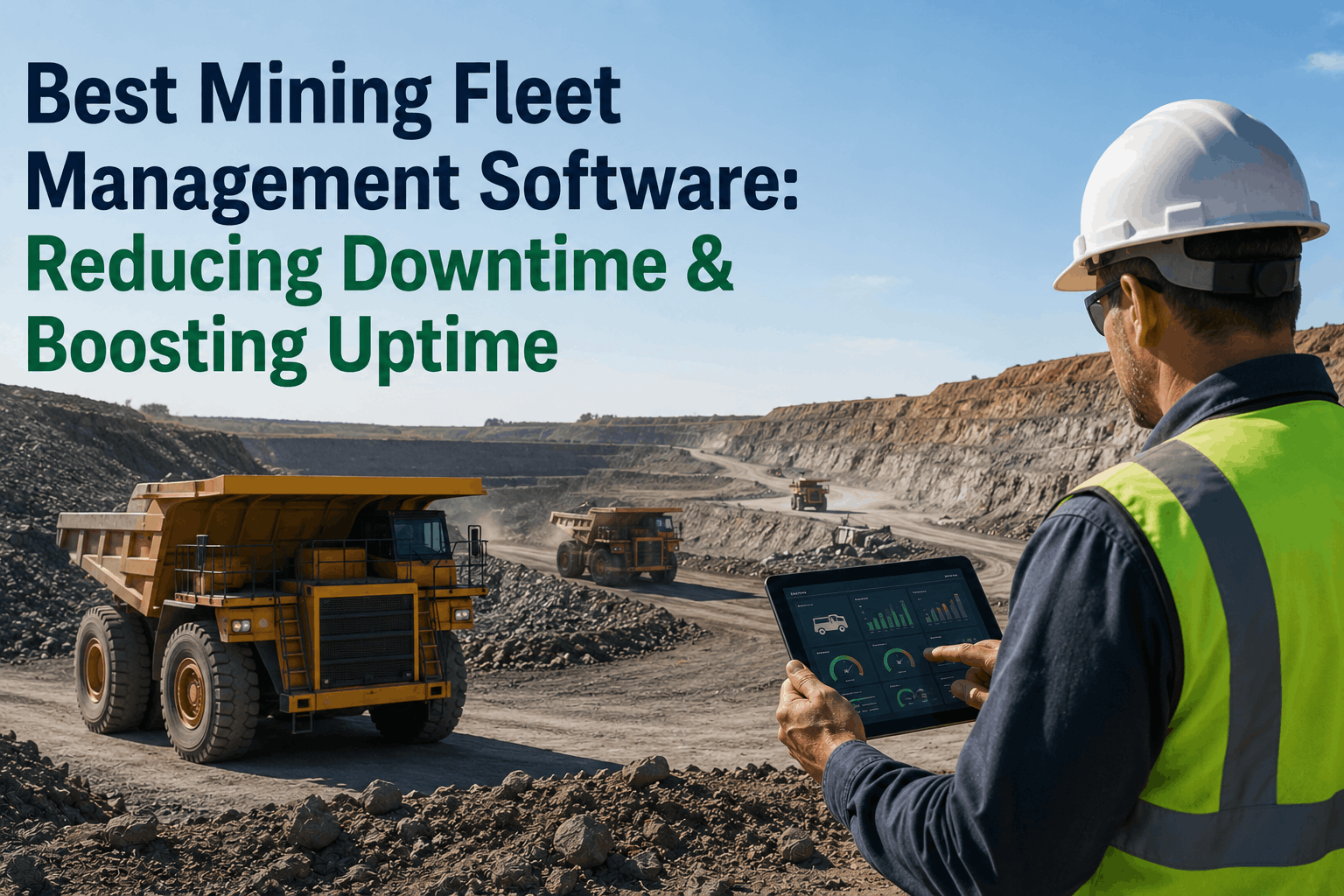
Best Mining Fleet Management Software: Reducing Downtime and Boosting Uptime
Over 75% of mining companies plan to adopt advanced fleet management technology by 2026. The ones moving first are already widening the gap on uptime, safety, and cost-per-tonne.
Why Standard Fleet Software Fails at Mine Sites
Most fleet management platforms were designed for commercial trucking or construction, then adapted for mining as an afterthought. The problem is that a mine site is not a trucking depot. The duty cycles are more severe, the assets are heavier and more expensive, the inspection requirements are governed by MSHA rather than DOT, the terrain is unstructured, and the connectivity environment — deep in an open-pit mine or underground — is fundamentally different from a paved route with cellular coverage. Software that works perfectly for a delivery fleet will fail a mine site on several dimensions simultaneously.
Mining-specific fleet management requirements include pre-shift inspections with MSHA-compliant digital checklists for each machine type, tiered PM scheduling based on engine hours (250/500/1,000/2,000 hour intervals) rather than mileage or calendar dates, integration with OEM telematics from Cat MineStar, Komatsu KOMTRAX, and Volvo CareTrack, offline-capable mobile inspection tools for remote pit locations without cellular coverage, and cost-per-hour tracking at the asset level — not cost-per-mile. These requirements eliminate generic fleet platforms from contention and define what purpose-built mining fleet software must deliver. Sign up with FleetRabbit to access mining-specific fleet management tools built for surface mines, quarries, and multi-site operations.
Mining equipment operates by engine hours, not road miles. Excavators, dozers, and drills accumulate wear by hours of operation under load — not kilometers traveled. Software that schedules maintenance by mileage misses the actual wear cycle entirely.
MSHA pre-shift inspection requirements differ by machine type — haul truck checklists differ from excavator, drill rig, and dozer checklists. Generic forms adapted from construction or trucking create compliance gaps that lead to citations.
Cat MineStar, Komatsu KOMTRAX, Volvo CareTrack, and Hitachi ConSite generate the most valuable diagnostic data on your heaviest assets. Software that cannot ingest these feeds leaves the most expensive equipment in a visibility blind spot.
Pre-shift inspections happen in pits, tunnels, and remote locations where cellular coverage is unreliable or absent. Mobile inspection tools that require connectivity are abandoned by operators and replaced with paper — defeating the entire purpose.
The Five Capabilities That Define Best-in-Class Mining Fleet Software
The best mining fleet management software in 2026 is evaluated on five core capability categories. Each addresses a documented, quantified cost driver at mine sites — from the $127,000 average annual loss at a 15-truck small mine to the multi-million-dollar per-day exposures at large operations. The platforms that deliver across all five categories are the ones worth evaluating for your operation.
Mining PM schedules must trigger on engine hours — not calendar dates — with tiered intervals at 250, 500, 1,000, and 2,000 hours that account for severe-duty operating conditions. Best-in-class platforms auto-sync hour counters from OEM telematics, adjust thresholds for high-load applications, and generate work orders with parts lists before PM is due. FleetRabbit's mining PM module reduces unexpected breakdowns by up to 42% through proactive, hour-triggered scheduling.
MSHA mandates pre-shift inspections before any equipment is operated, with surface mines inspected quarterly and underground mines at minimum four times per year. Digital inspection tools must provide machine-specific checklists with mandatory photo capture for defects, GPS and timestamp verification, offline functionality for remote pit locations, and an audit-ready digital trail that satisfies MSHA documentation requirements. Civil penalties for MSHA violations range from $112 to $90,649 per violation — prevention through documented compliance is the only rational approach.
Heavy mining vehicles are among the largest fuel consumers in any industry. A Cat 785 haul truck consumes 100 to 150 liters of diesel per hour at load. Advanced fleet management platforms track fuel consumption patterns per asset, flag abnormal consumption that indicates mechanical issues, monitor idle time in real time, and trigger alerts for unauthorized refueling events. Deployments of advanced fuel tracking and analytics reduce total mining fuel usage by up to 15%, creating material cost savings and supporting ESG fuel reduction targets simultaneously.
Site managers at surface mines need to know where every haul truck, excavator, loader, dozer, drill rig, grader, and water truck is positioned at any given moment — and whether it is operating, idle, or down. GPS-integrated fleet dashboards provide live equipment maps, operating status by asset, utilization percentage by shift, and geofencing alerts for equipment entering or leaving defined zones. Utilization analysis identifies chronically underperforming assets and supports equipment deployment decisions across multiple pit faces or mine sites.
Parts delays on a single excavator can cost $3,000 to $8,000 in lost production time per incident, plus expedited shipping charges 40 to 60% higher than standard orders. Mining fleet software must track spare parts inventory against each asset's historical consumption, trigger automatic reorders before critical components reach minimum stock levels, and provide cost-per-operating-hour analytics at the asset level — not fleet-wide averages — so maintenance budgets reflect actual machine performance.
FleetRabbit is built for surface mines, quarries, and heavy equipment operations — with hour-based PM scheduling, MSHA-compliant digital inspections, OEM telematics integration, and real-time asset tracking across every machine on your site.
MSHA Compliance: The Documentation Burden Software Must Solve
MSHA is not OSHA adapted for mines — it is a separate regulatory framework with its own mandatory inspection frequencies, documentation standards, and enforcement authority. Surface mines face quarterly MSHA inspections; underground mines face a minimum of four per year. Unlike many regulatory environments where documentation is reviewed periodically, MSHA requires that pre-shift inspection records demonstrate systematic, consistent equipment care with timestamped, signed documentation for every machine, every shift.
The most frequently cited MSHA standards in 2024 include equipment examination requirements and maintenance record-keeping failures — violations that digital fleet management platforms eliminate by automating both the inspection workflow and the documentation trail. When an MSHA inspector arrives on site, operations using digital fleet management can produce a complete, timestamped inspection and maintenance history for every machine in seconds. Operations still relying on paper logs spend hours pulling records — and frequently discover gaps that result in citations ranging from $112 to $90,649 per violation, with flagrant violations carrying penalties up to $313,790. Book a FleetRabbit demo to see how automated MSHA documentation works across your specific machine types and inspection requirements.
Equipment Utilization: The Metric Most Mine Fleets Are Under-Tracking
Equipment utilization — the percentage of available operating hours during which each machine is actually productive — is one of the most consequential KPIs in mining fleet management, and one of the least consistently tracked. Industry benchmarks for world-class operations target haul truck availability above 90% and utilization above 80% of available hours. The average mine falls significantly below these benchmarks, often because the data infrastructure to measure utilization accurately simply does not exist at the machine level.
When a fleet management platform tracks operating hours, idle hours, and downtime hours per machine per shift, site managers can identify which assets are chronically underutilized — perhaps due to operator scheduling gaps, route bottlenecks, or shadow downtime that appears as idle time in GPS data. Addressing chronic underutilization typically delivers a 10 to 20% improvement in effective equipment productivity without adding a single machine to the fleet. For operations running expensive haul trucks at $2 to $5 million each, that improvement in utilization rate represents enormous capital efficiency gains. Sign up with FleetRabbit and start tracking real utilization rates per machine across your entire mine site today.
FleetRabbit gives surface mine managers live equipment dashboards, shift-by-shift utilization reports, MSHA-compliant digital inspections, and predictive maintenance alerts — all in one platform built for mining, not adapted from trucking.