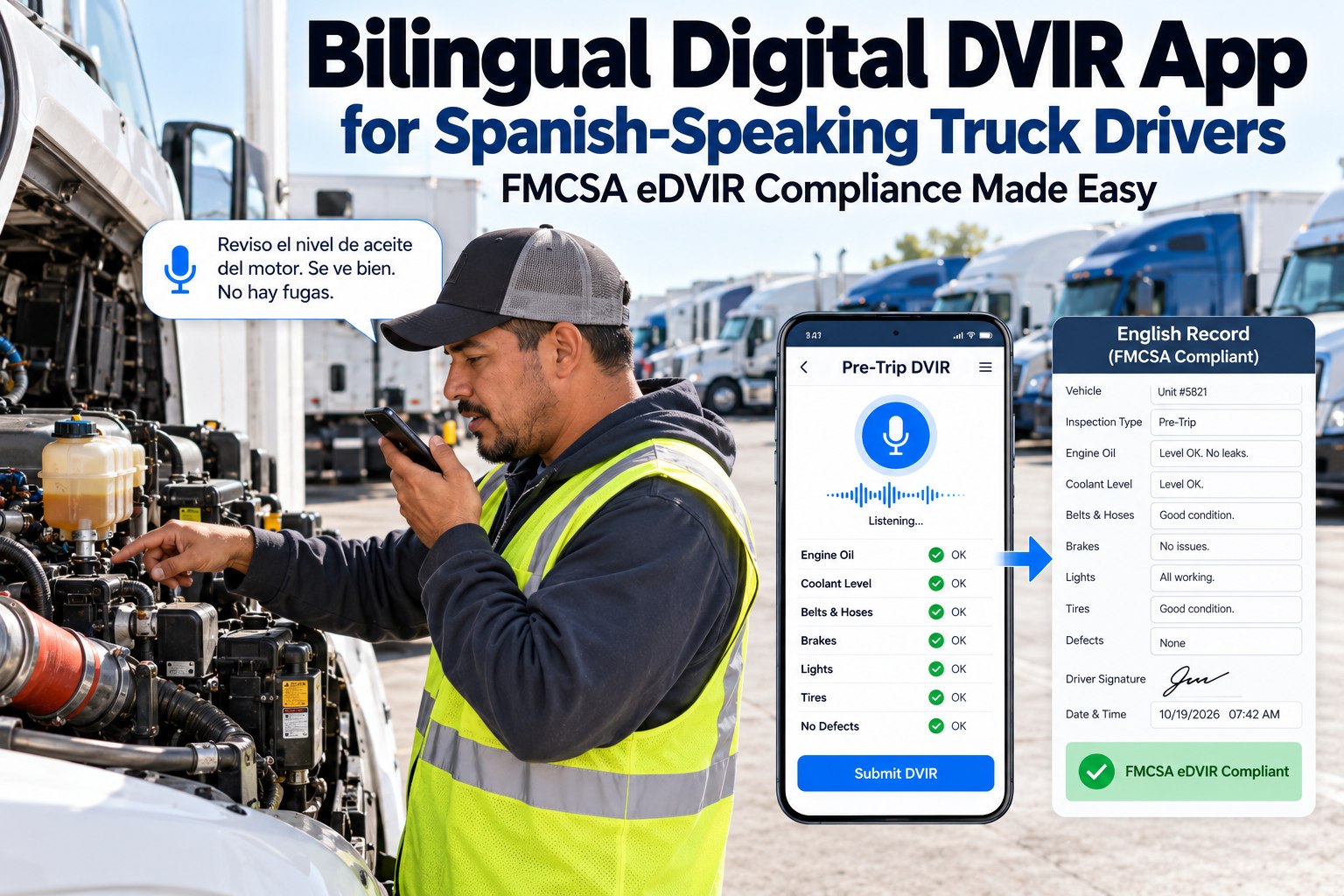
More than one in five U.S. truck drivers is Hispanic or Latino, and for many of them the pre-trip inspection is the one form they fill in every day. A DVIR app that shows each item in Spanish as well as English can make that inspection more thorough. It can’t replace English, though: federal rules expect drivers to make entries on reports and records in English, and inspectors now place drivers out of service when they can’t. This guide covers what 396.11 requires, how the English proficiency rule touches the DVIR, and how to build a bilingual pre-trip for tractors, trailers and intermodal chassis. To see FleetRabbit’s digital DVIR, book a short walkthrough with our team.
Digital DVIR · Spanish-speaking drivers
Spanish on the prompt, English on the record, every trailer checked
A bilingual checklist helps a driver inspect what they understand. A standard English record keeps the report readable by your mechanics, auditors and roadside inspectors.
Pre-trip · Trailer 5302
Representative screen · sample data
Service brakes
Frenos de servicio
OK
Trailer brake connections
Conexiones de freno del remolque
Defect
Lighting and reflectors
Luces y reflectores
OK
Tires, wheels and rims
Llantas, ruedas y rines
OK
Coupling devices
Dispositivos de acoplamiento
OK
Defect stored as: “Trailer brake connection, air leak at glad hand”
A signed defect report kept for three months: what 49 CFR 396.11 asks of every driver
The DVIR rule is short. Under 396.11(a), every motor carrier must have its drivers prepare a report at the end of each day’s work on each vehicle they operated. The report identifies the vehicle, lists any defect that would affect safety or cause a breakdown, and is signed by the driver. If no defect is found or reported, no report is required. Before the vehicle runs again, the carrier must repair the defects and certify on the report that each one was fixed or didn’t need fixing. The report and certifications are kept for three months.
Who
Every driver, on every vehicle operated that day
The motor carrier must require it
When
At the end of each day’s work
Only when a defect is found or reported
What
Unit ID, each safety defect, driver signature
Separate report for each vehicle
Keep
Three months from the date it was prepared
With repair and review certifications
Before driving, the next driver must review the last report and, if defects were listed, sign to acknowledge the repair certification, under 396.13. That chain of driver, mechanic and next driver is where a language gap does damage: a defect that was understood by one person and described vaguely to the next.
FMCSA made electronic DVIRs explicit in 2026, and paper is still allowed
Electronic DVIRs were already accepted, but FMCSA’s final rule on electronic driver vehicle inspection reports, published in February 2026 and effective about 30 days later, added explicit language to 396.11 and 396.13: the reports may be created and kept electronically under 49 CFR 390.32. The rule made no change to what the report must contain, and FMCSA declined a request to bring back no-defect reports for passenger carriers. For a bilingual fleet this matters because an app can do what paper can’t: show two languages on the same item, attach photos and route a defect straight to the shop.
Before 2026
eDVIRs accepted under general electronic records rules
→
Feb 2026
Final rule published, docket FMCSA-2025-0115
→
About 30 days later
396.11 and 396.13 name electronic reports directly
The English proficiency rule reaches the DVIR, not just the roadside conversation
Section 391.11(b)(2) says a driver must read and speak English well enough to do four things. Most coverage focuses on the first three. The fourth is the one that touches every DVIR a driver signs.
✓
Converse with the general public
✓
Understand highway traffic signs and signals
✓
Respond to official inquiries
DVIR
Make entries on reports and records
Enforcement changed sharply in 2025. CVSA put English proficiency back into its out-of-service criteria on 25 June 2025. In the six months before, 7,812 violations led to 33 out-of-service orders. Between 25 June 2025 and 19 March 2026, more than 60,000 violations led to roughly 19,000, according to figures summarised by J.J. Keller in Heavy Duty Trucking. In Roadcheck 2026, English proficiency was 9.1% of all driver out-of-service orders.
English proficiency out-of-service orders, before and after CVSA’s June 2025 change
25 Jun 2025 to 19 Mar 2026
≈19,000
Periods differ in length. Source: FMCSA figures via J.J. Keller, Heavy Duty Trucking, October 2026
Inspectors assess English without an interpreter, translation app or cue cards, and may ask the driver about the vehicle, logs and shipping papers. A bilingual DVIR app is a tool for a better inspection. It is not a way around the rule, and it shouldn’t be sold to drivers as one.
Where Spanish helps
Understanding what each checklist item means
Spotting the part on an unfamiliar trailer or chassis
Training new drivers on the walkaround
Safety instructions from the shop or yard
and
Where English stays
The stored defect description and the signed report
Answering an inspector about the vehicle and records
Reading highway signs and signals
The mechanic’s repair certification
The federal DVIR parts list, in English and Spanish, by unit type
Here is the minimum list from 396.11, with the intermodal chassis items from 396.11(b) included, a common Spanish term for each, and the defect a driver is most likely to find. Trucking Spanish varies by region, so check the terms with your own drivers before you load them into a template.
| Item on the report | Unit | Spanish line on the prompt | Typical defect |
|---|
| Service brakes, incl. trailer brake connections | | Frenos de servicio y conexiones de freno | Air leak, damaged chamber, chafed hose |
| Parking brake | | Freno de estacionamiento | Won’t hold the unit on a tug test |
| Steering mechanism | | Mecanismo de dirección | Excess free play, loose parts |
| Lighting devices and reflectors | | Luces y reflectores | Lamp out, missing conspicuity tape |
| Tires, wheels and rims | | Llantas, ruedas y rines | Low tread, cut sidewall, loose lugs |
| Coupling devices | | Dispositivos de acoplamiento | Fifth wheel jaw or kingpin wear |
| Locking pins, clevises, clamps or hooks | | Pernos de bloqueo, horquillas, abrazaderas o ganchos | Twist lock that won’t seat |
| Sliders or sliding frame lock | | Deslizadores o seguro del bastidor | Slider pins not engaged |
| Horn, wipers, mirrors, emergency equipment | | Claxon, limpiaparabrisas, espejos, equipo de emergencia | Cracked mirror, missing triangles |
20-minute walkthrough
See a tractor, trailer and chassis pre-trip built on your own units
We’ll set up a sample inspection, mark a defect with a photo and follow it to mechanic sign-off.
Brakes, tires and lights: where Roadcheck 2026 found the defects drivers missed
CVSA’s International Roadcheck in May 2026 ran 54,575 inspections and placed 10,350 vehicles out of service. Brakes made up 39.1% of vehicle out-of-service orders, tires 20.9%, cargo securement 12.4% and lighting 11.9%, as reported by CCJ. Most of these are items a pre-trip is meant to catch, and most of them sit on the trailer as much as the tractor.
Share of vehicle out-of-service orders, International Roadcheck 2026
Source: CVSA results as reported by CCJ, August 2026. “All other” is the remainder.
Tractor
Brakes, steering and the fifth wheel
The tractor carries the parts list’s heaviest items: service and parking brakes, steering, horn, wipers, mirrors and emergency equipment. A driver who reads “slack adjuster” in a second language may skip it, so the prompt should name the part in both languages and show where to look.
Trailer
Brake connections, lamps and tires
Brakes were 39.1% of vehicle out-of-service orders in Roadcheck 2026, and trailer brake connections are on the federal list by name. Glad hands, air lines, marker lamps, conspicuity tape and tires make up most of a trailer walkaround.
Intermodal chassis
Locking pins, sliders and the provider’s report
A chassis tendered by an intermodal equipment provider has its own list under 396.11(b): locking pins, clevises, clamps or hooks, sliders, tie-down bolsters and the kingpin upper coupling. The driver’s report goes back to the provider.
Intermodal chassis DVIRs go to the equipment provider, with seven required fields
Chassis pulled from a port or rail ramp are covered by 396.11(b). The provider must have a way to receive the driver’s report, and the driver or carrier must report known damage or defects when the chassis is returned. The provider then repairs it and certifies the repair on the original report before the chassis goes out again, and keeps it for three months. Because chassis change every load, the unique equipment ID is the field most often wrong on a paper form.
Chassis report, fields required by 396.11(b)
Blank form layout
Equipment provider USDOT number
Unique equipment ID
e.g. chassis or container number
Defects found
damage or deficiency
From walkaround to mechanic sign-off: how a bilingual pre-trip should run
The inspection itself doesn’t change. What changes is where language enters the process and where it leaves. In the flow below, Spanish appears on the prompts the driver reads, and English is what the record keeps.
1
Walkaround prompt
Each item is named in English with a Spanish line under it, in the order the driver walks the unit: tractor, then trailer or chassis.
2
Mark and photograph
The driver marks OK or Defect and takes a photo. A photo crosses the language gap better than any description.
3
Pick, don’t write
The defect is picked from a short standard list for that part, so the stored record reads in plain English.
4
Sign
The driver signs on screen. The signature confirms the report, whatever language the prompts were read in.
5
Repair and certify
The mechanic repairs the defect, or records that repair isn’t needed, and certifies it before the unit runs.
6
Next driver reviews
At the next pre-trip the driver reviews the last report and signs it if defects were noted, as 396.13 requires.
FleetRabbit’s DVIR and DOT inspection software covers this chain: electronic signatures, defect photos, pre-trip and post-trip reports, and mechanic sign-off on repairs.
Five design rules for a DVIR app Spanish-speaking drivers will actually use
Most failed rollouts fail on the same thing: drivers tap “OK” on every item to get the form done. These rules make the honest answer the easy one.
Bilingual labels, English record
Show the Spanish term as a second line; store the English term. Inspectors, mechanics and auditors read one version.
Order prompts by walkaround, not by regulation
Drivers inspect in a physical loop. A checklist in the order of the CFR makes them jump between the cab, the axles and the coupling.
Photo first, words second
A photo of a chafed air line needs no translation. Make it one tap from every defect.
Fixed defect choices per part
“Air leak”, “cracked”, “missing”. A short list beats free text in any language.
Unit numbers confirmed, not typed
Trailer and chassis numbers change every load. Confirm them against the unit list so the report lands on the right asset.
A two-month rollout that also builds English readiness
Treat the bilingual DVIR as a bridge, not a permanent crutch. The same parts vocabulary a driver sees every morning is the vocabulary an inspector may use at the roadside. FMCSA doesn’t require carriers to provide English training, but carriers are responsible for confirming a driver is qualified before dispatch.
Weeks 1–2
Set up and pilot
Build the tractor, trailer and chassis templates, add the Spanish lines, and run them with four or five drivers.
Weeks 3–4
Fix what drivers skip
Check which items get marked OK too fast and which defect choices are missing. Adjust the wording with the drivers.
Month 2
Roll out, with English practice
Move the whole fleet over, and use the DVIR vocabulary as practice for roadside conversations in English.
Defects found on the DVIR should feed the shop’s schedule, not sit in a folder. Linking them to preventive maintenance scheduling turns a recurring trailer lamp fault into a planned repair.
What FleetRabbit documents today, and what to confirm in a demo
Documented on fleetrabbit.com
Pre-trip, post-trip, annual and custom inspection types
Defect photos and electronic driver signatures
Mechanic sign-off on repairs, with records kept digitally
Hands-free DVIR prompts over Bluetooth, on the voice pages
Confirm in a demo
Spanish prompts or a Spanish-language interface, which the DVIR pages don’t describe
Spanish speech for spoken DVIR entries
How bilingual labels are added to your own templates
What the 20-minute demo covers
A tractor and trailer pre-trip on a driver’s phone
Marking a defect with a photo and signing
The mechanic’s repair certification
Custom templates for intermodal chassis
Where bilingual labels fit, tested honestly
FleetRabbit for tractor, trailer and chassis fleets
One defect record from the driver’s walkaround to the repaired unit
Digital DVIR
Pre-trip and post-trip reports with photos and on-screen signatures.
Custom inspection types
Separate templates for tractors, trailers and chassis.
Mechanic sign-off
Repairs certified on the record before the unit runs again.
Voice DVIR prompts
Hands-free prompts over Bluetooth during the walkaround.
Every certified repair also lands in the unit’s history, so the fleet maintenance records for each trailer and chassis stay complete.
Bilingual DVIR questions from carriers and drivers
Is a DVIR in Spanish valid under FMCSA rules?
The rules don’t name a language for the report itself, but 391.11(b)(2) requires drivers to read and speak English well enough to make entries on reports and records. The safe design is Spanish prompts with an English record.
Can a driver use a translation app during a roadside inspection?
No. Inspectors assess English without an interpreter, translation app or cue cards, according to J.J. Keller’s summary of the enforcement guidance.
Is an electronic DVIR allowed?
Yes. FMCSA’s eDVIR final rule, published in February 2026, added language to 396.11 and 396.13 confirming reports may be electronic. Paper remains allowed.
Does a driver need to file a DVIR with no defects?
Under 396.11(a), no report is required if no defect is found or reported to the driver. Many fleets still log every inspection for their own records.
How long do DVIRs need to be kept?
Three months from the date the report was prepared, together with the repair certification and the next driver’s review.
Does FleetRabbit’s DVIR app have Spanish prompts?
Spanish isn’t described on FleetRabbit’s published DVIR pages. Custom inspection types are, so ask to see your bilingual templates in a demo.
Who gets the DVIR for an intermodal chassis?
The intermodal equipment provider. 396.11(b) requires providers to have a process for receiving driver reports and to certify repairs before the chassis goes out again.
Bilingual pre-trip, English record
Give every driver a pre-trip they understand, and every inspector a report they can read
Set up tractor, trailer and chassis templates, test the wording with your drivers, and keep one clean English record.
October 19, 2026By Alex Rowan
All Blogs