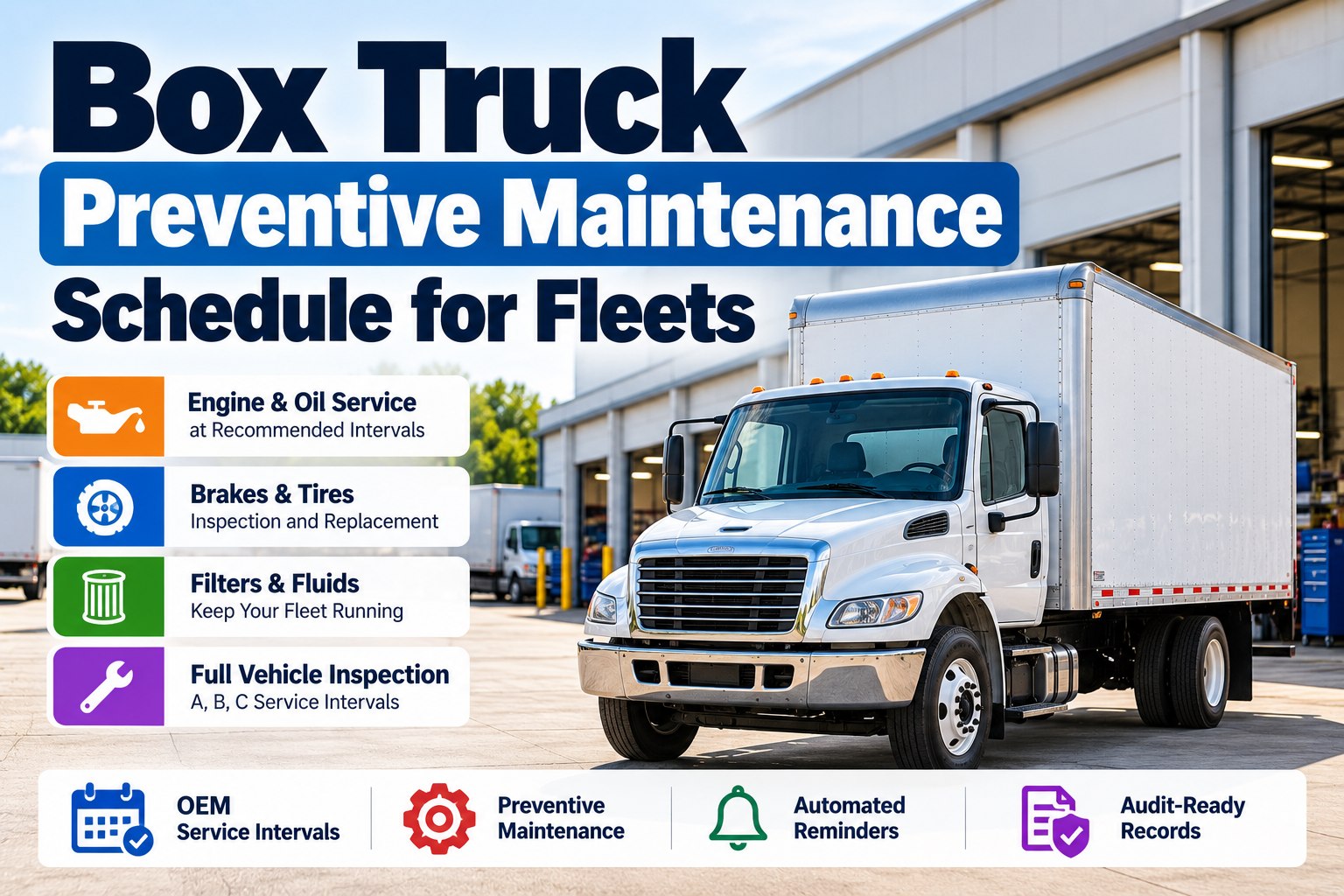
Box truck maintenance schedules are usually inherited from the chassis — the Isuzu, the Hino, the Freightliner underneath. That schedule is thorough, and it covers almost none of what actually stops these trucks. A box truck is stranded by its liftgate, its roll-up door and its body far more often than by its engine, and the liftgate in particular runs on a clock nothing else on the vehicle produces: the manufacturer specifies inspection quarterly or every 1,250 cycles, whichever comes first. No odometer counts cycles, and on a multi-drop route the gate reaches 1,250 long before the quarter does. The door and the body have no published schedule at all. Book a box truck review.
The Part That Strands You Is Not on the Schedule
Why the liftgate has its own interval measured in cycles, where that overtakes the calendar, what the published gate schedule actually asks for, and how to count cycles when nothing on the truck does it for you.
What Actually Stops a Box Truck
Worth ordering these by how often they end a day's work rather than by how much attention they get.
A truck with a healthy engine and a dead gate cannot deliver. It is the highest-consequence component on the vehicle and the one least likely to appear on a maintenance schedule.
Jams, broken springs, damaged panels and worn rollers. A door that will not open strands the load as completely as a breakdown does, and usually does it at a customer site.
Box trucks hit things that other trucks drive under. Roof and upper corner damage is common, often unreported, and lets water into a body that then rots from the inside.
The part every schedule covers thoroughly, and the one least likely to be what stopped the truck this week.
The ordering is deliberate. None of this means the chassis schedule is unnecessary — it means a maintenance programme built only from it leaves the three most common causes of a stranded delivery entirely unscheduled, which is why box truck fleets so often feel like they are maintaining diligently and still losing days.
The Liftgate Runs on a Third Clock
Miles and engine hours are the two clocks every fleet system knows about. The gate uses neither.
Each grid is the 1,250-cycle allowance between quarterly inspections, with every square representing 25 cycles. After a single month of work a truck averaging ten gate cycles a day has used around a quarter of it. One averaging forty — an ordinary multi-drop route where the gate goes up and down at most stops — has used nearly all of it. The calendar says it has two months to go.
Where the Count Overtakes the Calendar
The two limits cross at a specific rate, and knowing it tells you which of your trucks need watching.
1,250 cycles spread across a calendar quarter works out at roughly 19 cycles per working day. Below that rate the quarterly limit arrives first and a calendar-based schedule is adequate. Above it, the cycle limit arrives first — and because nothing counts cycles, the gate simply runs past its interval with no indication that it has. The same arithmetic applies to the annual limit, which is 5,000 cycles at the same roughly 19-a-day crossover.
That number is a useful sorting tool. A truck doing a handful of large drops is comfortably on the calendar. A parcel or food service route doing thirty to fifty stops is not, and those are exactly the trucks whose gates are working hardest and whose failures cost the most.
Do you know how many times your gates went up yesterday?
Almost nobody does, and it is the number the manufacturer's schedule actually runs on. In thirty minutes we will set up a cycle meter per truck, derive it from your stop data where no counter exists, and put the gate on the schedule beside the chassis.
What the Published Gate Schedule Asks For
Drawn from the manufacturer's own maintenance manual. Swipe the table sideways on mobile.
| Interval | What is checked or done |
|---|---|
| Quarterly or 1,250 cycles | Hydraulic fluid level in the pump reservoir; lines and fittings checked for chafing and leaks; grade of fluid recorded |
| Quarterly or 1,250 cycles | Loose or missing nuts, bolts, covers, roll pins, screws and pins; the whole gate checked visually for worn parts and broken welds |
| Quarterly or 1,250 cycles | Platform hinge pins for excessive wear; platform latch and transit hook mechanisms working correctly |
| Quarterly or 1,250 cycles | Warning and instruction decals present and legible; electrical wiring checked for chafing with connections tight |
| Annually or 5,000 cycles | Everything above, plus a hydraulic fluid change |
| Annually or 5,000 cycles | Clearance between main housing and the bottom of the flipover; wear on the slide pads |
Two things stand out. Most of the quarterly list is inspection rather than replacement, so it is cheap and quick — the cost of missing it is not the service, it is the failure it would have caught. And the annual item that matters most is the hydraulic fluid change, which on a gate that has been running past its cycle interval is arriving late on fluid that has already done more work than intended.
How to Count Cycles When Nothing Counts Them
Four practical options, in roughly descending order of accuracy.
Some gates are fitted with a cycle counter. If yours are, reading it at every service turns the interval from an estimate into a number.
Your delivery or dispatch system already knows how many stops each truck made. One gate cycle per stop is a reasonable starting assumption, and a conservative one for routes where the gate goes up and down more than once.
On the highest-utilisation trucks, a counter costs less than one unplanned gate failure at a customer site and removes the guesswork entirely.
If none of the above is practical, move the high-utilisation units from quarterly to every six or eight weeks and record why. An interval chosen deliberately beats one inherited by default.
The second option is the one most fleets can act on immediately, because the data already exists in a different system. If dispatch knows a truck made 38 stops, you have a usable cycle estimate for that day without fitting anything to anything.
The Door and the Body Have No Schedule at All
At least the gate comes with a published interval. The rest of the box generally does not.
A roll-up door is a spring-loaded mechanism with rollers, tracks, hinges and a counterbalance that is under tension the whole time it exists. It gets opened and closed more times per day than almost anything else on the truck, usually by someone in a hurry, and it fails gradually — stiffer, then noisy, then stuck. The driver using it every day knows weeks before anybody else does, which only helps if there is somewhere for them to report it.
The body itself is mostly a question of water. Roof and upper corner strikes let water in, and a box that is wet inside degrades its floor and its structure quietly over a season. Nobody inspects a roof during a chassis PM because the roof is not part of the chassis, and the damage is above eye level.
Neither of these needs an elaborate programme. A door operation check and a look at the roof and upper corners, added to whatever inspection the truck already receives, catches most of it — but it has to be written into the inspection, because a technician working from a chassis checklist will not do it otherwise.
Why Gate Failures Cost More Than They Should
A point about where these failures happen, which is what makes them disproportionately expensive.
An engine problem usually gives warning and usually happens somewhere you can deal with it. A gate fails at a stop, with a load on board and a customer waiting, and there is no workaround — you cannot hand-ball a pallet off a truck with no tail lift. The driver waits, the route stops, and the remaining drops become somebody else’s problem that afternoon.
The repair itself is usually modest. A seal, a hose, a solenoid, a worn pin. These are the failures that a quarterly inspection exists to catch, and they are exactly the ones that develop quietly over a few thousand cycles. The gap between the cost of the inspection and the cost of the failure it prevents is wider on a liftgate than on almost anything else on the vehicle.
Intervals vary by gate manufacturer and model, so the figures above are the published schedule for one common range rather than a universal standard. The manual for your specific gates is the authority, and it is worth checking whether yours are stated in cycles at all — some are, some are not, and knowing which you have changes how you schedule them.
How FleetRabbit Handles This
Four things, built on the fact that this vehicle has three clocks and only two of them are standard.
The liftgate interval runs on a count nothing else on the truck produces. FleetRabbit holds it as its own meter so the gate falls due on the limit that actually applies.
Door, hinges, seals, floor and roof live on the vehicle rather than in a separate note, so a reported defect attaches to the unit and reaches the schedule.
Hydraulic levels, fasteners, welds, hinge pins and decals as individual checks rather than one line reading “liftgate serviced”, which is what makes a history usable later.
A door that is getting harder to lift is the earliest warning you will get, and it comes from the person using it every day.
Questions Box Truck Fleets Ask
How often should a liftgate be serviced?
The manufacturer's schedule is quarterly or every 1,250 cycles, whichever occurs first, with an annual or 5,000-cycle service that adds a hydraulic fluid change. The cycle limit is the one most fleets never check because nothing counts it. Check Your Gate Intervals.
What counts as a cycle?
One raise and lower of the platform. On a multi-drop route that is usually at least one per stop, sometimes more where a load comes off in stages, so a stop count is a reasonable and slightly conservative proxy. Start Counting Cycles.
At what point do cycles matter more than the calendar?
Around 19 cycles per working day, which is where 1,250 cycles and a calendar quarter land together. Below that the quarterly schedule covers you; above it the gate is running past its interval between visits. Sort your fleet by rate.
We do not have cycle counters. What now?
Derive it from stops using the data your dispatch system already holds, or shorten the calendar interval on the busiest trucks and record why you did. Fitting counters is worth it on the highest-utilisation units. Set it up from stop data.
What does the quarterly gate inspection actually involve?
Hydraulic fluid level, lines and fittings for chafing and leaks, loose or missing fasteners, a visual check for worn parts and broken welds, hinge pins, the latch and transit hook, wiring, and that the warning decals are legible. Mostly inspection, so it is quick. Add it to the schedule.
Does the roll-up door need scheduled maintenance?
There is rarely a published interval, which is not the same as it needing nothing. An operation check and a look at rollers, tracks and the counterbalance belongs in whatever inspection the truck already gets, because a door that will not open strands the load. Schedule the Body Items.
Why does body damage matter if it is only cosmetic?
Because roof and upper corner strikes let water in, and a box that is wet inside degrades its floor and structure over a season. The damage is above eye level and gets missed during a chassis-focused inspection. Put the roof on the list.
Can the gate sit on the same system as the truck?
It should, with its own meter. Cycles alongside miles and hours on one maintenance record is what makes a gate interval something that falls due rather than something somebody remembers. Start Free on Three Trucks.
Schedule the Whole Truck, Gate Included
FleetRabbit runs cycles as a meter beside miles and hours, holds the gate, door and body on the same record as the chassis, records gate findings as individual checks, and gives the driver a route to report a door that is getting harder to lift.