A preventive maintenance schedule is a written plan that says which service each truck gets, when it is due and what the technician must do at that visit. Building one takes seven steps: inventory the fleet, pull the history, start from the OEM, define the service tiers, choose the triggers, adjust for duty cycle and then schedule, stage and record. This guide walks through each step and shows where fleet software takes over the tracking. Schedule a call to build your PM schedule with us.
PM PROGRAM SETUP · FLEET MANAGERS AND SHOP LEADS
Seven Decisions Turn a Pile of Service Records Into a Schedule That Runs Itself
Start with the maker's intervals, bend them to how each truck really works, and write every tier down so the shop does the same job every time.
WHICHEVER COMES FIRST, PER UNIT
MilesHighway units
Engine hoursIdle-heavy units
CalendarLow-use units
Pick the trigger that matches how the truck works.
The Seven Steps to a Fleet PM Schedule at a Glance
Each step feeds the next, so do them in order the first time through
1
Inventory every unit
List each truck and trailer with year, make, model, VIN, class and in-service date, and name one owner for the list.
2
Pull the service history
Gather dates, meter readings, vendors, parts and costs, and look for repeat failures and costly systems.
3
Start from the OEM
Use the manufacturer manual and warranty terms as the baseline for each engine and chassis.
4
Build the A, B and C tiers
Write down exactly what each tier covers so every technician does the same service.
5
Choose the trigger
Set mileage, engine hours or calendar for each unit, whichever comes first.
6
Adjust for duty cycle
Shorten intervals for severe service, and refine them with your own data.
7
Schedule, stage and record
Put it on a calendar with buffer, stage parts and bays, and record every service on the unit.
A schedule you can follow beats an ideal one that lives in someone's head
Intervals vary by OEM, truck class and duty, so there is no single schedule to copy. The seven steps give you a repeatable way to arrive at yours, and to revise it as your own data comes in.
Steps 1 to 3: Know the Fleet, Its History and the OEM Baseline
Step 1 and 2: Inventory every unit and gather what has already been done to it
Step 1. Fleet inventory
Year, make, model, VIN and plate
Asset class and in-service date
Assigned driver or home location
One named owner who keeps the list current
Step 2. Service history
Date, service type and vendor
Meter reading at each service
Parts used and cost
Repeat failures and the costliest systems
Step 3: Start from the OEM, and note that makers do not agree with each other
Use the manufacturer manual and warranty terms to set each unit's baseline, then adjust for age, climate and usage. One guide lists the A, B and C baselines below, which show how far apart the makers can be.
Peterbilt and KenworthOEM baseline, miles
A12,500
B25,000
C50,000
VolvoOEM baseline, miles
A20,000
B40,000
C60,000
International, Mack and FreightlinerOEM baseline, miles
A15,000
B30,000
C60,000
Steps 4 and 5: Define the A, B and C Tiers and Choose What Triggers Them
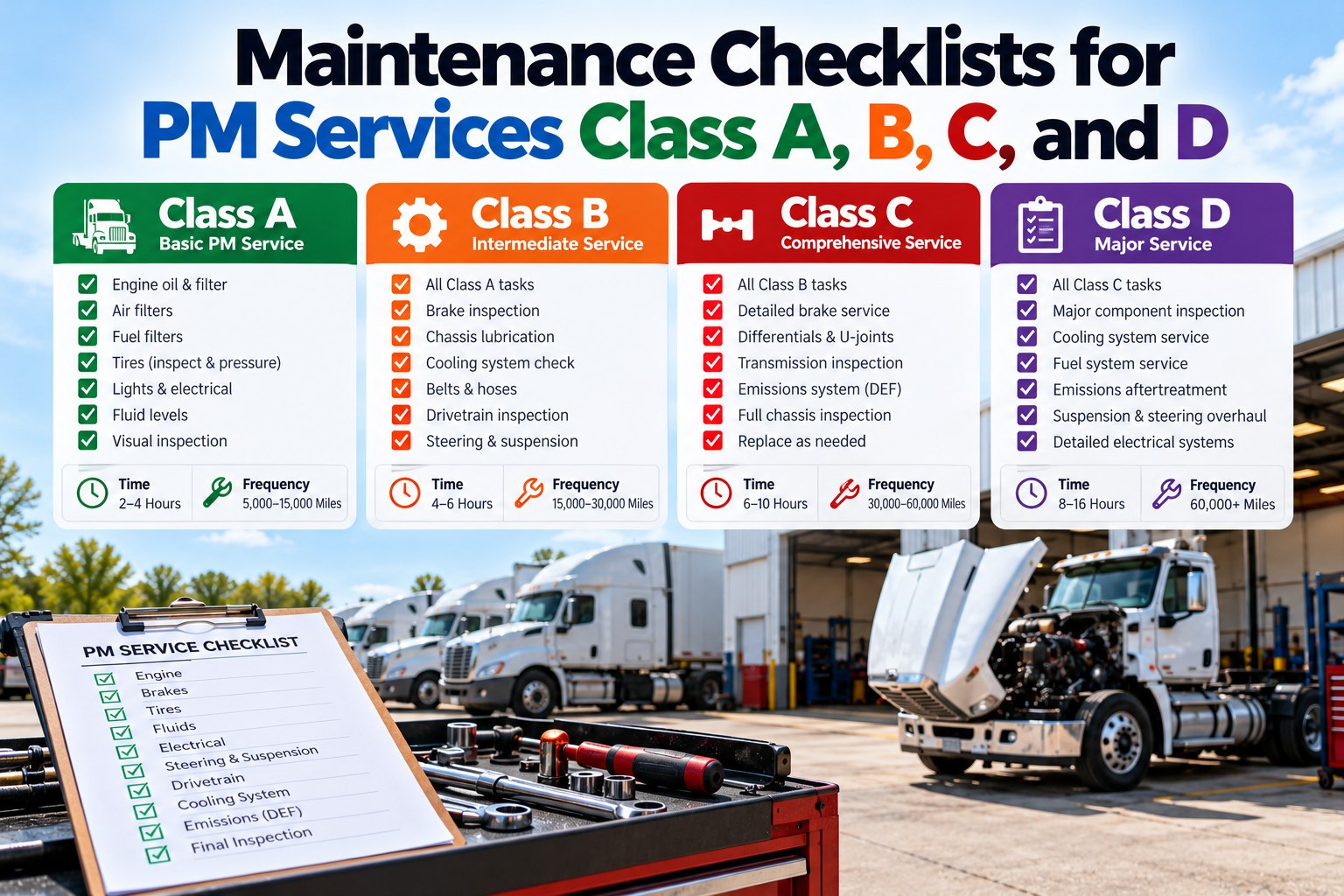
Step 4: Three nested tiers keep the work consistent, and each one includes the one below
PM-A · LIGHT
10,000 - 15,000 mi
Oil and filter change, chassis lube, fluid top-offs, tires, lights and a visual brake and safety check.
PM-B · INTERMEDIATE
25,000 - 30,000 mi
Adds fuel filter, belts and hoses, driveline and U-joints, steering, and measured brake wear.
PM-C · MAJOR
50,000 - 60,000 mi, or annually
Adds transmission and differential service, coolant and brake fluid, alignment check and a full driveline and suspension review.
TYPICAL PM TIER INTERVALS, MILES. PURPLE IS A, B AND C, AMBER IS THE OPTIONAL OVERHAUL TIER
PM-D, optional overhaul
100k+ mi
Step 5: Match the trigger to the duty, and set it to whichever threshold arrives first
Mileage
BEST FOR HIGHWAY TRACTORS
Odometer readings track wear on trucks that run steadily.
Engine hours
BEST FOR IDLE-HEAVY AND VOCATIONAL
Often set at about 400 to 600 hours, because miles understate the work an idling engine does.
Calendar
BEST FOR LOW-USE AND SEASONAL
Keeps fluids and seals serviced when the truck barely moves.
Trailers usually run on their own schedule, with one guide suggesting every three months regardless of mileage. The DOT annual inspection runs on its own 12-month clock, independent of mileage-based PM, so track it separately for each vehicle.
Have the OEM manuals but no schedule? Schedule a call and we will set the tiers up together.
Bring one truck class, and leave with tiers, triggers and reminders on every unit.
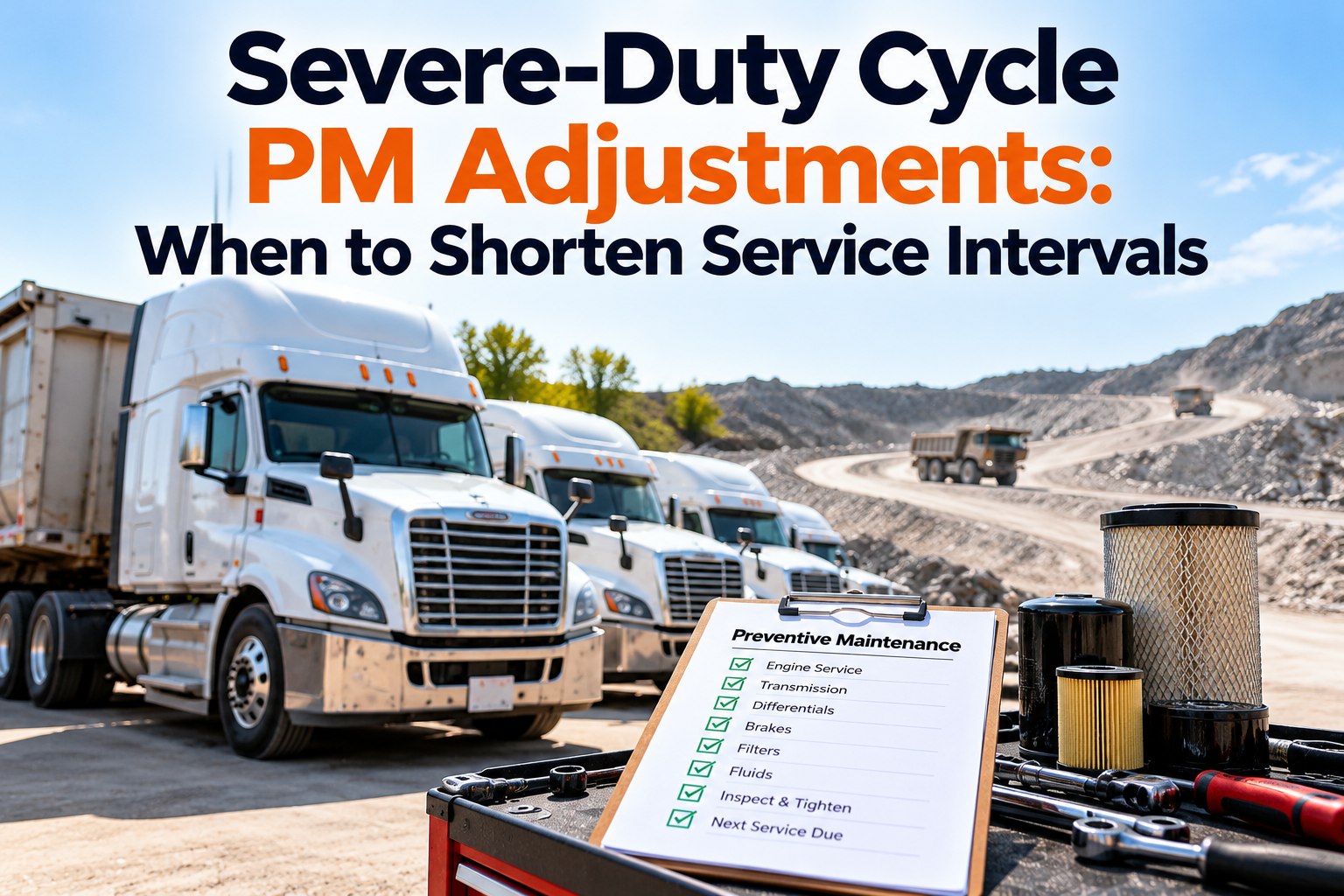
Step 6: Adjust the Schedule for Duty Cycle and Severe Service
Six conditions can justify shorter intervals than the manual's baseline
Severe-duty factors
Dust and debris
Extended idling
Short or stop-and-go trips
Heavy loading
Temperature extremes
Mountain terrain
Shorten intervals by roughly 15 to 30 percent, then let your own data correct the number
Published guidance ranges from 15 to 20 percent to 15 to 30 percent for severe duty, and it is a guideline rather than a measured rule. Oil analysis, brake-wear trends and inspection findings tell you whether to shorten further or relax. The chart shows what the range does to a 15,000-mile A interval.
EXAMPLE: A 15,000-MILE PM-A INTERVAL AFTER A SEVERE-DUTY ADJUSTMENT
Standard A interval
15,000 mi
Severe duty, 15% shorter
12,750 mi
Severe duty, 30% shorter
10,500 mi
Step 7: Put the Schedule on a Calendar, Stage Parts and Record Every Service
A schedule only works once it has dates, bays, parts and a record behind it
Calendar with buffer
Map intervals to dates, stagger similar units, and account for shop capacity and technician availability. Scheduling the annual inspection at 11 months leaves a 30-day buffer.
Parts staged ahead
Forecast parts from the PM calendar and stage kits before each service, so a truck is not waiting on a filter.
Record on the unit
Log the meter reading, work done, parts and cost on that truck, so the next due date is calculated from facts.
How Fleet Management Software Automates the PM Schedule
Spreadsheets hold the plan, and software runs it when the odometer moves
Spreadsheet or paper
!Spreadsheets and calendars do not know the odometer changed
!Paper logs hide missed services until an inspection
!Each tier is remembered, not written down
!Overdue units are found by walking the yard
Fleet maintenance software
✓Meter readings trigger the next PM on each unit
✓Each tier is a template with its tasks listed
✓Work orders carry parts, labor and cost
✓Overdue and due-soon units are listed in one place
Set up the tiers once, and let reminders carry the schedule from there
FleetRabbit takes the intervals you chose in steps 3 to 6 and turns them into recurring PM schedules per unit. When a driver reports a defect on a DVIR, it becomes a work order against the same truck, so repairs and PMs sit on one record. FleetRabbit is free for up to 3 vehicles and $5 per vehicle per month after that.
PM Schedule Readiness Checklist for Fleets
If every box is ticked, your schedule is ready to run
Steps 1 to 5
Every unit is on the asset list with VIN and class
Service history is gathered for each unit
OEM intervals are recorded per engine and chassis
Each tier has a written task list
Every unit has a trigger and a backup trigger
Steps 6 and 7
Severe-duty units have shortened intervals
The DOT annual inspection is tracked on its own 12-month clock
Parts kits are staged before each tier
Every service is recorded with the meter reading
Overdue PMs are reviewed on a fixed day each week
Build a Fleet PM Schedule That Runs Itself: Set Up PM Tiers, Triggers and Reminders in FleetRabbit
FleetRabbit turns your A, B and C tiers into recurring PM schedules for every truck and trailer, triggered by miles, engine hours or the calendar. Reminders go out before a unit is due, DVIR defects become work orders, and every service stays on that unit's record.
PM tiers per unit
Mileage, hour and date triggers
DVIR defects to work orders
Service history per truck
Frequently Asked Questions
Quick answers on building a fleet preventive maintenance schedule
What are the steps to build a PM schedule?
Inventory the fleet, pull the service history, start from OEM intervals, define the A, B and C tiers, choose mileage, hour or calendar triggers, adjust for duty cycle, then schedule, stage parts and record every service.
How often should a truck get a PM service?
Typical guides place PM-A at about 10,000 to 15,000 miles, PM-B at 25,000 to 30,000 and PM-C at 50,000 to 60,000 or annually. Always check the OEM manual for your engine and chassis.
Should I use miles, hours or calendar days?
Use miles for highway tractors, engine hours for idle-heavy or vocational trucks and the calendar for low-use units. Set each unit to trigger on whichever comes first.
How much should I shorten intervals for severe duty?
Guides suggest roughly 15 to 30 percent for dust, idling, stop-and-go, heavy loads, extreme temperatures or mountains. Refine it with oil analysis and inspection findings.
How does the DOT annual inspection fit in?
It runs on its own 12-month clock regardless of mileage. Many fleets align it with a PM-C, and scheduling it at 11 months leaves a buffer.
Do I need software to run a PM program?
Not to start, but spreadsheets cannot track meter readings or send reminders on their own. Software does, and keeps the history for each unit.
What does FleetRabbit cost?
Turn Your PM Schedule Into Reminders: Put Every Unit's Tiers and Triggers on Record
A schedule on paper is a good start. A schedule that reminds you before each unit is due, and records what was done, is a PM program. Set up the tiers once and let the system keep the dates.
Free tier for up to 3 vehicles · No credit card required · Tiers and history stored per unit
October 12, 2026By Emily Parker
All Blogs