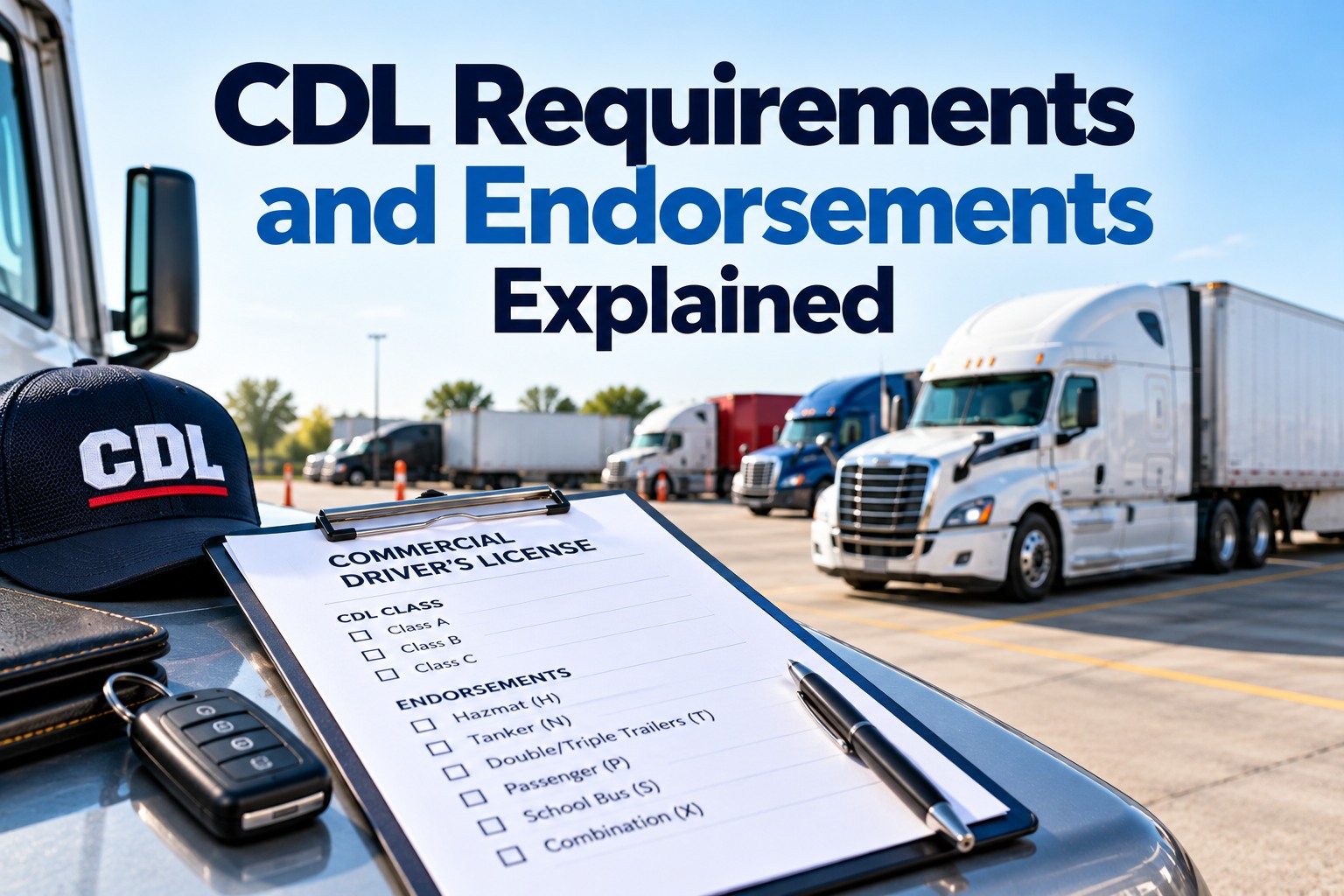
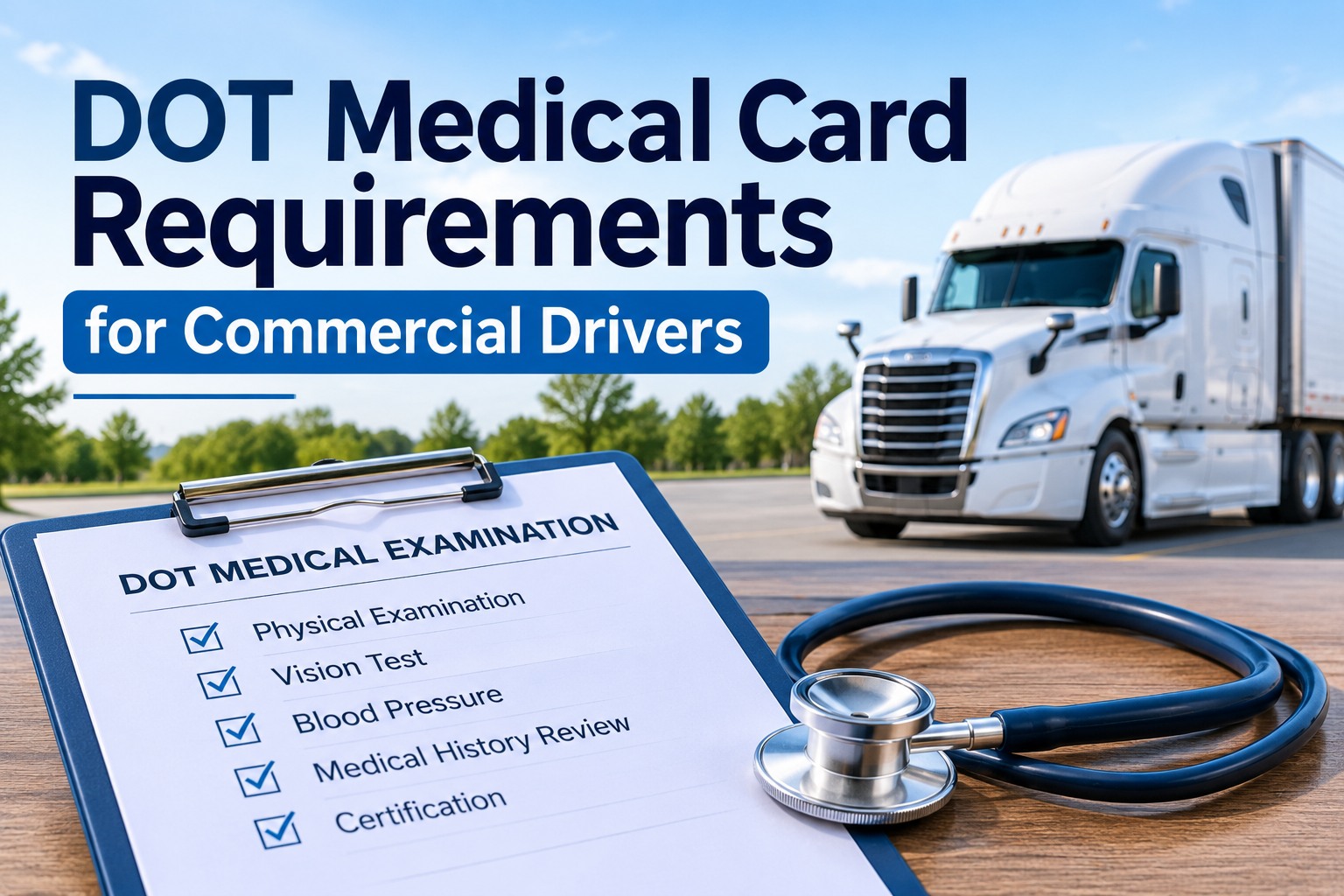
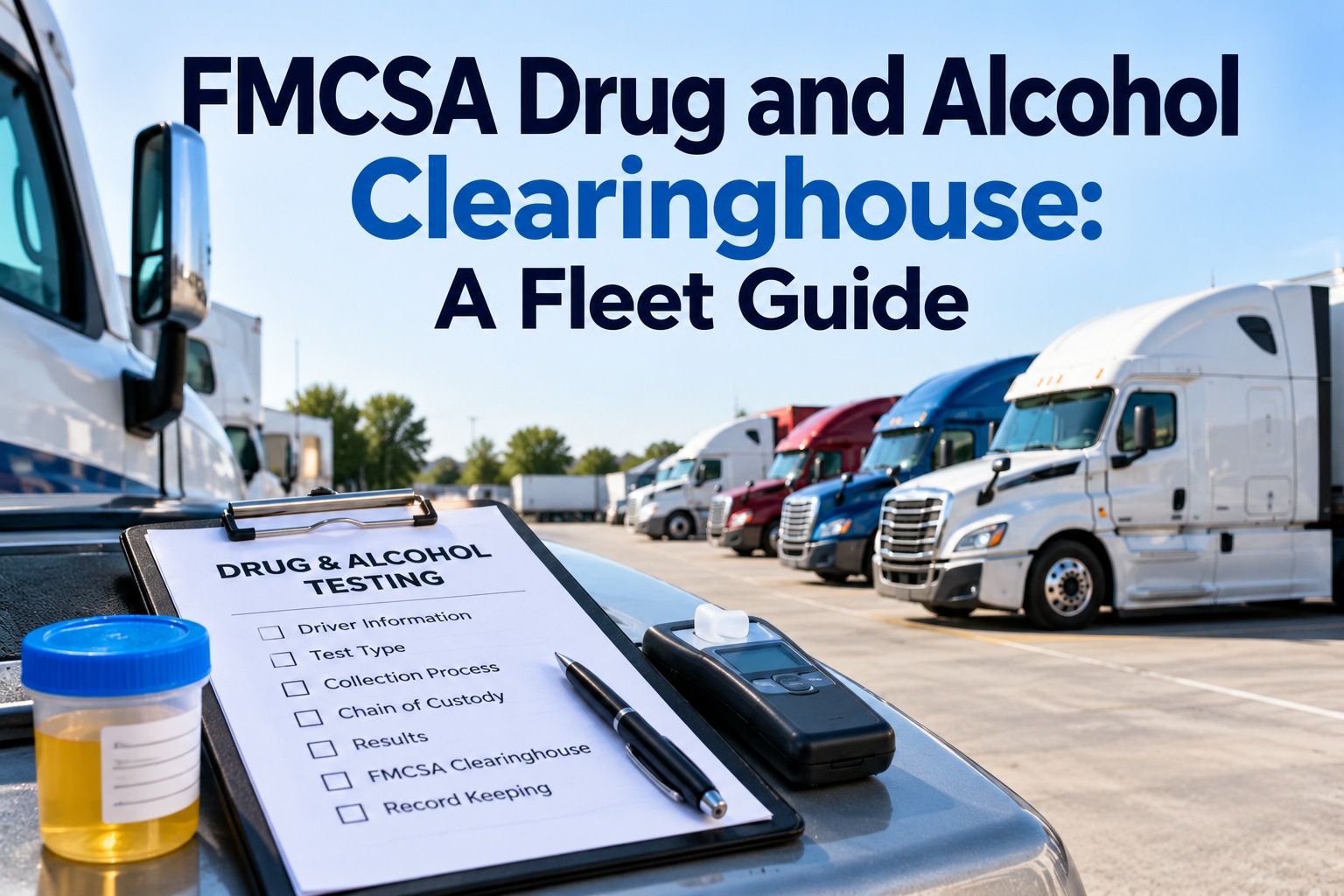
A CDL is more than a class letter. What a driver may actually operate depends on three things printed on the license: the class, the endorsements and the restrictions. A Class A driver with an L restriction can’t take an air-brake tractor out of the yard. A driver without an N endorsement can’t pull a tank trailer, even an empty one. This guide covers the three CDL classes, each endorsement and restriction, which combination your tractors, trailers and chassis need, how drivers get licensed, what changed in 2025 and 2026, and a checklist you can use as a template. To see how FleetRabbit keeps driver and truck records together, book a short demo with our team.
CDL requirements · endorsements · restrictions
Class, endorsements, restrictions: three lines on a license decide which truck a driver can take
Commercial driver license
Representative · sample
Can drive: tractor with a tank trailer, or doubles. Not hazmat.
Class A, B or C: what each license covers, by weight and use
The class comes from the vehicle’s weight rating and what it tows. Weight ratings, not the actual load on the day, decide the class.
Commercial driver license
Class A
Combination vehicles
GCWR of 26,001 lb or more, towing a unit over 10,000 lb
Tractor-trailers, tankers, flatbeds, container chassis rigs
Commercial driver license
Class B
Heavy single vehicles
GVWR of 26,001 lb or more, towing 10,000 lb or less
Straight trucks, dump trucks, box trucks, large buses
Commercial driver license
Class C
Small special vehicles
Below Class A and B, but carrying 16+ people or placarded hazmat
Small hazmat trucks, passenger vans
A higher class covers the lower ones, as long as the driver holds the endorsements the vehicle needs. A Class A driver can drive a Class B straight truck, but not the other way round.
Four questions that settle which class a vehicle needs
Work down the list and stop at the first yes. This is where pickups with heavy equipment trailers often catch fleets out.
Is the combination 26,001 lb or more, towing a unit over 10,000 lb?
Yes →
Class A
Is the single vehicle 26,001 lb or more?
Yes →
Class B
Does it carry 16+ people, or placarded hazardous materials?
Yes →
Class C
None of the above
Then →
No CDL, but a medical card may still apply
The six CDL endorsements, letter by letter
Endorsements add permission for a specific kind of vehicle or load. Each needs its own test, and some need more.
H
Hazardous materials
Knowledge test, TSA security threat assessment and fingerprints, and ELDT for a first-time endorsement
N
Tank vehicle
Knowledge test; for liquid or gas tanks of 1,000+ gallons, or 119+ gallons per tank
X
Tank and hazmat
Combines H and N: both knowledge tests and the TSA assessment
T
Double and triple trailers
Knowledge test; Class A only. Triples are allowed only in some states
P
Passenger
Knowledge and skills tests, plus ELDT; for 16 or more occupants
S
School bus
Knowledge and skills tests in a school bus, plus ELDT; requires P
Hazmat endorsements have their own renewal cycle tied to the TSA assessment, which is separate from the license expiry. That second date is easy to lose.
Eight restriction codes, and the one that keeps drivers off air-brake tractors
Restrictions are usually the result of how the skills test was taken. They limit the license, and a driver can remove most of them by retesting in the right vehicle.
Know every driver’s class, endorsements and expiry dates before you assign the next load
A 20-minute look at driver credential records next to each tractor, trailer and chassis, and what to confirm for your fleet.
Which class and endorsements your tractors, trailers and chassis need
Here are common equipment setups and the license each needs. Always check the weight ratings on the actual units.
| Equipment | Class | Endorsement | Watch for |
|---|
| Tractor with a dry van or reefer trailer | A | None | No restriction O; no L if the unit has air brakes |
| Tractor with a tank trailer | A | N | X if the load is placarded hazmat |
| Tractor pulling doubles | A | T | N or X too if either trailer is a tank |
| Tractor with an intermodal container chassis | A | None for general freight | H if the container carries placarded hazmat |
| Straight truck with a liftgate, 26,001 lb+ | B | None | E if the driver tested in an automatic |
| Straight fuel truck | B | N, usually X | TSA threat assessment for X |
| Pickup towing a 12,000 lb equipment trailer, GCWR 26,001 lb+ | A | None | Often missed: the trailer weight makes it Class A |
The license has to match the unit on every trip. The unit’s inspection records belong in the same file: a digital DVIR app shows which tractor and trailer the driver inspected, and when.
Checking a driver’s license at hire, every year, and before each new assignment
Carriers don’t just file a copy of the license once. At hire, the driver qualification file needs a driving record from every state the driver held a license in over the past three years. Every year after that, the carrier must get a new driving record and review it, and keep a signed note of the review. Between those checks, the risk is in the assignment, not the license: a driver hired for dry vans is moved onto a tank trailer, or a driver with an O restriction is covering for someone on a tractor. A simple rule closes the gap. Before a driver takes a unit type they haven’t driven for you before, someone checks the class, endorsements and restrictions against that unit, and notes it in the file. The same moment is a good time to walk the driver through the inspection checklist for that unit, because a tanker or a set of doubles has items a van doesn’t.
From permit to license: the five-step path for a new driver
Since 7 February 2022, first-time Class A and B applicants, and drivers adding P, S or H for the first time, must complete entry-level driver training before testing. Drivers must be 21 to drive across state lines, or 18 within one state.
1
Knowledge tests
General knowledge, plus air brakes and combinations for Class A
2
Learner’s permit
A CLP, held for at least 14 days before the skills test
3
Entry-level training
Theory and behind-the-wheel training from a provider on FMCSA’s Training Provider Registry
4
Skills test
Pre-trip inspection, basic control and on-road test in the vehicle class
5
CDL issued
With any endorsements and restrictions earned
The skills test includes a full vehicle inspection. Drivers who learn the pre-trip on the units they’ll drive, with the same checklist used every day, are better prepared for both the test and the job.
What changed for CDLs in 2025 and 2026
Several federal changes affect who can hold a CDL and how drivers are tested. Check your state licensing agency for how each applies to your drivers.
Mar 2026
Non-domiciled CDLs restricted
A final rule limits non-domiciled CDLs to holders of certain visa categories, with documents checked through SAVE. FMCSA estimates about 194,000 current holders won’t be able to renew over five years.
2026
English-only CDL testing
FMCSA has announced that CDL knowledge and skills tests will be given only in English, as reported in May 2026.
2025 to 2026
Training provider clean-up
FMCSA removed nearly 3,000 providers from the Training Provider Registry after more than 1,400 on-site inspections.
Nov 2024
Clearinghouse-II downgrades
States remove CDL privileges from drivers in prohibited drug and alcohol status.
A CDL and endorsements checklist you can use as a template
License class matches every unit the driver is assigned
Endorsements match the loads: tank, hazmat, doubles
Restrictions checked against the equipment: air brakes, manual transmission, fifth wheel
Hazmat endorsement renewal and TSA assessment dates tracked
License expiry date tracked, and the license copy in the file
Medical status confirmed on the driving record
Annual driving record review completed and signed
Clearinghouse query on file for the past 12 months
ELDT completion shown on the record for new entry-level drivers
Road test or license accepted in place of it, filed at hire
Driver files and vehicle files are checked together in an audit. Keeping each unit’s preventive maintenance schedule and repair history current covers the vehicle side.
Where FleetRabbit fits a CDL compliance program
Documented on fleetrabbit.com
Digital DVIRs with photos, signatures and mechanic sign-off
Preventive maintenance and work order history
Hours-of-service data from ELD providers for dispatch
Credential tracking with expiry alerts, on FleetRabbit’s transit pages
Confirm in a demo
How credential alerts work for a truck fleet
Tracking hazmat endorsement and TSA renewal dates
Matching drivers to units by class and endorsement
FleetRabbit for truck, trailer and chassis fleets
The right driver on the right unit, with the records to prove it
Driver side
Credentials and hours
License, endorsement and medical expiry dates, and ELD hours for dispatch.
+
Vehicle side
Inspections and maintenance
DVIRs, defects, repairs and service schedules for every unit.
CDL requirements and endorsements questions
What are the three CDL classes?
Class A for combinations of 26,001 lb or more towing over 10,000 lb, Class B for single vehicles of 26,001 lb or more, and Class C for smaller vehicles carrying 16 or more people or placarded hazardous materials.
Which CDL endorsements do truck drivers need most?
N for tank vehicles, H for hazardous materials, X for both, and T for double and triple trailers. Most general freight drivers on a dry van or container chassis need none.
What does the L restriction mean?
The driver can’t drive a commercial vehicle with air brakes, usually because they took the skills test in a vehicle without them. Most tractors have air brakes, so it matters.
How do you get a hazmat endorsement?
Pass the hazmat knowledge test, complete a TSA security threat assessment with fingerprints, and, for a first-time endorsement, complete entry-level driver training theory.
What is entry-level driver training?
Since 7 February 2022, first-time Class A or B applicants, and drivers adding P, S or H for the first time, must complete training from a provider on FMCSA’s Training Provider Registry before testing.
Can a CDL driver with an O restriction drive a tractor-trailer?
No. The O restriction means the driver tested without a fifth-wheel tractor-trailer, so they can’t drive one until the restriction is removed.
Does FleetRabbit track CDL and endorsement expirations?
A FleetRabbit transit page describes credential tracking with expiry alerts to drivers and the safety office. Confirm how it works for your truck fleet in a demo; matching drivers to units by endorsement isn’t described.
Put every driver on a unit their license actually covers
Track the class, the endorsements and every expiry date, next to the trucks they drive.
October 21, 2026By Alex Rowan
All Blogs