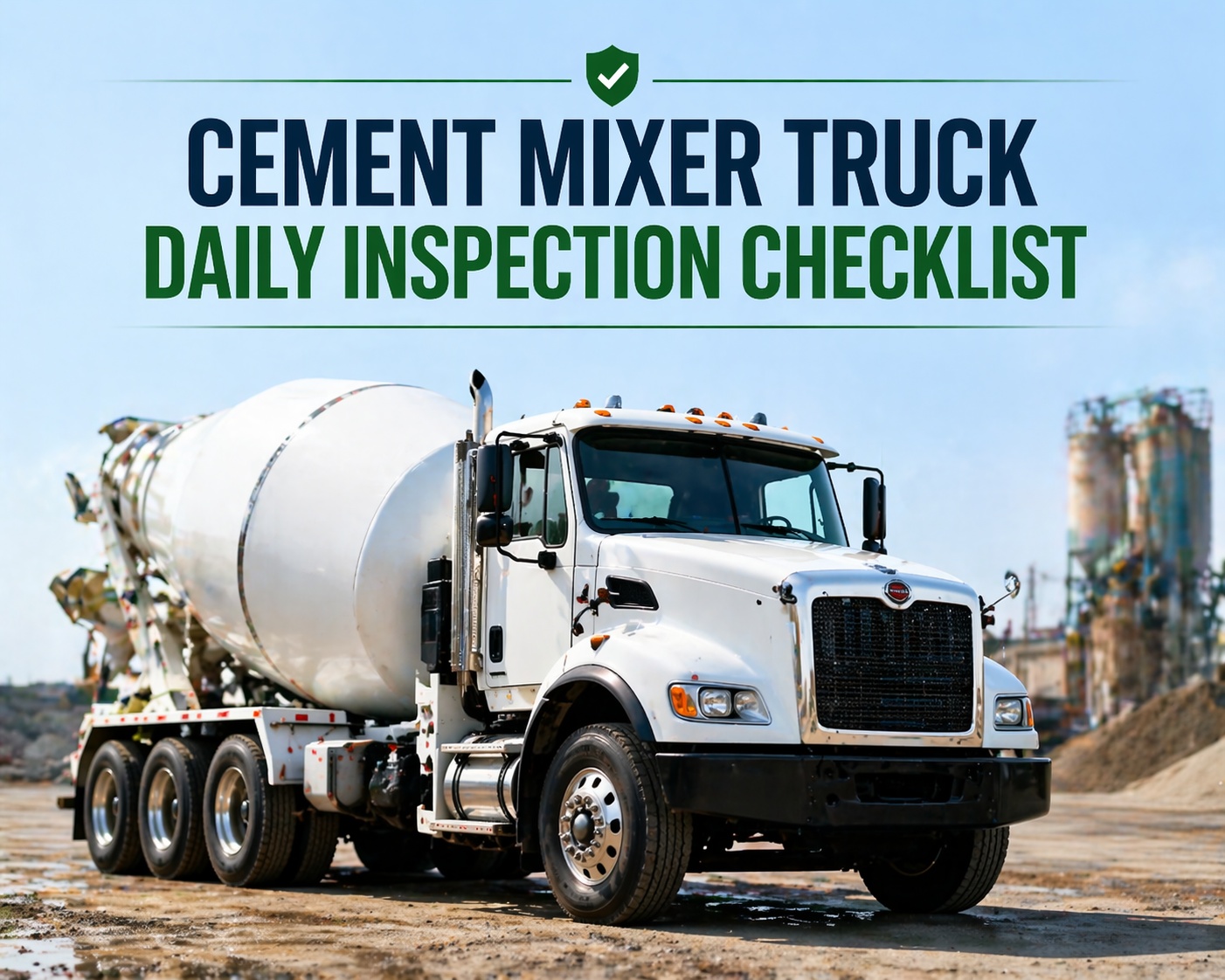
A cement mixer truck is two pieces of equipment bolted together — a Class-8 highway tractor and a continuously-rotating 10-cubic-yard concrete vessel — and the daily inspection has to cover both without compromise. A missed hydraulic leak becomes a transmission failure. An unchecked drum bearing becomes a $45,000 drum replacement with three weeks of downtime. An overlooked mudflap becomes a DOT citation and a 1-point CSA hit. And the one thing every profitable ready-mix operator has in common: a structured, repeatable, 42-point pre-trip checklist that gets done the same way every morning, on every truck, by every driver — documented, timestamped, and defensible. This guide gives you the exact 42-point inspection framework used by 500+ ready-mix operators, organized by system, with measurement specs, pass/fail criteria, and the DOT items that keep you off the shoulder and out of the out-of-service column.
42 Points. 9 Systems. Every Truck. Every Morning.
From drum bearings to PTO engagement, hydraulic pressure to chute lock — this is the complete pre-trip inspection checklist for ready-mix cement mixer trucks. Built around 49 CFR 396.11 DOT requirements plus mixer-specific failure modes.
Why a Structured Daily Checklist Is Non-Negotiable
Cement mixer trucks live harder lives than almost any other commercial vehicle. Continuous drum rotation on the highway plus hours of stationary mixing at the pour site, plus abrasive concrete exposure, plus heavy axle loads — all compounding wear patterns that show up as catastrophic failures if you are not watching for them daily. The cost of skipping an inspection is measured in numbers most owners prefer not to see.
The Complete 42-Point Cement Mixer Daily Inspection Checklist
Work through the list in order — each system builds on the last. Any defect flagged should immediately generate a work order before the truck is dispatched. No exceptions, no "I'll check it after the first run."
Turn This Paper Checklist Into a Digital Workflow
Every point, every truck, photo-verified, GPS-stamped, auto-work-ordered on defect. Zero paper. Zero lost forms. 100% audit-ready.
Every point verified, every defect flagged — the driver signs off, the fleet manager approves, the work order closes or opens the loop. See How Digital Checklists Auto-Generate Work Orders →
Top 5 Failure Patterns This Checklist Prevents
Every point on the 42-item list traces back to a specific failure mode that shows up in ready-mix fleets with expensive regularity. Here are the top five — and exactly which inspection points catch each one before it becomes a repair bill.
Hardened concrete inside drum exceeds 2 inches, throws rotation out of balance, destroys bearings, cracks drum shell. Caught by: Points 28, 29, 30.
Chafed or bulging hose lets go at 2,800 PSI, coats site + crew with hot fluid, drum stops mid-load. Caught by: Points 32, 33, 34.
PTO engages under load without proper seat, shears splines or cooks clutch pack during stationary mixing. Caught by: Points 36, 37.
Missing mudflap, failed brake light, worn tire tread, expired registration — each one a 1–2 point Vehicle Maintenance BASIC hit. Caught by: Points 5, 8, 23, 25.
E-stop fails the 2-second shutdown test during CVSA inspection; truck placed out-of-service on the spot. Caught by: Point 35.
How to Run This Checklist Efficiently (12 Minutes, Every Morning)
A 42-point inspection sounds daunting until you do it three times. The trained driver runs the whole flow in about 12 minutes using this sequence. The order matters — each step positions you for the next without backtracking.
Start inside the cab. Document check, dash test, reflective tape walk-around. Sets up the rest of the inspection.
Need a helper or a reflection. Signal test with a rag on the pedal or a buddy; clearance lights at night.
Engine off, cold. Hood up. All fluids checked before you crank the engine for brake + hydraulic tests.
Engine running. Air build, leak test, parking brake, then PTO engagement while air still up.
Exterior walk. Tires first, then drum, then hydraulic system. This is where mixer-specific knowledge pays.
Chute deployment test, water pump, safety gear, signage. Digital sign-off timestamps the complete inspection.
Digital vs Paper: Why Every Ready-Mix Fleet Is Switching
Paper checklists are the industry default for one reason: inertia. The moment a ready-mix operator switches to digital, the differences are obvious and immediate. Here is the full side-by-side.
| Capability | Paper Checklist | Digital Inspection App |
|---|---|---|
| Inspection enforcement | Driver can skip points quietly | Mandatory fields — cannot submit until complete |
| Defect photo proof | None — written description only | Photo-required on every defect, GPS + timestamp locked |
| Work order creation | Driver tells shop, shop forgets | Auto-generated work order, prioritized, visible instantly |
| Audit documentation | Filing cabinet, often lost | Cloud-archived, searchable, export in 30 seconds |
| Trend analysis | Impossible — no dataset | MTBF per truck, defect patterns, driver compliance by name |
| Cost per inspection | Paper, printing, filing, labor | One software subscription, unlimited inspections |
On a 20-truck ready-mix fleet, the switch from paper to digital typically saves 15–20 hours/week in administrative time and catches 30–40% more defects before they become breakdowns. Book a Demo to See the Digital Inspection App Live →
How Fleet Rabbit Digitizes This 42-Point Inspection
Fleet Rabbit turns this entire checklist into a mobile-first workflow built specifically for ready-mix operations. Drivers complete it on a phone or tablet in under 12 minutes; defects auto-generate work orders; photos and timestamps create a defensible audit trail. Here is what you get when the paper checklist becomes software.
The 42-point cement mixer inspection comes pre-built — every system, every point, every spec already configured. Customize thresholds per truck or use industry defaults.
On any defect flag — cracked hose, drum buildup, hydraulic leak — the app requires a photo before submission. GPS + timestamp lock the evidence.
Flagged defects instantly create prioritized work orders visible to the shop. Cracked hydraulic hose = critical, burnt-out turn signal = standard — each routed automatically.
Pour sites and yard corners often have dead zones. Inspections complete offline and sync automatically when connectivity returns — no data loss.
90 days of inspection records available as a single PDF export in under a minute. DOT calls? You have everything they want before the end of the call.
See defect trends across the fleet. Truck 7 keeps flagging the same hydraulic hose? Truck 12's drum bearing is failing quarterly? The data surfaces patterns paper never could.
Frequently Asked Questions
A trained driver completes the full 42-point inspection in approximately 12 minutes using the workflow sequence above. First-time inspectors may take 20–25 minutes, but efficiency builds quickly with daily repetition.
Yes — the 42 points cover all items required under 49 CFR 396.11 (driver vehicle inspection reports) plus mixer-specific items recommended by OEMs and the NRMCA. Digital execution via Fleet Rabbit meets eDVIR authorization effective March 23, 2026. See DOT-Ready Digital DVIR in Action →
The assigned driver/operator is responsible per FMCSA regulations. Shop technicians handle repairs flagged on the inspection but should not be replacing the driver for routine pre-trip. The driver's signature is the legal record.
The truck does not leave the yard until the defect is repaired and re-inspected. Points marked CRITICAL (drum, hydraulics, brakes, E-stop) are all dispatch-blockers. Fleet Rabbit locks dispatch automatically on critical flags until the work order is closed.
Visual daily, detailed ultrasonic measurement weekly at 8 standardized drum points. For fleets running > 50 loads per week, increase to twice-weekly detailed measurements. Replace drum when thickness reduction exceeds 30% of original.
Absolutely. The 42-point framework is the baseline; Fleet Rabbit lets you add OEM-specific items (McNeilus vs Oshkosh vs Con-Tech etc.), set custom pressure specs, and configure different thresholds by truck class. Request a Custom Template Demo →
Stop Running Paper Checklists. Start Running a Documented Fleet.
Every point, every truck, every morning — photo-verified, timestamped, GPS-stamped, audit-ready. Auto-generated work orders. Mobile-first for the yard. Used by 500+ ready-mix operators to cut breakdowns by 89% and slash audit prep from days to seconds.