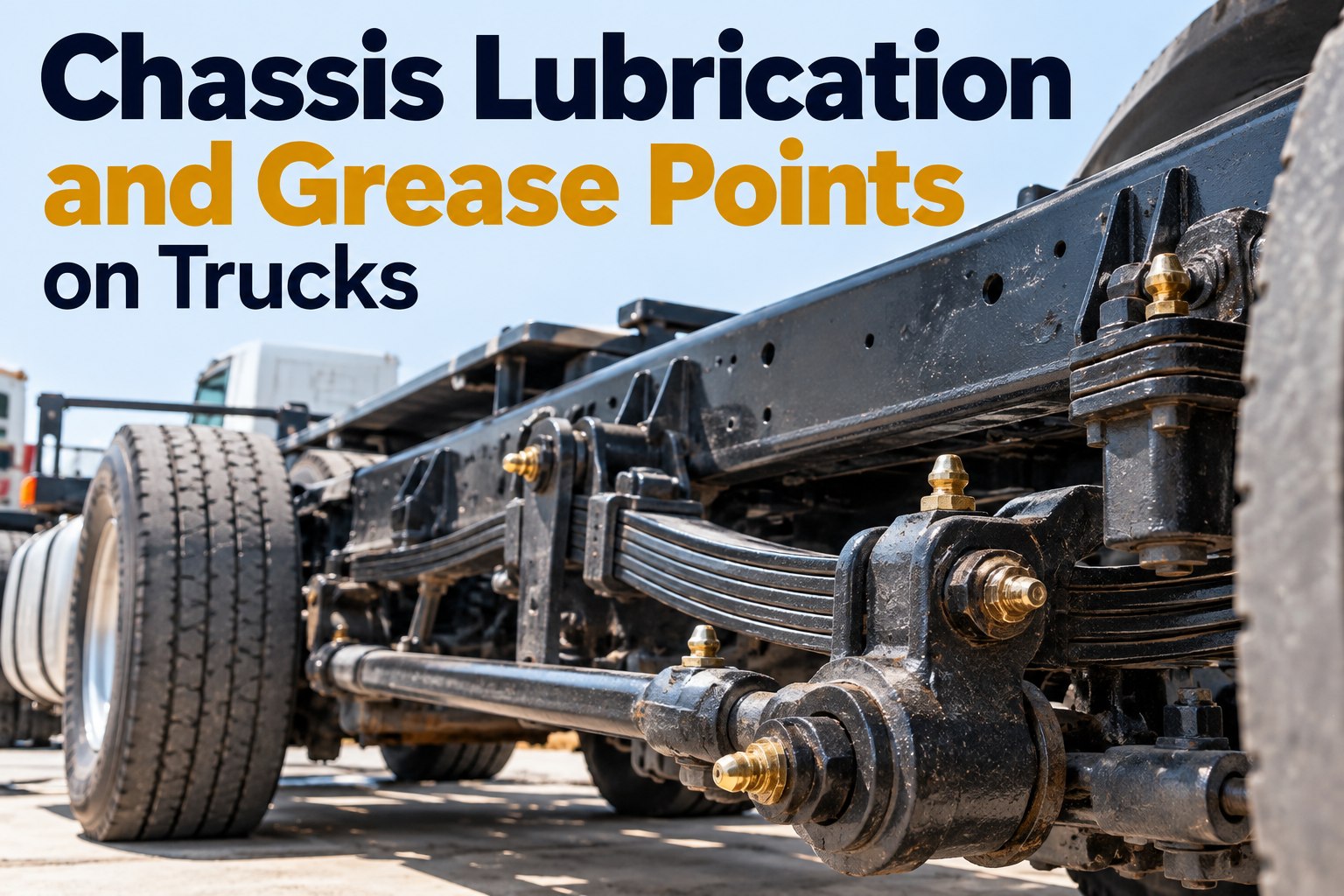
Chassis lubrication is the cheapest maintenance on a truck and the one most likely to be recorded as done without being done. Two decisions make it work: the right grade, and the right thickener. The grade is almost always NLGI 2 — the consistency of peanut butter, and the most widespread classification for chassis and suspension components — and the certification to look for is NLGI GC-LB, which means the grease meets the most demanding test standards for automotive chassis components and wheel bearings. The thickener is the part that catches fleets out. Some polyurea greases are completely compatible with lithium and lithium complex, and others are definitely incompatible, so the label alone never settles it; mixing the wrong pair leaves a product whose properties are significantly different from either grease you started with. This guide covers every grease point on a tractor, how to read the NLGI scale, what GC-LB certifies, grease compatibility and changeover, the symptoms of a dry joint, and what missing a point costs. Book a 30-minute demo to see lube points tracked per unit, or start free with 3 vehicles.
Nobody Fails an Inspection for a Dry Kingpin. They Just Pay for It Eighteen Months Later.
For fleet mechanics, shop leads and maintenance managers: where every grease point is, which grade and thickener belong in the gun, and how to make a lube record mean something.
No credit card required. Fits the PM sheet you already run.
Every Grease Point on a Tractor, and Why Each One Matters
Seven groups cover almost every fitting on a conventional tractor. The count varies by specification — air ride removes some, a steerable lift axle adds others — so the list below is the shape of the job rather than a fitting count for your fleet. Keep a per-unit point list on a free account.
Upper and lower bushings on each side. The joint that carries the steering load and the one most likely to seize on a truck that gets missed.
Ball joints in the steering linkage. Dry joints show up as wander and play at the wheel long before anything comes apart.
Front and rear suspension pivots. They move a little on every bump, and a dry one wears the pin and the hanger together.
Camshaft bushings and the adjuster body. A dry camshaft makes a healthy automatic slack adjuster look faulty.
Top plate for the trailer to slide on, and the jaw and pivot mechanism, which needs grease where the plate does not.
Every cross and the splined slip joint. A dry U-joint fails suddenly and takes driveline and crossmember with it.
Cross-shaft bushings and the linkage pivots on manual boxes, plus the release bearing where the design calls for it.
Schematic is simplified and not to scale. Fitting locations and counts differ by chassis, axle and suspension specification — build the actual point list for each unit from the maker's lubrication chart, and mark the ones that need the truck jacked or the wheel turned to reach.
Reading the NLGI Grade Scale, and Why Chassis Grease Is Almost Always a 2
NLGI grades describe consistency, measured as worked penetration — how far a standard cone sinks into the grease, in tenths of a millimetre. Softer grease pumps more easily in cold weather; firmer grease stays where it is put. NLGI 2 sits in the middle and is the most widespread classification for chassis and suspension work. We'll check your grades against your climate in a demo.
Penetration ranges per the NLGI consistency classification as published by AMSOIL. For reference, a grade 000 has the consistency of cooking oil, a grade 2 is about like peanut butter, and a grade 6 is nearly solid. Cold-climate operations sometimes drop a grade for pumpability — confirm against the component maker before changing.
NLGI GC-LB on the container
GC-LB signifies the grease meets the most demanding test standards for automotive chassis components and wheel bearings, and a product carrying it typically satisfies most automotive OEM requirements. It is a single mark that answers two questions at once, which is exactly what a parts room needs when several people are ordering.
Which Grease Is Actually in Your Gun Right Now?
In most shops the answer is whatever the last cartridge was, and nobody recorded it. In 30 minutes we'll set up a per-unit lube point list with the specified grade against it, so the record shows what went where — and a missed point shows up as a gap rather than a tick.
Grease Thickeners and the Compatibility Problem Nobody Checks
The thickener is the structure holding the oil; the oil does the lubricating. Mixing two incompatible thickeners produces a mixture whose properties are significantly different from either grease on its own, which is how a joint that was greased on schedule still fails. Record which product went into each unit, free on 3 vehicles.
- The most common chassis thickener in trucking
- Lithium complex raises the dropping point and load capacity over plain lithium
- Widely available in NLGI 2 and in GC-LB certified products
- Compatible with many, but not all, other thickeners
- Used where long life at temperature is wanted
- Some polyurea formulations are fully compatible with lithium, others are definitely not
- Which means "polyurea" on the label does not settle the question
- Check the specific product, not the thickener family
- Soap-salt complexes built for higher dropping point and load carrying
- Often chosen for water resistance in wet and dirty duty
- Compatibility varies by product and must be verified
- Test data, not assumption, is what makes a changeover safe
- Non-soap thickener with no true dropping point
- Historically poor compatibility with both lithium and calcium soaps
- Rare on modern truck chassis but still found in older stock
- Treat any clay product as a full changeover, not a top-up
Purge as much of the old product as you can, through both the gun and the joint
That is the standard approach when the two greases are not confirmed compatible — and if they are confirmed compatible, the purge may be unnecessary. Compatibility is evaluated by test, ASTM D6185, and the responsibility for verifying it sits with whoever makes the change. In practice that means deciding on one product per fleet and writing it on the lube chart, rather than leaving it to whatever the parts room had in stock that week.
Compatibility guidance, the lithium and polyurea nuance, ASTM D6185 and the purge procedure are per Machinery Lubrication's grease compatibility reference. NLGI grades, penetration ranges and the GC-LB description are per AMSOIL's grease guide.
What a Dry Joint Tells You Before It Fails
Chassis lubrication problems arrive as noise, play and handling complaints, and the driver almost never calls it a lube problem. Read the symptom back to the joint. We'll map your own driver reports to lube points in a demo. Swipe the table on mobile.
| What gets reported | Which point it points at | What to do first |
|---|---|---|
| Steering wander, play or a heavy wheel | Dry kingpins, tie rod ends or drag link | Check for play at the joint, then look at the last lube record for that position |
| Squeal or groan over bumps | Dry spring pins, shackles or cab mounts | Find the joint before the noise becomes a worn pin and an elongated hole |
| Brakes that drag or adjust unevenly | Dry brake camshaft bushings or a seized slack adjuster | Grease the camshaft, then re-check stroke — the adjuster may be fine |
| Driveline vibration or a clunk on take-up | Dry U-joint or slip yoke | Inspect each cross for rust dust at the cap, which appears before the noise |
| Trailer hard to couple, or jaws sticking | Dry fifth wheel jaws and pivot | Grease the mechanism as well as the plate; they are different jobs |
| Grease gun takes pressure but nothing moves | Blocked fitting or a passage packed with hardened grease | Replace the fitting and confirm flow rather than recording it as done |
| Fresh grease at a joint that was never lubed | Someone hit the fitting without purging the old | Purge until clean grease appears, then wipe the joint clean |
How to Grease a Point Properly, and How the Job Gets Faked
The difference between a lube service that works and one that ticks a box is visible at the joint. Four rules cover it, and the last one is what the record should capture. Put it on the inspection report and into preventive maintenance so the point list travels with the truck. Set the point list free on 3 vehicles.
A dirty fitting injects grit straight into the bushing. The wipe is not a courtesy, it is part of the job.
Old grease carries the dirt and water out with it. Stopping at the first resistance leaves the contaminated grease exactly where the wear happens.
Some points only take grease with the wheel turned or the weight off. A fitting that accepts grease in the wrong position may not be filling the bushing at all.
"Chassis lubed" tells you nothing eighteen months later. A point list with a blocked fitting flagged is a record that prevents the next failure.
What Missing a Grease Point Actually Costs
A cartridge of grease and five minutes at the fitting against a kingpin job, a U-joint that let go, or a fifth wheel that has to come off. Industry benchmarking puts unplanned downtime at roughly $448 to $760 per truck per day before towing and repair, and ATRI puts 2025 repair and maintenance cost at $0.215 per mile, up 8.6%. Estimate your own exposure with our team.
Relative cost by where the dry joint is caught, illustrative — not prices. Downtime benchmark: FleetNet America and ATA's Technology & Maintenance Council via industry reporting; per-mile cost: ATRI.
Chassis Lubrication Questions Fleet Mechanics Ask
What grease should I use on a truck chassis?
An NLGI 2 in almost all cases, and one carrying the NLGI GC-LB mark, which signifies it meets the most demanding test standards for automotive chassis components and wheel bearings. Confirm the grade against the chassis maker's lubrication chart before standardising. Check your spec with our team.
What does NLGI 2 actually mean?
It is a consistency grade, not a quality grade — worked penetration of 265 to 295 tenths of a millimetre, roughly the consistency of peanut butter. It is the most widespread classification for chassis and suspension components. Record the grade per unit free.
Can I mix two different greases?
Only when compatibility is confirmed. Some polyurea thickeners are completely compatible with lithium and lithium complex and others are definitely incompatible, and an incompatible mixture behaves differently from either original product. Verification is the user's responsibility, by test method ASTM D6185. Review your products with us.
How do I change from one grease to another?
Purge as much of the previous product as possible through the dispensing system and through the application itself. If the two are confirmed compatible that step may be unnecessary — but confirmation has to come first. Log the changeover per unit, free.
How often should a truck chassis be greased?
On the chassis maker's interval for each point, tightened for severe duty — wet, dusty, high-idle or stop-start work washes and contaminates grease faster than highway running. Build the interval per point rather than one number for the whole truck. Set intervals per point in a demo.
Why does grease keep coming out of one joint and not another?
The one that takes grease easily may have a worn bushing with nowhere left to seal, and the one that takes nothing may have a blocked fitting or a passage packed with hardened grease. Neither is a finished job — replace the fitting, confirm flow, and note the joint that no longer holds. Flag blocked fittings on the record free.
Make the Lube Record Say Which Points, Not Just Which Truck
FleetRabbit holds the point list, the product used and the fittings flagged as blocked against each unit, so a dry kingpin shows up as a point that has been skipped three services running — and every driver complaint becomes a work order with that history attached.
No credit card required. Start with your next PM.