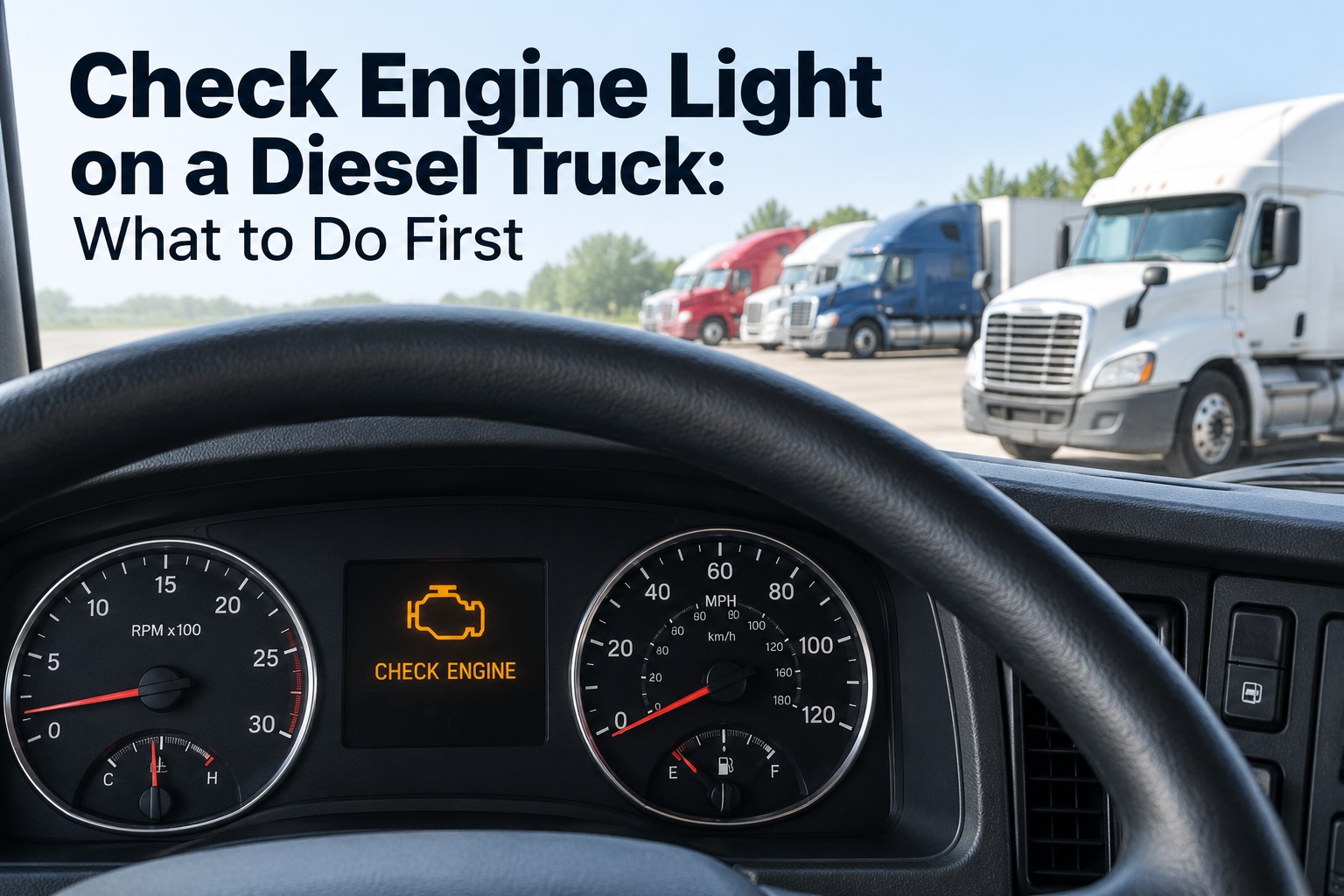
When the check engine light comes on in a diesel truck, the first thing to do is look at what else is lit: a red stop lamp or a low oil pressure or high coolant warning means pull over safely and shut down, reduced power means get to a shop today, and the check engine light alone usually means an emissions-related fault you should read and fix within days — not ignore. On heavy-duty diesels that light is mostly about the emissions system, and the most common culprits are aftertreatment and fuel system faults. This guide explains what the light means on a truck, the five systems behind most of them, a 15-minute first response, the symptoms that change the answer, how long you have before a derate, what waiting costs, and the maintenance that stops the next one. Book a demo to see every fault logged and routed to a repair, or create a free account to start with your own trucks.
Diesel truck check engine light · First response guide
Red Lamp, Lost Power or Just the Check Engine Light? Know Your Next Move in One Minute
For drivers, dispatchers and maintenance managers who need a clear answer in the first few minutes — keep driving, get to a shop, or stop now — and a way to make sure the same light doesn't come back.
What the Check Engine Light Actually Means on a Heavy-Duty Diesel Truck
On heavy-duty diesel trucks, the check engine light — formally the malfunction indicator lamp, or MIL — is mainly an emissions warning. EPA's heavy-duty on-board diagnostics rule required it on highway engines over 14,000 pounds from the 2010 model year, with every engine covered from 2013, and it must light when the system finds a fault that could raise emissions, including in the diesel particulate filter and NOx catalyst. Most trucks also carry separate amber, red and engine-protection lamps, so the check engine light is one of several signals, not the whole story. You can log which lamp came on with every fault on a free account.
Check engine light (MIL)
An emissions-related fault is stored. The truck usually drives normally, but some faults start a derate countdown.
Read the code, repair within daysAmber warning lamp
An engine or vehicle fault that needs attention but not an immediate stop.
Book the repair before the next long tripEngine protection lamp
The engine is protecting itself — typically from coolant, oil or temperature problems — and may reduce power.
Get to a shop todayRed stop lamp
A fault serious enough to stop the vehicle. Some engines will shut themselves down to prevent damage.
Stop safely nowA code can be stored before the light ever comes on
Heavy-duty OBD systems store codes in stages — pending, MIL-on and previous MIL-on. A pending code means the system has seen a problem once but hasn't confirmed it, so the light may still be off. Reading codes at every PM catches these before they turn into a lamp on the road.
The Five Engine Systems Behind Most Diesel Check Engine Lights
Aftertreatment and fuel system codes are among the most prevalent and consequential faults in heavy-duty trucks, according to diagnostics specialists interviewed by Fleet Maintenance magazine, because left alone they can trigger derates or shutdowns. Follow the exhaust path from the engine to the tailpipe and the usual suspects line up. We can map your own fault history to these systems in a demo.
Aftertreatment: DPF soot and SCR efficiency faults
Soot builds when regenerations don't finish; SCR efficiency codes such as SPN 4364 point to DEF quality, dosing, NOx sensor readings or exhaust leaks. These are the faults most likely to lead to a derate.
Fuel system: rail pressure and injector faults
Low or unstable rail pressure can cause power loss or a full derate quickly, and diagnosis takes care because several parts can cause the same code.
Cooling system: low coolant level
Not always a check engine code, but common: telematics provider Pitstop recorded the coolant level code (SPN 111) more than 12,000 times across 17 million fault incidents.
Sensors and wiring throughout
Emissions sensors and their harnesses sit in hot, wet places. A damaged connector can look like a failed component, so check wiring before replacing parts.
What to Do in the First 15 Minutes After the Light Comes On
The first 15 minutes decide whether a fault becomes a planned repair or a roadside tow, and the driver and the dispatcher each have a job. Record everything before anyone clears a code, because the code and its conditions are what the technician needs. Set up this response as a checklist on a free account.
Check every lamp and gauge
Note which lamps are lit and their color, plus coolant temperature and oil pressure.
Stop if anything is red
Pull over safely and shut down for a red lamp, low oil pressure or overheating.
Check the simple things when safe
DEF level, visible leaks, and coolant level once the engine is cool.
Report it without clearing anything
Call it in or log it on the DVIR with any messages on the dash.
Pull the fault code remotely
Read the active code from connected OEM telematics instead of relying on the driver's description.
Decide the route
Stop and tow, nearest shop today, or finish the load and repair within days.
Open the work order
Code, lamp, location and symptoms on one work order, so the technician starts diagnosing on arrival.
Symptoms That Tell You Whether to Keep Driving or Stop
The same light can mean very different things, and what the driver sees, hears and smells is often the quickest way to tell them apart. Use these as general guides, then confirm with the fault code. We can turn these into triage rules for your fleet in a demo.
Oil pressure warning, overheating or a red lamp
Running an engine with low oil pressure or high coolant temperature can damage it within minutes.
Heavy smoke, a burning smell or a sudden loud noise
Possible fire, turbo or major engine failure — safety first, diagnosis second.
Loss of power or a derate message on the dash
Often aftertreatment or fuel pressure. Waiting usually makes the derate worse, not better.
Black, white or blue exhaust smoke that wasn't there before
Black typically suggests fuel or air problems, white can mean unburned fuel or coolant, blue usually means oil.
More frequent regenerations or rising fuel use
Early signs of a DPF or sensor problem that will grow into a derate if left.
Check engine light only, truck drives normally
Record the code and schedule the repair; don't let it become "normal."
How Long You Have Before an Emissions Fault Turns Into a Derate
If the fault involves the DEF or SCR system, the truck is on a clock. Under EPA's August 2025 guidance, heavy-duty trucks with updated engine software give a warning for the first 650 miles or 10 hours, then a 15% power derate, and reach a 25 mph limit only after about 8,400 miles or 160 hours — roughly four work weeks. Trucks without the update can derate much sooner. Track which trucks have the software update on a free account.
Source: EPA diesel exhaust fluid guidance for heavy-duty trucks, August 2025, as reported by Waste Advantage and DieselNet. Applies to engines with updated calibrations.
What a Diesel Check Engine Light Really Costs When You Wait
The repair is rarely the biggest cost; the days the truck sits are. Benchmarking by FleetNet America and ATA's Technology & Maintenance Council puts unplanned downtime at roughly $448 to $760 per vehicle per day before towing and repair, and ATRI's latest data puts average repair and maintenance at $0.215 per mile in 2025, up 8.6%. Estimate your own downtime cost with our team.
Downtime cost before the repair bill
Calculated from the per-day benchmark range; excludes towing, parts and labor.
Why fixing early is cheaper
- A sensor or connector caught early is a planned repair in your own shop.
- The same fault after a derate can mean a tow, an outside shop and a missed load.
- Connected diagnostics help: Volvo and Mack report cutting breakdown diagnosis time by 70% with remote data.
Why Clearing the Code Without Fixing the Cause Brings the Light Back
Clearing a code turns the light off; it does not fix anything, and it erases the evidence the technician needs. On emissions faults, the system will simply detect the problem again and relight — sometimes restarting a derate sequence. Record the code, the conditions and the repair on the truck's history so a repeat is recognized as a repeat. Keep every code and repair on each truck's history for free.
Clear-and-go
- Light off, cause still there
- Freeze-frame data lost
- Same code weeks later, diagnosed from scratch
- Derate risk returns
Record-and-repair
- Code and conditions saved on a work order
- Technician starts with full history
- Repeat on the same truck flagged automatically
- Light stays off because the cause is fixed
Preventive Maintenance Tasks That Stop the Next Check Engine Light
Most diesel check engine lights come from systems that wear or clog gradually, which is exactly what preventive maintenance is built to catch. Schedule these by interval and track them per truck. See these tasks scheduled automatically in a demo. Swipe the table on mobile.
| When | Task | Which light it prevents |
|---|---|---|
| Every trip | Check lamps at key-on, DEF level, visible leaks on the DVIR | Low DEF and leak-related faults |
| Every PM | Read pending, active and previous codes; review regeneration frequency | DPF and sensor faults caught before the lamp |
| Every PM | Replace fuel filters on schedule; inspect air intake and charge air piping | Fuel pressure and boost faults |
| Per maker's interval | DPF cleaning or service; DEF filter replacement | Soot load and SCR efficiency faults |
| Seasonally | Coolant level and condition; inspect aftertreatment wiring and connectors | Coolant level and sensor circuit faults |
Diesel Check Engine Light Questions Fleet Managers Ask Most
Is it safe to drive a diesel truck with the check engine light on?
If only the check engine light is on and the truck drives normally, it's usually safe to finish the trip and book a repair within days. A red stop lamp, low oil pressure, overheating, heavy smoke or loss of power changes that — stop or head straight to a shop. Set up triage rules with us.
What are the most common causes of a diesel check engine light?
Aftertreatment faults — DPF soot load, SCR efficiency, DEF quality and NOx sensors — and fuel system faults such as rail pressure are among the most common, followed by sensor and wiring problems. Track your own most common codes free.
Can I just clear the code?
Clearing turns the light off but doesn't fix the cause and erases useful diagnostic data. Emissions faults will usually return, and some derates persist until the underlying problem is repaired. See code history tracking in a demo.
How much does a diesel check engine light repair cost?
It ranges from a connector or sensor repair to major aftertreatment work, but downtime often costs more than parts: roughly $448 to $760 per truck per day out of service by industry benchmarks, before towing and repair. Track repair costs per truck free.
How long until an emissions fault derates the truck?
For DEF and SCR faults on trucks with updated software, EPA's 2025 guidance allows a warning for 650 miles or 10 hours, then a 15% derate, with a 25 mph limit only after about 8,400 miles or 160 hours. Older calibrations can act much sooner. Check your trucks' derate exposure with us.
How can we stop check engine lights from coming back?
Read pending codes at every PM, keep up fuel and DEF filter and DPF service intervals, fix the root cause instead of clearing codes, and keep every fault on the truck's history so repeats are spotted early. Build that PM schedule free.
Log Every Check Engine Light, Fix the Cause and Stop the Repeat
FleetRabbit takes each fault from your trucks, opens a work order with the code and symptoms attached, and keeps the repair on the truck's history — so the next light is a planned repair, not a roadside surprise.