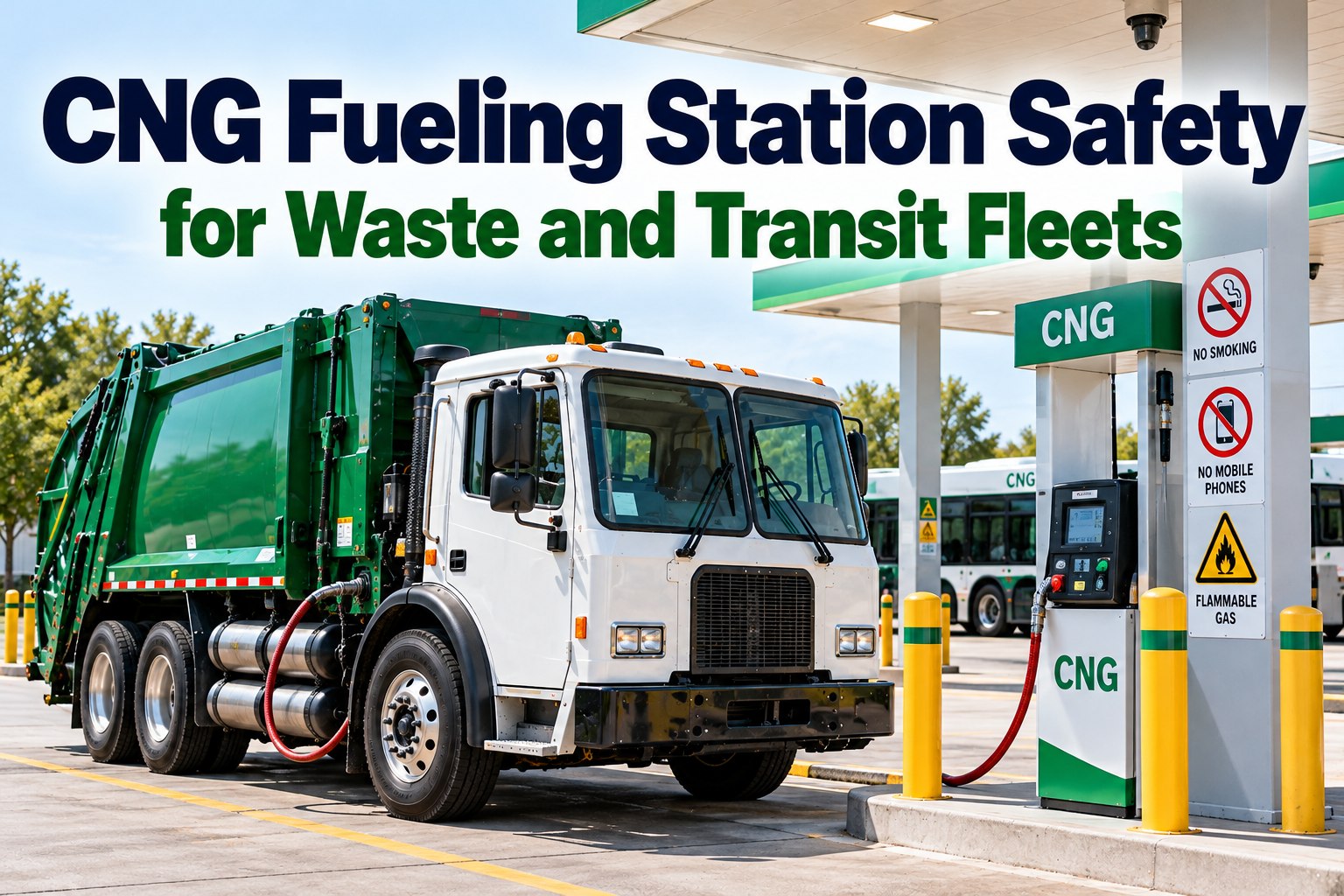
CNG fuelling safety trips up experienced diesel operations for one reason: almost every physical instinct the trade has built up is inverted. Diesel pools, runs downhill and collects in pits and drains, so a diesel workshop is engineered around floor level. Natural gas is lighter than air — a leak outdoors rises and disperses on its own, and the hazard only concentrates where there is nowhere for it to go. That makes an enclosed bay, not the forecourt, the place worth worrying about, and it makes the ceiling rather than the floor the place to look. LNG inverts it once more. Here is what the codes require and where the money actually goes. Book a facility review.
Diesel Runs to the Drain. Natural Gas Goes Straight to the Ceiling.
Why an enclosed bay is the real hazard and the forecourt usually is not, which of four codes governs which building, the facility changes that actually matter, and what to put on the inspection.
Outdoors a Leak Disperses. Enclosed, It Collects Overhead.
Published guidance states the mechanism plainly: natural gas is lighter than air, so a leak from a vehicle parked outside will generally rise and disperse safely. The problem in an enclosed garage is simply that there is limited area for the gas to disperse into.
LNG behaves differently at first. Its cold vapour is heavier than air on release, so it can pool near the ground before warming and rising — which is why the recommendation for LNG is gas detectors near both the floor and the ceiling, with ventilation at both levels. A fleet running both fuels needs the union of the two, not an average of them.
The practical consequence is uncomfortable for anyone retrofitting an existing building. The investment a diesel workshop has already made — sealed floors, drainage, bunding, low-level extraction — counts for very little here, and the things that matter are mostly at roof level where nothing is currently installed and access is worst.
Four Codes, and Each One Governs a Different Building
Fleets routinely treat this as one compliance question. It is at least three, and which one applies depends on where the vehicle is standing. Swipe sideways on mobile.
| Where the vehicle is | Code | What it governs |
|---|---|---|
| The vehicle and the fuelling facility | NFPA 52 | Vehicular Natural Gas Fuel Systems Code. Defines safety requirements for natural gas vehicles and the facilities that fuel them — the station itself, the dispenser and the storage. |
| Where you maintain and repair them | NFPA 30A | Covers facilities that maintain and repair natural gas vehicles. This is the one most fleets discover late, because the workshop is treated as an afterthought to the station project. |
| Where you park them overnight | NFPA 88A | Parking structures. A yard is one thing; an enclosed or partly enclosed parking structure full of gas vehicles is a different question with its own answer. |
| If any of the fleet is LNG | NFPA 59A and NFPA 57 | Liquefied natural gas production and storage, and LNG vehicular fuel systems. Separate codes because the hazard behaves differently. |
The second row is where projects overrun. A station build is a visible capital project with a budget and a contractor. The workshop modification is a separate code, a separate scope and frequently a separate year — and a fleet that has commissioned a dispenser but not yet modified the bay has vehicles it can fuel and cannot safely work on indoors.
Six Facility Changes That Actually Matter
Not an exhaustive compliance list — your authority having jurisdiction decides that. These are the ones where diesel habits lead teams wrong.
A floor-level sniffer in a CNG bay is looking where the gas is not. For a mixed fleet with LNG you need both heights, because cold LNG vapour pools low before it warms and rises.
Including the awkward ones — roof voids, above mezzanines, the apex of a pitched bay. Gas accumulates in whichever pocket is highest, not wherever the extract fan happens to be.
They still matter for other reasons, but a CNG leak does not run into them. Time spent protecting floor level is time not spent on the ceiling.
Unit heaters, radiant tubes and anything else mounted high stops being background equipment and becomes a location question.
Published guidance is explicit that repair facilities must secure CNG cylinders while they are being serviced. It is a simple requirement and a common omission.
Close the manual shut-off valve if the vehicle has one, then get it to a qualified repair facility. Deciding this in advance beats improvising it on the day.
The gap most fleets have
Can you show when each cylinder was last inspected?
Gas cylinders carry their own inspection and life regime, separate from anything on the chassis schedule. It is the record most likely to be held in a spreadsheet somebody maintains personally, and the one most likely to be asked for.
The retrofit question nobody asks early enough
If the fleet is converting rather than starting fresh, the sequencing decision is worth making deliberately. A station can be commissioned relatively quickly and starts producing value immediately. A workshop modification is disruptive, happens in a building you are still using, and produces no visible benefit at all — which is precisely why it slips. The result is a common and uncomfortable interim state: trucks that can be fuelled and parked but cannot be worked on indoors, with maintenance either pushed outside, pushed to a third party, or quietly done anyway in a bay that was never assessed for it. Deciding in advance which of those three it will be is a better position than discovering on a wet February morning that the answer is the third one.
Fast Fill, Time Fill, and Why Two Trucks Disagree About Full
A recurring complaint worth explaining before it becomes a dispenser dispute.
Compressing gas quickly heats it, and warm gas occupies more volume at the same pressure. A fast fill therefore reaches target pressure with less gas in the cylinder than the gauge suggests, and as the contents cool over the following hour the pressure falls. The truck has not leaked and the dispenser has not short-changed anybody — it is the behaviour of the gas. Time fill, run slowly overnight, avoids the effect entirely and reliably puts more fuel in for the same indicated pressure.
This matters operationally rather than mechanically. A fleet that fast-fills mid-shift and time-fills overnight will see two different apparent capacities on the same vehicle, and drivers will reasonably report the lower one as a fault. Explaining it once, in writing, saves a long run of work orders that find nothing. Where a truck genuinely is losing pressure, that is a different matter and belongs on the maintenance record with everything else.
What Gas-System Problems Cost, Caught Early Versus Late
The spread here is wider than on almost any diesel component, and it is worth being blunt about why.
A valve, a regulator or a fitting replaced on a scheduled inspection is an ordinary parts-and-labour job. The same fault found because somebody smelled gas in a bay is a building evacuation, a halted shift and an incident report, and the component cost is irrelevant next to it. Cylinders are the other end of the scale: they are inspected and life-limited, and a cylinder that reaches its date without a replacement planned takes the vehicle off the road until one is sourced. None of that is unusual or alarming — it is simply a different cost structure from diesel, where almost everything degrades gradually and visibly.
What this changes on the daily walkaround
Most of a gas truck’s daily inspection is identical to a diesel one, which is the trap. The additions are few and specific: confirm the cylinder mounting and shielding are intact and nothing has shifted, check the manual shut-off is accessible and operates, look for physical damage or impact marks on cylinders and lines, and report any fuel odour immediately rather than at the end of the shift. Four items, none of which takes more than a few seconds, and all of which are routinely missing from inspection templates that were written for diesel and had a fuel-type column added later.
The odour item deserves emphasis because it is the one drivers are least likely to raise. Natural gas is odourised precisely so people notice it, and a driver who mentions a faint smell at shift end has given you the information several hours after it would have been most useful. That is a culture and template problem rather than a technical one.
Keep Cylinder Dates and Gas Checks on the Vehicle Record
Everything above produces a record somebody will eventually ask for. The software’s job is to make sure that record exists without anyone maintaining it by hand.
What FleetRabbit tracks on a gas fleet
Cylinder condition, valve and shut-off function, leak checks and cylinder security on a recurring schedule rather than a shared diesel template.
Gas cylinders carry their own inspection and expiry regime. Tracking it per unit is the difference between planning a replacement and discovering one.
A fuel smell, a slow fill or a dispenser fault reported immediately and attached to the vehicle rather than mentioned at shift end.
A gas-related inspection failure becomes a job with an owner and a date, which is exactly the trail you want to exist afterwards.
Every gas-system fault and repair on one vehicle timeline, assembled before anybody asks for it.
Gas-system spend per unit, so the trucks consuming the budget are visible before the next order.
Product walkthrough · 20 minutes · no obligation
See Cylinder Dates and Gas Checks on One Fleet View
- We build the gas-specific inspectionCylinder security, valve function, leak check, shut-off operation — on the intervals you want, assigned across the fleet.
- We add cylinder dates per vehicleSo the inspection and replacement regime is a planned schedule rather than a surprise.
- We show the driver reporting pathA fuel smell goes from cab to shop queue in front of you, attached to the right truck.
- You decide whether it fitsTwenty minutes, no obligation. If your current process already covers it, we will say so.
Or set it up yourself — the first three vehicles are free, and the preventive maintenance schedule can be live today.
CNG Fueling Safety Questions Fleet Managers Ask
Is a CNG leak more dangerous outdoors or indoors?
Indoors, by a wide margin. Natural gas is lighter than air, so a leak outside generally rises and disperses safely. In an enclosed garage there is limited area for it to disperse into, which is where it concentrates.
Where should gas detectors be mounted?
At the ceiling for CNG. If any of the fleet is LNG, at both floor and ceiling — cold LNG vapour is heavier than air when it first leaks and pools low before rising. Record Every Gas Check.
Which code applies to our workshop?
Maintenance and repair facilities for natural gas vehicles are covered separately from the fuelling facility itself. The station and the vehicle fall under the vehicular natural gas fuel systems code; the workshop is its own scope, and parking structures are a third.
Can we work on CNG vehicles in our existing diesel bay?
Not without assessing it against the right code first, and your authority having jurisdiction makes that call. The relevant changes are mostly at high level, which is where a diesel building has had no reason to install anything. Book a Facility Review.
Why does the same truck hold different amounts?
Fast filling heats the gas, so the cylinder reaches target pressure with less fuel in it and the pressure falls as it cools. Time fill avoids this. It is physics rather than a fault, and worth explaining to drivers once in writing.
What should happen if someone smells gas?
Published guidance is to close the manual shut-off valve if the vehicle has one, and get the vehicle to a qualified repair facility. Agree the sequence in advance rather than improvising it.
Do cylinders need their own schedule?
Yes. Gas cylinders have an inspection and life regime independent of the chassis schedule, and it is the item most often tracked in a personal spreadsheet. Keep Cylinder Records Straight.
How much does facility modification cost?
It varies enormously with the building, which is why a figure from another fleet is close to meaningless. The reliable advice is to scope the workshop at the same time as the station rather than a year later. Price a Facility Upgrade.
Records before inspections, not after
Have the Gas Records Ready Before Anyone Asks for Them
Cylinder dates per vehicle, gas-specific checks on a recurring schedule, driver reports attached to the truck, and failures that open a work order instead of a conversation. First three vehicles free.