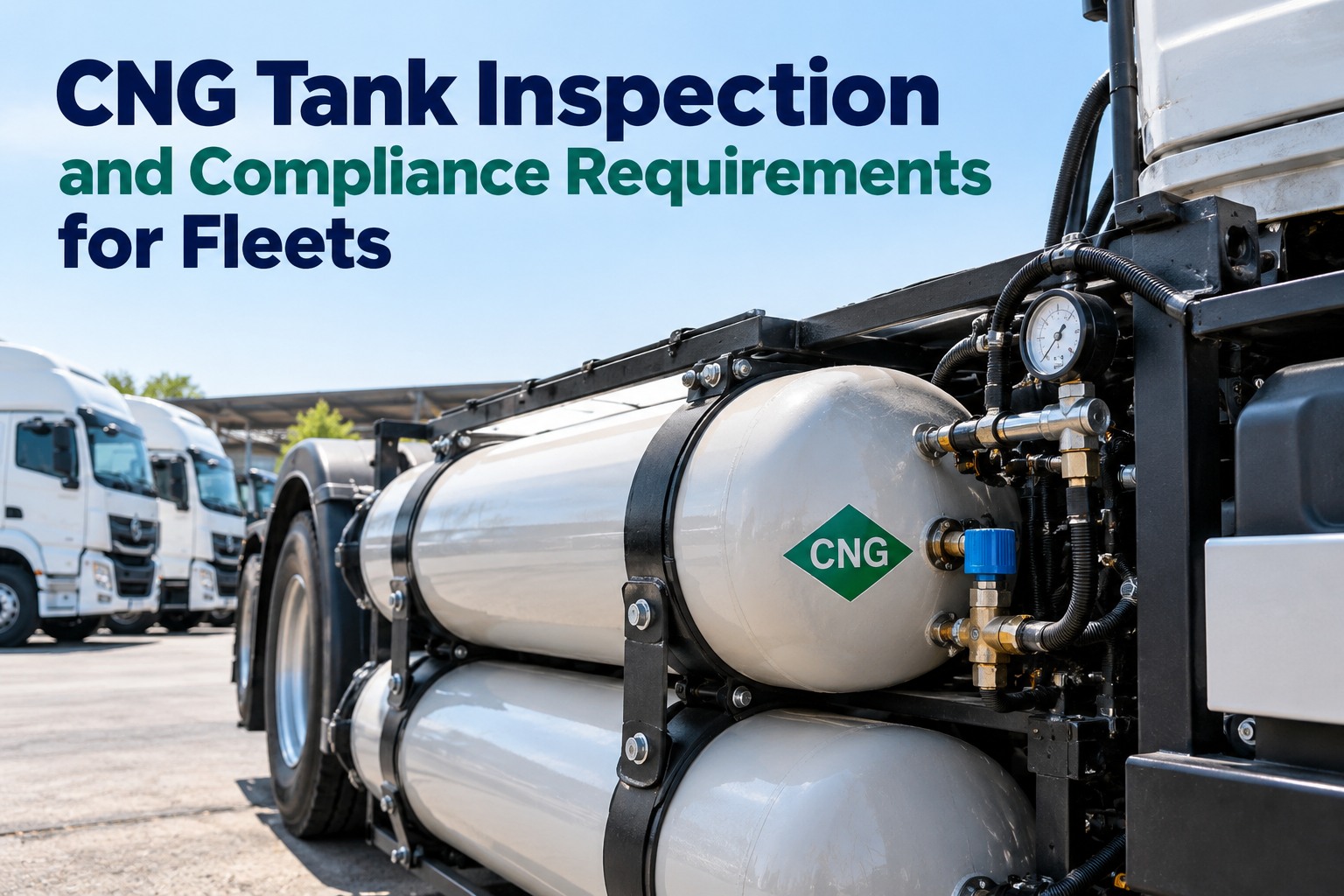
CNG tank inspection is a layered routine, not a single annual test: drivers look at the fuel system every trip, technicians check it at every PM, and a certified inspector does a detailed inspection each year. Every cylinder also carries an expiration date, and after it the tank must be replaced. This page lays out the inspection levels, intervals, expiry rules and a tick-box checklist for CNG fleets. Schedule a call to track CNG tank inspections and expiry dates.
CNG FLEET COMPLIANCE · INSPECTION AND TANK EXPIRY
Four Inspection Levels and One Expiration Date Decide Whether a CNG Truck Can Run
Who inspects what and when, which intervals apply by vehicle weight, and how to stop a tank from expiring unnoticed.
WHO INSPECTS THE CNG SYSTEM
DriverEvery trip
TechnicianEvery PM
Certified inspectorAnnually
Plus a tank expiration date on every cylinder.
How CNG Tank Inspection Is Structured
A four-level routine puts the most frequent checks on the driver and the deepest on a certified inspector
CNG storage runs at about 3,600 psi, so even minor damage matters. NGVAmerica's inspection guide recommends four levels. Where the container maker or installer gives its own guidance, follow that first.
1
Pre-service inspectionTECHNICIAN OR CERTIFIED INSPECTOR
A full inspection of the whole fuel system before a new or newly converted vehicle enters service, with shielding removed and cameras or mirrors used where needed.
When: Once, on every new vehicle
2
Cursory inspectionDRIVER
A look at exposed surfaces and the fill receptacle, without removing shielding or opening panels. Report any damage, leak or missing label before the truck moves.
When: Every pre-trip and post-trip
3
General inspectionTRAINED TECHNICIAN
A check of shielding and the readily accessible components, done as part of regular preventive maintenance. Damage found here takes the vehicle out of service until it is investigated.
When: At every PM event
4
Detailed inspectionCERTIFIED OR FLEET-QUALIFIED INSPECTORMost thorough
A thorough check of the entire high-pressure system, often with shield removal and mirrors or cameras. Fleets typically keep a form for each one.
When: Annually, and after a fire, accident or leak found at a General inspection
If damage is found, park the truck. The guide says to take the vehicle out of operation when a Cursory or General inspection finds damage, until a more thorough investigation is done.
Inspection Intervals and What Is Required
Container labels set the interval by weight class, and the sources differ on whether it is mandatory
Federal Motor Vehicle Safety Standard (FMVSS) 304 requires the container label to state an inspection interval. The U.S. Department of Energy's Alternative Fuels Data Center lists those intervals as requirements to follow. NGVAmerica's guide describes the FMVSS interval as a labeling requirement and not an inspection mandate, and notes that FMVSS 304 and NGV 2 cover only the containers, not the whole system. Treat the label as your minimum and check what your state or insurer requires.
| Vehicle | Container label interval | Source |
|---|
| Over 10,000 lb GVWR | 12 months | AFDC; FMVSS 304 as described by NGVAmerica |
| Light-duty | 36 months or 36,000 miles, whichever comes first | AFDC; FMVSS 304 |
| Any vehicle, any class | After a fire, accident or other damaging event | AFDC; Automotive Fleet |
| CSA/ANSI NGV 2:19 | At least every 36 months, or at reinstallation | NGVAmerica inspection guide |
Want every CNG inspection due date on one calendar? Schedule a call and we will set it up.
Cursory, General and Detailed inspections, tied to each vehicle's record.
Detailed Inspection Checklist for the CNG System
From the fill receptacle to the shutoff solenoids, covering the whole high-pressure system
NGVAmerica's detailed checklist has 16 items; a few are split into separate lines here, such as mounting and isolators. Use it with the container maker's manual, or CGA C-6.4, the external visual inspection standard, if the manual is not available.
Know the damage signs that should stop a truck
The guide gives no numerical damage allowances. For limits on dents and abrasions, use the container manufacturer's manual and CGA C-6.4.
CNG Tank Expiration: The Date That Ends a Cylinder's Life
Every cylinder has a manufacturer-set service life, and it cannot be extended
Labels read "Do not use after" with a date. The Alternative Fuels Data Center puts useful life at 15 to 20 years depending on construction and certification, and says tanks must be replaced at expiration. A trade article from 2010 describes the NGV2 standard as moving from 15 to 20 to 25 years across revisions. That article is old, so check the label on each cylinder and not the standard.
CYLINDER SERVICE LIFE BY NGV2 REVISION, YEARS. AUTOMOTIVE FLEET, 2010; VERIFY ON EACH LABEL
1992 original NGV2
15 years
No national reminder
No national system notifies owners of expiration. The fleet manager is responsible for replacing the tank.
Look in more than one place
The label may be near the fueling connector or under the hood as well as on the cylinder.
Buying a used truck?
Get the last inspection record and have a qualified facility inspect the tank before purchase.
Who May Perform a Detailed CNG Inspection
Certified inspectors, fleet-qualified technicians and drivers each have a defined role
Where to find an inspector
CSA Group certified-inspector database
NGV Institute training and certification
Qualified service facilities
Your OEM or converter dealer
Never Miss a CNG Tank Inspection or Expiry Date: Track Mixed Diesel, EV and CNG Fleets in One FleetRabbit Schedule
FleetRabbit lets you set recurring inspection tasks per vehicle, record each tank's expiration date and send reminders before it is due. Diesel, electric and CNG units share one maintenance schedule, and every completed inspection stays on the truck's record.
Inspection reminders per unit
Tank expiry tracking
Mixed-fuel fleet schedules
Inspection record per truck
Frequently Asked Questions
Quick answers on CNG tank inspection and compliance
How often must a CNG tank be inspected?
The container label sets the interval: 12 months for vehicles over 10,000 lb GVWR and 36 months or 36,000 miles for light-duty vehicles, plus after any fire or accident. NGVAmerica describes this as a labeling requirement, so confirm what your jurisdiction mandates.
Who can inspect a CNG tank?
A certified CNG fuel system inspector or a qualified service facility. Drivers and trained technicians handle the lighter inspection levels.
What does a CNG tank expiration label say?
It reads "Do not use after" with a date. The tank must be replaced after that date.
How long does a CNG cylinder last?
The Alternative Fuels Data Center says 15 to 20 years depending on construction and certification. Check the label on each cylinder.
Can an expired CNG tank be recertified?
No. The AFDC says there is no safe way to requalify one for extended use.
What damage should take a CNG truck out of service?
Dents, cuts, gouges, abrasions, discoloration, heat damage or any sign of leakage. Park the truck until a thorough inspection is done.
What does FleetRabbit cost?
FleetRabbit is free for up to three vehicles and $5 per vehicle per month after that.
Track 3 vehicles free.
Keep Every CNG Cylinder Inspected, Documented and Inside Its Service Life
Set the inspection routine once, record each tank's expiration date and let reminders carry the schedule across your diesel, electric and CNG trucks.
Free tier for up to 3 vehicles · No credit card required · Inspection records stored per unit
October 16, 2026By Alex Rowan
All Blogs