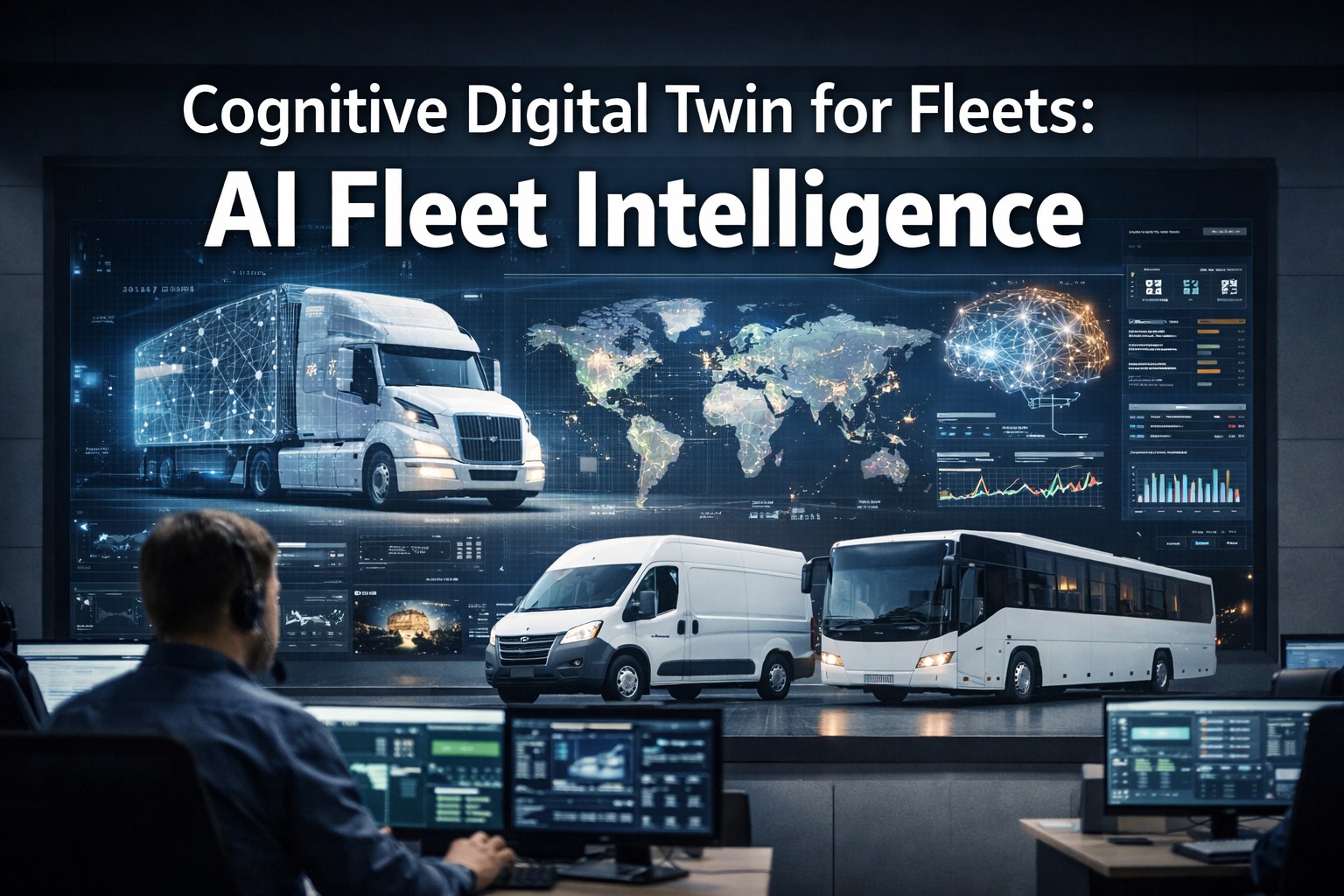
A 200-truck fleet generates over 50 million data points daily from engines, transmissions, brakes, and telematics systems. Somewhere in that data stream, a turbocharger's boost pressure starts trending 3% below specificationa subtle anomaly invisible to traditional dashboards. Without cognitive digital twin technology, that degradation continues unnoticed until catastrophic failure strands a driver 600 miles from home with $15,000 in repair costs and $800/day in lost revenue. This scenario plays out across commercial fleets daily because most operations lack AI-powered systems that can predict failures before they happen.
Cognitive digital twins represent the next evolution in fleet management—virtual replicas of physical assets enhanced with artificial intelligence, machine learning, and predictive analytics. Unlike basic telematics that shows what happened, cognitive systems predict what will happen and recommend what to do about it. This guide explains how cognitive digital twin fleet technology works, compares it to traditional approaches, and demonstrates how AI-powered platforms transform raw telematics data into predictive maintenance intelligence.
The Fleet Intelligence Gap
Most fleets operating 50-500 vehicles still rely on outdated diagnostic methods: reactive maintenance after breakdowns, time-based service intervals regardless of actual condition, and dashboards that only display historical data. This means predictable failures go undetected, maintenance costs remain unnecessarily high, and vehicles break down despite regular servicing.
| Current Practice | Fleet Impact |
|---|---|
| Reactive maintenance only | Roadside breakdowns → $800+/day lost revenue |
| Time-based service intervals | Over-maintenance waste → 15-25% excess cost |
| Historical dashboards | No prediction capability → missed warning signs |
| Siloed telematics data | No pattern correlation → hidden failure modes |
| Manual diagnostic interpretation | Technician bottleneck → delayed decisions |
Cognitive digital twin platforms solve this by applying AI to telematics data automatically—predicting component failures weeks in advance, optimizing maintenance schedules based on actual condition, and converting raw sensor data into prioritized work orders. See how AI-powered diagnostics work.
What Is a Digital Twin in Fleet Management?
A digital twin is a virtual representation of a physical asset that continuously updates based on real-time data. In fleet management, this means creating dynamic digital models of trucks, trailers, and equipment that mirror their real-world counterparts. Unlike static vehicle records, digital twins maintain a living connection to each asset—every sensor reading, fault code, and performance metric feeds into the model.
The power of digital twins lies in simulation capability. Fleet managers can test maintenance strategies, routing changes, and operational scenarios virtually before implementing them. When enhanced with AI, these twins become "cognitive"—capable of learning, reasoning, and predicting. Start building your fleet digital twin free.
The Four Phases of Fleet Technology Evolution
Understanding how fleet technology evolved helps clarify why cognitive digital twins represent such a significant advancement. Each phase built on the previous generation's capabilities while addressing its limitations.
Basic Telematics
1990s–2010s
GPS location tracking and simple vehicle diagnostics. Shows where vehicles are and basic fault codes. No predictive capability—purely reactive information.
Predictive Analytics
2010s–2020
Statistical pattern recognition using historical data. Estimates maintenance windows based on trends. Limited by rule-based logic and lack of context awareness.
Digital Twin
2020–2024
Real-time virtual models synchronized with physical assets. Enables simulation and scenario testing. Still relies on predefined rules rather than learning.
Cognitive Digital Twin
2024–Present
AI-enhanced virtual models with machine learning, autonomous reasoning, and predictive intelligence. Learns from outcomes, improves continuously, and makes context-aware recommendations.
Traditional Telematics vs Cognitive Digital Twins
The difference between conventional telematics and cognitive digital twin technology isn't incremental—it's transformational. Understanding these differences helps fleet managers evaluate the value proposition. Schedule a demo to see cognitive capabilities in action.
| Capability | Traditional Telematics | Cognitive Digital Twin |
|---|---|---|
| Data Analysis Type | Descriptive (what happened) | Predictive + Prescriptive (what will happen, what to do) |
| Fault Detection | After fault codes trigger | 3-6 weeks before symptoms appear |
| Maintenance Approach | Time/mileage intervals | Condition-based, AI-optimized |
| Decision Support | Alerts requiring human interpretation | Context-aware recommendations with confidence scores |
| Learning Capability | Static rules and thresholds | Continuous ML improvement from outcomes |
| Scenario Testing | Not available | Full simulation and what-if analysis |
Ready to Move Beyond Basic Telematics?
See how AI-driven fleet intelligence transforms maintenance operations and reduces unplanned downtime by 40-60%.
What Makes a Digital Twin "Cognitive"?
The "cognitive" designation separates AI-enhanced systems from traditional digital modeling. While a standard digital twin mirrors physical assets in real time, a cognitive digital twin reasons about that data autonomously. Experience cognitive fleet analytics free.
Turbocharger Degradation Detection:
- Traditional System: Alerts when turbo boost pressure drops 15% and fault code triggers
- Cognitive System: Detects 3% boost trend deviation, correlates with exhaust temps and fuel consumption
- AI Prediction: "Turbocharger failure probable in 18-24 days based on degradation pattern"
- Recommendation: "Schedule replacement during planned service window on March 15th"
The cognitive system identifies the issue 3-4 weeks earlier, enabling proactive repair instead of roadside breakdown.
How Cognitive Digital Twins Process Fleet Data
Cognitive digital twins derive their intelligence from sophisticated AI models that process multiple data streams simultaneously. Machine learning algorithms correlate these streams to identify patterns invisible to human analysts or rule-based systems.
Data Collection
Sensors, ECUs, telematics
Twin Sync
Real-time model update
AI Analysis
Pattern recognition
Prediction
Failure probability
Recommendation
Prioritized action
Work Order
Automated dispatch
Data Streams Feeding Cognitive Digital Twins:
- Sensor Data: Temperature, pressure, vibration, fluid levels from IoT devices across all vehicle systems
- Engine Telemetry: ECU parameters, fault codes, performance metrics via J1939/CAN bus protocols
- Driver Behavior: Acceleration patterns, braking habits, idle time, speed profiles, harsh events
- Maintenance History: Work orders, parts replaced, repair outcomes, technician notes, warranty claims
- Environmental Context: Weather conditions, road types, altitude changes, ambient temperature, humidity
- Operational Data: Load weights, route characteristics, delivery schedules, seasonal patterns
ROI: Cognitive Digital Twin Implementation
Understanding the financial impact helps justify cognitive digital twin investment. This model demonstrates typical results for a 50-vehicle fleet implementing AI-powered predictive maintenance. Get a custom ROI analysis for your fleet.
50-Vehicle Fleet: Annual ROI Analysis
Manual Diagnostics vs Cognitive Fleet Intelligence
Comparing traditional manual diagnostic approaches against cognitive digital twin capabilities illustrates the operational transformation.
| Metric | Manual Diagnostics | Cognitive Digital Twin |
|---|---|---|
| Fault detection timing | After symptoms appear | 3-6 weeks before failure |
| Diagnostic accuracy | 70-80% (technician dependent) | 87-94% (AI-validated) |
| Analysis time per vehicle | 45-90 minutes manual scan | Real-time continuous |
| Fleet-wide pattern detection | Rarely possible | Automatic cross-fleet analysis |
| Maintenance scheduling | Calendar/mileage based | Condition-optimized |
| Work order generation | Manual entry required | Automated with parts list |
FleetRabbit and AI-Driven Fleet Intelligence
Modern fleet management platforms are evolving toward cognitive capabilities. FleetRabbit integrates telematics data, predictive analytics, and maintenance automation to deliver foundational elements of cognitive fleet operations. Start free with 3 vehicles—all features included.
FleetRabbit's Approach to Fleet Intelligence:
- Telematics integration from 200+ device providers for universal fleet coverage
- Automated fault code interpretation with severity scoring and root cause analysis
- Predictive maintenance scheduling based on actual vehicle condition data
- Work order automation from diagnosis through completion tracking
- Driver behavior analytics for safety improvement and fuel efficiency
- Comprehensive maintenance history enabling pattern analysis and optimization
Explore AI-Driven Fleet Intelligence
Discover how predictive analytics can transform maintenance operations and reduce unplanned downtime.
Frequently Asked Questions
What is a cognitive digital twin in fleet management?
A cognitive digital twin is a virtual replica of a fleet vehicle enhanced with AI reasoning, machine learning, and predictive analytics. Unlike basic digital twins that simply mirror data, cognitive versions learn from patterns, reason about complex scenarios, and make intelligent recommendations. They transform raw telematics into actionable predictions about maintenance needs, performance optimization, and failure prevention.
How does a cognitive digital twin differ from traditional telematics?
Traditional telematics provides descriptive analytics—showing what happened and current status. Cognitive digital twins deliver predictive and prescriptive analytics—forecasting what will happen and recommending specific actions. While telematics alerts you after fault codes trigger, cognitive systems predict component failures 3-6 weeks in advance using AI analysis of sensor patterns and maintenance history.
What ROI can fleets expect from cognitive digital twin technology?
Industry implementations report 40% reductions in maintenance costs, 60% decreases in unplanned downtime, and 5-10% improvements in vehicle availability. ROI typically materializes within 12-18 months, with the first prevented major breakdown often covering several months of platform costs. Larger fleets see faster payback due to scale effects.
What data is required to implement a cognitive digital twin system?
Effective cognitive digital twins require telematics data (GPS, engine diagnostics, sensor readings), maintenance records (work orders, parts replaced, service history), fuel transactions, and driver behavior metrics. The more comprehensive and accurate the historical data, the better AI models can predict outcomes. Most fleets can start with existing telematics and build additional data streams over time.
How do cognitive systems handle mixed fleets with different vehicle types?
Modern cognitive systems adapt to fleet diversity automatically. AI models recognize different vehicle behaviors based on make, model, year, and configuration. Older vehicles with fewer sensors still benefit from pattern analysis of available data, while newer vehicles with extensive telematics enable more granular predictions. The cognitive framework learns fleet-specific patterns regardless of vehicle mix.